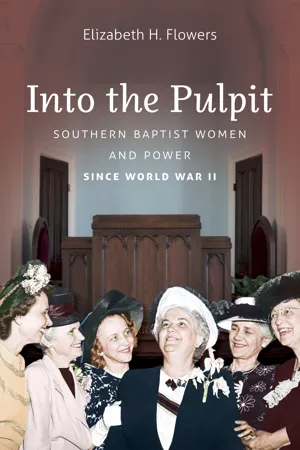
The debate over women’s roles in the Southern Baptist Convention’s conservative ascendance is often seen as secondary to theological and biblical concerns. Elizabeth Flowers argues, however, that for both moderate and conservative Baptist women — all of whom had much at stake — disagreements that touched on their familial roles and ecclesial authority have always been primary. And, in the turbulent postwar era, debate over their roles caused fierce internal controversy. While the legacy of race and civil rights lingered well into the 1990s, views on women’s submission to male authority provided the most salient test by which moderates were identified and expelled in a process that led to significant splits in the Church. In Flowers’s expansive history of Southern Baptist women, the “woman question” is integral to almost every area of Southern Baptist concern: hermeneutics, ecclesial polity, missionary work, church-state relations, and denominational history.
Flowers’s analysis, part of the expanding survey of America’s religious and cultural landscape after World War II, points to the South’s changing identity and connects religious and regional issues to the complicated relationship between race and gender during and after the civil rights movement. She also shows how feminism and shifting women’s roles, behaviors, and practices played a significant part in debates that simmer among Baptists and evangelicals throughout the nation today.
- 280 pages
- English
- ePUB (mobile friendly)
- Available on iOS & Android
eBook - ePub
About this book
Information
Topic
Theology & ReligionSubtopic
North American History1
Into the Center Pulpit
A DANGEROUS DREAM
On August 9, 1964, Watts Street Baptist Church in Durham, North Carolina, ordained Addie Davis to the gospel ministry—the first ordination of a woman by a Southern Baptist church. It came well ahead of many mainstream Protestant bodies and only one year after the publication of The Feminine Mystique by Betty Friedan.
Davis was a well-educated, professional, and single woman from a long line of Virginian Baptists. She grew up in Covington Baptist Church, the very church that her great-great-grandfather had pastored. From an early age, Davis felt called to preach. Speaking in the measured Virginian brogue that also characterized her sermons, she later narrated her story: “I was baptized between the ages of eight and nine. I have, as long as I remember, had a very strong religious interest. As a child I felt a call to preach, but women were not preachers so I never expressed this openly.”1 It took Davis years to follow her sense of call. She graduated in 1938 from Meredith College, a Baptist women’s college in Raleigh, North Carolina, with a degree in psychology. She served briefly as the education director for a local Baptist congregation and then became the dean of women at Alderson Broaddus College, a Baptist school in West Virginia. When her father died four years later, she left her academic post to help her mother run the family furniture business. During this time, Davis became critically ill and vowed that “if I was permitted to live, I would do what I’d always felt in my heart I should do, which was to be a preacher.”2
In 1960, at the age of forty-three, Davis matriculated at Southeastern Baptist Theological Seminary. When her home pastor in Covington made it clear that he would not recommend her or any woman for ordination, she turned to Watts Street Baptist. Davis knew Watts Street’s pastor, Warren Carr, as both he and Watts Street had achieved something of a reputation for their civil rights activism. In recalling his conversations with her, Carr said she was actually unaware that no other Southern Baptist congregation had ordained a woman. Davis’s strong sense of call swayed Carr, who insisted that “she belonged in the center pulpit, according to our tradition, to proclaim the gospel on the Lord’s Day.”3
One might assume that her ordination would create a storm of controversy across the Southern Baptist Convention (SBC). After all, during their first 100 years, Southern Baptists had debated almost every change in women’s denominational and ecclesial status, from their organizing for missions in 1888 to their being seated as convention messengers in 1918. In 1929, the issue of women’s public speaking practically brought the annual convention in Memphis to a halt. Reaction to Davis’s ordination, though immediate, was also limited. Carr reported about fifty angry letters to Watts Street over the occasion, and Davis puzzled why people as far away as California would bother to write, one even denouncing her as a “child of the Devil.” As an unmarried woman, she must have found the letter instructing her to learn from her husband rather humorous. But by and large, the protests ended there. Like Davis, those who participated in the 1964 service remained largely unaware of the event’s historic significance.4 The SBC’s official news service, Baptist Press, simply ran a single story announcing the ordination with the veiled conclusion that “women graduates of Southern Baptist seminaries usually enter church vocations in education or music, become teachers or are appointed as unordained missionaries.”5 At the 1965 convention in Dallas, the topic was not raised, at least from the floor. Even more astounding, when asked in 1966 about women’s ordination, Marie Mathis, president of the Woman’s Missionary Union (WMU), insisted, “I’ve never heard of a woman wanting to be a minister, and I’ve been connected with women’s organizations in this faith since 1938.... I think it is women’s intuitive feeling that ministers should be men.”6
Scholars have explained the event as an anomaly or aberration in Southern Baptist life.7 Davis was an unassuming and modest personality who dreamed of a pulpit rather than a debating chamber, and when she could not find a Southern Baptist placement, she moved to Vermont. Out of sight meant out of mind. Still, one is hard-pressed to accept that the major milestone for Southern Baptist women in the twentieth century could be so easily forgotten. It seems more likely that Mathis and the WMU were intentionally avoiding any hint of controversy. Like their male counterparts, WMU officials operated from the center. If Davis’s ordination became the symbol of progress for Southern Baptist women, as it was later touted, its downplaying also embodied the spirit of compromise that marked Southern Baptist life during the 1950s and early 1960s. By 1966, though, compromise was in jeopardy. The SBC was mired in an inerrancy debate, and despite the WMU’s best efforts, women were soon to be implicated. In fact, the controversy in 1971 surrounding the second ordination of a Southern Baptist woman by a Southern Baptist church stood in stark contrast to that of Davis’s ordination seven years earlier. The second ordination revealed the extent to which compromise had been eroded as well as the presence of the new interpretive lens of feminism.
This chapter considers the years from 1945 to 1972. It shows that the prosperity and nationalization of the South after World War II provided Southern Baptists with newfound wealth and middle-class status. Riding this wave of success, denominational leaders adopted a corporate model of church that kept the SBC growing and expanding. They emphasized financial solvency and organizational restructuring while encouraging the downplaying of theological differences and social tensions. During this period, institutional loyalty usurped democratic diversity and partisan identities. The strategy worked as long as optimism prevailed; however, changes in both southern and American culture eventually brought a sense of anxiety and fear to Southern Baptists. Longtime SBC statesmen as well as WMU officials could not tame the forces of evolutionary science, civil rights, feminism, and the countercultural movements of the 1960s. By the decade’s end, they were hard-pressed to pit bureaucratic issues against biblical debates or questions concerning women. The interaction of these ecclesial and cultural dynamics shattered the synthesis that held the denomination together.8
Regional Change
Economic prosperity transformed the postwar southern landscape and, with it, Southern Baptists.9 Two events served as catalysts. First, while southerners had watched falling cotton prices throughout the first part of the century, technological innovations both diversified crop production and revived agricultural production. Second, a large nonunionized workforce alongside a mild climate and low cost of living made the lower states attractive to the developing military industrial complex. Seemingly overnight, the South, which had lagged well behind the North in almost every measurable category of stability and success, found itself a vital part of the burgeoning American economy.10
Related developments marked the “newer” New South and the nationalization of Dixie. Industrialization led to the rapid urbanization of the South’s population. In 1940, 65 percent of southerners lived in rural areas and 35 percent resided in urban settings. By 1960, more than half, 57 percent, claimed urban residence. The 1970 figures reversed the 1940 ones: 64 percent resided in urban areas whereas 36 percent lived in rural ones.11 Better modes of transportation that made travel far more efficient were integral to urbanization. The increase in paved roads along with the expanded federal highway system connected southern towns and cities to one another as well as to the rest of the country. Television made southerners more immediately aware of nationwide events and trends. Perhaps even more telling, southerners could actually afford the latest technology and trappings of consumer culture. In 1940, southerners earned 2 cents to every nonsouthern dollar. By 1968, they were receiving 69 cents.12 As more southerners became part of the American middle class, they also took advantage of educational opportunities, which meant greater status and wealth.13
Over this period, migration patterns reversed themselves as well. During the Depression, southerners had left their homes, heading north and west in record numbers. After the war, however, increasing numbers of nonsoutherners moved south to find better jobs. At the same time, southerners continued to leave the region for education and vocational purposes. With the growth of a national economy, physical mobility and movement across regional boundaries increased. Starting in the mid-1960s, the South also experienced transnational migration. As immigration once again opened, Vietnamese and other Southeast Asian refugees frequently chose to relocate in the burgeoning Sunbelt, which included the South with the Southwest. They were soon followed by Hispanics, Middle Easterners, Africans, and others who complicated the divisive dynamics of what had been viewed as a society composed strictly of blacks and whites.
Southern Baptists benefited as much as any group from the postwar boom. As congregations became increasingly white collar and middle class, congregants filled their offering plates. Suddenly, after a century of near-bankruptcy, the SBC and its agencies found their coffers overflowing. Simultaneously, a stately group of silver-haired, golden-tongued, and grey-suited men entered the SBC’s upper echelons. They inherited the denomination’s highest offices from respected elders like Austin Crouch, James Gambrell, and E. Y. Mullins, who had struggled valiantly simply to keep the SBC afloat. The new generation of leadership acquired a variety of names: genteel oligarchs, organization men, and new denominationalists. Most of them had been educated at Southern Baptist Theological Seminary in Louisville, and together they formed a tight cadre that dominated the SBC’s politics, governed its agencies and boards, ran its seminaries, and defined its policies well into the 1970s. Their tenures were extensive and noteworthy: James Sullivan headed the Sunday School Board from 1954 to 1974; Baker Cauthen led the Foreign Mission Board from 1954 to 1979; Porter Routh beat his record, standing as secretary-treasurer of the SBC executive board from 1951 to 1979. He inherited the position from Duke McCall, who then served as Southern Seminary’s president from 1951 to 1982, an unprecedented thirty-one years. The tenure of Alma Hunt at the WMU from 1945 to 1974 matched that of her male colleagues, with whom she worked in tandem. Together, they ushered in a new era.
The Corporate Church
Under the governance of this genteel oligarchy, Southern Baptists moved from a local, nonintegrated, lived religious vitality to that of a corporate sect.14 According to the SBC’s sesquicentennial chronicler, Jesse Fletcher, World War II cultivated in American business and industry a “strong organizational awareness and a commitment of corporate efficiency.”15 The South was also central to big business and the burgeoning national economy. Reflecting and accommodating their new cultural environment, denominationalists adopted a corporate model of church.16 Several strategies proved crucial to their success.
First, they prioritized organizational restructuring. In the fifteen years after World War II, the SBC established a plethora of new commissions, committees, and foundations along with an interagency council to coordinate their varied tasks and services.17 In the mid-1950s, both the executive committee and the Sunday School Board hired outside management consultants whose recommendations for greater bureaucratic efficiency were far-reaching. One recommendation led to a second related strategy: programmatic unity. Through the Sunday School Board, the WMU, and other agencies, the SBC provided local congregations with a standardized slate of age-appropriate organizations and accompanying program material. It urged them to adopt a convention calendar that filled the weeks and months with events and activities. Unlike in years past, Southern Baptist congregations, eager to compete with their Protestant neighbors, grabbed all that Nashville sent their way.18 By the 1950s, growing up Southern Baptist meant not only a series of moral no’s but Wednesday “Royal Ambassadors and Girls Auxiliary, revivals in the fall and spring, and Vacation Bible School in the summer.”19 As the sociologist Nancy Ammerman observes, even diversity in worship lessened: “Although Southern Baptists vigorously claimed to be a ‘nonliturgical’ denomination, there was a liturgy as predictable as in any church with a prayer book. Like the Latin Mass, it provided a universalizing experience for those who participated in it.”20 Southern Baptists could travel from their own church to another SBC-related one and find the “familiar feel of home.”21 During this period, organizational restructuring and programmatic unity became a primary means to keeping the Southern Baptist family connected and intact.
A third strategy of the corporate model, somewhat more vague and difficult to pinpoint, promoted a style of leadership that downplayed any controversy, whether doctrinal or political in nature. While a basic theological and cultural conservatism had dominated Southern Baptist life, Southern Baptists never represented one tradition or persuasion. Variety had posed challenges as Southern Baptists bickered over differences, but in former days, the main struggle was simply to keep the denomination solvent and afloat. Now, as SBC executives expanded the denomination, they felt the pressure more than ever to downplay doctrinal precision and democratic diversity. Compromise, accommodation, and institutional loyalty guided denominationalists’ decision-making, and they carefully steered a middle course in all of their endeavors. James Sullivan, president of the Sunday School Board, insisted, “The most basic principle of administration for any [SBC] agency or institution, therefore, is that it must operate at the center of its constituency. A true leader is one with skill who will never identify himself with either extreme group.”22 Denominationalists quite often treated the SBC as a big business. The bottom line was to keep the company growing, prosperous, and moving forward.
And yet these leaders were perceived as more than just organization men. A fourth strategy was that they constructed, in the words of Ammerman, “a remarkable bridge between the world of past and present, between the efficiency of the bureaucracy and the inspiration of the pulpit.”23 As denominational agents, they tirelessly traversed the states of the SBC, addressing local congregations, associational and state meetings, Ridgecrest and Glorieta camp assemblies, various retreats, and the annual convention. When these leaders spoke, they spoke with the evangelistic zeal and missionary passion that Southern Baptists felt to be their own.24 In other words, the new generation mastered the old rhetoric of personal morality, piety, and evangelism, or what some historians refer to as the language of Zion.25 As Ammerman describes them, “They were respected as fine Southern gentlemen, looked up to as outstanding pulpiteers, and depended upon for the inspiration that kept missionaries volunteering and support money flowing.” They stirred Southern Baptists to response and reassured them of God’s presence in their lives.26 Southern Baptists accepted the new corporate model because in its quest for numbers and growth, they heard the echoes of revivalism.
By almost every measurable statistic, the corporate model demonstrated astounding success, particularly on the financial front, as Southern Baptists gave generously to the Cooperative Program. In 1941, it reported $7.8 million in revenues, representing only a slight increase over the previous decade. Within twenty years, it had jumped to $84 million. By 1971, it was $160.5 million.27 As a result, programs such as Adv...
Table of contents
- Cover Page
- Into the Pulpit
- Copyright Page
- Dedication
- Contents
- Acknowledgments
- Introduction
- 1 Into the Center Pulpit
- 2 Redigging the Old Wells
- 3 A Rattlesnake in the House
- 4 First Tier in the Realm of Salvation
- 5 Behold a New Thing?
- Epilogue
- Notes
- Bibliography
- Index
Trusted by 375,005 students
Access to over 1.5 million titles for a fair monthly price.
Study more efficiently using our study tools.
Frequently asked questions
Yes, you can cancel anytime from the Subscription tab in your account settings on the Perlego website. Your subscription will stay active until the end of your current billing period. Learn how to cancel your subscription
No, books cannot be downloaded as external files, such as PDFs, for use outside of Perlego. However, you can download books within the Perlego app for offline reading on mobile or tablet. Learn how to download books offline
Perlego offers two plans: Essential and Complete
- Essential is ideal for learners and professionals who enjoy exploring a wide range of subjects. Access the Essential Library with 800,000+ trusted titles and best-sellers across business, personal growth, and the humanities. Includes unlimited reading time and Standard Read Aloud voice.
- Complete: Perfect for advanced learners and researchers needing full, unrestricted access. Unlock 1.5M+ books across hundreds of subjects, including academic and specialized titles. The Complete Plan also includes advanced features like Premium Read Aloud and Research Assistant.
We are an online textbook subscription service, where you can get access to an entire online library for less than the price of a single book per month. With over 1.5 million books across 990+ topics, we’ve got you covered! Learn about our mission
Look out for the read-aloud symbol on your next book to see if you can listen to it. The read-aloud tool reads text aloud for you, highlighting the text as it is being read. You can pause it, speed it up and slow it down. Learn more about Read Aloud
Yes! You can use the Perlego app on both iOS and Android devices to read anytime, anywhere — even offline. Perfect for commutes or when you’re on the go.
Please note we cannot support devices running on iOS 13 and Android 7 or earlier. Learn more about using the app
Please note we cannot support devices running on iOS 13 and Android 7 or earlier. Learn more about using the app
Yes, you can access Into the Pulpit by Elizabeth H. Flowers in PDF and/or ePUB format, as well as other popular books in Theology & Religion & North American History. We have over 1.5 million books available in our catalogue for you to explore.