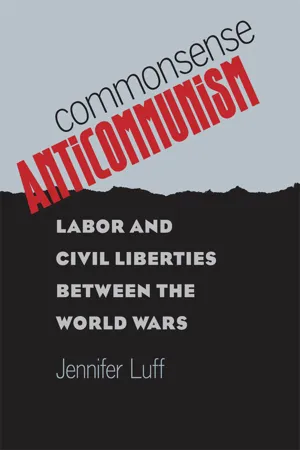
Between the Great War and Pearl Harbor, conservative labor leaders declared themselves America’s “first line of defense” against Communism. In this surprising account, Jennifer Luff shows how the American Federation of Labor fanned popular anticommunism but defended Communists' civil liberties in the aftermath of the 1919 Red Scare. The AFL’s “commonsense anticommunism,” she argues, steered a middle course between the American Legion and the ACLU, helping to check campaigns for federal sedition laws. But in the 1930s, frustration with the New Deal
order led labor conservatives to redbait the Roosevelt administration and liberal unionists and abandon their reluctant civil libertarianism for red scare politics. That frustration contributed to the legal architecture of federal anticommunism that culminated with the McCarthyist fervor of the 1950s.
Relying on untapped archival sources, Luff reveals how labor conservatives and the emerging civil liberties movement debated the proper role of the state in policing radicals and grappled with the challenges to the existing political order posed by Communist organizers. Surprising conclusions about familiar figures, like J. Edgar Hoover, and unfamiliar episodes, like a German plot to disrupt American munitions manufacture, make Luff’s story a fresh retelling of the interwar years.
- 304 pages
- English
- ePUB (mobile friendly)
- Available on iOS & Android
eBook - ePub
About this book
Information
Part I
The AFL and the Origins of Modern Civil Liberties
Chapter One
Labor and Liberties
The American Federation of Labor, 1886–1915
In 1908, Samuel Gompers, president of the American Federation of Labor, became a civil libertarian. He and other officers of the federation had been charged with contempt of court for publishing a notice to boycott Buck’s Stove, a nonunion iron-stove manufacturer. In their defense, the AFL leaders invoked a right to free speech and freedom of the press. “In all the history of the American Federation of Labor,” Gompers wrote, “no greater struggle has taken place than that for the preservation and the maintenance of the right of free press and free speech.” This defense was an unorthodox argument in an era when the notion of a categorical right to free speech was novel. Gompers explained that the AFL pursued this fight for First Amendment protection on behalf of all Americans, “because this attack upon free press and free speech among the workers is only the insidious beginning of the entire withdrawal of those rights from the whole people.”1
In the Progressive Era, the AFL was struggling for respectability. Strikes, boycotts, and the notion of unionism itself were of dubious legality and seemed to reflect workers’ unseemly pursuit of self-interest. For years, Gompers had tried to find ways to cast the federation as a champion of the common good. The language of civil liberties let him make that case in a fresh, universalist way.
Gompers was unpleasantly surprised when Theodore Schroeder, the crusader who helped develop the new theory of free speech, questioned his sincerity. Schroeder, a lawyer and pamphleteer, took an absolutist approach to defending the right of free speech. Schroeder disliked “partisan defenders” of civil liberties who, when “called upon to defend against some particular abridgment of freedom, have been so overwhelmed by its importance that they have failed to define or defend freedom in general.” Gompers was a prime offender, as he “wants only freedom to advocate the boycott,” not a “general ‘freedom of speech.’”2
Schroeder was right. Gompers was indifferent to violations of the civil liberties of others and hostile to the free-speech campaign being waged by radicals in the Industrial Workers of the World. From street-corner soapboxes across the West, IWW organizers bellowed abuse of capitalists, preachers, and Gompers himself. Schroeder and other civil liberties advocates backed these free-speech fights as important test cases. But Gompers and the AFL leadership saw this defiance as insolence, and the Wobbly free-speech fights as damaging to the cause of labor rights, and the federation consistently refused to support the IWW campaign. The AFL leaders were like other advocates who “desire unlimited liberty for themselves” but “suppress the opinions of which they disapprove,” said Schroeder. Civil liberties were a tactic, not a commitment.3
Since the founding of the federation in 1886, repeated political defeats had taught AFL leaders that tactical alliances were safer than ideological commitments. They learned to distrust the state—judiciary, executive, and legislative branches alike. They grew skeptical of the potential of political parties to represent unionists’ interests fairly. They doubted the intentions of reformers who sought to improve working conditions with social policy. And they viewed leftists—socialists, anarchists, syndicalists—as hopeless dreamers who diluted labor’s strength by dividing it. Workers could not rely on anyone else to defend their interests, AFL leaders believed. Trade unions were the only hope for workers to build and sustain enough power to make material improvements in the things that mattered: wages, hours, and working conditions.
This notion put the AFL out of step with potential allies in the Progressive Era. At a time when reformers lobbied to expand the state’s role in regulating relations between workers and employers, Gompers argued to keep the “juggernaut of government” out of the workplace. As activists organized new political parties to press for social change, the AFL insisted on nonpartisanship. Rather, federation leaders sought political power through lobbying, claiming to speak on behalf of all American workers, although its member unions represented only a small share of the workforce and many nonmembers saw their interests differently.
When AFL officials spoke, they were making arguments, not registering consensus views. Increasingly, those arguments were characterized as “conservative,” by AFL leaders and observers alike. By the outbreak of the Great War, the AFL had become the chief proponent and organizing force of a distinctly laborist conservatism that valorized collective bargaining over state intervention as the best tool for social redistribution. In an era of creative experimentation with new forms of state action and social engineering, this political vision sometimes marginalized the AFL. But Gompers and his colleagues had mastered the new technique of lobbying, and they displayed remarkable political agility, exercising influence far beyond their apparent reach. Even as the federation lost popular support, it gained political influence.
On the issue of civil liberties, though, the AFL found common ground with many progressives. In the early twentieth century, the rights of freedom of speech and of the press were far from settled law in U.S. courts. Individuals were regularly and successfully prosecuted for defamation, explicit materials from medical guides to pornography could not circulate in the federal mail, and police arrested public speakers who professed syndicalism and other subversive ideas. As historian David M. Rabban shows, “free speech in its forgotten years” had few defenders. In the years before World War I, Gompers and the AFL became vocal proponents of the notion that Americans enjoyed a broad right to “freely speak and print for the wrongs that need resistance and cause that needs assistance.” Should those causes include syndicalism or socialism? Over the next thirty years, the federation would grapple with that question.4
Founding the Federation
In his long career, Samuel Gompers accumulated an impressive array of detractors. He was a man “between the two millstones,” according to a sympathetic magazine profile in 1910. “The upper stone is capitalism. The lower is international Socialism.” Oddly, capitalists and socialists used similar terms to describe Gompers and the American Federation of Labor. The AFL was selfish, grasping for advantage at the expense of nonmembers. The Los Angeles Times, whose printing plant had been bombed during a citywide union drive, derided Gompers as “a special pleader” who served only those “who drop their tribute into the coffers of the American Federation of Labor.”5 Likewise, Socialist Eugene V. Debs deplored “the crime of craft unionism,” whose adherents “do not care what becomes of the rest, if only they can get what they are after for themselves.”6
Having survived decades of violent strikes and virulent quarrels among unionists, Gompers was unmoved. “We welcome any attack or abuse,” he told his critics. The AFL was hardly self-serving, he argued; rather, the federation sought to “promote, advance, and protect the rights and interests of the working people,” regardless of their occupation, and to “make for the greatest sum total of human happiness.” In Gompers’s mind, the vision behind the AFL was no less utopian than the socialist dream. Attaining this vision, however, required tough-minded realism.7
Short, squat, and pugnacious, Gompers had learned the arts of disputation in the New York cigar-making shops where he began working at the age of thirteen. Gompers migrated to the United States from England with his family in 1850, entering a vibrant milieu of artisans forming organizations of all sorts. In the early 1870s, Gompers fell in with socialists in the International Workingmen’s Association, a disorderly congress of unions and radical parties that Communists later termed the First International. Gompers taught himself German so he could read Marx’s treatises and join the debate.8 Artisans in New York, like their counterparts in Geneva and London, were arguing about the proper balance between political and workplace mobilization. Should workers dedicate their energies to confronting capitalism by striking and seizing industrial control, or were they more likely to transform the workplace by building political power and seizing control of the state?
In Europe, where few workers had the franchise in the 1870s, the debate resonated differently. In the United States, universal white male suffrage gave workers a far greater range of political options. In the postbellum American party realignment, the Republican and Democratic parties divvied up the labor vote. Native-born northeastern artisans mostly went to the Republicans, the growing immigrant factory workforce tended toward the Democrats, western miners and timber workers switched between the two parties, and black workers everywhere preferred the party of Lincoln, although encroaching Jim Crow laws suppressed the southern black vote. Women workers, of course, could not vote at all except in a few sparsely populated western states. Urban machine politics helped the parties hold their constituents regardless of platform. This diffusion of labor’s political power limited the rallying potential of a national labor movement.9
Efforts to unite the producing classes—farmers and laborers—in repeated failed third-party drives fell apart as the Democrats and Republicans strategically picked off supporters. Gompers saw this dynamic play out firsthand, from Henry George’s New York mayoral campaign in 1886 to the electoral campaigns of the Populists in the 1890s and the Socialists and Progressives in 1908 and 1912. From these defeats, Gompers took a lesson: third parties offered little hope, and neither major party functioned as a labor party. Nonpartisanship was the safest policy for building unity among American workers. This was not a foregone conclusion. In Australia, as historian Robin Archer has shown, universal white manhood suffrage did not preempt the formation of a labor party in the same years. Moreover, AFL unions could have attempted to vote as a bloc within one of the major parties, concentrating their strength, a strategy that unions would embrace in later years. But in the early years of the federation, Gompers insisted that partisan loyalties threatened solidarity. As much as anyone, Gompers helped dig the city trenches that came to divide workplace from community in American politics.10
Union, not party, promised the most immediate advantage in Gompers’s mind, but here again diversity jeopardized unity. Gompers had learned this from watching the rise and fall of the Knights of Labor. Founded in 1869, the Knights had drawn on the ideological heritage of republicanism to call all producers together into local assemblies of a national organization. Anyone who worked—farmer, factory laborer, artisan, housewife—could join the Knights (lawyers, liquor dealers, and bankers could not). A fusion of union, party, and revival movement, the Knights of Labor adopted a broad populist program. They marched for the eight-hour day, demanded government ownership of the railroads, and ran candidates for election in numerous cities. Knights assemblies also enrolled workers in industries ranging from railroading to cigar making, making no distinction by skill. This heterogeneity helped the Knights grow rapidly. After winning concessions from Jay Gould’s railroads in the early 1880s, the Knights mushroomed to 750,000 members.11
But to skilled workers such as Gompers, mixing up membership impaired militancy. In New York, the Knights of Labor assembly urged workers to conciliate their demands and pushed to settle conflicts with arbitration rather than strikes. Since the early 1870s, Gompers had been building up the Cigar Makers’ International Union (CMIU) on an entirely different basis. Open to cigar makers anywhere in the city, the CMIU charged high dues to fund generous strike and unemployment benefits for members. Union officers monitored all the cigar-making shops in the city, setting work rates for members and subduing recalcitrant employers with strikes and boycotts. Soon CMIU members could enforce real wage and working-hour demands. When the Knights tried to enlist New York cigar makers to join the city assembly, Gompers balked. Dispersed in a large organization with multiple demands, how could the cigar makers maintain the internal structure and unity that allowed them to sustain their hard-won standards?12
By 1886, disaffected Knights—ironworkers, carpenters, miners, and cigar makers—had reached the same conclusion. They joined Gompers to form the American Federation of Labor, an organization dedicated to the idea that workers should unionize along occupational and industrial lines. At their founding meeting in Columbus, Ohio, unionists designed the AFL as a sort of coordinating committee to promote this style of organizing. The federation was constituted as a weak central governing body, charged with mediating conflicts among unions about jurisdictional rights (in an industrializing economy, it could be hard to tell whether a metalworker belonged in the Steel Workers, Iron Molders, Machinists, or some other organization). Its founders agreed that the federation should focus on organizing unions, not pursuing broad social reforms. Once enough workers built sufficiently powerful unions, they would have the economic and political wherewithal to actually achieve reform. The delegates in Columbus named Gompers president of the new federation.13
From its founding, then, the AFL was making an argument about the best way for workers collectively to transform their material conditions. In Gompers’s many speeches advocating trade unionism, he painted a vision that rivaled any radical’s: “I believe that the trade unions will bring about both the improvement of conditions and the ultimate emancipation of workers,” he said in 1890.14 Indeed, Gompers believed his approach best reflected Marx’s analysis of how working-class political consciousness developed through direct collective action, once going so far as to write to Engels for support.15
But almost from the beginning, the AFL was characterized as a “practical and conservative” force.16 For one thing, the federation’s emphasis on skills as the basis for solidarity necessar...
Table of contents
- Cover Page
- Commonsense Anticommunism
- Copyright Page
- Contents
- Illustrations
- Acknowledgments
- Introduction
- Part I The AFL and the Origins of Modern Civil Liberties
- Part II Becoming Commonsense Anticommunists
- Part III From Commonsense Anticommunism to Red-baiting
- Epilogue
- Notes
- Bibliography
- Index
Trusted by 375,005 students
Access to over 1.5 million titles for a fair monthly price.
Study more efficiently using our study tools.
Frequently asked questions
Yes, you can cancel anytime from the Subscription tab in your account settings on the Perlego website. Your subscription will stay active until the end of your current billing period. Learn how to cancel your subscription
No, books cannot be downloaded as external files, such as PDFs, for use outside of Perlego. However, you can download books within the Perlego app for offline reading on mobile or tablet. Learn how to download books offline
Perlego offers two plans: Essential and Complete
- Essential is ideal for learners and professionals who enjoy exploring a wide range of subjects. Access the Essential Library with 800,000+ trusted titles and best-sellers across business, personal growth, and the humanities. Includes unlimited reading time and Standard Read Aloud voice.
- Complete: Perfect for advanced learners and researchers needing full, unrestricted access. Unlock 1.5M+ books across hundreds of subjects, including academic and specialized titles. The Complete Plan also includes advanced features like Premium Read Aloud and Research Assistant.
We are an online textbook subscription service, where you can get access to an entire online library for less than the price of a single book per month. With over 1.5 million books across 990+ topics, we’ve got you covered! Learn about our mission
Look out for the read-aloud symbol on your next book to see if you can listen to it. The read-aloud tool reads text aloud for you, highlighting the text as it is being read. You can pause it, speed it up and slow it down. Learn more about Read Aloud
Yes! You can use the Perlego app on both iOS and Android devices to read anytime, anywhere — even offline. Perfect for commutes or when you’re on the go.
Please note we cannot support devices running on iOS 13 and Android 7 or earlier. Learn more about using the app
Please note we cannot support devices running on iOS 13 and Android 7 or earlier. Learn more about using the app
Yes, you can access Commonsense Anticommunism by Jennifer Luff in PDF and/or ePUB format, as well as other popular books in History & North American History. We have over 1.5 million books available in our catalogue for you to explore.