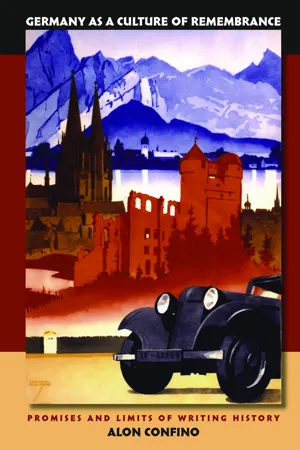
An acknowledged authority on German history and memory, Alon Confino presents in this volume an original critique of the relations between nationhood, memory, and history, applied to the specific case of Germany. In ten essays (three never before published and one published only in German), Confino offers a distinct view of German nationhood in particular and of nationhood in general as a product of collective negotiation and exchange between the many memories that exist in the nation.
The first group of essays centers on the period from 1871 to 1990 and explores how Germans used conceptions of the local, or Heimat, to identify what it meant to be German in a century of ideological upheavals. The second group of essays comprehensively critiques and analyzes the ways laypersons and scholars use the notion of memory as a tool to understand the past. Arguing that the case of Germany contains particular characteristics with broader implications for the way historians practice their trade, Germany as a Culture of Remembrance examines the limits and possibilities of writing history.
- 336 pages
- English
- ePUB (mobile friendly)
- Available on iOS & Android
eBook - ePub
About this book
Information
PART I
THE LOCAL LIFE OF NATIONHOOD GERMANY AS HEIMAT, 1871–1990
Several years ago I was asked to give a lecture on the “local turn” in the study of nationhood. The term left me pensive. It was exaggerated as far as it associates grand shifts in the humanities such as the linguistic or cultural turn. But it was not inappropriate to describe a grand shift in the study of nationhood, and the use of the term itself was significant. Who would have thought two decades ago that it would make no sense—in terms of method, theory, and empirical research—to understand the national without the local? I would like to articulate briefly this shift in the study of nationhood and of German nationhood, and to place my own work within that context.
The historiography of nationalism has been organized in the past two decades or so according to a three-tiered explanatory model: from the global—often expressed in terms of modernity—via the national, down to the local. How has the local been treated, as an explanatory device of nationalism, in these three levels? The first level is that of theoretical studies, such as the path-breaking works of Ernest Gellner and Benedict Anderson, that attempt to explain nationalism as a global historical phenomenon, as a social and cultural result of modernity.1 For Gellner, nationalism is a result of industrial social organization; for Anderson, of print capitalism and widespread literacy. As modernity spreads around the globe, it spreads nationalism as well, though how this is exactly done we are never told. For these and other theoretical studies are interested, understandably, in the macro. They mention individual national cases only by way of example and by focusing on official and elite nationalism. As a result, they are uninterested in the ways modernity shaped, as well as was shaped by, the local. In short, for them the local can never be explanatory in any significant way: it is only the background, the context, for the national idea.
The second level is that of research on nationalism in specific nations. Scholars have explored the symbolism and social engineering of nationalism and the relations between old and new pasts in the making of nations. They have analyzed how people invented the nation through monuments, celebrations, museums, images, and other artifacts. But a dominant approach in these studies has viewed the locality only as a test case of a given territory where the nation fulfills itself. Already, with Eugen Weber’s outstanding Peasants into Frenchmen, the question was posed in these terms: How did peasants (the local) become Frenchmen (that is, the national)? How the locality and the concept of localness altered, even forged, national belonging was an issue left largely unexplored.2 In short, in terms of the scale of explanation, these studies are not fundamentally different from the perspective of Anderson and Gellner: they are simply doing on the national level what Anderson and Gellner had done on a global level.
Studies of the third, local level only took the invention of the nation onto a narrower spatial category, namely the locality and the region. The aim has been to show the nationalization of the locality and the region, and how the nation penetrated the local level, thus introducing mass politics, industrialization, and modernity. In the most extreme interpretation, influenced by modernization theory, local identity was seen as obliterated by national identity. Thus, in the 1970s and 1980s, two distinguished historians, Jürgen Kocka and Eugen Weber, made this argument for Germany and for France.3 Again, in terms of the scale of explanation, this approach was simply doing on the local level what other studies did on the national and global level; the scale of observation was the local, but the local was not explanatory in any significant way.
A much more complex view of matters has now evolved.4 We insist that the national did not simply erase or write over the local. We emphasize instead how the local appropriates the national, how the nation acquires different local meanings, how the local is celebrated in nationalist thought as the national home, and how the nation claims to actually be the local. We appreciate that no modern national identity could ignore or do without ideas of localness and regional identity. The old shibboleth about the relations of localness and nationhood was turned on its head: nationhood did not obliterate local and regional identity but instead invented, revived, and breathed new life into them.5 The locality was not a bedrock of provincial backwardness but was interconnected with modernity. And nationalism and state building were constructed on the foundation of old regional, particularist states. This was the case in Germany, for example, where governments of territorial states (such as Bavaria and Württemberg) fostered particularism by building on policies and representations of German nationalism, which in turn were used after the unification in 1871 to sustain the new nation-state.6 Overall, this new treatment of the local reflects the important shift from functional and structural analysis of nationalism toward analysis in terms of negotiations, mediation, culture, representation, memory, and agency.7 The result of this approach, which has startlingly transformed the study of nationalism in terms of method, sophistication, and empirical knowledge, has been to view localness as part of, not as contradictory to, nationhood.
My work on the Heimat idea has been indebted to this distinguished body of work. From Anderson I took the idea of the nation as an imagined community that should be treated not as an ideology but in an anthropological spirit as religion and kinship; from Gellner, the idea that nationalism is not the awakening of nations to their deep historical essence but rather serves to invent nations where these do not exist; from Chatterjee, the process of appropriation, reception, imitation, rejection, and reinvention of the national idea by different groups within the nation; from Weber, the magnificent historical reconstruction of how ways of life and thought altered when nationhood met localness. And I have shared with other scholars of the new approach the view that negotiations and memory are fundamental to the meaning of localness and nationhood.
Still, it has been my sense that the challenge posed by localness to the understanding of nationhood—that is, to make the local the stage of the national plot, the shaper of nationhood imagination, and one of the explanations for the success of the national idea—has not been quite met. The locality has not been treated to a sufficient degree as an experimental variable. This has been true also for the new approach that views the relations between localness and nationhood in terms of mediation and negotiation, and which has a clear advantage over the model that saw the local as only the background of the national historical plot. For this new approach did not automatically change the basic perspective under which the meaning of the local was subordinate to the national. Some sophisticated treatments of the relations between national and regional identities, influenced by cultural history, have viewed the local as a significant part within the national plot, but they have not changed the explanatory relations whereby the nation acts as a context within which the region can be intelligibly understood and without which it has no meaning.
The point can be illustrated by using the following analogy, where the relations between nationhood and localness are viewed in terms of the relations between text and context. National identity often functions in studies of nationalism much like a necessary context that describes and analyzes the general conditions within which a particular local reality evolves. The national plot functions as a foundation story that, while complex and multi-faceted, still provides a single context within which and in relation to which people make choices about local and national identity. It constructs one social reality within which local identity must make sense. But what happens when we reject this separation between localness and nationhood, when we break down the dichotomy of text and context? This is an invitation to reject the historian’s common approach to place and explain the text in relation to a context. To reject the separation of localness and nationhood assumes that historical actors participate in various processes at the same time, that localness and nationhood simultaneously and reciprocally interact. To accept that none of these identities has primacy and yet to understand the meaning of national identity, we need to understand all of them as intertwined—the nation as a whole that is bigger than the sum of its parts. This serves as a reminder of what is declared more often than practiced—namely, the multiplicity of social experiences and representations, in part contradictory and ambiguous, in terms of which people construct the world and their actions.8
I attempted this kind of conceptualization in my own work on the Heimat idea in modern Germany.9 My point of departure has been that there is no meaning to the national without the local, and that the question to ask is how did localness mold nationhood. Instead of understanding local identity as part of national identity, and localness against the background of nationhood, I viewed local identity as a constituent of national identity and localness as a shaper of nationhood. In contrast to the view of local, regional, and national sentiments as contradictory or overlapping, I viewed the Heimat idea as representing interchangeably the locality, the region, and the nation through an interlocking network of symbols and representations in which the nation appeared local and the locality national. Germans thus imagined nationhood as a form of localness. We have come full circle from the days when the local was the background and context of nationhood and could never be explanatory in any significant way: it has instead become the maker of national imagination and one of the explanations for the success of the national idea.
This way of using the notion of the local was useful to destabilize long-existing boundaries in current historical methods and narratives. One main problem in the study of nationhood is how to pose questions and at what level or scale. The three levels in the historiography of nationalism—the global, the national, and the local—are analytically neat and well organized; but they also create a tautology of narration within prearranged categories. By looking at the Heimat idea, we challenge the boundaries and the hierarchy between these levels and scales of explanation. Rather than taking nationhood as the hard and set context within which localness operates, the attempt is to elucidate their hybrid relations and interdependent influences. We thus learn that nationhood is not primarily experienced and enacted on the abstract national level, but instead that it comes into being on the local level, in everyday life, in people’s multiple decisions to become national and to embrace its past (invented or not). As a result the local appears as a shaper of nationhood: it is not merely symbolic of some deeper and more real national reality; it is a national reality (but not the national reality, for there are many others). It is not simply a place where the local and national meet in social practices; it is a place where one is made by the other. There is no pure space where the local remains immaculately local and the national immaculately national; they are in constant configurations as one shapes the other.
In German historiography, the pioneering study of Celia Applegate, A Nation of Provincials: The German Idea of Heimat, signaled a new evaluation of the role of the local within the national. Tracing the Heimat idea in the Palatinate from the 1850s to the 1950s, Applegate shed new light on its cultural invention and social origins and on the reformulations of the concept that placed the Palatinate and its inhabitants within the context of the nation for more than a century of political upheavals. Viewing the Heimat idea as a mediating concept between the immediate local life and the abstract nation, Applegate successfully showed the different ways in which Pfälzers used it “to rest finally on what both region and nation have in common.”10
After being excoriated for decades, the Heimat idea has thus enjoyed in recent years a historiographical revival. Before the current interpretative change, the Heimat idea was usually seen either as a mythic German concept or as a human state-of-mind that longs for stability and human relations.11 It was viewed as hopelessly antimodern, a reactionary escape from modernity, and a desperate nostalgic longing for a bucolic past.12 Manufactured by conservatives in nineteenth-century Germany, the Heimat idea fostered, so the argument went, fundamentally anti-industrial and antitechnological ideas about a return to a primeval and pure state of society. From here the road was short and one-directional to the Nazi use of Heimat as an ideology of race, blood, and soil (Blut und Boden). Reactionary, provincial, antimodern, and manipulative—the Heimat idea epitomized all that was wrong with German nationhood.
In contrast, the Heimat idea is now considered a sophisticated cultural artifact engineered anew in the wake of the 1871 national unification as a way to reconcile local, regional, and national identities. Compared with two decades ago the number of new studies today is considerable and continues to grow.13 Based on novel approaches to culture, nationalism, and memory, new studies have argued that Heimatlers took traditional ways of thinking about, and modes of representation of, the local and regional community and gave them a whole new meaning by connecting them to the nation in ways that were unpredictable before 1871. Far from being antimodern, Heimatlers expressed the ambiguity of modernity itself by simultaneously mourning the past while applauding the material progress and cultural opportunities promised by modernity. They commonly attempted to strike a modus vivendi between the preservation of national roots and the continuation of modernity and the prosperity it promised. Moreover, Heimat, far from being an exclusively reactionary idea, was widely popular in German society as a shared idiom of localness and nationhood. It has been appropriated by every group and ideology since 1871, from the bourgeoisie in imperial Germany, to the Nazis, to postwar West German Heimat films and East German authorities.14 A flexible, dynamic, and malleable notion, Heimat was appropriated for different political and cultural ends; no one had exclusive copyrights on the Heimat idea, as it had been appropriated by very different hands in unpredictable ways.
What, then, was the significance of this diversity of meanings that constituted the Heimat idea? Was there at all a common denominator to this idea that steered such different emotions, represented different ideologies, and served different spatial and political masters? If we wish to understand the Heimat idea in terms of ideology, we miss the point. The ideological element of the Heimat idea is important if we wish to uncover aspects of political legitimacy and cultural representation. But the meaning of the Heimat idea was precisely its ability to go beyond ideological difference by providing a national lexicon to think and talk about Germanness regardless of who was in power. It would, I think, make things easier if one treated the Heimat idea as a historical mentality that gave Germans a cultural backbone to the modern changes in polity and society. It had a portable, symbolic manual that represented one ideology after another and gave Germans a sense of identity over time, regardless of the frequent political changes and opposing ideologies. Still, why this symbolic manual and not another? Which symbolic ingredients made it a success, and why? The following chapters tell the story of the invention, attributes, and working of the Heimat symbolic manual from the unification in 1871 to the unification in 1990.
1
THE NATION AS A LOCAL METAPHOR
Heimat, National Memory, and the German Empire, 1871–1918
The essence of a nation is that all individuals have many things in common, and also that they have forgotten many things.
—Ernest Renan, What Is a Nation? (1882)
THINKING THE NATION
In the past two decades the most influential way of making sense of the sense of national belonging has been to regard the nation as a cultural artifact, as a product of invention and social engineering.1 This “cultural turn” in the study of nationalism displaced the modernization theory, prevalent during the 1960s and 1970s, that argued that nationhood was a necessary concomitant of modernity, a form of belief produced by the cultural, economic, and technological transformation into and of modernity.2 But in spite of the now flourishing interest in nationalism, the sense of national belonging remains a puzzling problem. This is due, in part, to the paucit...
Table of contents
- Cover Page
- Halftitle Page
- Title Page
- Copyright Page
- Dedication
- Contents
- Preface
- Prologue: The Historian’s Representations
- Part I. The Local Life of Nationhood: Germany as Heimat, 1871–1990
- 1 The Nation as a Local Metaphor: Heimat, National Memory, and the German Empire, 1871–1918
- 2 A Century of Local Nationhood: Edgar Reitz’s Heimat, Memory, and Understandings of the Past, 1871–1990
- 3 Heimat and Memories of War in West Germany, 1945–1960
- 4 Heimat, East German Imagination, and an Excess of Reality
- 5 A National Lexicon for All Seasons
- Part II. Memory as Historical Narrative and Method
- 6 Freud, Moses, and National Memory
- 7 Collective Memory and Cultural History: Problems of Method
- 8 Telling about Germany: Narratives of Memory and Culture
- 9 Dissonance, Normality, and the Historical Method: Why Did Some Germans Think of Tourism after May 8, 1945?
- 10 Traveling as a Culture of Remembrance: Traces of National Socialism in West Germany, 1945–1960
- Notes
- Index
Trusted by 375,005 students
Access to over 1.5 million titles for a fair monthly price.
Study more efficiently using our study tools.
Frequently asked questions
Yes, you can cancel anytime from the Subscription tab in your account settings on the Perlego website. Your subscription will stay active until the end of your current billing period. Learn how to cancel your subscription
No, books cannot be downloaded as external files, such as PDFs, for use outside of Perlego. However, you can download books within the Perlego app for offline reading on mobile or tablet. Learn how to download books offline
Perlego offers two plans: Essential and Complete
- Essential is ideal for learners and professionals who enjoy exploring a wide range of subjects. Access the Essential Library with 800,000+ trusted titles and best-sellers across business, personal growth, and the humanities. Includes unlimited reading time and Standard Read Aloud voice.
- Complete: Perfect for advanced learners and researchers needing full, unrestricted access. Unlock 1.5M+ books across hundreds of subjects, including academic and specialized titles. The Complete Plan also includes advanced features like Premium Read Aloud and Research Assistant.
We are an online textbook subscription service, where you can get access to an entire online library for less than the price of a single book per month. With over 1.5 million books across 990+ topics, we’ve got you covered! Learn about our mission
Look out for the read-aloud symbol on your next book to see if you can listen to it. The read-aloud tool reads text aloud for you, highlighting the text as it is being read. You can pause it, speed it up and slow it down. Learn more about Read Aloud
Yes! You can use the Perlego app on both iOS and Android devices to read anytime, anywhere — even offline. Perfect for commutes or when you’re on the go.
Please note we cannot support devices running on iOS 13 and Android 7 or earlier. Learn more about using the app
Please note we cannot support devices running on iOS 13 and Android 7 or earlier. Learn more about using the app
Yes, you can access Germany as a Culture of Remembrance by Alon Confino in PDF and/or ePUB format, as well as other popular books in History & German History. We have over 1.5 million books available in our catalogue for you to explore.