- 424 pages
- English
- ePUB (mobile friendly)
- Available on iOS & Android
eBook - ePub
About this book
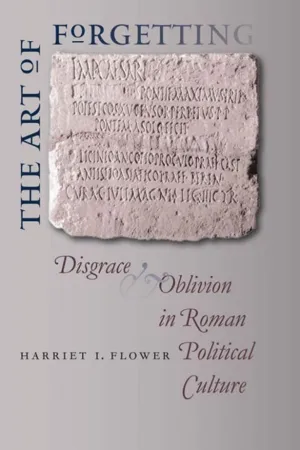
Elite Romans periodically chose to limit or destroy the memory of a leading citizen who was deemed an unworthy member of the community. Sanctions against memory could lead to the removal or mutilation of portraits and public inscriptions. Harriet Flower provides the first chronological overview of the development of this Roman practice — an instruction to forget — from archaic times into the second century A.D. Flower explores Roman memory sanctions against the background of Greek and Hellenistic cultural influence and in the context of the wider Mediterranean world. Combining literary texts, inscriptions, coins, and material evidence, this richly illustrated study contributes to a deeper understanding of Roman political culture.
Information
Topic
HistoriaSubtopic
Historia antigua romanaChapter I
Clementis’ Hat
The Politics of Memory Sanctions and the Shape of Forgetting
The face of the Lord is set against the doers of evil To wipe their memory from the earth.
Psalm 34.16
Psalm 34.16
Who controls the past controls the future: who controls the present controls the past.
George Orwell, 1984
George Orwell, 1984
Any recalling or recording of the past involves selection, both deliberate and unintended. Choosing what to remember must entail also the choice of what to forget, what to pass over in silence, and what to obscure. Consequently, every account of the past is incomplete and partial. It involves a loss, whether for an individual, a family, or a whole community. It is impossible to travel back in time to recover every detail, to relive past experience as if moment by moment. Nor would such a journey even be desirable. Rather, we pay attention to memories of the past in a present that is by definition not the same as the time that is being invoked as “past.” Similarly, active recalling itself (re)creates that past from fragmented pieces of evidence, whether in the human brain or on the basis of an archive or at the physical site of some historical action.1
The image of the past that is most alive in human memory is seen as a road that leads from that past into the present. A past that is completely disconnected from present experience and circumstances does not remain “memorable.” Rather the past, because it comes before the present, is expected to connect in a logical manner to subsequent events and circumstances. Hence our picture of the past shapes both our present identity and our hopes for the future, for what has not yet happened is essentially unknowable. Only the past really stands available — at least apparently — as material in our search for meaning, purpose, and pattern in human experience.
One of the most powerful effects on human memory and perception is the bias created by hindsight.2 As we look back into the past, we already know what will happen next. The shape of the story is familiar. Therefore, it is natural and inevitable to look for explanations that will accommodate what did happen, rather than what could have happened. Meanwhile, other aspects of the past become easy to forget because they seem irrelevant and become increasingly hard to understand, if they do not lead to results and consequences in our present lives. Our account of the past, whether expressed in terms of history or of memory, is selective and tends to favor information that appears relevant to later events, and especially to present circumstances at the time of recollecting or writing. Hence the perspective of the person or group that guards and (re)produces memory is also vital and may produce a very different narrative from that of another party, even if both are eyewitnesses or have access to similar original sources.
Memory sanctions are deliberately designed strategies that aim to change the picture of the past, whether through erasure or redefinition, or by means of both. Such strategies can be found in most, perhaps even in all, human societies that place distinct value on an account of their past. Conscious manipulation, introduced for a specifically desired effect, must be understood as one vital factor that affects the picture of the past outlined here — in other words, a picture that is by its very nature incomplete and subject to various other distortions. Deliberately imposed modifications resulting from memory sanctions do not impede a perfect view, as if of a landscape on a cloudless and sunny day. Rather they contribute to and interact with many other factors that shape human memory, causing it to produce its own, very particular narrative of the past. An alternate account to the one that has obviously been tampered with would not necessarily represent a “true” and “unbiased” version, but in most cases simply a different version, one that brought out another set of emphases, meanings, and implications. With such considerations in mind, Maurice Baring called his memoirs, which were published in 1922, The Puppet Show of Memory.
In Roman thought, memory was not taken for granted as a natural state or product. Rather, oblivion was considered the more normal condition, as the past receded from the present and was simply no longer connected to it. Hence, as a carefully cultivated and deliberately invoked culture of commemoration, Roman memory (memoria) was designed precisely in opposition to the vast oblivion into which most of the past was conceived as having already receded. Such an attitude was the product of a world in which life was often short and unpredictable, with the result that time must have seemed to move quickly, and change to come rapidly with the passing generations.3 For example, Tacitus ends the biography of his father-in-law with these words: “For oblivion will bury many of the men of old as if they had been without renown or prestige: Agricola will survive for posterity, his story told and handed on.”4
Naturally, the Romans also drew on similar conceptions of memory in other ancient societies, especially among the Greeks. In Homer the generations of men are likened to the leaves on the trees that so quickly fall and die.5 Only the fame (kleos) of the Homeric warrior, often expressed specifically in terms of the very function of epic poetry itself to immortalize that fame, is seen as a defense against the loss of status brought by oblivion. Similarly, Herodotus sets out to research and to write history so that memorable deeds of both Greeks and barbarians will not pass into oblivion.6 Roman memory and commemoration were also designed to ward off the constant threat of loss of identity and status within the community, after the death of the individual or of his generation. In a wide variety of settings — for example, in battle or in the writing of literary works — the production of memory was the aim and the reward for effort and achievement.
A vivid picture of the function of Roman memory in a historiographic context is provided by a dream experienced by the elder Pliny, when he was a young man on campaign in Germany. Pliny dreamed that a ghost or image of the elder Drusus, who had died in his prime as a result of a riding accident in his camp in Germany in 9 B.C., came to visit him, with the request that Pliny should undertake to rescue Drusus’ memory from oblivion.
Incohavit, cum in Germania militaret, somnio monitus: adstitit ei quiescenti Drusi Neronis effigies, qui Germaniae latissime victor ibi periit; commendabat memoriam suam orabatque, ut se ab iniuria oblivionis adsereret. (Pliny Ep. 3.5.4)
He began [his history of the German wars] at the time when he was serving in the army in Germany, when he received inspiration from a dream. As he was sleeping the ghost of Drusus Nero, who died in Germany after winning many victories there, appeared to him. Drusus commended his memory to Pliny and begged him to free him from the assault of oblivion.
Pliny’s dream suggests the emotive and very personal urgency attached to active commemoration in Roman elite culture. Drusus himself appears to entrust his memory to Pliny. Past events and the recording of them in narrative form take on meaning through the lives of individual Romans of previous ages, even as later writers like Pliny might come to feel a personal connection with their historical subjects. Pliny’s dream also conjures up Roman beliefs about the restlessness of those who die before their time and in unfortunate circumstances, especially through violence. It is tempting to imagine that the ghost of Drusus appeared to Pliny in a camp or other place where Drusus had spent time, or perhaps even where he had died.7 Despite the fact that his body was returned to Rome for a splendid funeral, Drusus’ ghost seems to be haunting the camps and battlefields of Germany, voicing his fears of oblivion in the specific context of conquest and empire, and of the now somewhat faded imperial project of an earlier age.8 At the same time, these places in Germany should have served to commemorate Drusus, who had received a cenotaph on the banks of the Rhine River.
Drusus was the younger brother of Tiberius, born to Livia soon after her marriage to Octavian, the future emperor Augustus. Subsequently, Drusus was to be the father of Claudius, who was emperor when Pliny had his dream, sometime in the late 40s A.D. By then Drusus had been dead for more than fifty years. This fiftieth anniversary, which closely coincided with the unexpected accession of Drusus’ son to imperial power, may have helped “prompt” the dream in Pliny’s mind.
Hence, Pliny experienced Germany as a special place of memory for Romans, and notably for Drusus, whose untimely death put an end to his hopes of winning unique personal military honors there. There is, however, an anomaly in the notion that the father of the emperor might be forgotten, particularly in a Roman Empire that his son was expanding with an expedition to Britain. Tacitus, who was more than a generation younger than Pliny, remarks on the vivid popular memory of Drusus.
Quippe Drusi magna apud populum Romanum memoria, credebaturque, si rerum potitus foret, libertatem redditurus. Unde in Germanicum favor et spes eadem.(Ann. 1.33.2)
Indeed, the memory of Drusus was vast among the Roman people, and it was believed that, if he had succeeded to power, he would have restored political freedom. This belief also resulted in the same popular favor and hopes being placed in Germanicus [Drusus’ oldest son].
If Pliny’s history of the Romans in Germany (which eventually extended to twenty papyrus rolls) served as a source for Tacitus, Pliny may have enhanced Drusus’ image in the eyes of posterity.9 It is also likely that Pliny’s dream had a more symbolic than a literal meaning: now was the right time to choose Drusus as a subject, because others, including the emperor Claudius, who was himself a historian of distinction, were rediscovering the relevance of this particular ancestor of the Julio-Claudian house. However that may be, Pliny’s dream, and the fact that he shared it with others, perhaps in the introduction to his German history (now lost), reveal that the elite Roman memory project was a personally inspired struggle against oblivion in the particular context of the Roman Empire. We know of his dream from a letter of his nephew and adopted son, Pliny the Younger, who includes this episode in a bibliographic list of all his uncle’s works. In this secondary context, as narrated by the younger Pliny, the ghost of Drusus speaks also to the literary and political concerns of the early years of Trajan.
Memory sanctions, then, take shape against the background of a natural state of oblivion, as constructed in the Roman imagination of the day. In the sense that they were designed to prevent or remove the commemorative strategies specific to the Roman community, their function is analogous to that of exile, which drove the unworthy citizen outside the territory of the city, into a place that was not Roman. Like the exile, a citizen subject to memory sanctions was denied honorific commemoration within the city’s own memory space. In such a rich cultural context, memory sanctions, especially in Rome, did not have a single meaning or purpose but were complex and often contradictory, both in conception and implementation.10 They corresponded to the evolving memory world of Rome, in all its manifestations. Moreover, any particular sanction or erasure would always have taken on its meaning within its own particular milieu, a historical context that is often lost to us. Memory sanctions often appear to float freely between the extremes of oblivion and disgrace, in a dynamic memory space shaped in part by shame and silence, but in part also by vituperation and ongoing debate about the merits or vices of the deceased.
Ancient societies did not exercise total control over memory, because they generally did not envision a world in which any individual or group could wield the power to excise memory in society. Nor did ancient cultures have a secret police force or other organized mechanisms of surveillance to intrude into the personal and domestic spheres of its citizens. These circumstances should not be labeled as a lack of “efficiency.”11 Because sanctions targeted the formal and symbolic memory spaces of the political elite, not all memory was erased. People who had witnessed the past themselves knew and surely had their own opinions about what had happened. Yet the opinions of most ordinary people (or even the ways in which they might cultivate those memories) counted for little at the various moments when sanctions were imposed by those in power. Rather, sanctions looked ahead to a future that was never too far away in Rome, a future when a new generation would be learning the story of the (not necessarily so distant) past from the collective remembrance and monuments of the city. In addition, those who imposed memory sanctions may have assumed that natural oblivion was on their side. Meanwhile, a few negative examples were always useful, if only as warnings of the dire consequences of delinquent behavior. Despite the occasionally striking similarities, it is anachronistic and often misleading to read Roman memory sanctions simply or primarily in terms of Orwellian erasures and the totalitarian rewriting of history practiced in the twentieth century.
Every culture has its own memory world, within which its chosen sanctions take on their characteristic meaning and significance. The quality of memory is not only personal but also cultural: the memories of the individual mark that person as a member of a particular community. This notion, along with many other thoughts about memory, is brought out by Isabel Allende in her poignant description of her own experience as she sat by the hospital bed of her daughter Paula, who had fallen into a coma from which she would never recover. Like Pliny, Allende was a long way from home (since her daughter had fallen ill in Spain) and was experiencing memory as both powerful and yet at the same time fragile. In a reversal of the pattern found in Pliny, Allende entrusts her own memory to her dying daughter, rather than herself receiving an appeal to keep the past alive.
In the long, silent hours, I am trampled by memories, all happening in one instant, as if my entire life were a single, unfathomable image. The child and girl I was, the woman I am, the old woman I shall be, are all water in the same rushing torrent. My memory is like a Mexican mural in which all times are simultaneous: the ships of the Conquistadors in one corner and an Inquisitor torturing Indians in another, galloping Liberators with blood-soaked flags and the Aztecs’ Plumed Serpent facing a crucified Christ, all encircled by the billowing smokestacks of the industrial age. So it is with my life, a multilayered and ever-changing fresco that only I can decipher, whose secret is mine alone. The mind selects, embraces, and betrays; happenings fade from memory; people forget one another and, in the end, all that remains is the journey of the soul, those rare moments of spiritual revelation. What actually happened isn’t what matters, only the resulting scars and distinguishing marks. My past has little meaning; I can see no order in it, no clarity, purpose, or path, only a blind journey guided by instinct and detours caused by events beyond my control. There was no deliberation on my part, only good intentions and the faint sense of a greater design determining my steps. Until now, I have never shared my past; it is my innermost garden, a place not even my most intimate lover had glimpsed. Take it, Paula, perhaps it will be of some use to you, because I fear that yours no longer exists, lost somewhere during your long sleep — and no one can live without memories.12
As Allende suggests, crisis and loss both conjure up the past and change its appearance for us. Trauma can make us feel ready or even compelled to rewrite the past, if only to make a difficult new present more bearable. This effect can be observed in terms both of personal recollection and of the collective experience of a whole society, as it faces political rupture and a transition to a new and uncer...
Table of contents
- Cover Page
- The Art of Forgetting
- Copyright Page
- Dedication
- Epigraphs
- Contents
- Map and Illustrations
- Preface
- Acknowledgments
- Chapter I Clementis’ Hat
- Part I The Roman Republic and Greek Precedents
- Part II The Principate From Octavian to Antoninus Pius
- Notes
- Bibliography
- Index
Trusted by 375,005 students
Access to over 1.5 million titles for a fair monthly price.
Study more efficiently using our study tools.
Frequently asked questions
Yes, you can cancel anytime from the Subscription tab in your account settings on the Perlego website. Your subscription will stay active until the end of your current billing period. Learn how to cancel your subscription
No, books cannot be downloaded as external files, such as PDFs, for use outside of Perlego. However, you can download books within the Perlego app for offline reading on mobile or tablet. Learn how to download books offline
Perlego offers two plans: Essential and Complete
- Essential is ideal for learners and professionals who enjoy exploring a wide range of subjects. Access the Essential Library with 800,000+ trusted titles and best-sellers across business, personal growth, and the humanities. Includes unlimited reading time and Standard Read Aloud voice.
- Complete: Perfect for advanced learners and researchers needing full, unrestricted access. Unlock 1.5M+ books across hundreds of subjects, including academic and specialized titles. The Complete Plan also includes advanced features like Premium Read Aloud and Research Assistant.
We are an online textbook subscription service, where you can get access to an entire online library for less than the price of a single book per month. With over 1.5 million books across 990+ topics, we’ve got you covered! Learn about our mission
Look out for the read-aloud symbol on your next book to see if you can listen to it. The read-aloud tool reads text aloud for you, highlighting the text as it is being read. You can pause it, speed it up and slow it down. Learn more about Read Aloud
Yes! You can use the Perlego app on both iOS and Android devices to read anytime, anywhere — even offline. Perfect for commutes or when you’re on the go.
Please note we cannot support devices running on iOS 13 and Android 7 or earlier. Learn more about using the app
Please note we cannot support devices running on iOS 13 and Android 7 or earlier. Learn more about using the app
Yes, you can access The Art of Forgetting by Harriet I. Flower in PDF and/or ePUB format, as well as other popular books in Historia & Historia antigua romana. We have over 1.5 million books available in our catalogue for you to explore.