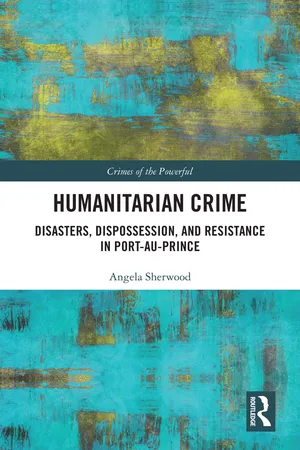
This is the first book to theorise humanitarian power within the crimes of the powerful tradition. It offers a compelling account of the structural forces embedded in humanitarian institutions and the practices and forms of legitimation through which the violent effects of humanitarian intervention are typically produced and obscured.
Focusing on post?earthquake Haiti, a setting marked by large?scale international involvement and deep historical and colonial inequalities, this book examines how humanitarian organisations helped shape the city's post?disaster
landscape. It shows how humanitarian actors, working alongside the Haitian state, contributed to the reproduction of homelessness, landlessness, and urban exclusion through their management of displacement camps, their
reliance on property?based models of assistance, and their role in coercive programmes of camp closure.
Drawing on extensive fieldwork, interviews, and archival research, this book develops the concept of humanitarian crime to illuminate the state processes, institutional arrangements, and material structures that underpin violent
outcomes in humanitarian settings. At the same time, it centres the voices of Haitian civil society and affected communities, highlighting how those subjected to state–humanitarian expulsions interpret, contest, and resist the
harms inflicted through humanitarian governance. It foregrounds land occupations and informal urbanisation as key forms of resistance that expose and challenge the dispossession inscribed within the everyday workings of
humanitarian intervention.
By situating humanitarianism within wider relations of sovereignty, accumulation, and control, this book opens new pathways for studying humanitarian power and its role within contemporary global violence. It
also establishes a research agenda for understanding humanitarian crime and for examining how contemporary crises, not least increasingly frequent climate disasters, are being governed in ways that only deepen precarity and dispossession.
This book is essential reading for all those engaged in work on crimes of the powerful, disaster recovery, state and corporate crime, and Caribbean Studies.
eBook - ePub
Humanitarian Crime
Disasters, Dispossession, and Resistance in Port-au-Prince
- 178 pages
- English
- ePUB (mobile friendly)
- Available on iOS & Android
eBook - ePub
About this book
Information
Table of contents
- Cover
- Endorsement Page
- Half Title
- Series Page
- Title Page
- Copyright Page
- Dedication Page
- Table of Contents
- Acknowledgements
- 1 Humanitarian Crime: An Introduction
- 2 Humanitarianism in Crimes of the Powerful Research
- 3 Port-au-Prince and the Making of a Violent Urban Order
- 4 Governing the ‘Ungovernable’ City: Humanitarianism and Managing Urban Crisis
- 5 Forced Evictions and Campicide as State–Humanitarian Crime
- 6 Exposing Humanitarian Crimes of Dispossession
- 7 Camp Afterlives and Humanitarian Denial
- 8 Concluding Reflections
- Index
Trusted by 375,005 students
Access to over 1.5 million titles for a fair monthly price.
Study more efficiently using our study tools.
Frequently asked questions
Yes, you can cancel anytime from the Subscription tab in your account settings on the Perlego website. Your subscription will stay active until the end of your current billing period. Learn how to cancel your subscription
No, books cannot be downloaded as external files, such as PDFs, for use outside of Perlego. However, you can download books within the Perlego app for offline reading on mobile or tablet. Learn how to download books offline
Perlego offers two plans: Essential and Complete
- Essential is ideal for learners and professionals who enjoy exploring a wide range of subjects. Access the Essential Library with 800,000+ trusted titles and best-sellers across business, personal growth, and the humanities. Includes unlimited reading time and Standard Read Aloud voice.
- Complete: Perfect for advanced learners and researchers needing full, unrestricted access. Unlock 1.5M+ books across hundreds of subjects, including academic and specialized titles. The Complete Plan also includes advanced features like Premium Read Aloud and Research Assistant.
We are an online textbook subscription service, where you can get access to an entire online library for less than the price of a single book per month. With over 1.5 million books across 990+ topics, we’ve got you covered! Learn about our mission
Look out for the read-aloud symbol on your next book to see if you can listen to it. The read-aloud tool reads text aloud for you, highlighting the text as it is being read. You can pause it, speed it up and slow it down. Learn more about Read Aloud
Yes! You can use the Perlego app on both iOS and Android devices to read anytime, anywhere — even offline. Perfect for commutes or when you’re on the go.
Please note we cannot support devices running on iOS 13 and Android 7 or earlier. Learn more about using the app
Please note we cannot support devices running on iOS 13 and Android 7 or earlier. Learn more about using the app
Yes, you can access Humanitarian Crime by Angela Sherwood in PDF and/or ePUB format, as well as other popular books in Politics & International Relations & Global Politics. We have over 1.5 million books available in our catalogue for you to explore.