The eleventh and twelfth centuries comprised a period of great significance in Islamic history. The Great Saljuqs, a Turkish-speaking tribe hailing from central Asia, ruled the eastern half of the Islamic world for a great portion of that time. In a far-reaching analysis that combines social, cultural, and political history, Omid Safi demonstrates how the Saljuqs tried to create a lasting political presence by joining forces with scholars and saints, among them a number of well-known Sufi Muslims, who functioned under state patronage.
In order to legitimize their political power, Saljuq rulers presented themselves as champions of what they alleged was an orthodox and normative view of Islam. Their notion of religious orthodoxy was constructed by administrators in state-sponsored arenas such as madrasas and khanaqahs. Thus orthodoxy was linked to political loyalty, and disloyalty to the state was articulated in terms of religious heresy.
Drawing on a vast reservoir of primary sources and eschewing anachronistic terms of analysis such as nationalism, Safi revises conventional views both of the Saljuqs as benevolent Muslim rulers and of the Sufis as timeless, ethereal mystics. He makes a significant contribution to understanding premodern Islam as well as illuminating the complex relationship between power and religious knowledge.
eBook - ePub
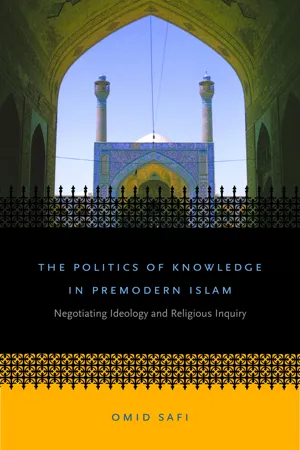
The Politics of Knowledge in Premodern Islam
Negotiating Ideology and Religious Inquiry
- 352 pages
- English
- ePUB (mobile friendly)
- Available on iOS & Android
eBook - ePub
About this book
Information
Topic
Theology & ReligionSubtopic
Islamic TheologyTable of contents
- Cover Page
- The Politics of Knowledge in Premodern Islam: Negotiating Ideology and Religious Inquiry
- Copyright Page
- Dedication
- Contents
- Map and Illustrations
- Foreword
- Acknowledgments
- Transliteration Systems and Chronologies
- Introduction
- Chronology of the Great Saljūqs and ʿAbbāsids
- Key Figures and Primary Sources
- Chapter One: Deconstructing the Great Saljūq Myth
- Chapter Two: The Niẓām’s Realm, the Orderly Realm
- Chapter Three: Saljūq State Apparatuses
- Chapter Four: The Shifting Politics of al-Ghazālī
- Chapter Five: Bargaining with Baraka
- Chapter Six: An Oppositional Sufi: ʿAyn al-Quḍāt Hamadānī
- Conclusion
- Appendix: Niẓām al-Mulk’s Descendants in Saljūq Administration
- Notes
- Bibliography
- Index
Trusted by 375,005 students
Access to over 1.5 million titles for a fair monthly price.
Study more efficiently using our study tools.
Frequently asked questions
Yes, you can cancel anytime from the Subscription tab in your account settings on the Perlego website. Your subscription will stay active until the end of your current billing period. Learn how to cancel your subscription
No, books cannot be downloaded as external files, such as PDFs, for use outside of Perlego. However, you can download books within the Perlego app for offline reading on mobile or tablet. Learn how to download books offline
Perlego offers two plans: Essential and Complete
- Essential is ideal for learners and professionals who enjoy exploring a wide range of subjects. Access the Essential Library with 800,000+ trusted titles and best-sellers across business, personal growth, and the humanities. Includes unlimited reading time and Standard Read Aloud voice.
- Complete: Perfect for advanced learners and researchers needing full, unrestricted access. Unlock 1.5M+ books across hundreds of subjects, including academic and specialized titles. The Complete Plan also includes advanced features like Premium Read Aloud and Research Assistant.
We are an online textbook subscription service, where you can get access to an entire online library for less than the price of a single book per month. With over 1.5 million books across 990+ topics, we’ve got you covered! Learn about our mission
Look out for the read-aloud symbol on your next book to see if you can listen to it. The read-aloud tool reads text aloud for you, highlighting the text as it is being read. You can pause it, speed it up and slow it down. Learn more about Read Aloud
Yes! You can use the Perlego app on both iOS and Android devices to read anytime, anywhere — even offline. Perfect for commutes or when you’re on the go.
Please note we cannot support devices running on iOS 13 and Android 7 or earlier. Learn more about using the app
Please note we cannot support devices running on iOS 13 and Android 7 or earlier. Learn more about using the app
Yes, you can access The Politics of Knowledge in Premodern Islam by Omid Safi in PDF and/or ePUB format, as well as other popular books in Theology & Religion & Islamic Theology. We have over 1.5 million books available in our catalogue for you to explore.