- 424 pages
- English
- ePUB (mobile friendly)
- Available on iOS & Android
eBook - ePub
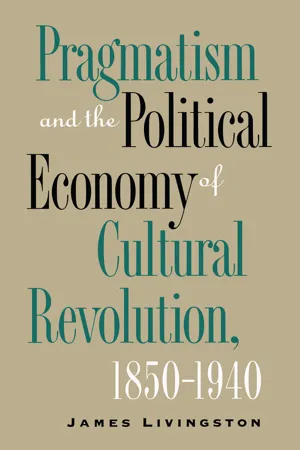
Pragmatism and the Political Economy of Cultural Revolution, 1850–1940
About this book
The rise of corporate capitalism was a cultural revolution as well as an economic event, according to James Livingston. That revolution resides, he argues, in the fundamental reconstruction of selfhood, or subjectivity, that attends the advent of an 'age of surplus' under corporate auspices. From this standpoint, consumer culture represents a transition to a society in which identities as well as incomes are not necessarily derived from the possession of productive labor or property. From the same standpoint, pragmatism and literary naturalism become ways of accommodating the new forms of solidarity and subjectivity enabled by the emergence of corporate capitalism. So conceived, they become ways of articulating alternatives to modern, possessive individualism. Livingston argues accordingly that the flight from pragmatism led by Lewis Mumford was an attempt to refurbish a romantic version of modern, possessive individualism. This attempt still shapes our reading of pragmatism, Livingston claims, and will continue to do so until we understand that William James was not merely a well–meaning middleman between Charles Peirce and John Dewey and that James's pragmatism was both a working model of postmodern subjectivity and a novel critique of capitalism.
Information
Part 1: The Political Economy of Consumer Culture, 1850–1940
But to the degree that large industry develops, the creation of real wealth comes to depend less on labour time and on the amount of labour employed than on the power of the agencies set in motion during labour time, whose “powerful effectiveness” is itself all out of proportion to the direct labour time spent on their production, but depends rather on the general state of science and on the progress of technology, or the application of this science to production. . . . As soon as labour in the direct form has ceased to be the great well-spring of wealth, labour-time ceases and must cease to be its measure, and hence exchange value of use value.
—Karl Marx, 1858
—Karl Marx, 1858
Under modern conditions of production, no measurable relation can be found between work contributed and goods consumed. . . . A whole moral fabric is thus rent and torn, with the most alarming and far-reaching consequences.
—Stuart Chase, 1934
—Stuart Chase, 1934
Meanwhile we have lost our former proprietor and must go back to find him.
—Adolf A. Berle, Jr., 1958
—Adolf A. Berle, Jr., 1958
Chapter 1: Making Use of Marx
Marx’s Model and Its Echoes
In a famous essay of 1930, J.M. Keynes chided his Anglo-American audience for its obsession with the “economic problem,” which he defined as the cultural corollaries of the “struggle for subsistence.” He was afraid that the great slump would reinstate the social significance of that struggle, refurbish the reputation of economists, and so rehabilitate the “pseudo-moral principles” that had promoted the accumulation of capital. He concluded with this admonition: “But, chiefly, do not let us overestimate the importance of the economic problem, or sacrifice to its supposed necessities other matters of greater and more permanent significance.”
The audience for this book is composed, I would guess, of those who share Keynes’s fear of reiterated sacrifice to the “supposed necessities” of economic growth and who tend, therefore, to designate economists not as he had hoped—“as humble, competent people, on a level with dentists”—but as my friend Alec Marsh does, as the “court poets” of modern capitalism. Why, then, must we begin by attending the court society in which economists still celebrate the rule of dead matter and blind “market forces”?1
As I see it, we do not have much of a choice. If we do not read and interpret the deadly poetry of political economy, we cannot make sense of American culture; for Americans have typically derived political meanings and moral significance from the distribution of property and the production of value through work. I do not mean that Americans have agreed on how to do so, or on what the results should be. Instead I mean that until the mid-twentieth century, most Americans found the condition of salvation as well as self-determination under the sign of necessary or productive labor. To understand the culture they created is to understand how and why they could derive so much from what we would define as economic activities.
Perhaps it is more to the point to say that we cannot appreciate the intellectual innovations known as pragmatism and literary naturalism unless we attend to the cultural meaning and significance of economic activities—and vice versa. James and Dewey and Dreiser never tried to rise above the realm of necessity in the name of higher truths; they never treated the commodity form as the enemy of the spirit or, alternatively, as the solvent of things in themselves. Instead they tried to discover durable truths in and through what seem to be the most transient market phenomena. In this sense, they were responding to Emerson’s complaint of 1842: “We have yet had no genius in America, with tyrannous eye, which knew the value of our incomparable materials, and saw, in the barbarism and materialism of the times, another carnival of the same gods whose picture he so much admires in Homer; then in the Middle Age; then in Calvinism.”2
Like Whitman, the first writer to fit Emerson’s specification of genius, James and Dewey and Dreiser did see this carnival in the barbarism and materialism of their times. They admired the “credit economy” of the late nineteenth century for its capacity to increase the stock of those fundamental truths that are contingent on the shape of the future. They also grasped the “trust movement” as the source of new truths about genuine selfhood. In other words, they treated the effects of nineteenth-century economic development as the causes of intellectual revolution—as a common fund of cultural capital from which they drew in speculating on the future of subjectivity. To understand their achievement is, then, to try on Emerson’s tyrannous eye, to see what we can learn from the barbarism and materialism of the late nineteenth and early twentieth centuries.
That is what I have tried to do in part 1 of this book. But I do not want to claim that part 1 is a reinterpretation of U.S. economic history as such; for it is a contribution to the current debates on the periodization of consumer culture rather than a survey of economic growth and development from the mid-nineteenth century to the mid-twentieth. In short, it is more cultural than economic history. One of my principal purposes in restricting the scope of my inquiry is to demonstrate that the antagonism between saving or investment on the one hand and spending or consumption on the other is quite real under circumstances specific to the regime of capital accumulation. In my view, it follows that those nineteenth-century observers who designated the restriction of consumption as the necessary condition of economic growth and social progress (of “development”), or who treated the deferment of immediate gratification as the cause and effect of a specifically modern subject, were not merely inflating the commonplaces of middle-class morality in the age of anality. It also follows that if twentieth-century economists and policymakers do not understand development in the same or similar terms—for example, if they designate consumer expenditures, not investment out of saving, as the fulcrum of economic growth—then their departure from the nineteenth-century consensus requires a historical explanation that asks whether their outlook is consistent with, and perhaps ingredient in, the pattern of economic change since the nineteenth century. In effect, then, I am asking when, how, and why consumption became the fulcrum of economic growth, in theory and practice.
My procedure at the outset is to outline a model of accumulation drawn from the work of Marx and his latter-day interpreters, including “left Keynesians” such as Michal Kalecki and Anatol Murad but relying more immediately on Martin Sklar, Sydney Coontz, and Michio Morishima.3 The model is, however, less eclectic than this odd list of theorists might suggest; for, as we shall see, modern theories of growth begin with the rediscovery (or reinvention) of Marx’s two-sector reproduction schemes. Lineages and legacies aside, I adopt a Marxian model of accumulation for three reasons. First, it reveals the tension between saving and spending without abstracting from the social relations in which goods production and income distribution are embedded; that is, it allows us to examine economic phenomena without losing sight of the larger social or cultural context in which spending and saving are valorized. In this sense, the model produces more interesting results and significant facts than a theory of capitalist growth which is predicated on the notion of “concentration.” For a model of accumulation acknowledges such concentration but does not elevate it to a regulative principle of analysis, and thereby does not entail a periodization of capitalism which is dominated, willy-nilly, by the question of scale.4
Second, a Marxian model of accumulation produces more significant facts than a theory of growth (or of “modernization”) which is obsessed with change in the distribution of resources (including human resources) between agriculture and industry—mainly because a model of accumulation distinguishes between the production of consumer goods and capital goods within industry as such.5 It thereby acknowledges the crucial limits on consumer expenditure and choice presumably represented by faster growth in the labor force and output of the capital goods industries. As W. Arthur Lewis points out: “At any level of income, people can consume only the quantity of consumer goods which exists. Since their incomes derive from producing consumer goods and investment [i.e., capital] goods, and since they can buy only the consumer goods, it follows that they must save a part of their income equal to the value of the investment goods which have been produced. . . . What they are thus forced to save may not, however, correspond to what they would like to save at that level of income.”6 For the same reason, a Marxian model produces more interesting results than a theory of growth which, because it makes no distinction between consumer and investment demand—and indeed designates change in consumer preferences as the cause of growth—simply ignores the difference between consumption and investment which not only characterizes modern industrial development but, in the form of a theoretical problem (what is the source and function of profit?), shapes the discipline of economics from the mid-nineteenth to the late twentieth century.7
Third, a Marxian model of accumulation has broader scope and utility than general equilibrium models that do not treat business cycles or economic crises as inevitable episodes in the course of growth under capitalism. For the point of the model of accumulation is precisely to relate secular and cyclical phenomena, to show how balanced growth is possible but not necessary; thus it does not force us to abandon the search for “covering laws” even while it allows us to acknowledge the fundamental contingency of capitalist accumulation.8
Marx developed his model of accumulation at two levels of abstraction, in volumes 1 and 2 of Capital. In the first volume, he establishes the in-dispensability of the “system of constants” available through the theory of value (part 1); sketches the historical stages or conditions—primitive accumulation, Manufacture, Modern Industry—that accompany and enforce capitalist growth (parts 3–5, 8); and introduces the “general law of accumulation” as both cause and effect of capitalist growth (part 7). In the second volume, the periodization of volume 1 is assumed; hence the analysis proceeds according to a sectoral disaggregation by “value composition” and economic function which is consistent with the previous statement and background of the general law of accumulation.9
Now the law of accumulation as Marx stated it was “change in the technical composition of capital by which the variable constituent becomes always smaller and smaller as compared with the constant” (1:685). By “the technical composition of capital,” he meant the technologically determined relation between a given mass of means of production and the labor force necessary to operate it. The law of accumulation thus posits a relatively faster growth of the mass of means of production vis-à-vis the number of employees (or work hours) required to mobilize it for purposes of commodity production. At this level, the law is the necessary corollary of growth in labor productivity. “Whether condition or consequence, the growing extent of the means of production, as compared with the labour-power incorporated with them, is an expression of the growing productiveness of labour. The increase of the latter appears, therefore, in the diminution of the mass of labour in proportion to the mass of means of production moved by it, or in the diminution of the subjective factor of the labour process as compared with the objective factor” (1:682).
There is, according to Marx, a “strict correlation” between the technical composition and the value composition of capital—by the latter he meant the relation between the exchange value of past labor-time embodied in existing means of production (“constant capital”) and the exchange value of current labor-time embodied in wage goods available for consumption by the employed labor force (“variable capital”). This strict correlation he termed the “organic composition of capital.” So the law of accumulation also holds that the value relation between past and present labor-time will be increasingly skewed toward the former, that the value of means of production and intermediate goods (such as raw materials) will increase faster than the value of those commodities which compose the wage bill. In short, accumulation means the growth of “constant capital” both absolutely and relatively to “variable capital,” whether accumulation itself is conceived in terms of use value (the technical composition) or exchange value (the value composition). The linkage between these forms of value is the labor process, or rather the productivity of labor as it is enforced and increased by the general law of accumulation. For growth in the productivity of labor implies the reduction in the exchange value (though not the use value) of wage goods, because a smaller amount of labor-time is necessary to produce a given quantity of wage goods; this in turn implies the availability of relatively more labor-time for purposes of accumulation, not consumption, that is, for production and reproduction of means of production which cannot be consumed as wage goods.
Before we turn to the formalization of the model in volume 2 of Capital, we should note two implications of the general law of accumulation and then, in the spirit of Marx’s own inquiry, ask whether it is merely an article of faith that we might admire but also ignore. First, at the level of the firm, the rise in the organic composition of capital implies the displacement of labor, unless the firm’s addition of plant or equipment to its existing capital stock requires an increase in the number of employees paid at prevailing wages (or in the number of hours worked by the existing labor force)—unless, that is, the expected increase in gross output which originally induced investment in additional plant and equipment is large enough to warrant additions to the payroll. But at the level of the economy as a whole, the rise in the organic composition of capital covered by the law of accumulation implies an increase in the demand for labor or an increase in employment as such. For as machines replace the skills and exertions of men or women in the central shops and the factories, the labor force producing those machines and their various inputs (raw materials, etc.) will necessarily grow. Here is how Marx explained it in Theories of Surplus Value: “As the constant capital grows, so also does the proportionate quantity of the total labour force which is engaged in its reproduction. . . . While for the individual capital the fall in the variable part of the capital as compared with the constant part takes the form of a reduction in the capital expended in wages, for the total capital—in its reproduction—this necessarily takes the form that a relatively greater part of the total labour force employed is engaged in the reproduction of means of production than is engaged in the production of products themselves” (1:219).
Second, as the passage just cited would suggest, the general law of accumulation implies, or rather entails, the “priority of Department I”—the priority, that is, of the capital goods sector in the growth pattern of capitalism. “That which distinguishes in this case capitalist society,” as Marx announced in defending his reproduction schemes, is simply that it “employs more of its available annual labor in the production of means of production (and thus of constant capital) which are not convertible into revenue in the form of wages or surplus-value, but can serve only as capital” (2:509–10). The rise in the organic composition of capital means, in other words, that the rates of labor force growth and output in the capital goods sector will exceed those in the consumer goods sector (Department II), with all that implies for the distribution of income between profits and wages or investment and consumption. This asymmetry in the growth rates of Departments I and II ultimately makes the expansion of Department II the derivative of expansion in Department I. At this stage of development, the source of increasing demand for labor in Department II—the source of expanded operation of means of production in the consumer goods sector—becomes the increasing demand for wage goods represented by the more rapid growth of the labor force in Department I, that is, it becomes expanded production of means of production.
But the “priority of Department I” should not be exaggerated. The stage at which the expansion of Department II becomes a function of expansion of Department I has all the characteristics of industrialization as Walt Rostow, A.O. Hirschman, Lewis, and others have defined it, and of what Marx himself called the advent of “Modern Industry” (1:368–466).10 Yet Marx did not treat accumulation and Modern Industry as interchangeable concepts or moments; instead he claimed that his general law covered three different (but overlapping) forms of accumulation. From this standpoint, the rise in the organic composition of capital presupposes a faster growth rate in Department I than in II, but does not stipulate that the relation between them which is observable under the regime of Modern Industry necessarily holds under all other forms or stages of accumulation.
We might then suppose that there is a stage before (or after) Modern Industry, one in which the rise in the organic composition of capital takes place as a consequence of a boom in the consumer goods sector, through which increased demand for and output of means of production, and a recognizable division of labor between Departments I and II, are created or enforced by the expansion of Department II. At this stage, the expansion of Department I would be the derivative of expansion in Department II—production would still presuppose a certain level of consumption—but accumulation would nevertheless be under way.11 In any event, accumulation so conceived requires the creation of “surplus labor,” or a labor force that is not needed to produce for purposes of immediate consumption. That division of labor presupposes the growth of the labor force as such: “Accumulation is, therefore, increase of the proletariat,” as Marx suggested in analyzing the reproduction of the social relation between capital and labor (1:673). The corresponding growth of consumer demand—the new working class must buy the right not to die of starvation or exposure—presumably stimulates concentration, innovation, and greater investment in consumer goods industries; the result is not only larger output but also increased labor productivity in these industries....
Table of contents
- Cover Page
- Series Page
- Pragmatism and the Political Economy of Cultural Revolution, 1850–1940
- Copyright Page
- Dedication
- Contents
- Foreword
- Preface to the Paperback Edition
- Preface
- Acknowledgments
- Part 1: The Political Economy of Consumer Culture, 1850–1940
- Part 2: Naturalism, Pragmatism, and the Reconstruction of Subjectivity, 1890–1930
- Notes
- Index
Trusted by 375,005 students
Access to over 1.5 million titles for a fair monthly price.
Study more efficiently using our study tools.
Frequently asked questions
Yes, you can cancel anytime from the Subscription tab in your account settings on the Perlego website. Your subscription will stay active until the end of your current billing period. Learn how to cancel your subscription
No, books cannot be downloaded as external files, such as PDFs, for use outside of Perlego. However, you can download books within the Perlego app for offline reading on mobile or tablet. Learn how to download books offline
Perlego offers two plans: Essential and Complete
- Essential is ideal for learners and professionals who enjoy exploring a wide range of subjects. Access the Essential Library with 800,000+ trusted titles and best-sellers across business, personal growth, and the humanities. Includes unlimited reading time and Standard Read Aloud voice.
- Complete: Perfect for advanced learners and researchers needing full, unrestricted access. Unlock 1.5M+ books across hundreds of subjects, including academic and specialized titles. The Complete Plan also includes advanced features like Premium Read Aloud and Research Assistant.
We are an online textbook subscription service, where you can get access to an entire online library for less than the price of a single book per month. With over 1.5 million books across 990+ topics, we’ve got you covered! Learn about our mission
Look out for the read-aloud symbol on your next book to see if you can listen to it. The read-aloud tool reads text aloud for you, highlighting the text as it is being read. You can pause it, speed it up and slow it down. Learn more about Read Aloud
Yes! You can use the Perlego app on both iOS and Android devices to read anytime, anywhere — even offline. Perfect for commutes or when you’re on the go.
Please note we cannot support devices running on iOS 13 and Android 7 or earlier. Learn more about using the app
Please note we cannot support devices running on iOS 13 and Android 7 or earlier. Learn more about using the app
Yes, you can access Pragmatism and the Political Economy of Cultural Revolution, 1850–1940 by James Livingston in PDF and/or ePUB format, as well as other popular books in History & North American History. We have over 1.5 million books available in our catalogue for you to explore.