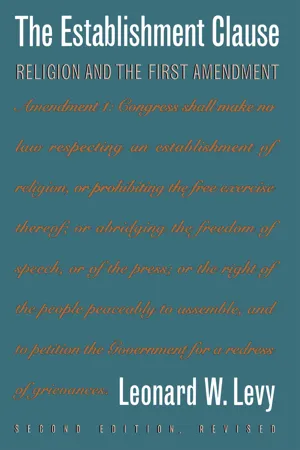
Leonard Levy’s classic work examines the circumstances that led to the writing of the establishment clause of the First Amendment: 'Congress shall make no law respecting an establishment of religion. . . .' He argues that, contrary to popular belief, the framers of the Constitution intended to prohibit government aid to religion even on an impartial basis. He thus refutes the view of 'nonpreferentialists,' who interpret the clause as allowing such aid provided that the assistance is not restricted to a preferred church.
For this new edition, Levy has added to his original arguments and incorporated much new material, including an analysis of Jefferson’s ideas on the relationship between church and state and a discussion of the establishment clause cases brought before the Supreme Court since the book was originally published in 1986.
- 300 pages
- English
- ePUB (mobile friendly)
- Available on iOS & Android
eBook - ePub
About this book
1 Colonial Establishments of Religion
On the eve of the American Revolution most of the colonies maintained establishments of religion. Those colonies, although resentful of British violations of American rights, discriminated against Roman Catholics, Jews, and even dissenting Protestants who refused to comply with local laws benefiting establishments of religion. In the five southern colonies, including Virginia, the oldest, largest, and most influential of the thirteen colonies, the Church of England (Anglican) enjoyed the privileges of an exclusive legal union with the state; in the three New England colonies which the Congregationalists dominated, the laws operated to prefer their churches at the expense of others.
The Reverend Isaac Backus, leader of the Baptists in Massachusetts, in the course of a protest against that colony’s establishment of religion, informed the governor and council in 1774 that eighteen Baptists from the town of Warwick had been jailed forty miles from home, in Northampton, during the extremity of winter, for the crime of refusing to pay taxes in support of the town’s Congregational minister.1 They were jailed for conscience’ sake, Backus declared, at a time when all America expressed alarm at British violations of American liberties. He believed that Massachusetts violated the right to be free from taxation without representation, because its legislature had authorized all the towns to impose “religious taxes.” They were as illegal as Parliament’s taxation of America, Backus alleged, because the province’s charter guaranteed liberty of conscience to all Christians except “Papists.” Moreover, Massachusetts law required that Baptists obtain a certificate proving that they regularly attended a church of their own denomination to be exempt from ministerial and church taxes. The towns enacted such taxes for the support of public worship held by “learned and orthodox” ministers (Congregationalists); but these individuals had to pay a tax of four pence (the tea tax was only three pence per pound) for a copy of the certification or legal document that they needed to prove their tax-exempt status. “All America are alarmed at the tea tax; though, if they please, they can avoid it by not buying the tea, but we have no such liberty,” Backus complained, and, he added, conscience prevented payment of the certificate tax: government had no lawful authority over religion.2 Backus had acted on behalf of a Baptist grievance committee formed to fight “oppressions occasioned by nonconformity to the religious establishment in New England.”3 Backus spoke for the Baptist minority that felt persecuted by the Congregational majority. John Adams spoke for the Congregationalists when he stated that the establishment to which he gave his support was “but a slender one” that did not infringe religious liberty.4
The Reverend Ezra Stiles, president of Yale College, who agreed with Adams, also ignored the fact that Massachusetts imprisoned Baptists and any others who refused obedience to the government in matters of support for religion. In Virginia and other southern colonies, Stiles observed, Baptists “not only pay ministerial Taxes for building churches but are imprisoned for preaching in unlicensed Houses.”5 The decade before the Revolution constituted the “time of persecution” in the history of Virginia’s Baptists. Some were beaten by mobs, others fined and imprisoned for their religious beliefs, which prevented them from obeying the laws that established the Anglican (Episcopalian) Church.6
To protect the established religion, the Virginia courts regarded certain Baptist conduct as criminal. Preaching in unlicensed houses and preaching without Episcopal ordination were common crimes. For such crimes some Baptist ministers spent up to five months in jail. In a 1771 case, four preachers were convicted of unlawful assembly for having held a religious meeting “under the pretense of the exercise of Religion in other manner than according to the Liturgy and Practice of the Church of England.” In another case the crime was defined as “Preaching the Gospel” contrary to the Anglican Book of Common Prayer, for which the criminal spent forty-six days in jail. About fifty Baptists suffered imprisonment for such crimes. Other Baptists were indicted for not attending the services of the established church. The law also made it a crime for any clergyman not licensed by that church to conduct marriages.7 Young James Madison informed a Philadelphia friend in 1774, “That diabolical Hell conceived principle of persecution rages among some and to their eternal Infamy the Clergy can furnish their Quota of Imps for such business. This vexes me the most of any thing whatever. There are at this [time] in the adjacent county not less than 5 or 6 well meaning men in close Gaol [jail] for publishing their religious Sentiments which in the main are very orthodox.”8
The established church for whose benefit Baptist preachers faced jail for illegally preaching the gospel was an extension of the Church of England. The Virginia establishment originated with the colony’s first charter in 1606, which provided that all ministers should preach Christianity according to the “doctrine, rites, and religion now professed and established within the realm of England.” Dale’s Laws in 1611 required everyone to be a churchgoer and observe the Sabbath, enjoined the clergy to offer regular religious instruction, and severely punished various offenses against religion including blasphemy, sacrilege, and criticism of the doctrine of the Trinity. Subsequent legislation commanded the public maintenance of every Anglican minister and tithed everyone for that purpose, required “uniformity to the canons and constitutions of the Church of England,” allowed only ordained clergymen of the mother church to perform the marriage ceremony, demanded that every clergyman accept the Thirty-nine Articles of faith, and exacted taxes to underwrite the costs of building and repairing churches. The legal code governing this establishment of religion also required vestries in each parish to levy assessments for the benefit of those churches and ordered that the liturgy of the Church of England be followed according to the Anglican Book of Common Prayer. Thus, Virginia’s Anglican church was established by law. It was the official church, the only one that enjoyed the benefits of a formal alliance with the government.9 As the Presbyterian clergy of Virginia declared in a remonstrance to the legislature in 1784, the Anglican or “Episcopal Church was virtually regarded as the constitutional Church, the Church of the State” before the Revolution, laden with special privileges that destroyed the equality of all others.10
An establishment of religion in the conventional sense denoted a legal union of government and religion, if by “religion” is meant the religion of a single church or denomination, such as Roman Catholicism in Spain, Presbyterianism in Scotland, or Lutheranism in Sweden. Attendance at a state church was compulsory, unless the state indulged the existence of open religious services by dissenters. An establishment of religion had an official creed or articles of faith, and its creed alone could be publicly taught in the schools or elsewhere. Its clergy alone had civil sanction to perform sacraments or allow them to be performed. Subscribers to the established faith enjoyed their civil rights, but the law handicapped dissenters, even if it tolerated their worship, by the imposition of civil disabilities. Dissenters were excluded from universities and disqualified for office, whether civil, religious, or military. Their religious institutions (churches, schools, orphanages) had no legal capacity to bring suits, hold or transmit property, receive or bequeath trust funds. Test oaths usually discriminated against dissenters. Every establishment employed such oaths, although some governments, such as those of the Middle Adantic colonies that had no establishments, also imposed religious tests on officeholders to make certain that only believers in the gospel would be entrusted with an official capacity.
Conventional establishments of religion existed in the southern colonies of Virginia, Maryland, North Carolina, South Carolina, and Georgia. In each the Church of England was the state church. In South Carolina the Reverend William Tennent, a Presbyterian acting as a spokesman for various non-Anglican denominations, drew up a “Petition of the Dissenters” in 1777, requesting the legislature to disestablish the Church of England, by then calling itself the Protestant Episcopal Church. The existence of an established church, Tennent declared, abridged the “free and equal liberty in religious matters” to which all good Christian subjects were entitled, and by Christian he meant Protestant. He announced his objection to “all religious establishments” because they infringed religious liberty, but he did not favor the complete separation of government and religion. Very few Christians did. Like Tennent, they believed that the state should “give countenance to religion” by protecting all denominations and “do anything for the support of religion, without partiality to particular societies” and without abridging “the rights of private judgment” by exacting taxes to promote religion.11
Tennent depicted the establishment in South Carolina from the standpoint of a dissenter. He emphasized that it made invidious distinctions among people of different religious beliefs, merely tolerating dissenters as if they stood “on the same footing with the Jews,” unmolested but unequal.12 It also taxed all for the support of one religion. Invidious distinctions and tax support constituted its chief characteristics. “The law,” he declared,
knows and acknowledges the society of the one as a Christian church; the law knows not the other churches. The law knows the clergy of the one as ministers of the gospel; the law knows not the clergy the other churches, nor will it give them a license to marry their own people…. The law makes provision for the support of one church; it makes no provision for the others. The law builds superb churches for the one; it leaves the others to build their own churches. The law, by incorporating the one church, enables it to hold estates and to sue for rights; the law does not enable the others to hold any religious property not even the pittances which are bestowed by the hand of charity for their support. No dissenting church can hold or sue for their property at common law. They are obliged therefore to deposit it in the hands of trustees, to be held by them as their own private property and to lie at their mercy. The consequence of this is that too often their funds for the support of religious worship get into bad hands and become either alienated from their proper use or must be recovered at the expense of a suit in chancery.
These are important distinctions indeed, but these are not all. The law vests the officers of the Church of England with power to tax not only her own people but all other denominations within the bounds of each respective parish for the support of the poor—an enormous power which ought to be vested in no denomination more than another. Greater distinction still—where there are parishes the law throws the whole management of elections, the most estimable of all the rights of freemen, into the hands of church officers exclusively. [Church wardens in each parish issued writs for the election of members of the legislature and managed the elections.]13
A scholar familiar with classic establishments of religion, like the one described by Tennent in South Carolina, concluded in capital letters that an establishment had always and everywhere meant what he found it meant in Europe: “A SINGLE CHURCH OR RELIGION ENJOYING FORMAL, LEGAL, OFFICIAL, MONOPOLISTIC PRIVILEGE THROUGH A UNION WITH THE GOVERNMENT OF THE STATE. That is the meaning given in the Encyclopedia Britannica. The phrase has been used this way for centuries in speaking of the established Protestant churches of England, Scotland, Germany, and other countries, and of the established Catholic church in Italy, Spain, and elsewhere.”14 The foremost American constitutional scholar of this century, Edward S. Corwin, advanced the same thesis. Criticizing the Supreme Court’s doctrine of the unconstitutionality...
Table of contents
- Cover Page
- Title Page
- Copyright Page
- Dedication
- Contents
- Preface
- 1 Colonial Establishments of Religion
- 2 State Establishments of Religion: New England
- 3 State Establishments of Religion: The South
- 4 The Constitution and Religion
- 5 Framing the Establishment Clause
- 6 James Madison versus the Nonpreferentialists
- 7 The Supreme Court and the Clause: Judicial Tests and Aids to Parochial Schools
- 8 The Supreme Court and the Clause: Public Schools and Public Creches
- 9 Incorporation and the Wall
- Epilogue
- Appendix
- Selected Bibliography
- Index
Trusted by 375,005 students
Access to over 1.5 million titles for a fair monthly price.
Study more efficiently using our study tools.
Frequently asked questions
Yes, you can cancel anytime from the Subscription tab in your account settings on the Perlego website. Your subscription will stay active until the end of your current billing period. Learn how to cancel your subscription
No, books cannot be downloaded as external files, such as PDFs, for use outside of Perlego. However, you can download books within the Perlego app for offline reading on mobile or tablet. Learn how to download books offline
Perlego offers two plans: Essential and Complete
- Essential is ideal for learners and professionals who enjoy exploring a wide range of subjects. Access the Essential Library with 800,000+ trusted titles and best-sellers across business, personal growth, and the humanities. Includes unlimited reading time and Standard Read Aloud voice.
- Complete: Perfect for advanced learners and researchers needing full, unrestricted access. Unlock 1.5M+ books across hundreds of subjects, including academic and specialized titles. The Complete Plan also includes advanced features like Premium Read Aloud and Research Assistant.
We are an online textbook subscription service, where you can get access to an entire online library for less than the price of a single book per month. With over 1.5 million books across 990+ topics, we’ve got you covered! Learn about our mission
Look out for the read-aloud symbol on your next book to see if you can listen to it. The read-aloud tool reads text aloud for you, highlighting the text as it is being read. You can pause it, speed it up and slow it down. Learn more about Read Aloud
Yes! You can use the Perlego app on both iOS and Android devices to read anytime, anywhere — even offline. Perfect for commutes or when you’re on the go.
Please note we cannot support devices running on iOS 13 and Android 7 or earlier. Learn more about using the app
Please note we cannot support devices running on iOS 13 and Android 7 or earlier. Learn more about using the app
Yes, you can access The Establishment Clause by Leonard W. Levy in PDF and/or ePUB format, as well as other popular books in Law & Public Law. We have over 1.5 million books available in our catalogue for you to explore.