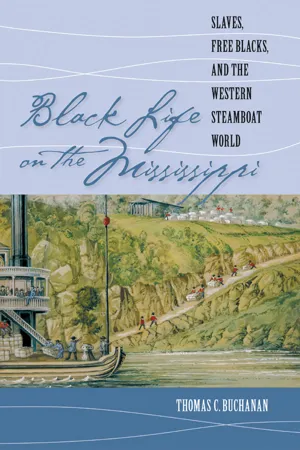
All along the Mississippi — on country plantation landings, urban levees and quays, and the decks of steamboats — nineteenth-century African Americans worked and fought for their liberty amid the slave trade and the growth of the cotton South. Offering a counternarrative to Twain’s well-known tale from the perspective of the pilothouse, Thomas C. Buchanan paints a more complete picture of the Mississippi, documenting the rich variety of experiences among slaves and free blacks who lived and worked on the lower decks and along the river during slavery, through the Civil War, and into emancipation.
Buchanan explores the creative efforts of steamboat workers to link riverside African American communities in the North and South. The networks African Americans created allowed them to keep in touch with family members, help slaves escape, transfer stolen goods, and provide forms of income that were important to the survival of their communities. The author also details the struggles that took place within the steamboat work culture. Although the realities of white supremacy were still potent on the river, Buchanan shows how slaves, free blacks, and postemancipation freedpeople fought for better wages and treatment.
By exploring the complex relationship between slavery and freedom, Buchanan sheds new light on the ways African Americans resisted slavery and developed a vibrant culture and economy up and down America’s greatest river.
eBook - ePub
Black Life on the Mississippi
Slaves, Free Blacks, and the Western Steamboat World
- 272 pages
- English
- ePUB (mobile friendly)
- Available on iOS & Android
eBook - ePub
Black Life on the Mississippi
Slaves, Free Blacks, and the Western Steamboat World
About this book
Information
chapter one
From Plantation to Freedom
African American Steamboat Workers
and the Pan-Mississippi World
and the Pan-Mississippi World
WILLIAM WELLS BROWN knew the pan-Mississippi world. While most slaves in the antebellum West were concentrated on plantations in Mississippi and Louisiana, Brown traveled thousands of miles through much of the United States. He worked on upper Mississippi packets and lower Mississippi boats, in the Missouri River trade, and on steamboats along the Ohio River. These voyages put him into contact with the heavy trading that took place along the Tennessee and Cumberland rivers in the upper and middle South, as well as with the deep South Red River trade to Texas. The plantations along these routes were an important part of his world. He knew the Missouri’s emergent “Little Dixie,” the tobacco and hemp plantations in Kentucky, the sugar plantations of Louisiana, and the growing cotton economies of Mississippi and Tennessee. He knew the cities of Louisville, St. Louis, Vicksburg, Jefferson City, Davenport, and New Orleans. Brown was a worldly slave indeed.
Brown was not alone in experiencing such mobility. His account reflects the experience of thousands of slaves and free blacks who circulated the rivers with liberties that made them the most widely traveled of southern slaves. Importantly, their movements spanned the regions of the West. Even as the country lurched toward Civil War and divisions between North and South became ever more acute, economic connections between the sections flourished. Along these economic networks, African Americans linked market vendors in New Orleans, plantation hands in Louisiana’s cotton and sugar
bowls, and slave fugitives and abolitionist activists in Cincinnati’s Bucktown. These communities and others like them are often discussed in isolation from one another, but they were intimately joined by river commerce. Riverboats connected city and country, North and South, slavery and freedom.
The world of William Wells Brown and his free black companions has been for too long hidden from view. The western river world shaped African American steamboat workers’ mentality and created the intellectual, psychological, and material bases for broad networks that helped African Americans survive slavery. It allowed black workers to create a pan-Mississippi community that nourished collective challenges to authority, as well as opportunities for individual gain. We will travel here from seedy docks, to neighborhood saloons and brothels, to the private landings where steamboat hands talked with plantation slaves about the latest news from the river. These were places where hidden communication networks sustained the slave community.
Before exploring the contours of this world it is important to understand the patterns of mobility, as well as the sorts of riverside contact, that slaves and free blacks variously experienced. Slaves and free blacks often labored side by side on steamboats and mingled in a riverside African American culture, but the contours of their mobility differed. Southern lawmakers restricted free blacks’ movement in city and state statutes, and slaves’ responsibilities to masters and agents limited their activities. Owners and their agents, for instance, often prevented them from shipping out on Ohio River steamboats, from which escapes frequently occurred. Steamboat owners most commonly employed slaves on deep South rivers, frequently used them in the upper South, and rarely employed them in the lower North. Many slave owners insisted that their steamboat slaves working on the Ohio River be jailed in Louisville or Covington while their boats docked on free soil. Some owners, however, took the risk and had their slaves work all the way to Pittsburgh. Steamboat historian William Tippitt noted the regional concentration of African American workers. “Deck crews were as a general rule [in the deep South] . . . Negro slave laborers on most boats.”1 Passenger Benjamin Latrobe noted that on his lower Mississippi steamer the crew members “were almost invariably athletic negroes, or mulattos.”2 On lower North steamers, on the other hand, cabin positions were filled by a mixture of native-born whites, European immigrants, and free blacks. Lillian Foster, traveling through the deep South, noted that all the waiters and attendants on the Ingomar were black.3 Another traveler commented, “I must say that the stewards and waiters on the steamboats of Louisiana are all Negroes.”4
While most slave steamboat workers did not work in trades that bordered on free soil, they did travel extensively within the South. The labor needs of steamboat owners, who contracted workers for short periods of time so that they could dismiss them when trade was slack, ensured broad mobility. Unlike in other southern industries, slave owners were generally unable to lease their hands for an entire year to one steamboat owner. Slave owners were forced to move their chattel from boat to boat, and often from trade to trade, in order to keep their hands occupied. By shifting from boat to boat, slaves often also shifted to different rivers and thus were exposed to broader geographical experiences. For example, from 1856 to early 1857, the Louisville merchant James Rudd recorded leasing “Big George” to four boats: the David White, which worked from Louisville to Wheeling, the Fanny Smith, the A. L. Shotwell, and the Woodford, which worked in the Louisville-to-New Orleans trade. Similarly, in 1859, Rudd hired “Little Charley” to at least three steamers, the Alvin Adams, which ran from Louisville to Cincinnati; the Time and Tide, which worked on the upper Mississippi; and the Kentucky, which traveled between Louisville and Memphis.5
While such shorter-term leases were often the rule, slave masters were always on the lookout for more efficient, longer-term boat leases. In a September 1, 1846, letter, James Lackland, a slave-leasing agent in St. Charles, Missouri, urged a master to place his slaves on the J. M. White, “where there would be pretty certain employment for them until spring.” He added that, “as they are now, they work a few days on one boat and then off to another so that you in reality don’t get wages for more than two thirds of their time.”6 Long-term leases often reduced the number of river trades that slaves worked along, but repeat trips strengthened their social networks. Because steamboat owners specialized in certain trades, slaves and free blacks with long-term leases strengthened riverside contacts.
Agents like James Lackland were central to the leasing process and, consequently, to the freedoms of steamboat slaves. Many agents were young entrepreneurs who rented slaves from masters before subleasing them to steamboats at a profit. One slave named William Richeson recalled that a man named Cook “had hired him from his mistress and then hired him, at Memphis, to the boat.”7 Other masters paid agents fees to collect steamboat slave wages.8 Keeping track of the comings and goings of steamboats was not easy, and some masters were too involved in other business matters to engage in this tiresome task. In either case, slaves often worked far away from their owners. It was not unusual for an agent to collect wages in New Orleans that ended up in a master’s pocket in Missouri or Kentucky. Elizabeth Peace, for example, lived in England while her agent managed the leasing of her two slaves, Simon and Dick, to Mississippi River steamers.9
Agents were men of opportunity and ambition. Most lived in cities and used their urban residence to serve rural masters, whether in managing their cotton crops or in leasing slaves. Memphis agent George Cook (to whom William Richeson referred) specialized in supplying both his own slaves and slaves of other masters, to the Louisville. The slaves’ various masters were not widely recognized beyond the ledgers of the boat clerk. Instead, they all were known as “Cook’s boys” on board. Family connections often facilitated agents’ jobs as labor brokers. James Lackland, for example, had a niece and nephew in St. Louis and another relative in New Orleans. Each sent letters to Lackland reporting on the business of leasing slaves to Mississippi River steamboats. 10
Slaves such as William Wells Brown hired their own time, thereby eliminating the role of masters and agents in the contracting process.11 While state legislatures criminalized the practice and southern dailies regularly railed against self-hires, labor-hungry steamboat owners, slave owners’ desire for a convenient way to hire out their slaves, and slaves’ desire for less supervision conspired to make self-hire common on southern city levees. Simon, a New Orleans slave, had a pass that stated, “The boy Simon is authorized to hire himself on any good boat running between this port and St. Louis or in the St. Louis and Missouri River trade.”12 During her testimony in the federal case United States v. Louisville, the chambermaid Judy Taylor told the District Court of Southern Illinois that “she has no particular bargain with her [master] . . . that she comes and goes as she pleases.”13 Similarly, Stephen Ridgely, the master of another steamboat chambermaid, told the Missouri Supreme Court in Ridgely v. Reindeer that the woman “made her own bargains with the boats.”14 In another court case, which involved a drowned steamboat slave, a witness commented that “owners generally come with them [the slaves] or send an order for them to hire themselves.”15 Milton Clarke commented of his master: “[He] gave me a free paper, to pass up and down the river as I pleased, and to transact any business as though I was free.”16 These practices were often institutionalized during shape-ups, where officers asked slaves “with passes from their masters” to come forward to have their passes checked. 17
Of course, in some cases, the line between self-hire and freedom became difficult to distinguish. Some steamboat slave self-hires paid their masters a monthly fee but lived on their own, and sometimes they were able to support their families in this way.18 Agents and boat owners complained bitterly about these arrangements, even though they generally profited from them. Boat owners, for instance, protested when masters sued them for helping their slaves escape. Captain Thomas Baldwin claimed that a slave named Harrison was “permitted to run about in the City of St. Louis and out of the State of Missouri from place to place at his own will and pleasure and without any restraint, and that [Harrison’s owner] . . . permitted [him] to make contracts or agreements for the hire of his own services to others.”19 How could he be responsible for Harrison’s escape? Free man of color Solomon Lynchhart, testifying for boat officers who had been accused of helping the slave John Scott escape, saw Scott and recalled that he “seemed to have no master. He acted as he pleased and let himself on board any boat he chose. I supposed he had no master . . . because he said so.”20 Agents vented their own frustrations with self-hires. James Lackland complained to his uncle frequently about the liberties of a slave named Lewis, who hired his own time. “I have not seen Lewis since he called to see me when I was in bed,” he wrote on one occasion. “Abe [another steamboat slave] says he is on the Nimrod but I have no means of knowing when he commenced or what he is getting [in wages]. . . . I will try to find out something about Lewis before I leave.”21
Imprecise steamboat schedules and the crowds at levee districts made slaves’ off-the-boat freedoms possible. With boats circulating in and out of ports, slaves were able to elude masters and agents. One St. Louis owner, missing her steamboat slave, simply assumed that the “boy” was “some where about and would return again.”22 Slaves George and Baptiste walked freely through New Orleans after their boats came into port. Their master had to send another steamboat slave — a friend of the missing men from yet another steamboat — to find them so that he could ship them out again.23 One St. Louis agent reported in March of 1844 that he had to find a “boy” named David “who had been employed on the Ben Franklin and had left her.”24 James Lackland complained that when the slave Abe came into port on the Tobacco Plant, “he left without leave or license — says he [is] used to doing as he pleases.” Abe came back the next day, to Lackland’s relief, and was promptly off on the Little Missouri.25
Free black workers’ mobility was also restricted. Southern masters were well aware that northern free black river workers, and their abolitionist ideas, threatened the tenuous control slaveholders held over their chattel, so they worked hard to restrict their movement. While southern cities had elaborate systems of legal and extralegal controls in place to discipline their own slave and free black populations, they were vulnerable to the infusion of masterless, foreign blacks who left city quays and freely circulated through urban environments. The more the southern economy flourished, the more this vulnerability — and the corresponding danger of a loss of racial control — challenged local elites.
In the same period that state legislatures in Alabama and South Carolina passed laws prohibiting free black sailors on ocean-going vessels from coming ashore in those states, western river city and state lawmakers passed laws restricting the mobility of free black riverboat workers.26 Deep South lawmakers were the most oppressive. In Louisiana in 1841, for example, the state legislature required that all free black rivermen and sailors be jailed when they came into New Orleans. In 1852, the law was amended so that out-of-state free blacks no longer had to be jailed but instead were required to obtain passes from the mayor’s offic...
Table of contents
- Title Page
- Copyright Page
- Table of Contents
- Dedication
- Acknowledgements
- in†roduc†ion
- chapter one - From Plantation to Freedom
- chapter two - Below the Pilothouse
- chapter three - Living Blood for Gold
- chapter four - Boats against the Current
- chapter five - Rascals on the Antebellum Mississippi
- chapter six - Emancipation and Steamboat Culture
- epilogue
- appendix
- notes
- bibliography
Trusted by 375,005 students
Access to over 1.5 million titles for a fair monthly price.
Study more efficiently using our study tools.
Frequently asked questions
Yes, you can cancel anytime from the Subscription tab in your account settings on the Perlego website. Your subscription will stay active until the end of your current billing period. Learn how to cancel your subscription
No, books cannot be downloaded as external files, such as PDFs, for use outside of Perlego. However, you can download books within the Perlego app for offline reading on mobile or tablet. Learn how to download books offline
Perlego offers two plans: Essential and Complete
- Essential is ideal for learners and professionals who enjoy exploring a wide range of subjects. Access the Essential Library with 800,000+ trusted titles and best-sellers across business, personal growth, and the humanities. Includes unlimited reading time and Standard Read Aloud voice.
- Complete: Perfect for advanced learners and researchers needing full, unrestricted access. Unlock 1.5M+ books across hundreds of subjects, including academic and specialized titles. The Complete Plan also includes advanced features like Premium Read Aloud and Research Assistant.
We are an online textbook subscription service, where you can get access to an entire online library for less than the price of a single book per month. With over 1.5 million books across 990+ topics, we’ve got you covered! Learn about our mission
Look out for the read-aloud symbol on your next book to see if you can listen to it. The read-aloud tool reads text aloud for you, highlighting the text as it is being read. You can pause it, speed it up and slow it down. Learn more about Read Aloud
Yes! You can use the Perlego app on both iOS and Android devices to read anytime, anywhere — even offline. Perfect for commutes or when you’re on the go.
Please note we cannot support devices running on iOS 13 and Android 7 or earlier. Learn more about using the app
Please note we cannot support devices running on iOS 13 and Android 7 or earlier. Learn more about using the app
Yes, you can access Black Life on the Mississippi by Thomas C. Buchanan in PDF and/or ePUB format, as well as other popular books in History & North American History. We have over 1.5 million books available in our catalogue for you to explore.