eBook - ePub
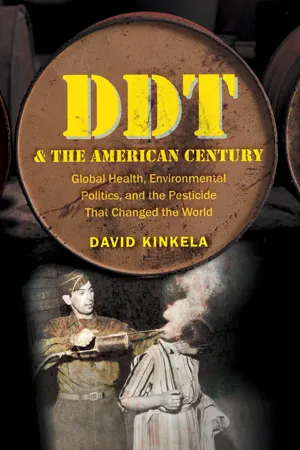
DDT and the American Century
Global Health, Environmental Politics, and the Pesticide That Changed the World
- 272 pages
- English
- ePUB (mobile friendly)
- Available on iOS & Android
eBook - ePub
DDT and the American Century
Global Health, Environmental Politics, and the Pesticide That Changed the World
About this book
Praised for its ability to kill insects effectively and cheaply and reviled as an ecological hazard, DDT continues to engender passion across the political spectrum as one of the world’s most controversial chemical pesticides. In DDT and the American Century, David Kinkela chronicles the use of DDT around the world from 1941 to the present with a particular focus on the United States, which has played a critical role in encouraging the global use of the pesticide. Kinkela’s study offers a unique approach to understanding both this contentious chemical and modern environmentalism in an international context.
Information
Topic
StoriaSubtopic
Storia del XX secolo1 AN ISLAND IN A SEA OF DISEASE
DDT Enters a Global War
It should not be inferred from the results of these surveys that DDT is not all that its champions claim it to be, an almost perfect insecticide.
—Fred Soper, W. A. Davis, F. S. Markham, and L. A. Riehl, The American Journal of Hygiene, 1947
—Fred Soper, W. A. Davis, F. S. Markham, and L. A. Riehl, The American Journal of Hygiene, 1947
The Japanese bombing of Pearl Harbor propelled the United States into a global war. It also set in motion a series of transformative events that redefined the nation. Millions volunteered for military service, including thousands of Filipino Americans, Japanese Americans, and African Americans who navigated the complexities of military service, racial discrimination, and citizenship. Millions of other Americans, including women, supported the war effort through their labor. Domestically, the Arsenal of Democracy afforded women and minorities real, albeit temporary, employment opportunities within the industrial sector. Massive public investment in defense also reversed the nation’s economic fortune, which had been mired in a decadelong depression, setting the stage for a remarkable period of prosperity after the war. And, under the leadership of Vannevar Bush, President Roosevelt’s scientific adviser, the United States strengthened its commitment to science, forging new networks of knowledge between federal agencies, business, and universities that would eventually bolster the nation’s Cold War strategy.
What was surprising about the enormous deployment of soldiers and civilians at the onset of war, and what has been largely overlooked, was the health of those deployed. By 1941, the current generation of Americans was arguably the healthiest population in the nation’s history. Despite the hardships of the Great Depression, average life expectancy increased from around forty-nine years in 1900 to nearly sixty-four at the start of the war.1 Advances in medicine, disease prevention, and, more critically, public health ushered in a new era of health in the United States. Consumer and workplace protections ensured that foods and factories were safer. Rural and urban development projects under the New Deal contributed to the reduction of communicable diseases. The Farm Security Administration, for one, devoted enormous resources to public health. Other alphabet agencies were similarly committed to health.2 While discriminatory practices continued to limit access to quality health care, by 1941 Americans were increasingly, if not overwhelmingly, a healthy group of people.
Even though polio remained an unexplained horror and cancer rates increased throughout the century, a host of other human ailments receded into the past. Some of the largest killers of the nineteenth century—tuberculosis, cholera, and diphtheria—had either been expunged or were in steep decline.3 Insect-borne diseases like typhus, yellow fever, and malaria had been reduced to historic lows. According to a survey conducted by the Office of Malaria Control in War Areas, a wartime predecessor to the Centers of Disease Control and Prevention, “The incidence of malaria in the United States at the beginning of the war emergency [was] the lowest in history.”4
Thus, as Americans readied for war, they did so with firm resolve and sound body. The marked improvement in health prior to the bombing of Pearl Harbor underscored the nation’s ability to wage war on two fronts.
Looking beyond the nation’s borders, however, a different story emerged. Military deployment sent U.S. servicemen and -women to some of the most dangerous environments in the world. Countless diseases threatened American forces throughout the Mediterranean and South Pacific, including filariasis, typhus, dengue fever, and malaria, an affliction that concerned Douglas MacArthur, the supreme allied commander in the Pacific. “This will be a long war,” MacArthur proclaimed, “if for every division I have facing the enemy I must count on a second division in hospital and a third division convalescing from this debilitating disease.”5
MacArthur’s concerns were certainly well founded. Not only did U.S. servicemen and -women endure difficult circumstances against dangerous enemies, but sickness also undermined their ability to fight effectively. MacArthur fully understood, as did many top U.S. commanders, that disease was as dangerous, if not more so, than a well-armed adversary. History bore this out.
“Typhus,” the noted American bacteriologist Hans Zinsser wrote in his influential book Rats, Lice, and History (1934), “with its brothers and sisters, —plague, cholera, typhoid, dysentery,—has decided more campaigns than Caesar, Hannibal, Napoleon, and all the inspector generals of history.”6 In 1780, nearly half of General Cornwallis’s British troops succumbed to malaria, giving aid to the outnumbered American soldiers in the War of Independence. Shortly thereafter, yellow fever killed 22,000 of the 25,000 French troops during the Haitian revolution. Typhus has been credited with helping Russia defeat Napoleon in 1812–13. In the First World War, British forces in Salonika lost 162,000 men to malaria, while there were only 28,000 battle casualties. And the global impact of the Spanish flu, which killed nearly 18 million people during the First World War, confirmed in the minds of many public health and military officials the deadly consequences of disease.7
The Second World War created its own set of challenges. Even under the best of circumstances, the struggle with disease proved quite vexing. Because the war was fought in deserts, tropical islands, temperate forests, swamps, and cities, health officials faced a variety of diseases that in their own right would be difficult to cure. The destructive impact of war made fighting these diseases a titanic struggle. Insects thrived in wartime environments. Breeding areas for mosquitoes multiplied, increasing the likelihood of epidemics of malaria, filariasis, and dengue fever for civilian and military populations. Those forced to live among the rubble of destroyed cities and towns faced enormous health challenges, including the threat of typhus, dysentery, and plague. It was not just a war; it was, according to Surgeon General Thomas Parran, “a public health war.”8
Crossing the Atlantic or Pacific, therefore, meant more than just heading to the front. It meant entering environments where the presence of insects and disease threatened a soldier’s ability to fight effectively. By the start of the war, the chasm between health in the United States and the unhealthy environments millions of soldiers would soon enter widened. Looking back at the war effort, Robert Moore, a professor of pathology at Washington University, remarked that the United States was “an island in a sea of disease.”9
Building on the promising public health work of previous decades, the global war created a powerful moment in which entomological research, new methods of public health, and the development of new chemical pesticides coalesced around a common theme: that of protecting soldiers from insect-borne diseases around the world. Arguably, DDT was one of the most important scientific innovations of the war. Its significance rested not only on its capacity to kill insects—other chemicals were effective insecticides as well—but on its ability to reduce a series of complex biological problems into a single solution. Spraying DDT simplified public health strategies, making it the dominant method of insect control by the war’s end. This shift was neither immediate nor universal. Instead, it reflected the work of a vast scientific network determined to solve a range of health-related problems beyond U.S. borders.
DDT WAS AN UNLIKELY HERO OF THE WAR. In 1939, Paul Müller, a relatively unknown scientist working for the Swiss chemical company Geigy A.G., made a remarkable discovery. Charged with finding an agricultural chemical to control the Colorado potato beetle, an invasive species that threatened the important Swiss crop, Müller uncovered a chemical formula developed nearly seventy years earlier, in 1874. At that time, Othmar Zeidler, a graduate student at the University of Strasbourg, synthesized a crystalline compound, combining chloral hydrate with chlorobenzene in the presence of sulfuric acid. Zeidler’s innovation was dichloro-diphenyl-trichloroethane, more commonly known as DDT. Because Zeidler’s synthesis was only an experiment to fulfill his thesis requirement, he did not recognize the insecticidal properties of the compound. Consequently, his work was shelved.
Years later, when Müller rediscovered the chemical formula, he was immediately amazed. Initial tests demonstrated DDT’s efficacy against Müller’s test subjects, houseflies. What amazed Müller more than DDT’s immediate effectiveness was its persistency. Day after day, Müller returned to the laboratory to find dead flies in the experimental container that had been treated with DDT only once. Encouraged by these findings, Geigy immediately deployed DDT on infested potato fields. Almost magically, the Colorado potato beetle infestation ended within a year. By 1940, DDT proved to be an effective agricultural pesticide with seemingly limited or no toxicological impacts on humans.
But Müller’s discovery generated little international publicity. Europe was engulfed in a continental war, and the United States remained an interested observer. But as the United States entered the war, which expanded across continents and into the tropics, where the threat of insect-borne diseases increased, military health officials on all sides of the conflict demanded new methods to control disease, and DDT was positioned to play an important role in the war effort.
At the start of the war, pyrethrum, a botanical compound derived from chrysanthemum petals, seemed to offer much promise. A popular and effective insecticide, pyrethrum had been used to control body lice during the Napoleonic wars and remained a widely used form of pest control in the United States. American chemical producers proclaimed that pyrethrum offered soldiers “Freedom from Pestilence.” Enlisting “Jonny Pyrethrum,” another U.S. manufacturer noted, demonstrated that the chemical industry was “doing a big job for Uncle Sam in controlling the pest that affects the health of our men on every war front—yes pyrethrum is on malaria patrol.”10
Such optimism would be short lived. By 1939, the U.S. imported 13.5 million pounds of pyrethrum from two major producer-nations, Kenya and Japan, with Japan producing over 90 percent of the chrysanthemum blossoms.11 The war brought an abrupt end to the Japanese market and, as the war progressed, Kenyan production could not keep up with demand. As a result, U.S. military officials looked to military and civilian scientists to develop an alternative insecticide.12 Brigadier General James S. Simmons, army chief of preventive medicine, informed a group of civilian researchers that the most important thing they could do for military medicine was to find “a substitute for pyrethrum.”13
Finding the substitute for pyrethrum would fall under the jurisdiction of the Bureau of Entomology and Plant Quarantine (BEPQ). Part of the U.S. Department of Agriculture (USDA), the BEPQ came into existence in 1872 (and was then the division of entomology) to coordinate control of invasive boll weevil and gypsy moth populations that threatened crops and native flora. Later, under the leadership of Leland Ossian Howard (bureau chief, 1894–1927), whose book, Mosquitoes: How They Live; How They Carry Disease; How They Are Classified; How They May Be Destroyed (1901), became a classic text in the field of entomology, the bureau moved from supporting biological and cultural insect control methods to recommending chemicals, including Bordeaux mixture, lead arsenate, Paris green, sulfur, and kerosene. At the start of the war, the bureau remained steadfast in its commitment to chemical pesticides.
Edward Fred Knipling was called upon to direct the laboratory of the Bureau of Entomology and Plant Quarantine in Orlando, Florida. A native of the coastal town of Port Lavaca, Knipling completed his master’s degree in entomology from Texas A&M in 1932, and he spent much of the early 1930s on the move, working on a number of USDA projects in Iowa, Illinois, and Georgia. In 1937, Knipling returned to Texas and embarked on a series of research projects that focused on the biological control of screwworms, a parasitic fly that threatened livestock populations in Texas and along the Mexican borderlands region. In 1940 Knipling moved to Portland, Oregon, after being named the new director of the Division of Insects Affecting Man and Animals. Knipling was charged with investigating mosquito populations of the Pacific Northwest, a region and insect species that were quite foreign to him. His stay in Portland, however, would be short lived as war interrupted the best-laid plans of most Americans.14
Knipling’s laboratory would become the epicenter of a massive cross-border research effort to determine how to protect people and crop plants from the dangers of insects. Yet the laboratory was not alone in its effort to improve human health. No stranger to the ravages of disease, President Roosevelt increased federal funding for health-related programs. Jonas Salk, for example, who would go on to be the celebrated inventor of the polio vaccine, spent the war years working on flu vaccines. The Public Health Service’s Office of Malaria Control in War Areas, directed by Dr. Louis Laval Williams, developed preventative strategies to reduce the hazards of malaria at home and abroad. Roosevelt also funded the nascent Committee on Medical Research, which would spearhead biomedical research on antimalarial drugs. Additionally, in December 1942, Roosevelt established by executive order the United States of America Typhus Commission. The commission was designed for the “purpose of protecting the members of the armed forces from typhus fever and preventing its introduction into the United States.” Operating under the command of the secretary of war, the commission was given free rein to construct public health programs to protect military personnel from typhus “within and without the United States.”15
The scientific and institutional linkages developed for disease prevention and control during the war were not limited to the United States; they were in fact global. Rather than being an isolated research station, the Orlando laboratory was part of an international network of scientists focusing on limiting the impact of insect-borne infections during the war. Research conducted by military and civilian scientists in Mexico, Brazil, Trinidad, Australia, Algeria, Egypt, and Italy developed new understandings of disease within different environments. This expansive scientific undertaking would ultimately reshape the postwar period. Yet, during the war, U.S. science remained steadfast in its commitment to vanquish foreign enemies, human and insect alike.
Knipling and his fellow scientists at the Orlando laboratory faced the sea of disease head-on and were determined to navigate and conquer the treacherous world that lay beyond U.S. borders. The enormous promise of DDT provided a means to envision this victory, but much was unknown about the chemical few had ever heard of. The question was whether DDT could fill the vacuum left by the undersupply of pyrethrum.
Despite the limits of initial wartime markets, the Swiss manufacturer Geigy attempted to capitalize on Müller’s discovery. In 1940, Geigy began marketing two DDT products; one was a louse powder called Neocid, and the other a spray insecticide sold under the name Gesarol. Used primarily as agricultural agents within Switzerland, Neocid and Gesarol provided remarkable protection against a number of insect pests. Building on the success of early experiments, Geigy provided samples to Allied and Axis powers, an...
Table of contents
- Cover Page
- DDT AND THE AMERICAN CENTURY
- Copyright Page
- Dedication
- Contents
- Illustrations
- Acknowledgments
- INTRODUCTION: DDT AND THE AMERICAN CENTURY
- 1 AN ISLAND IN A SEA OF DISEASE
- 2 DISEASE, DDT, AND DEVELOPMENT
- 3 SCIENCE IN THE SERVICE OF AGRICULTURE
- 4 THE AGE OF WRECKERS AND EXTERMINATORS
- 5 GREEN REVOLUTIONS IN CONFLICT
- 6 IT’S ALL OR NOTHING
- 7 ONE MAN’S PESTICIDE IS ANOTHER MAN’S POISON
- EPILOGUE: RETHINKING DDT IN A GLOBAL AGE
- Notes
- Bibliography
- Index
Trusted by 375,005 students
Access to over 1.5 million titles for a fair monthly price.
Study more efficiently using our study tools.
Frequently asked questions
Yes, you can cancel anytime from the Subscription tab in your account settings on the Perlego website. Your subscription will stay active until the end of your current billing period. Learn how to cancel your subscription
No, books cannot be downloaded as external files, such as PDFs, for use outside of Perlego. However, you can download books within the Perlego app for offline reading on mobile or tablet. Learn how to download books offline
We are an online textbook subscription service, where you can get access to an entire online library for less than the price of a single book per month. With over 1.5 million books across 990+ topics, we’ve got you covered! Learn about our mission
Look out for the read-aloud symbol on your next book to see if you can listen to it. The read-aloud tool reads text aloud for you, highlighting the text as it is being read. You can pause it, speed it up and slow it down. Learn more about Read Aloud
Yes! You can use the Perlego app on both iOS and Android devices to read anytime, anywhere — even offline. Perfect for commutes or when you’re on the go.
Please note we cannot support devices running on iOS 13 and Android 7 or earlier. Learn more about using the app
Please note we cannot support devices running on iOS 13 and Android 7 or earlier. Learn more about using the app
Yes, you can access DDT and the American Century by David Kinkela in PDF and/or ePUB format, as well as other popular books in Storia & Storia del XX secolo. We have over 1.5 million books available in our catalogue for you to explore.