In this illuminating look at gender and Scouting in the United States, Benjamin René Jordan examines how in its founding and early rise, the Boy Scouts of America (BSA) integrated traditional Victorian manhood with modern, corporate-industrial values and skills. While showing how the BSA Americanized the original British Scouting program, Jordan finds that the organization’s community-based activities signaled a shift in men’s social norms, away from rugged agricultural individualism or martial primitivism and toward productive employment in offices and factories, stressing scientific cooperation and a pragmatic approach to the responsibilities of citizenship.
By examining the BSA’s national reach and influence, Jordan demonstrates surprising ethnic diversity and religious inclusiveness in the organization’s founding decades. For example, Scouting officials’ preferred urban Catholic and Jewish working-class immigrants and “modernizable” African Americans and Native Americans over rural whites and other traditional farmers, who were seen as too “backward” to lead an increasingly urban-industrial society. In looking at the revered organization’s past, Jordan finds that Scouting helped to broaden mainstream American manhood by modernizing traditional Victorian values to better suit a changing nation.
eBook - ePub
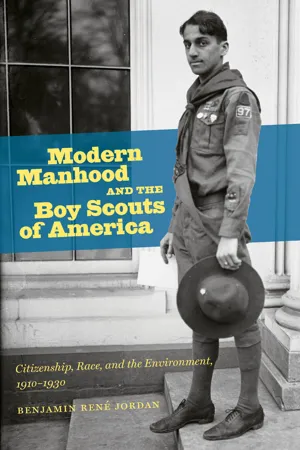
Modern Manhood and the Boy Scouts of America
Citizenship, Race, and the Environment, 1910-1930
- 306 pages
- English
- ePUB (mobile friendly)
- Available on iOS & Android
eBook - ePub
Modern Manhood and the Boy Scouts of America
Citizenship, Race, and the Environment, 1910-1930
About this book
Information
Part I: Adapting Dominant Manhood to Modern America
Chapter 1: The BSA’s Triumph
Balancing Traditional and Modern Manhood and Authority
At the BSA’s first large public event—a September 1910 dinner at New York City’s posh Waldorf Astoria Hotel—over two hundred of the country’s elite gathered to welcome British Boy Scout founder General Robert Baden-Powell and to receive his official blessing for the American branch. John D. Rockefeller Jr., psychologist G. Stanley Hall, and muckraking editor Jacob Riis agreed with the other philanthropic representatives, bankers, reformers, educators, clergy, and youth organization leaders at the banquet that Boy Scouting offered a highly effective solution to a broad array of boys’ and men’s concerns resulting from the modernization of society. What has most intrigued historians and gender studies researchers alike about the event is that following BSA Chief Scout Ernest Thompson Seton’s introduction of Baden-Powell as the “Father of Scouting,” the general diplomatically responded that there were many who deserved credit for originating the Scouting idea—and that he was but one of its uncles. He was alluding to the influence of Seton’s Woodcraft Indians and Beard’s Sons of Daniel Boone on outdoor programs for boys, but Baden-Powell’s organization was notably different. Moreover, in focusing on Baden-Powell’s statement and the question of which of these three men was the true originator of the Boy Scout ideal, most researchers have tended to overlook other remarks made at the banquet about the importance of peacetime civic responsibilities and corporate values in the emerging BSA. The expansion of supervisory oversight and bureaucratic processes partly explains the BSA’s victory over competing youth organizations such as Beard’s and Seton’s. The balance between traditional and modern men’s authority and values that the BSA’s corporate-style administration and teachings helped achieve made an even larger contribution to the organization’s rapid growth and popular support. Its efficient bureaucratization aided a tilt from the American heritage of individualistic volunteer men toward twentieth-century society’s professional standards and expert management and governance. BSA administrators soon modernized Baden-Powell’s character and civic teachings to the point that it can sometimes be more revealing to contrast BSA manhood against that of the British Boy Scouts and, especially, the Woodcraft Indians and Sons of Daniel Boone rather than lump them together, as does the “three uncles” concept.1
Despite the military-like uniforms, the association of the term “Scout” with forward military units, and General Baden-Powell’s having originated Boy Scouting in London, most BSA officials and local practices would soon come to stress civilian duties and corporate values over primitive virility and military aggression. One of the banquet’s most impressive moments came when a letter was read aloud from former president Theodore Roosevelt accepting the honorary vice presidency of the BSA, in which he emphasized that Scouting should primarily teach boys to be good citizens and men for times of peace rather than war. In addition to Baden-Powell having declined that day to review troops from publisher William Randolph Hearst’s rival and more militarist American Boy Scout organization, his speech stressed that proper Scouting taught British boys civic service, Life Saving, and doing a Good Turn to others daily. Baden-Powell stated that while British Scouting needed to “put back some of the wild man in the city boys,” the BSA should instead teach a balanced program of chivalry, discipline, and helpfulness to American boys, who already had enough of the pioneer spirit in them. Finally, he commented that the BSA’s organizers had exhibited more foresight in planning a corporate-like organization than had the movement he led in England. An article in the New York Times summed up the speech: “With true American genius, too, he went on, they had organized a combine, a trust, and then had got Col. Theodore Roosevelt to be Vice President of it. ‘Upon this trust you can depend.’” While he seemed to be paying the BSA a compliment and may have aimed the remark at the many captains of industry, banking, and commerce present in the Waldorf Astoria’s banquet room that evening, the early BSA had already steered away from British Scouting’s values and begun to shift toward a corporate makeup and governance.2
Focusing on Baden-Powell’s remark that he shared credit with Beard and Seton for developing Boy Scouting also obscures the man who would help resolve these core tensions as the lead BSA administrator from 1911 to 1943: child welfare specialist and lawyer James West. While realizing that Beard and Seton were becoming disgruntled with the new direction the organization and its masculine teachings were taking, the Executive Board hired West as the new Executive Secretary to replace the staff on loan from the Young Men’s Christian Association and moved the BSA out of its original YMCA home to larger, separate headquarters on Fifth Avenue in January 1911. On the surface, West’s hiring seemed to point the organization toward an even greater focus on underprivileged, immigrant urban youth than the YMCA leaders provided. As a crippled orphan who put himself through law school, West embodied a prime example of how poor urban children could be redeemed by education and effort paired with a proactive social welfare system. A key authority on prominent Progressive reform institutions for poor urban youth like the Playground Movement, the juvenile court system, and the National Child Rescue League, West had recently organized the seminal White House Conference on Dependent Children in 1909, which helped shift parentless children’s placement from orphanages to foster homes. The BSA, however, did not become another destitute boys’ organization. American Scouting increasingly focused on the needs of white middle- and working-class town and urban boys at the expense of rural farm and destitute boys. West helped guide the transformation of the BSA into a centralized bureaucracy that hedged Seton’s and Beard’s self-reliant primitivism and Baden-Powell’s military tone with modern virtues like scientific efficiency, expert management, and loyalty to corporate hierarchy. BSA administrators, partly due to their desire to cleanse the organization from any debt to Seton and his writings, curtailed use of his Indian model in national Scout publications and conferences after 1910. Some local leaders continued to deploy Indian lore in camp rituals and Scout fraternal societies like the Order of the Arrow, but it was clearly not the dominant ideal in the BSA through the 1920s. The change of West’s title from Executive Secretary to Chief Scout Executive exemplified his triumph over the ousted Chief Scout Seton and symbolized the BSA’s merger of traditional and modern masculine values.3
The balance the BSA achieved between self-reliant volunteerism and its emerging administrative apparatus helps account for the organization’s widespread popularity and rapid growth. This chapter illustrates how and why the BSA’s masculine and civic ideology, leadership structure, and membership focus shifted markedly after the September 1910 Waldorf Astoria banquet. As the BSA emphasized more corporate methods and modern masculine skills, it soon distanced itself from its Woodcraft Indian, Sons of Daniel Boone, British Boy Scout, and YMCA heritage. Moving the BSA beyond the narrow confines of aggressive militarism, primitive pioneer and Indian lore, and denominational leadership to lay claim to providing a universal model of modern American manhood and leading citizenship necessitated such changes. Only then did it triumph over other youth and Scout organizations and garner its broadest popular and governmental support. In the process of exploring these shifts, this chapter explains how the early BSA operated, of what and whom it consisted, and its key advocates. It examines two intertwined masculine and civic debates the BSA helped resolve: charismatic volunteerism versus professional management, and the balance of power between central and local authority. These debates connected with the broader shift from men’s self-made individualism of the nineteenth century toward their corporate-like, cooperative hierarchy of the twentieth century.4
The BSA’s Victory over Competing Scout and Youth Organizations
The BSA’s modern manhood and balanced authority responded better to the needs of early twentieth-century American males and differed significantly from the focus on primitive virility in less successful boys’ organizations as well as from Boy Scouting’s British military origins. Given Baden-Powell’s Waldorf Astoria banquet comment that Scouting was partly inspired by Seton and Beard and the fact that these two charismatic men joined the leadership of the BSA, many historians have assumed that the BSA promoted individualism and primitive virility like the Woodcraft Indians and the Sons of Daniel Boone. Other historians read militarism into Baden-Powell’s reputation as the British South African “Hero of Mafeking” during the Anglo-Boer War, the Boy Scouts’ military-like uniform and name, and the possibility that William Smith’s Boys’ Brigade youth organization was a model for Boy Scouting. Baden-Powell did borrow selectively from all three organizations in forming British Boy Scouting, but it is essential to understand that Smith’s, Seton’s, and Beard’s organizations failed to attract significant memberships or popular support in America because their masculine ideals and their administrative apparatuses could not help men and boys trying to adapt to a modernizing society and workforce. If Seton or Beard had truly succeeded in fashioning the BSA according to his vision, then the organization would never have flourished to the same degree and history would likely have long since forgotten about it. Moreover, as Baden-Powell himself insisted at the banquet, the BSA became a unique adaptation distinct from his original British Scouting. The BSA soon distanced itself from British Scouting and beat out or absorbed a dozen or more competing Boy Scout organizations in the United States, most of which had quite different interpretations of men’s authority and what constituted proper character and civic training for adolescent boys.5
Despite having a head start on Scouting, the Boys’ Brigade, Woodcraft Indians, and Sons of Daniel Boone never enjoyed a broad range of support or large membership in America because their heroes and masculine skills were too nostalgic and narrow in scope to be useful for daily living in a modern society. In 1883, Scotland’s William Smith started the Boys’ Brigade using martial regalia and drill to interest boys in church lessons and temperance. Through a series of 1902 articles in the Ladies Home Journal and then a full-scale handbook, Seton initiated the decentralized American Woodcraft Indians movement focused on idealized primitive Indian crafts and boys’ self-government. Beard’s Sons of Daniel Boone organization, developed via ideas from his late nineteenth-century American Boy’s Handy Book and his 1905 writings for Recreation Magazine, heroized the rugged, individualistic outdoor skills of frontier pioneers.
Baden-Powell effectively incorporated elements of each of these existing organizations into his own unique program, which soon proved more attractive to boys and men throughout the British Empire. His 1899 training manual for soldiers, Aids to Scouting, contained some of the rudimentary forms and goals of the Boy Scout organization he would develop. The adult manual provided instructions on how patrols of eight soldiers, under the supervision of a trained officer, could learn the outdoor and military skills needed to succeed in the British Empire’s scout army. Rejecting the traditional infantry drill employed by the regular army and Smith’s Boys’ Brigade, Baden-Powell argued that scouting developed self-reliance by encouraging each soldier to take initiative based on his own observations and deductions. To adapt the book for boys, he added stories, games, a moral code, and a system of ranks and topical merit badge honors. Baden-Powell incorporated some of the soldierly dress and ritual of Smith’s Boys’ Brigade, but he balanced the Brigade’s adult authority and strict obedience by dividing the Scout troop into patrols of eight boys. Under the leadership of an elected boy, the British Scout Patrol learned to think and act independently of the troop’s adult Scoutmaster. Seton’s and Beard’s organizational structures, however, were even looser and did not rely on paid staff or even require boy units to have an adult leader. It is likely that neither American organization surpassed twenty thousand active members at any point, and even that is hard to pinpoint, since Seton and Beard did not invest much time or interest in maintaining precise membership rosters or statistics (an idea that BSA administrators would soon come to abhor). Still, Seton’s Woodcraft Indians appeared to provide much of the skeletal form and method of Boy Scouting, including the system of ranks and merit awards as well as the notion of a boys’ oath and set of organizational laws. Baden-Powell’s Boy Scout handbook gestured briefly to “primitive” races, like Seton’s Native American heroes and Australian aborigines, but he clearly focused on developing the character attributes of men from the supposedly advanced white races. Baden-Powell also adopted some of the peaceful handicraft and outdoor pioneering emphasis of the Sons of Daniel Boone.6
With the 1908 publication of Baden-Powell’s Boy Scout handbook and a weekly paper facilitated by the savvy promotional support of publisher Sir Arthur Pearson, the British organization quickly outpaced previous boys’ programs and spread rapidly throughout the world. Baden-Powell’s small staff could hardly keep up with the flood of requests for membership and more information. One hundred and ten thousand British boys had joined by September 1909, eclipsing membership figures for the other three youth organizations combined. Army officers, educators, and missionaries helped extend Scouting throughout Britain’s vast empire. As the handbook and news of the organization reached other countries, boys and youth workers began their own troops and associations. Official national Scout organizations quickly formed in at least twenty-six countries, including such disparate nations as France, Russia, Turkey, Argentina, South Africa, and Japan. People across the world recognized the Scout uniform and the manly character and leading citizenship it represented. However, Scouting in America would soon become much more centralized, modern, and adult led—to the point that it drew criticisms from Scout officials in other countries and from Baden-Powell himself.7
In 1908, boys, girls, and interested adults across the United States began forming their own Scout troops based on Baden-Powell’s handbook. Despite the prior existence of church-based youth organizations, such as the Boys’ Brigade and the Knights of King Arthur, church leaders and Young Men’s Christian Association officials helped start or support many of these early Boy Scout troops. A few American units applied for charters from the British office, while others established independent troops or their own Scout associations. Some patrols of boys or girls simply read the handbook and interpreted it for themselves, without the help of adult leaders. This was unsurprising, since Baden-Powell’s original handbook encouraged youth to start patrols on their own initiative and suggested that Scouting could also benefit girls.8
It took two failed incarnations in its first year before the BSA settled on the modern masculine character, civic teachings, and centralized bureaucratic management that would help it defeat Scouting competitors and become the largest voluntary youth organization in the country’s history. Before the Waldorf Astoria banquet in September 1910, the BSA appeared as if it might end up teaching Baden-Powell’s militarism or primitive virility and youth self-government via Seton’s Indian or a medieval knight role model to rural boys or urban working-class boys. Rural publishing magnate William D. Boyce started and incorporated the BSA in February 1910. Boyce initially planned to use Boy Scouting as a form of welfare capitalism to instill a good work and civic ethic in his army of newsboys in rural districts across the Midwest and to help increase his subscriptions and profits. He hired a former clergyman to promote a decentralized, loosely run BSA along the lines of the British program, but his efforts did not produce tangible results. Boyce soon found himself in a Scout organizing and publicity race against publisher William Randolph Hearst’s American Boy Scouts, which emphasized strict military drill and rifle practice. Meanwhile, YMCA officials had started a number of their own Scout troops and used Baden-Powell’s methods at some of the four hundred existing YMCA summer camps. Edgar M. Robinson, the head of the YMCA’s international Boys’ Work division, had been consulting with his friend Ernest Thompson Seton on designing a Scout program with a Native American theme for the urban YMCA. Upon hearing about Boyce’s new BSA corporation, they instead decided to team up with him. Boyce was relieved when Robinson approached him in May 1910 to join forces and take the BSA under the wing of the much larger and longer-established Boys’ Work and summer camp division. Robinson leaned toward using Seton’s Indian hero, while John Alexander (his main BSA assistant brought over from the YMCA) championed a chivalric medieval knight—similar to that of the Knights of King Arthur church organization—as the best role model for adolescent American boys.9
Robinson and Alexander opened a one-room BSA headquarters in the YMCA’s New York City office, but requests for information and support quickly overwhelmed the small staff. Alexander reportedly lost track of troops, and a number of Scoutmasters resigned. Pioneer lore enthusiast Dan Beard (who had a modest national following as an outdoors writer and an illustrator for such works as Mark Twain’s A Connecticut Yankee in King Arthur’s Court) came aboard, but he and Seton quickly locked horns. Boyce’s promised financial support for the organization soon disappeared. The fledgling BSA staff and administrators spent several months trying to recruit additional allies but tellingly failed in their first effort to win a federal charter from the U.S. Congress. Neither rural and working-class boys nor nostalgic Indian and knight role models remained the focus of the rapidly evolving BSA.10
The September 1910 Waldorf Astoria banquet, capped by Theodore Roosevelt’s letter of support and Baden-Powell’s blessing, marked a significant turning point in the BSA’s fortunes. Administrators began recruiting a broader base of support and leadership, but only by making marked changes in its program, masculine ideology, and target membership. Over two hundred prominent men at the banquet pledged the support of the thirty-seven institutions they represented. Influential American politicians, reformers, clergy, educators, and child development theorists soon lined up behind the shifting BSA. Leading businessmen and politicians provided essential public marketing and money, which helped enable the BSA to establish a virtual monopoly on American Scouting. Some of the country’s wealthiest famil...
Table of contents
- Cover Page
- Title Page
- Copyright Page
- Dedication
- Contents
- Acknowledgments
- Introduction
- Part I: Adapting Dominant Manhood to Modern America
- Part II: Reconfiguring Social Hierarchies through Scouting
- Epilogue
- Notes
- Selected Bibliography
- Index
Trusted by 375,005 students
Access to over 1.5 million titles for a fair monthly price.
Study more efficiently using our study tools.
Frequently asked questions
Yes, you can cancel anytime from the Subscription tab in your account settings on the Perlego website. Your subscription will stay active until the end of your current billing period. Learn how to cancel your subscription
No, books cannot be downloaded as external files, such as PDFs, for use outside of Perlego. However, you can download books within the Perlego app for offline reading on mobile or tablet. Learn how to download books offline
Perlego offers two plans: Essential and Complete
- Essential is ideal for learners and professionals who enjoy exploring a wide range of subjects. Access the Essential Library with 800,000+ trusted titles and best-sellers across business, personal growth, and the humanities. Includes unlimited reading time and Standard Read Aloud voice.
- Complete: Perfect for advanced learners and researchers needing full, unrestricted access. Unlock 1.5M+ books across hundreds of subjects, including academic and specialized titles. The Complete Plan also includes advanced features like Premium Read Aloud and Research Assistant.
We are an online textbook subscription service, where you can get access to an entire online library for less than the price of a single book per month. With over 1.5 million books across 990+ topics, we’ve got you covered! Learn about our mission
Look out for the read-aloud symbol on your next book to see if you can listen to it. The read-aloud tool reads text aloud for you, highlighting the text as it is being read. You can pause it, speed it up and slow it down. Learn more about Read Aloud
Yes! You can use the Perlego app on both iOS and Android devices to read anytime, anywhere — even offline. Perfect for commutes or when you’re on the go.
Please note we cannot support devices running on iOS 13 and Android 7 or earlier. Learn more about using the app
Please note we cannot support devices running on iOS 13 and Android 7 or earlier. Learn more about using the app
Yes, you can access Modern Manhood and the Boy Scouts of America by Benjamin René Jordan in PDF and/or ePUB format, as well as other popular books in Social Sciences & Leadership. We have over 1.5 million books available in our catalogue for you to explore.