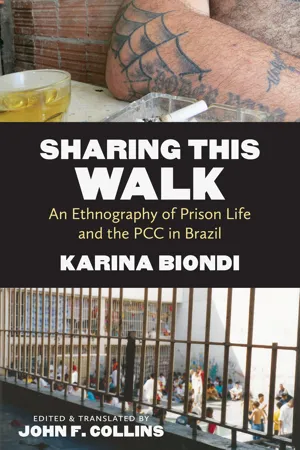
The Primeiro Comando do Capital (PCC) is a São Paulo prison gang that since the 1990s has expanded into the most powerful criminal network in Brazil. Karina Biondi’s rich ethnography of the PCC is uniquely informed by her insider-outsider status. Prior to his acquittal, Biondi’s husband was incarcerated in a PCC-dominated prison for several years. During the period of Biondi’s intense and intimate visits with her husband and her extensive fieldwork in prisons and on the streets of São Paulo, the PCC effectively controlled more than 90 percent of São Paulo’s 147 prison facilities.
Available for the first time in English, Biondi’s riveting portrait of the PCC illuminates how the organization operates inside and outside of prison, creatively elaborating on a decentered, non-hierarchical, and far-reaching command system. This system challenges both the police forces against which the PCC has declared war and the methods and analytic concepts traditionally employed by social scientists concerned with crime, incarceration, and policing. Biondi posits that the PCC embodies a “politics of transcendence,” a group identity that is braided together with, but also autonomous from, its decentralized parts. Biondi also situates the PCC in relation to redemocratization and rampant socioeconomic inequality in Brazil, as well as to counter-state movements, crime, and punishment in the Americas.
eBook - ePub
Sharing This Walk
An Ethnography of Prison Life and the PCC in Brazil
- 222 pages
- English
- ePUB (mobile friendly)
- Available on iOS & Android
eBook - ePub
Sharing This Walk
An Ethnography of Prison Life and the PCC in Brazil
About this book
Information
CHAPTER ONE
The PCC
São Paulo’s Carandiru House of Detention was inaugurated in the 1920s as a model prison designed to house 1,200 inmates. Over time, Carandiru came to hold approximately 8,000 men, a number that granted it the dubious distinction of being Latin America’s largest prison. In 1992, something took place in Carandiru that would have critical consequences for São Paulo’s prison system: A police “intervention” intended to quell a rebellion in Pavilion 9 resulted in the deaths of 111 inmates. This event would come to be known as the “massacre of Carandiru,” or what I refer to simply as “the Massacre.”1
The Massacre garnered significant attention from a variety of actors, both Brazilian and international, and ended up making Brazil the target of legal action in the Organization of American States’ (OEA) International Court. A number of commentators have also suggested that the killings made clear a series of fissures in Brazil’s ongoing redemocratization by highlighting the continued place of torture and violent practices that appear to have been inherited from the military dictatorship that ruled from 1964 to 1985. Although the military legacy is open to debate, the slaughter gave rise to change by sparking the creation of the Secretaria de Administração Penitenciária (Secretariat of Penitentiary Administration, SAP), a new institution charged with paving the way for the deactivation of violent, decrepit, and overcrowded Carandiru.2 And, indeed, during the period between the Massacre and Carandiru’s deactivation in 2002, São Paulo’s prison system underwent significant transformations. These were the result of a series of simultaneous yet distinct processes that constantly crossed into and influenced one another.
The first transformation involved the vertiginous growth of the incarcerated population. In 1992, São Paulo State’s prisons confined 52,000 prisoners in forty-three different prison units. But by the end of 2002, there were nearly 110,000 prisoners in eighty units.3 Such rapid growth failed to generate significant notice across the state, in part because social movement actors had begun to turn their gaze away from prisoners and prison conditions following the release of political prisoners detained during the dictatorship. But the principal reason for the public’s lack of attention involved a basic transformation in the prison system in the wake of the Massacre.
Among the initiatives pushed forward by SAP was the deactivation of urban public jail units, or those run by specific police battalions and neighborhood precincts. This meant the end of the small jails that once pockmarked São Paulo’s urban fabric. Instead, the SAP worked to construct large prisons in suburbs and rural areas. This created a situation in which an increase in cells meant not simply that the state could incarcerate more people, but also that those prisoners formerly concentrated in a disparate array of jails from which they often escaped and thus garnering neighbors’ attention, would be spread across suburban and rural São Paulo. This distribution of the incarcerated across São Paulo State—a political unit approximately the same size as the entire United Kingdom—meant that the new politics of mass imprisonment put in place by successive administrations could be camouflaged by the dispersion of prisoners and the facilities that housed them. Yet the construction of new, state of the art units failed to keep up with the rapid growth in the number of people incarcerated. As a result, the deactivation of the Carandiru House of Detention was postponed on multiple occasions. It was only after Carandiru came to be considered a source and command center of the “megarebellion” of September 2001, in which approximately 28,000 prisoners detained in twenty-nine penitentiaries rebelled simultaneously, that it was closed for good.
The 2001 megarebellion was the first large action put forth by the PCC, whose birth and early growth occurred silently and without being perceived by the great majority of São Paulo’s populace. The rise of the PCC constitutes the third of the processes responsible for the changes in the prison universe in the wake of the Massacre. And Carandiru’s deactivation constitutes something of a nodal point that brings together this megarebellion, the spike in prison population, and the shifts in the nature of carceral institutions in São Paulo State. From this point on, commuters on subways and buses would no longer catch glimpses of prisoners in their cells, residents whose houses abutted police stations stopped living in fear of (relatively common) escape attempts, and prison facilities came to be hidden, no longer a part of the everyday experience of living in São Paulo. However much their numbers grew, these prisoners were no longer so visible to most paulistanos. The transfer of prisons from city centers to peripheries, and then on to distant, rural areas, meant that the PCC also became a distant, or less visible, phenomenon. And this scattering of adherents and their associates, like the PCC’s tendency to act most forcibly at the margins of the city, meant that the Command took shape in what for many Brazilians were distant or forgotten areas.
I AM UNABLE TO SPECIFY precisely the date and exact circumstances of the PCC’s birth. Over the course of my research, I collected different versions of the Command’s origin stories. According to some, the PCC arose in 1989, in Carandiru. Other versions of the Party’s foundational myth claimed it came into being in 1991 in the prison near the city of Araraquara, located a little over 250 kilometers northwest of the state capital. Some of my sources argued that the PCC emanated from earlier prison groups, including the “Black Serpent” (Serpente Negra) or “Warriors of David” (Guerreiros de David). Some even claimed that the group originated in a soccer game. It is also widely claimed—but extremely rarely on the part of Brothers—that the PCC arose as part of the engagements between political prisoners imprisoned by the military regime and the “common” criminals who served time alongside them.
Whatever the real beginning of the PCC, one version of its birth came to be accepted over others in the prison universe after the publication in 2004 of Cobras e Lagartos (Snakes and Lizards) by São Paulo–based crime reporter Josmar Jozino. Within months of the book’s publication, prisoners came to accept Jozino’s version of events. So although I cannot trace exactly how this account came to be accepted to the detriment of others, I remain surprised by how quickly it took form and gained credence. The rise of the origin story based on Cobras e Lagartos took place in an environment in which it seemed that alternative accounts had never existed. And this stands as one of many cases of “collective amnesia,” or the term I employ to describe situations in which debates that burbled and boiled would cool down and disappear rather rapidly. For reasons as diverse as the impulses that first generated them, it would appear as if these debates had never existed.
One such impulse involved the polemic generated around information potentially revealed about prisoners and their actions—soon after the publication of Cobras e Lagartos, one of the prisoners cited in the account argued astutely that he had not yet been tried for one of the crimes described in the text and that it would therefore be incorrect to associate him with the action. This prisoner saw Jozino as a stool pigeon. Three years later, I came into contact with other prisoners who said they had known Jozino and contributed to his book. They affirmed that Jozino was not at risk as an informer because he had not “fingered” anyone, since everything he published had been authorized by the protagonists. Whatever the truth of these varied claims, the work’s repercussions inside São Paulo’s prisons were significant, and this density of discourse helped authenticate the origin myth published by Jozino.
According to Cobras e Lagartos, the PCC took definitive form on August 31, 1993, during a soccer match held in an annex of the Casa de Custódia e Tratamento de Taubaté, a jail generally considered one of the most rigorous in Brazil. The fight that erupted during the game between the Comando Caipira (Redneck Command, or loose affiliation of prisoners) and the First Command of the Capital led to the deaths of two members of the Comando Caipira. To protect themselves from retribution and prison abuse by authorities—most commonly beatings—all members of the First Command of the Capital team signed an agreement promising that any punishment of any member of the team would give rise to a serious response by all members of the team.4 Soon the soccer players were able to count on the support of numerous other prisoners. Next, an inmate named Mizael, recognized subsequently as one of the PCC’s founders, put together a constitution that enunciated two broad lines of action. First, it theorized a jailhouse organizing project aimed at ending the mistreatment he claimed was so basic to life in carceral institutions. Second, it brought together language that sought to regulate the relations between prisoners so that their actions would not be a part of the mistreatment described in the statute. This intervention into prisoners’ relations turned on the claim that since all prisoners faced the same brutal conditions, they needed to unite in order to demand dignified treatment within the prison system. According to Jozino, the wives of a number of the inmates involved in the demand got together immediately afterward in São Paulo’s City Council to discuss prison conditions.
Many prisoners today see the creation of the PCC as having extinguished the climate of constant war, of “all against all,” in which the basis for life in jail was “everyone for himself” and “survival of the strongest.” Up until that point, physical punishment from guards and violence between inmates was common in an environment in which the most minor of slights or disagreements might lead to a “decision by the knife,” or a contest in which only one participant would emerge alive. Additionally, before the rise of the PCC, sexual violence was quite common. Often, the only way to resist such attacks involved killing the aggressor, adding another charge to a prisoner’s record. And in a phenomenon that added to sexual and interpersonal violence, inmates would seek to control any available resources, from a roll of toilet paper to the cell itself, in order to sell them to other prisoners who could not obtain them through force. But this changed with the rise of the PCC. As a Protestant minister known as Pastor Adair put it, “I’m not looking to support or excuse any crimes, but before the PCC came into existence those imprisoned here really suffered. They suffered because they were organized into rival gangs. And there was a lot of extortion, rape, and deaths over nothing. But when in 1988, I came to know the Party as a pastor I began to observe their way of working and to note how jail was changing. The cell that you once had to buy, today you don’t buy any more. Rape no longer exists in jail. And those banal deaths no longer take place. So it would seem that there has been a change … for me it’s been a change for the better.”5
When I asked one prisoner, who had spent more than thirty years of his life in prison, whether there had been any change following the emergence of the PCC, he cracked a wide smile and told me, with his eyes gleaming, “Ah,… the Party! With the Party our situation has gotten so much better. There’s no comparison.” The PCC’s proposal, which involved a change in ethics within the prisons, was seductive. For this reason, it gained adherents inside and outside the prisons. But in spite of such growth inside prison walls, the PCC remained largely invisible on the “outside.” This had much to do with the position taken by authorities in relation to the PCC.
The state’s first reaction was to cover up the group, to hide its existence. But at the end of 1995, television reporter Fátima Souza broadcast an interview with the leader of a prison rebellion in Hortolândia, a city located in the interior of São Paulo, near Campinas, a university center. The prisoner declared himself a member “of a fraternity, a command that has spread across the jails” in order to “fight against injustices, against the prison system … against the judicial system … and for our rights.”6 Authorities quickly denied the prisoner’s claims and transferred him to a “more secure” jail. But the name of the prisoner’s “fraternity” had not been revealed. Not until 1997 would the acronym PCC be made public, as part of the efforts of the same reporter. But, again, the government denied the facts of the report. In fact, Secretary of Penitentiary Administration João Benedito de Azevedo Marques declared it a “fiction, idiocy. It’s complete garbage. I am completely convinced of this. I’ve been Secretary for almost two years and I’ve never seen any sign of this group.”7
And yet, finally, in September 1997, during a rebellion in a prison in the interior of São Paulo State, the secretary came face-to-face with public evidence of the PCC’s existence when a group of prisoners unfurled a banner reading “PCC” while Azevedo Marques was conducting a group interview. Nonetheless, it was not until 1999, following the PCC’s “rescue” of a group of prisoners from a police station’s holding pens, that the government of the state of São Paulo asked police to investigate the group. This inquiry, concluded in 2000, turned up significant evidence about the Command’s strength. But the state government continued to treat the PCC as but a small group of convicts, without much influence inside or outside prison walls. Nonetheless, authorities decided to transfer PCC leaders to prisons in other regions of Brazil. But if the plan was to weaken the group, the result was the opposite: The transfers permitted the PCC’s expansion into other states and the building of alliances with other criminal groups, including the Comando Vermelho (Red Command) of Rio de Janeiro.
But the real coalescence of the PCC in São Paulo’s prisons, as well as official and definitive government recognition of its existence, came with Brazil’s megarebellion of February 2001. The well-coordinated actions that came to be referred to as the “megarebellion” did much to push the PCC’s expansion: After 2001, the PCC came to act not simply in the overwhelming majority of São Paulo’s penal institutions but across most of its urban spaces. Only in the wake of overwhelming evidence of the group’s presence inside and outside prison walls did the government begin to publicly recognize the group’s existence.8 In June 2011, the Public Advocate’s Office (Ministerio Público) denounced the PCC as a “criminal organization.” Nonetheless, one secretary of the Penitentiary Administration, Nagashi Furukawa, announced that “criminal organizations are a minority within our jails.”9 But, by this point, leaders of the PCC had ceased trying to remain anonymous, and they struggled to make their acronym visible whenever possible. As a result, and in an attempt to calm the public, any mention of PCC, the number 15.3.3, or even the name Primeiro Comando da Capital was prohibited by the editors of certain news organizations. According to Josmar Jozino, who at the time worked as a reporter for the Diario de São Paulo, a newspaper owned by Brazil’s powerful Globo News Network (Rede Globo), the editorial board “prohibited the use of the acronym PCC, the number 15.3.3, and even the name ‘Primeiro Comando da Capital.’ More specifically, the acronym was barred, for an undetermined time period, from use in texts, titles, captions, headlines and first page news. Reporters were instructed to refer to the PCC only as the ‘criminal faction that dominates São Paulo’s prisons’ or else a ‘criminal group’ or ‘criminal faction.’ This decision was then applied to the other newspapers, magazines, and television networks of this [Rede Globo] group headquartered in Rio de Janeiro. The acronym ‘CV’ and title ‘Comando Vermelho’ [Red Comma...
Table of contents
- Cover
- Series Page
- Title Page
- Copyright
- Contents
- List of Illustrations
- Note from the Editor-Translator
- Foreword by Jorge Mattar Villela
- Sketch of the São Bernardo Do Campo Center for Temporary Detention (CDP)
- Introduction
- Chapter One: The PCC
- Chapter Two: Politics and Pedagogy
- Chapter Three: The Politics of Immanence
- Chapter Four: The Politics of Transcendence
- Conclusion
- Author’s Afterword to the English-Language Edition
- Notes
- Bibliography
- Index
Trusted by 375,005 students
Access to over 1.5 million titles for a fair monthly price.
Study more efficiently using our study tools.
Frequently asked questions
Yes, you can cancel anytime from the Subscription tab in your account settings on the Perlego website. Your subscription will stay active until the end of your current billing period. Learn how to cancel your subscription
No, books cannot be downloaded as external files, such as PDFs, for use outside of Perlego. However, you can download books within the Perlego app for offline reading on mobile or tablet. Learn how to download books offline
Perlego offers two plans: Essential and Complete
- Essential is ideal for learners and professionals who enjoy exploring a wide range of subjects. Access the Essential Library with 800,000+ trusted titles and best-sellers across business, personal growth, and the humanities. Includes unlimited reading time and Standard Read Aloud voice.
- Complete: Perfect for advanced learners and researchers needing full, unrestricted access. Unlock 1.5M+ books across hundreds of subjects, including academic and specialized titles. The Complete Plan also includes advanced features like Premium Read Aloud and Research Assistant.
We are an online textbook subscription service, where you can get access to an entire online library for less than the price of a single book per month. With over 1.5 million books across 990+ topics, we’ve got you covered! Learn about our mission
Look out for the read-aloud symbol on your next book to see if you can listen to it. The read-aloud tool reads text aloud for you, highlighting the text as it is being read. You can pause it, speed it up and slow it down. Learn more about Read Aloud
Yes! You can use the Perlego app on both iOS and Android devices to read anytime, anywhere — even offline. Perfect for commutes or when you’re on the go.
Please note we cannot support devices running on iOS 13 and Android 7 or earlier. Learn more about using the app
Please note we cannot support devices running on iOS 13 and Android 7 or earlier. Learn more about using the app
Yes, you can access Sharing This Walk by Karina Biondi, John F. Collins, John F. Collins,John F. Collins in PDF and/or ePUB format, as well as other popular books in History & Latin American & Caribbean History. We have over 1.5 million books available in our catalogue for you to explore.