Until the mid-1700s, law was not thought of as a science or profession. Most Virginians adhered to the English country tradition that considered law to be a local and personal affair. The growth of cities and business, however, guaranteed that disputes would spill over county boundaries. As law proliferated and became more complex, it encouraged the growth of a legal profession composed of men who shared specialized knowledge of law and the courts.
Originally published in 1981.
A UNC Press Enduring Edition — UNC Press Enduring Editions use the latest in digital technology to make available again books from our distinguished backlist that were previously out of print. These editions are published unaltered from the original, and are presented in affordable paperback formats, bringing readers both historical and cultural value.
eBook - ePub
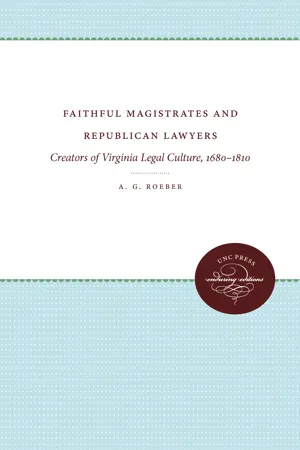
Faithful Magistrates and Republican Lawyers
Creators of Virginia Legal Culture, 1680-1810
- 311 pages
- English
- ePUB (mobile friendly)
- Available on iOS & Android
eBook - ePub
Faithful Magistrates and Republican Lawyers
Creators of Virginia Legal Culture, 1680-1810
About this book
Information
Chapter 1: Justices and Lawyers in England, 1680–1714
That Estate of Men which be Called Worshipful
—SIR THOMAS ELYOT, The Book Named the Governor
In 1749 a former county justice named Henry Fielding published a very long novel entitled A History of Tom Jones, a Foundling. Among the many character studies worked into the tale, none is more memorable than that of Squire Western, the country justice. Drawn from Fielding’s own memories of the county bench, Western epitomized the qualities of the independent country gentry. “The great are deceived,” wrote Fielding, “if they imagine they have appropriated ambition and vanity to themselves.” Western, the petty tyrant of his county, was a man whose arrogant self-importance was nonetheless rendered admirable by his sturdy defense of virtuous independence. Remonstrating with him over a decision, his sister cattily observed that a London magistrate would never have ruled so. Western responded with the classic dictum of the Country justice: “Like enough,” he cried. “It may be so in London; but the law is different in the country.”1
By Fielding’s day the bucolic independence of the country gentry had become part and parcel of the mythology of England. In another novel, Joseph Andrews, Fielding had already captured the nature of the vertically organized social order over which the gentry supposedly still presided. Society was divided into ranks that later generations would call “classes.” But in Fielding’s day the nature of social relationships was thought of as a “picture of dependance like a kind of ladder.” In a famous passage, Fielding summarized the patronage relationships of the greater and lesser residents of the counties in this way:
Early in the morning arises the postillion, or some other boy . . . and falls to brushing the clothes, and cleaning the shoes of John the footman, who . . . applies his hands to the same labours for Mr Second-hand the squire’s gentleman; the gentleman . . . a little later in the day, attends the squire; the squire . . . attends the levee of my lord . . . my lord himself is seen at the levee of the favourite, who after his hour of homage is at an end, appears himself to pay homage to the levee of his sovereign. Nor is there perhaps, in this whole ladder of dependance, any one step at a greater distance from the other, than the first from the second: so that to a philosopher the question might only seem whether you would chuse to be a great man at six in the morning, or at two in the afternoon.2
A curious combination of feisty independence of mind, landed rank, and deference to one’s social superiors made English country life what it was. Yet by the eighteenth century social reality in the counties was not a simple picture of rural gentlemen presiding over their dependents. From the mid-seventeenth century on, policies of the central government disrupted the independence of many localities, imposing a greater degree of control on the counties than before. Moreover, one of the areas where this change intruded most strongly was in the courts of law. Imagine the chagrin of a proud Western when berated by Judge Hyde at the Hereford winter assizes in 1663. To the assembled gentry the judge acidly ordered that “if there be any lawyer a justice of peace sitting on the bench . . . the rest of the justices ought to acquiesce to his judgment and opinion therein, and not (as is commonly practised) put [it] to the vote of many ignorant justices on the bench according to their fancy and opinion.”3
Such an incident illustrates, as well as any, the changes that occurred as a more professional brand of law was brought into the counties. Understandably, the gentry was not always pleased with such orders, and even less so because its own character and composition were changing at this very moment. Just as the aristocracy of England had begun to lose political and social power to the gentry in the early seventeenth century,4 so by the end of that century the old gentry itself was declining. Justices of the peace were no longer simply local squires, nobles, and landowners. England by the 1690s was embarked on a mercantile adventure, and the rise of merchants swung the balance of monied power once and for all out of the hands of the old landed gentry. New men—merchants—began sitting on the county benches, much to the chagrin of older families. Despite the picture drawn by Fielding and others the independence of the gentry in dealing with county problems from the bench of Quarter Sessions was seriously circumscribed by 1714. That circumscription was part of a larger story which involved a nation in the struggle between local traditionalism and national cosmopolitanism. The law became one of the central arenas in which very different notions of what the law was, and what men who were officers of the law ought to be doing, battled for supremacy throughout England from the local to the national level. Moreover, the proper notion of what law was, was itself intimately bound up with cultural definitions of what society and social relations along the “ladder of dependence” were supposed to be like.
The ladder of dependence that Fielding described defined the proper social relations of Britons in the county and the nation at large. Yet in any society social relations and the norms that govern conduct are never merely personal, one-to-one concerns. One of England’s boasts, that England was “a nation of laws, and not of men,” was a truism for some, a saw for others, and an empty bit of rhetoric in the opinion of yet others. But in so saying, Englishmen who subscribed to this notion were suggesting that not arbitrary power but the predictable and equitable application of law—ancient, customary, common law—determined the fate of an Englishman. Whether the administration of laws actually was equitable and fair is not the concern here. However, one can scarcely begin a discussion of justices of the peace and lawyers in any culture without also considering law, and especially what Englishmen thought the law was.
Law is broadly defined as a species of social control. But this positivist, utilitarian description of what laws do does not in fact satisfactorily convey understanding of what “law” meant for seventeenth-century Englishmen. The common law was the pride of those Englishmen who were fond of comparing their country’s customs and ancient institutions with those of more despotic and less happy nations. But besides familiarity with customary law or chancery decisions where discretion held out some hope for redress when remedies at law failed, most Englishmen (even the humblest) were also aware of statutory laws defined by Parliament, other kinds of law that governed through church courts and procedures, and above all these the king, the fountain of justice in the realm. The proper relationship between the various types of law and whether the king was above or subject to an even “deeper” or “higher” law would be hammered out in the controversies that wracked seventeenth-century England. Beyond all of the specific areas and types of law most Englishmen, like most descendants of medieval rural European society, had a sense that laws of whatever sort, though made by men, ought to reflect in some measure the laws of God. Nothing would be more erroneous than to suggest that the law, whether in the Country or elsewhere during the late seventeenth century, had already been disconnected from this notion, inherited from the classical, and more especially, the medieval discussion of natural law.5
To the modern student, thoroughly schooled in the dicta of legal realism and convinced by Justice Holmes’s statement that the law is not “some brooding omnipresence in the sky,” such transcendent notions of what the law was, or was supposed to be, seem remote. To the casual observer it may seem that the daily routine of affairs in county life had little to do with the lofty theories of the Schoolmen or of the constitutional theorists of the day.6 Yet, too vigorous a pursuit of such hard-headed attitudes risks impugning the integrity of a local community’s sense of itself. For precisely because they were geographically and mentally distant from the centers of power and novelty, Country justices clung to older notions of societal relationships and the awesome quality of the law in spite of, even in defiance of, vast social, economic, and demographic changes.
While these changes were taking place, a remarkably backwardlooking search for a usable past and an attachment to a traditional definition of the law characterized the mentality of local Englishmen. The most widely used publication for justices of the peace in the 1680s illustrated this. Published in 1681 as an update of Michael Dalton’s Countrey Justice (1618), Richard Chamberlain’s Complete Justice continued to advocate that the law be considered a species of activity very much like that carried on by the church—both were designed to secure the peace. Whether for peace of spirit and soul or for peaceable relations with others, the “Government of this Kingdom consists of two parts, vizt. first the Laws Ecclesiastic for the peace of the Church, and Laws Civil, or Temporal, for the peace of the Land.”7 The emphasis on peaceable relations in the kingdom reflected both St. Augustine’s claim that peace was the precondition for all other civilized action and England’s bloody recent past.
A clear notion of what law is was expressed by Chamberlain’s section entitled “A Compendious Charge to be given at the Quarter Sessions.” In this piece, Chamberlain reveals a very astute mind at work, one which saw how closely the peace of the county depended not merely on control and punishment but on the internal reformation of character through education and work. Chamberlain suggested to his justices that doing justice under the laws was no simple matter: “Now seeing Justitia est duplex viz. The punishing part, and the preventing Justice, the premisses only touching the former, therefore the conclusion shall point something at the latter, with a direction how it may be effected. We find by experience, that it is not frequent punishment that prevents offences; praestat cautela, quam medela, it is better preventing, than redressing offences.” The county justices, Chamberlain believed, should recognize that preventative justice lay in three things: first, education of youth, “which ought to be by instruction in the knowledge of Religion, and by learning some Trade in their tender years, so as there should not be an idel person, or a Beggar, according to the Scripture, Deut. 15. 4”; second, the justices needed to enforce the already sufficient laws against idleness; third, justices ought to refrain from pardoning too frequently, “which make many offend in hope. This preventing Justice is better than punishing Justice; as obedience is better than sacrifice; for in sacrifice we do but repent of sin, but in obedience we prevent sin; and it is better preventing than repenting sin.”8
The persistence of the idea that offenses against the laws of God and society were sin marks one of those important areas in which Squire Western’s dictum held some truth—the law continued “different in the country.” The precise expression of that sense of being different, however, was quite complex. Gradually, a devotion to old-fashioned virtues, a sense of sin, and a dedication to doing one’s duty to God and one’s betters and dependents were acknowledged by seventeenth-century Englishmen as the special preserve of the Country.
During the seventeenth and eighteenth centuries, the terms “Court” and “Country” acquired political definitions as catchall terms denoting groups alternately in and out of power. But the original meaning of the words derived less from politics than from a cultural understanding of what was right and wrong with life in Albion. Court and Country were symbols that summoned up a host of associations by which the user could identify what he believed in, who his friends or his enemies were, and what made his world intelligible and significant. As Perez Zagorin points out, Nicholas Breton’s tract The Court and the Country (1618) identified the Country as “the symbol of simplicity and wholesome pleasures based on religion and respect for tradition.” The definition of a Country man was one who not only stood for time-honored values and institutions but also served his “country” (originally this meant his county) out of a sense of duty and public spirit. This sense of duty, and the moral, religious tenor of private life that presumably informed and nourished the sense of duty, the Country called “virtue.” This term was also a verbal symbol, combining fairly secular notions of civic duty borrowed from the Renaissance with more squarely Christian notions of moral behavior and obedience to the law, even while depending through faith alone on the promise of the gospel. If the Country never bothered to define precisely the sources and implications behind its notion of virtue, that was hardly surprising. They did not seem vague to one raised in the Country tradition.9
The Country did know, precisely, what virtue was not. To identify the threats to virtue and the source of imminent doom they pointed to the Court. When the gentleman of Parliament in 1625 called himself “neither Courtier nor Lawyer but a plaine Countrey Gentleman,” his symbolic identity was immediately clarified for his listeners. The Court was associated with the monarchy and with those of nobility and their minions who did the bidding of the Stuarts. This aspect of the definition never completely disappeared, and it was still quite viable when Virginians in 1776 revived it with a rather piquant use against otherwise Whig Britons. But in the interim the writing of republican theorists during and after the Civil War—especially that of Harrington—had changed the definition in other aspects. By the late seventeenth century the “Whigs” under Lord Shaftesbury were reaching back into Harringtonian thought to justify their ideas and excoriate the political faction of “Tories” under Lord Danby. The added notion used by these “neo-Harringtonians” was that the Court represented “corruption,” which threatened the independent thinking, action, and care of dependents by the Country gentry. The abuse of the natural relationships on the ladder of dependence was a crime that the Court excelled in committing, according to Whig writers. Whether by buying the support of a person in Parliament or by suborning the judiciary by placing loyal favorites on the bench, the Court destroyed the possibility for sober, thoughtful action by men whose rightful duties and virtues on behalf of dependents and the nation was short-circuited. The means of buying men came, the Country said, from new, mercantile wealth.10
Ironically, even as the Whigs refined this definition, they themselves came to power, and the original, cultural definitions of Court and Country reemerged. Never really political identification tags, the terms Court and Country increasingly meant those who exercised power and aggrandized new wealth and those who berated and scorned them for so doing. The dilemma of Country partisans who sought to perpetuate their ancient and reformist ideas was simple and discouraging. As Pocock says: “They could not take office without falsifying their own ostensible values.”11 By the late seventeenth century, then, Court and Country were terms with political overtones but not terms synonymous with either “Whig” or “Tory” factions in English political life.
The Glorious Revolution of 1688–89 ended the overt threat of monarchic Court dominance and appeared to guarantee a limited monarchy in the Protestant line, but the troubles of the Country were far from over. Indeed, between 1690 and 1714 the death knell rang for the old-fashioned, pastoral England, so lovingly described by the Augustan poets, the England whose virtue, long since departed, was so eloquently mourned by the Scriblerians and the grandest apologist of the anc...
Table of contents
- Cover Page
- Title Page
- Copyright Page
- Dedication Page
- Contents
- Preface
- Abbreviations
- Introduction
- 1. Justices and Lawyers in England, 1680–1714
- 2. Justices and Lawyers in Virginia, 1680–1720
- 3. Court Day and Its Critics, 1720–1750
- 4. Country Justice Besieged, 1750–1774
- 5. Republican Lawyers, 1774–1790
- 6. The Impact of the District Courts on the Country, 1790–1805
- 7. The Legacy of Court and Country in Virginia Legal Culture
- Bibliography
- Index
Trusted by 375,005 students
Access to over 1.5 million titles for a fair monthly price.
Study more efficiently using our study tools.
Frequently asked questions
Yes, you can cancel anytime from the Subscription tab in your account settings on the Perlego website. Your subscription will stay active until the end of your current billing period. Learn how to cancel your subscription
No, books cannot be downloaded as external files, such as PDFs, for use outside of Perlego. However, you can download books within the Perlego app for offline reading on mobile or tablet. Learn how to download books offline
Perlego offers two plans: Essential and Complete
- Essential is ideal for learners and professionals who enjoy exploring a wide range of subjects. Access the Essential Library with 800,000+ trusted titles and best-sellers across business, personal growth, and the humanities. Includes unlimited reading time and Standard Read Aloud voice.
- Complete: Perfect for advanced learners and researchers needing full, unrestricted access. Unlock 1.5M+ books across hundreds of subjects, including academic and specialized titles. The Complete Plan also includes advanced features like Premium Read Aloud and Research Assistant.
We are an online textbook subscription service, where you can get access to an entire online library for less than the price of a single book per month. With over 1.5 million books across 990+ topics, we’ve got you covered! Learn about our mission
Look out for the read-aloud symbol on your next book to see if you can listen to it. The read-aloud tool reads text aloud for you, highlighting the text as it is being read. You can pause it, speed it up and slow it down. Learn more about Read Aloud
Yes! You can use the Perlego app on both iOS and Android devices to read anytime, anywhere — even offline. Perfect for commutes or when you’re on the go.
Please note we cannot support devices running on iOS 13 and Android 7 or earlier. Learn more about using the app
Please note we cannot support devices running on iOS 13 and Android 7 or earlier. Learn more about using the app
Yes, you can access Faithful Magistrates and Republican Lawyers by A. G. Roeber in PDF and/or ePUB format, as well as other popular books in Law & Early American History. We have over 1.5 million books available in our catalogue for you to explore.