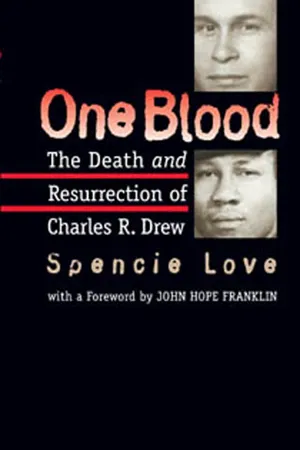
One Blood traces both the life of the famous black surgeon and blood plasma pioneer Dr. Charles Drew and the well-known legend about his death. On April 1, 1950, Drew died after an auto accident in rural North Carolina. Within hours, rumors spread: the man who helped create the first American Red Cross blood bank had bled to death because a whites-only hospital refused to treat him. Drew was in fact treated in the emergency room of the small, segregated Alamance General Hospital. Two white surgeons worked hard to save him, but he died after about an hour. In her compelling chronicle of Drew’s life and death, Spencie Love shows that in a generic sense, the Drew legend is true: throughout the segregated era, African Americans were turned away at hospital doors, either because the hospitals were whites-only or because the 'black beds' were full. Love describes the fate of a young black World War II veteran who died after being turned away from Duke Hospital following an auto accident that occurred in the same year and the same county as Drew’s. African Americans are shown to have figuratively 'bled to death' at white hands from the time they were first brought to this country as slaves. By preserving their own stories, Love says, they have proven the enduring value of oral history. General Interest/Race Relations
- 400 pages
- English
- ePUB (mobile friendly)
- Available on iOS & Android
eBook - ePub
About this book
Information
Notes
ABBREVIATIONS
- CD-ARC-NH
- Charles Drew File, American Red Cross, National Headquarters, Washington, D.C.
- CRDP
- Charles R. Drew Papers
- JAMA
- Journal of the American Medical Association
- JNMA
- Journal of the National Medical Association
INTRODUCTION
1. Whitney Young, “Bigotry and the Blood Bank,” Baltimore (Md.) Afro-American, 17 October 1964, p. A5.
2. Sterne, Blood Brothers; Hardwick, Charles Richard Drew; Lichello, Pioneer in Blood Plasma; Haber, Black Pioneers; Bertol, Charles Drew; Klein, Hidden Contributors; Richardson and Fahey, Great Black Americans; Mahone-Lonesome, Charles R. Drew; Yount, Black Scientists; Talmadge, Life of Charles Drew.
3. Stan Swofford, “Witness Dispels Myth in Black Doctor’s Death,” Greensboro (N.C.) Daily News, 11 July 1982, pp. A1, A3.
4. In Home Fires, a sociological study about the life of a postwar American family, author Donald Katz refers to Drew’s daughter, Sylvia, as a close friend of the daughter in this family. He mentions that Drew died “with no access to the blood plasma technology he’d pioneered,” but he does not indicate whether Sylvia Drew believed this (pp. 166–67).
5. Stanback interview.
6. Nevins, Gateway to History, pp. 64–66. Nevins and folklorist Richard M. Dorson were important figures in pointing out the importance of the historical content embedded in oral testimony. See Dorson, “Oral Tradition and Written History”; Nevins, Gateway to History, pp. iv, 62–68; and Billington, Allan Nevins on History, pp. 288–93.
7. I was influenced at the outset by writers, anthropologists, and sociologists who worked in the South, describing its people and folkways in the 1930s: Couch’s These Are Our Lives and Terrill’s and Hirsch’s Such As Us, both of which drew on interviews done by the Federal Writer’s Project; Powder-maker’s After Freedom; Johnson’s Backgrounds to Patterns of Negro Segregation; Dollard’s Caste and Class in a Southern Town; and Myrdal’s American Dilemma.
8. Oral testimony from the era of the civil rights movement, recorded in a growing collection of books, films, and video documentaries, has powerfully demonstrated the importance of people’s beliefs in inspiring history-making action. Some good examples are Chafe, Civilities and Civil Rights; Couto, Ain’t Gonna Let Nobody Turn Me Round; Evans, Personal Politics; Hampton and Fayer, Voices of Freedom; Kluger, Simple Justice; Morris, Origins of the Civil Rights Movement; Norrell, Reaping the Whirlwind; Powledge, Free at Last?; Raines, My Soul Is Rested; Smith, Winner Names the Age and Now Is the Time; and Williams, Eyes on the Prize. Lawrence Goodwyn, aware of the power of oral testimony through his own participation in the movement, extended oral history methodology into two new arenas in his impressive studies of movement cultures: Democratic Promise, on the Populist movement, and Breaking the Barrier, on the Solidarity movement in Poland.
9. An excellent discussion of the many viewpoints about the precise relationship between folk memory and history, along with references to others who have dealt with this subject, is found in the preface to Montell’s Saga of Coe Ridge. Taking the view that folk memory can be a reliable guide to a group’s past, Montell cites an article about the Southern Paiute Indians of southern Utah, whose oral folk traditions reflect ancient historical facts. The Paiutes tell stories about a prehistoric people, the Puebloids, that are consistent with eight-hundred-year-old archeological evidence (Pendergast and Meighan, “Folk Traditions as Historical Fact”).
10. African historians are familiar with the challenge of gleaning historical facts from long-established oral traditions. Vansina’s Oral Tradition offers sound guidance on the subject. See also Haley, “Black History, Oral History and Genealogy.”
11. Paul Thompson, Voice of the Past, p. 27.
12. Regarding the idea that oral history effectively amplifies and enriches traditional history shaped by elites, the best detailed discussion I have read is Paul Thompson’s Voice of the Past, especially chapters 1 and 3, 1–21 and 72–100. Thompson points out that oral history is not only more democratic but that it “should make for a more realistic construction of the past. Reality is complex and many-sided; and it is a primary merit of oral history that to a much greater degree than most sources it allows the original multiplicity of viewpoints to be recreated” (p. 5).
13. Good examples of recent African American history books that rely on oral testimony and folklore as important sources are Montell’s Saga of Coe Ridge; Rosengarten’s All God’s Dangers; Levine’s Black Culture and Black Consciousness; Genovese’s Roll, Jordan, Roll; Fry’s Night Riders; and Joyner’s Down by the Riverside. These works all demonstrate the importance of folk memory as a vital historical source, as does Goodwyn’s fine article “Populist Dreams and Negro Rights.”
14. “Robert Penn Warren,” Vanity Fair, April 1983, p. 45.
CHAPTER ONE
1. Washington Post, 31 March 1950, p. A1.
2. “Restaurant’s Refusal to Serve 3 Negroes Weighed by Court,” Washington Post, 1 April 1950, p. B1.
3. “Integrating D.C. Eating Places,” Washington Post, 25 April 1985, District Weekly, pp. 1 and 7. This retrospective article identifies Terrell, but the 1950 article, cited above, does not. This historic case (District of Columbia v. John R. Thompson Co., 346 U.S. 100 [1953]) eventually made its way to the Supreme Court, which ruled on 8 June 1953 to uphold the “lost” anti-segregation laws—termed “lost” because they had never been enforced. Four days later, Terrell and her three companions went back to Thompson’s Restaurant and were served by the manager himself.
4. “Restaurant’s Refusal,” Washington Post.
5. See Green, Secret City, for documentation of segregation in Washington, D.C.
6. Walter R. Johnson, “April 1, 1950” (typed manuscript), 15 November 1982, CD-ARC-NH. Johnson wrote this account of Drew’s death in 1982 and sent it to the American Red Cross headquarters at the instigation of C. Mason Quick, the North Carolina doctor who came forth to debunk the Drew legend. Johnson’s account was printed two years later within Sampson’s article “Dispelling the Myth.” All material not attributed to other sources comes from this account. In 1982, doctors Samuel Bullock and John Ford also reconstructed the events surrounding Drew’s death. (See letters cited from Bullock and Ford to Quick below.) C. Mason Quick’s debunking of the Drew legend in 1982 unleashed a controversy that made all three of Drew’s companions feel compelled to set the record straight. Their accounts of the incident agree. Only a few pieces of primary written evidence from 1950 survive: Drew’s death certificate; a letter from Lenore Drew to one of the white doctors on the scene; the hospital records of John Ford; and several newspaper articles.
7. “Drew’s Wife Urged Him to Take Plane,” Durham (N.C.) Carolina Times, 15 April 1950.
8. Nora Drew Gregory interview.
9. White interview.
10. Charles Drew to Edwin B. Henderson, 31 May 1940, Folder 6, Box 136-1, CRDP. What the eminent black medical activist W. Montague Cobb termed the black “medical ghetto” is outlined in his article “Integration in Medicine,” p. 3. For discussion of inadequate black medical care under segregation, see also Morais, History of the Afro-American in Medicine, pp. 89–102, and three works by Beardsley: History of Neglect, pp. 35–41, 77–100, and 273–309; “Making Separate, Equal”; and “Goodbye to Jim Crow.”
11. White interview. Wynes discusses Drew’s modest income and financial generosity in Charles Richard Drew, pp. 116–17. An excellent concise summary of Drew’s life with a reference to his modest salary is W. Montague Cobb, “Charles Richard Drew,” p. 244.
12. Robert S. Jason, “Charles Richard Drew” (speech delivered in April 1960 at the dedication of the Charles R. Drew Elementary School), Folder 2, Box 136-1, CRDP. Jason had been Drew’s chief in pathology at Howard University in 1935 and 1936 and was dean of the Howard University Medical School when he made this speech.
13. Watts interview, 25 January 1983.
14. Johnson, “April 1, 1950.”
15. Watts interview, 25 January 1983.
16. Ibid.; Cook interview. See also Wynes, Charles Richard Drew, pp. 49–54, and Lenore Robbins Drew’s own account of this incident, “Unforgettable Charlie Drew.”
17. Cobb interview. See also W. Montague Cobb, First Negro Medical Society.
18. See Wynes, Charles Richard Drew, pp. 83–92.
19. Drew’s life and character are discus...
Table of contents
- Cover Page
- One Blood
- Copyright Page
- Contents
- Acknowledgments
- Foreword by John Hope Franklin
- Introduction: A Tragedy Compounded by a Myth
- I: Death and Resurrection
- II: The Life and Times of Charles R. Drew
- III: The Death of an Invisible Man
- Conclusion: A Dark Stone of Enlightenment
- Notes
- Bibliography
- Index
Trusted by 375,005 students
Access to over 1.5 million titles for a fair monthly price.
Study more efficiently using our study tools.
Frequently asked questions
Yes, you can cancel anytime from the Subscription tab in your account settings on the Perlego website. Your subscription will stay active until the end of your current billing period. Learn how to cancel your subscription
No, books cannot be downloaded as external files, such as PDFs, for use outside of Perlego. However, you can download books within the Perlego app for offline reading on mobile or tablet. Learn how to download books offline
Perlego offers two plans: Essential and Complete
- Essential is ideal for learners and professionals who enjoy exploring a wide range of subjects. Access the Essential Library with 800,000+ trusted titles and best-sellers across business, personal growth, and the humanities. Includes unlimited reading time and Standard Read Aloud voice.
- Complete: Perfect for advanced learners and researchers needing full, unrestricted access. Unlock 1.5M+ books across hundreds of subjects, including academic and specialized titles. The Complete Plan also includes advanced features like Premium Read Aloud and Research Assistant.
We are an online textbook subscription service, where you can get access to an entire online library for less than the price of a single book per month. With over 1.5 million books across 990+ topics, we’ve got you covered! Learn about our mission
Look out for the read-aloud symbol on your next book to see if you can listen to it. The read-aloud tool reads text aloud for you, highlighting the text as it is being read. You can pause it, speed it up and slow it down. Learn more about Read Aloud
Yes! You can use the Perlego app on both iOS and Android devices to read anytime, anywhere — even offline. Perfect for commutes or when you’re on the go.
Please note we cannot support devices running on iOS 13 and Android 7 or earlier. Learn more about using the app
Please note we cannot support devices running on iOS 13 and Android 7 or earlier. Learn more about using the app
Yes, you can access One Blood by Spencie Love in PDF and/or ePUB format, as well as other popular books in Social Sciences & North American History. We have over 1.5 million books available in our catalogue for you to explore.