- 502 pages
- English
- ePUB (mobile friendly)
- Available on iOS & Android
eBook - ePub
About this book
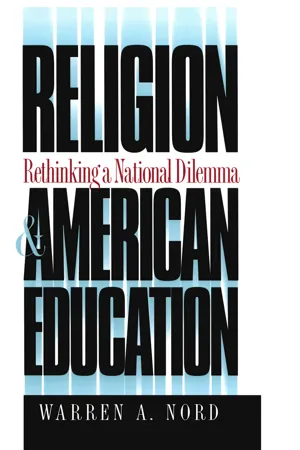
Warren Nord's thoughtful book tackles an issue of great importance in contemporary America: the role of religion in our public schools and universities. According to Nord, public opinion has been excessively polarized by those religious conservatives who would restore religious purposes and practices to public education and by those secular liberals for whom religion is irrelevant to everything in the curriculum. While he maintains that public schools and universities must not promote religion, he also argues that there are powerful philosophical, political, moral, and constitutional reasons for requiring students to study religion. Indeed, only if religion is included in the curriculum will students receive a truly liberal education, one that takes seriously a variety of ways of understanding the human experience. Intended for a broad audience, Nord's comprehensive study encompasses American history, constitutional law, educational theory and practice, theology, philosophy, and ethics. It also discusses a number of current, controversial issues, including multiculturalism, moral education, creationism, academic freedom, and the voucher and school choice movements.
Information
Topic
ÉducationSubtopic
Éducation générale1: RELIGION AND MODERNITY
We cannot explain the absence of religion from modern American education by appealing to Supreme Court decisions, the liberalism of the 1960s, or cabals of secular humanists. Modern education, like the culture in which it is embedded, is the product of profound secularizing forces at work in Western civilization over the last several hundred years. Unless we appreciate this history, our analysis will be hopelessly superficial.
In this chapter I will sketch the main plot line of one of the great dramas of modern history: the secularization of modern Western civilization. I will also describe two quite different religious responses to modernity—“liberal” responses, which draw heavily on modern ideas and values to reinterpret religious traditions, and “conservative” responses, which reject the religious relevance of modern ideas and values (at least on theological essentials). It is tremendously important to recognize that religion takes many forms, some more at home in the modern world than others. Finally, I will say something about postmodern ways in which intellectuals have made war on modernity for fully secular reasons.
Religion in the Premodern World
Until the beginnings of modernity—in, let us say, the seventeenth century— Western civilization had been, like all others, religious through and through. But as the historian of religion Wilfred Cantwell Smith has shown, the word “religion” is a peculiarly modern, Western word with no synonyms in most languages at most times. Most cultures have not divided the world up as we now do. “Religion” is a word we have come to use to categorize culture for our purposes.1
For us, “religion” names one aspect of life among many. We take religions to be discrete institutions and systems of belief which stand alongside scientific and political and economic institutions and ideas. We have built intellectual walls of separation between religion and the other institutions of culture. In traditional cultures religion was not so distinguishable but was integrated into the total life of the people. What we now call “religious” ideas and values pervaded science and politics and economics. Indeed, for the millennium before modernity, the West was called Christendom.2
How religion came to be wrenched out of its traditional cultural context to be remade into a discrete and largely private institution is a large part of the story I have to tell in this chapter. The whole structure of our academic and intellectual life depends on this being an acceptable story, for only if religion can be separated from our academic disciplines is it justifiable to teach them as we do without reference to religion.
All premodern civilizations had some notion of God (or the gods, or the spirit world, or transcendence) such that reality was experienced as richer than modern science now takes to be the case. Much Eastern religion rejected the idea that the transcendent (Brahman, Nirvana, the Tao) was a personal God, but in the West, God was understood by analogy with a person: He, to use the traditional language, created the world, and through His plan nature and history were given purpose. The existence of God rendered the events of this life meaningful (and the events of this life could not, consequently, be understood without reference to God). Although much inevitably remained a mystery, and God was taken to be largely beyond our knowing, we could have confidence that the world is not the result of random events or blind causal laws; it is a place in which all things work ultimately for His ends, toward that which is good.
The concern of the oldest religions was to secure the goods of life—rain, harvest, children, and health; their goal, as John Hick put it, was “to keep fragile human life on an even keel.”3 But in the first millennium B.C.E. an extraordinary revolution took place across the world as people began to reject life in this world for life in a radically different order of reality—in Heaven, in the Kingdom of God, in Nirvana.4 We must live in this fallen world for the time being, but our salvation is to be had in the world to come.
In the old view, the fundamental truths of life are remembered, not discovered. According to the Indian Brahmanas, “We must do what the Gods did in the beginning.”5 Lao Tzu would have us “Hold fast to the way of antiquity / In order to keep in control the realms of today. / The ability to know the beginning of antiquity / Is called the thread running through the way.”6 Veneration of ancestors dominated Confucian thought. In Greek myth, the Golden Age gave way to the Silver and the Bronze. In Jewish and Christian thought, the story of the Garden of Eden and the Fall makes perfection a thing of the past and the present a fallen time. Reformers appear and change takes place, but the goal of the reformers is typically to revive the blessings and wisdom of the past: the Messiah would restore the Kingdom of David; Jesus was the second Adam; and the Protestant Reformers were not creating a new Christianity but returning to the true Christianity of the Church Fathers. Premodern civilizations revered tradition: they idealized the past, the time when God established the world. In the beginning was the truth. The truth is not waiting to be discovered; it has been given.7
All of the great world religions have taught the importance of overcoming self-interest and living a life of love, of justice, of reconciliation—indeed, sometimes of renunciation. Our fallen state, they told us, is one of selfishness and self-sufficiency. We are invariably sinful. But we have the ability—with religious discipline, or perhaps with the grace of God—to overcome our sinful selves. Indeed, with salvation we are transformed.
Finally, traditional religion was largely a community affair. No doubt individuals could be saved, but premodern civilization sustained the idea that God’s relationship was with a community of people, not just with individuals. According to the Bible, God often punished—and protected—whole peoples. We were born into a religion; we did not choose it for we were not, as individuals, competent to make these decisions. For a thousand years—until the modern period—almost everyone in the West was born Christian.
On the eve of modernity, religion pervaded the Western world. As James Turner put it, “birth meant baptism; adulthood brought marriage by the priest; and life’s journey ended in the churchyard.” Indeed, the church was “as inevitable as death and taxes, one of which it presided over and the other of which it collected.”8 In the mass the priest performed the miracle of transubstantiation, changing bread and wine into the body and blood of Christ. Prayer was powerful; churches were built on the belief that prayers offered there could help save the souls of their founders languishing in purgatory. Monasteries and convents dotted the landscape. The world was filled with holy relics, holy shrines, holy places, and holy ground. People made pilgrimages. The liturgical calendar dictated the activities of life, and holidays were holy days, religious festivals.
The world was populated with supernatural beings. Martin Luther threw his ink bottle at Satan, and thousands of women were burned as witches. Everyone believed in providence: there was no chance or accident in the world. Outbreaks of plague were understood as God’s punishment for the sinfulness of people. Dreams were prophetic. Everyone believed that the world was only a few thousand years old, and most everyone believed that the end could not be far off. Even into the seventeenth century, according to Margaret Jacob, virtually every “English scientist or promoter of science from Robert Boyle to Isaac Newton believed in the approaching millennium, however cautious they may have been in assigning a date to its advent.”9
On some accounts kings ruled by divine right—and popes occasionally excommunicated them to bring them to their knees. Bishops helped elect the Holy Roman Emperor and cardinals conducted foreign policy. Keith Thomas reminds us that during this time,
Clerics played a dominant part in the censorship of the press, the licensing of school-masters and doctors, and the government of the universities. In an age without radio, television or (until the mid-seventeenth century) newspapers, the pulpit was the most important means of direct communication with the people. Contemporary sermons discussed not just theology, but morals, politics, economics and current affairs generally. The Church’s tentacles stretched out through the ecclesiastical courts, which exercised a wide jurisdiction over marriage and divorce, defamation, the probate of wills and every conceivable aspect of private morality.10
Justice was discerned through oaths and ordeals in which God guaranteed the soundness of the verdict. The church regulated the economy through canon law and interfered with supply and demand by setting “just prices.” Strangest of all, it was widely believed that the pursuit of self-interest was a sin and that poverty was holy.
The greatest theme of the artist was the life and death of Christ; the greatest task for the architect was to build a cathedral; the greatest work of litera ture in the thousand years before modernity was Dante’s account of Hell, Purgatory, and Paradise.
In such a world, James Turner tells us, the answers to all questions of any importance, “elaborated in a thousand tales, sermons, treatises, and summas, led back ultimately to God. Without some sort of God, the world disintegrated into incomprehensibility.”11 In such a world unbelief was all but unthinkable.
For most of us this is a foreign world.
The Reformation
No man had a greater influence on the shape of the modern world than Martin Luther. Leszek Kolakowski has written that whatever happened “in European history after Luther is, as we see it retrospectively, hardly conceivable without him: wars and philosophy, national movements and literature, religious conflicts and the reform of the Roman Church, economic development and education.”12 Of course, things did not always turn out as Luther intended; Kolakowski calls Luther the “accidental father” of modernity.
The theological origin of the Reformation is to be found in Luther’s overpowering sense of sin and his redeeming experience of grace. We are saved, Luther declared, not through our works or the works of the church, but by the mysterious and unmerited grace of God.
In medieval Catholicism the church was the intermediary between humankind and God, proclaiming the authoritative reading of Scripture, channeling God’s grace through its sacraments, and regulating the lives of the people. Luther and the Reformers would have none of this. For them the church separated us from God; we confront God and Scripture directly and receive His grace (or damnation) as individuals, not as children nestled in the arms of the church.
If salvation is a matter of grace, if there is nothing we can do to earn it (sinful creatures that we are), then the Catholic emphasis on penance, monasticism, and the heroic life of virtue made little sense. What is important is not how we live but what we believe by the grace of God. The Reformation, Charles Taylor tells us, brought the affirmation of ordinary life: “The fullness of Christian existence was to found within the activities of this life, in one’s calling and in marriage and the family.”13 (Luther left the monastery and married a nun.) With this new emphasis on grace, faith, and belief (rather than works, law, and tradition), religion began to withdraw to private places, leaving the public world free to be secular.
The Reformation secularized much of daily life. In the first half of the sixteenth century, according to Steven Ozment,
cities and territories passed laws and ordinances that progressively ended or severely limited a host of traditional beliefs, practices, and institutions that touched directly the daily life of large numbers of people: mandatory fasting; auricular confession; the veneration of saints, relics, and images; the buying and selling of indulgences; pilgrimages and shrines; wakes and processions for the dead and dying; endowed masses in memory of the dead; the doctrine of purgatory; Latin Mass and liturgy; traditional ceremonies, festivals, and holidays; monasteries, nunneries, and mendicant orders; the sacramental status of marriage, extreme unction, confirmations, holy orders, and penance; clerical celibacy; clerical immunity from civil taxation and criminal jurisdiction; nonresident benefices; papal excommunication and interdict; canon law; papal and episcopal territorial government; and the traditional scholastic education of clergy.14
The Reformation displaced, Ozment argues, “the beliefs, practices, and institutions that had organized daily life and given it security and meaning for the greater part of a millennium.”15
The Reformers did not seek religious liberty and the secularization of the state. The Protestant states maintained established religions: the Lutheran church in the Scandinavian and many of the German states; Calvinism in Geneva and Scotland and New England; Anglicanism in England. Each of the confessions, Roland Bainton reminds us, was concerned only with its own liberty, and “the possibility never so much as glimmered for most that divergent views might contain each a measure of truth, and that variance in practice even to the point of error might better be suffered than suppressed.”16 Nonetheless, the Reformation helped spawn the modern secular state in two—albeit unintended—ways.
The alternative Christianities created by the Reformation found it impossible to coexist with Catholicism or with each other; about all they agreed on was the importance of converting (or if need be, obliterating) their opposition. The result was the great religious wars of the sixteenth and seventeenth centuries....
Table of contents
- Cover Page
- RELIGION AND AMERICAN EDUCATION
- Copyright Page
- Dedication
- CONTENTS
- PREFACE
- INTRODUCTION
- 1: RELIGION AND MODERNITY
- 2: THE SECULARIZATION OF AMERICAN EDUCATION
- 3: THE CONSTITUTIONAL POLITICS OF RELIGION IN AMERICA
- 4: TEXTBOOKS
- 5: INDOCTRINATION
- 6: RELIGION AND LIBERAL EDUCATION
- 7: FAIRNESS AND NEUTRALITY
- 8: ACADEMIC FREEDOM
- 9: EVOLUTION AND ECONOMICS
- 10: RELIGIOUS STUDIES
- 11: RELIGION AND MORAL EDUCATION
- 12: VOUCHERS
- CONCLUSIONS
- POSTSCRIPT: SETTING STANDARDS
- NOTES
- BIBLIOGRAPHY
- INDEX
- SERIES
Trusted by 375,005 students
Access to over 1.5 million titles for a fair monthly price.
Study more efficiently using our study tools.
Frequently asked questions
Yes, you can cancel anytime from the Subscription tab in your account settings on the Perlego website. Your subscription will stay active until the end of your current billing period. Learn how to cancel your subscription
No, books cannot be downloaded as external files, such as PDFs, for use outside of Perlego. However, you can download books within the Perlego app for offline reading on mobile or tablet. Learn how to download books offline
Perlego offers two plans: Essential and Complete
- Essential is ideal for learners and professionals who enjoy exploring a wide range of subjects. Access the Essential Library with 800,000+ trusted titles and best-sellers across business, personal growth, and the humanities. Includes unlimited reading time and Standard Read Aloud voice.
- Complete: Perfect for advanced learners and researchers needing full, unrestricted access. Unlock 1.5M+ books across hundreds of subjects, including academic and specialized titles. The Complete Plan also includes advanced features like Premium Read Aloud and Research Assistant.
We are an online textbook subscription service, where you can get access to an entire online library for less than the price of a single book per month. With over 1.5 million books across 990+ topics, we’ve got you covered! Learn about our mission
Look out for the read-aloud symbol on your next book to see if you can listen to it. The read-aloud tool reads text aloud for you, highlighting the text as it is being read. You can pause it, speed it up and slow it down. Learn more about Read Aloud
Yes! You can use the Perlego app on both iOS and Android devices to read anytime, anywhere — even offline. Perfect for commutes or when you’re on the go.
Please note we cannot support devices running on iOS 13 and Android 7 or earlier. Learn more about using the app
Please note we cannot support devices running on iOS 13 and Android 7 or earlier. Learn more about using the app
Yes, you can access Religion and American Education by Warren A. Nord in PDF and/or ePUB format, as well as other popular books in Éducation & Éducation générale. We have over 1.5 million books available in our catalogue for you to explore.