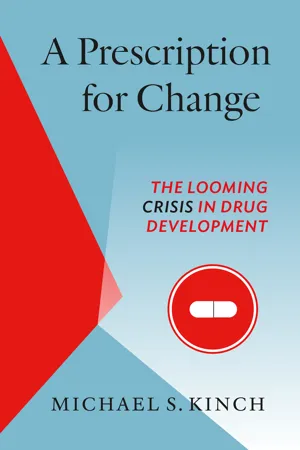
The introduction of new medicines has dramatically improved the quantity and quality of individual and public health while contributing trillions of dollars to the global economy. In spite of these past successes — and indeed because of them — our ability to deliver new medicines may be quickly coming to an end. Moving from the beginning of the twentieth century to the present, A Prescription for Change reveals how changing business strategies combined with scientific hubris have altered the way new medicines are discovered, with dire implications for both health and the economy.
To explain how we have arrived at this pivotal moment, Michael Kinch recounts the history of pharmaceutical and biotechnological advances in the twentieth century. Kinch relates stories of the individuals and organizations that built the modern infrastructure that supports the development of innovative new medicines. He shows that an accelerating cycle of acquisition and downsizing is cannibalizing that infrastructure Kinch demonstrates the dismantling of the pharmaceutical and biotechnological research and development enterprises could also provide opportunities to innovate new models that sustain and expand the introduction of newer and better breakthrough medicines in the years to come.
- 352 pages
- English
- ePUB (mobile friendly)
- Available on iOS & Android
eBook - ePub
About this book
Trusted by 375,005 students
Access to over 1.5 million titles for a fair monthly price.
Study more efficiently using our study tools.
Information
Topic
MedicineSubtopic
Business DevelopmentCHAPTER ONE
Why Regulate Medicines?
The quest to discover new medicines is as old as civilization. Our earliest ancestors were hunters and gatherers, whose quarry extended beyond simple nutrition to identifying and, ultimately, cultivating animals or plants with beneficial properties. The sources of some of the most common medicines of today literally have their roots in discoveries of herbal and folk remedies dating back to Paleolithic times (more than 10,000 years ago).
The story of discovery is at its heart a story of people, their needs and motivations. While it is healthy to remember that the majority of people are inherently noble and well intentioned, a small number of less virtuous individuals often stand out as more interesting. In the field of medicine, as we will see, a bad seed can be deadly. Thus it has been necessary to put into place regulations that protect the many from the few. In this chapter, we will detail how the United States came to see the need for regulating medicines and how the laws have evolved over time. The causation for major changes will be emphasized, using stories of real people who motivated the formation and evolution of organizations that became the underpinnings of the modern United States Food and Drug Administration (FDA).
Snake Oil
The phrase “snake oil salesman” entered the modern lexicon to denote the lowest form of huckster or politician. The actual meaning of the term itself is controversial. One school of thought maintains that the term “snake oil” refers to a traditional remedy for joint pains as practiced by Chinese laborers who collected fat from the Chinese water snake (Enhydris chinensis, or sheyou).1 Ancient cultures from Egypt to the Far East had similarly found some snake oils conveyed analgesic (pain-relieving) or restorative properties.2 There is a scientific rationale, as some snake oils, like those from the Chinese water snake, are enriched with eicosapentaenoic acid (EPA), an omega-3 fatty acid with verified anti-inflammatory properties.3
Snake oil acquired less positive connotations in nineteenth-century western United States.4 The story goes that Chinese laborers’ familiarity with traditional medicine spread the concept of snake oil from West to East, following the path of the transcontinental railroad. Given the lack of Chinese water snakes in Arizona and Texas, the local specialty, rattlesnakes, provided a substitute. Though rattlesnakes have low levels of EPA concentrations, reports of their curative properties spread like wildfire. Over time, the juicing of any snake would suffice. As fame and demand spread, a ready supply of snakes dwindled. Yet, the name stuck.
The most famous snake oil salesman is Clark Stanley, “the Rattlesnake King,” who captured the limelight in the 1893 Chicago World’s Exposition.5 Stanley mesmerized crowds by dramatically grabbing a live snake from a bag (we must assume not a rattlesnake), cutting it open, and scraping its guts into a boiling pot of water. Like any fat-laden stew, the fat rose to the top and the Rattlesnake King spooned the oil into a vessel that was sold on the spot to a lucky buyer. Clifford was sympathetic to the needs of the crowd, who were able to buy samples from crates of snake oil, which happened to be just behind the curtain (and which actually consisted of mineral oil, beef fat, red pepper, turpentine, and camphor).
Like competing salesmen hocking different products, this definition of snake oil has been questioned. An alternate story is that the term arose in the eastern United States and traveled west. This version maintains that “snake oil” is an etymological variation of “Seneca oil.”6 The alternative maintains that “Seneca oil” morphed over time into “snake oil” and was sold to the masses based on its reputed analgesic and restorative properties. The Seneca Nation of Indians, the largest of the Six Nations of the Iroquois Confederacy, spanned a large area that included the western counties of modern-day New York and Pennsylvania. This region was, indeed, known for a black, oily substance that seeped from the ground, and the nearby Drake well, near Oil Creek in Titusville, Pennsylvania, was the first source of American petroleum. Like many aspects of snake oil, it isn’t clear which story to trust.
Parasitizing upon America’s Obsession with Diets
Anyone who has found themselves digging out a credit card at three o’clock in the morning in a sleep-addled response to an infomercial for a new diet fad can take comfort in knowing they are participating in a great American tradition7. America’s obsession with weight loss has a long history, as exemplified by a late nineteenth-century advertisement: “Fat [is] the ENEMY that is shortening your life” announced an advertisement from WT Bridge, a New York chemist.8 Rather than relying upon other ways to shed fat, such as “diets, baths, or exercise,” the advertisement maintains the solution is “easy-to-swallow, jar-packed tape worms.” Before recoiling in horror, recognize these were not just any tapeworms, but “sanitized” tape worms. The poster states unequivocally that there are “no ill effects” and “no danger.” The ad features a lovely women standing behind piles of food, with the rejoinder to “Eat! Eat! Eat! & Always Stay Thin.”
The truth is that a tapeworm diet works. Worm aficionados know the head of the tape worm is a scolex, a word whose pleasant sound nicely captures the beauty of its structure.9 The scolex is composed of a double crown of about two dozen beak-like hooks surrounded by a series of suckers. The scolex tears into the intestine of its host, generally preferring muscle tissue, as this makes for a nice anchor to hold the worm in place while its feeds on your insides. You share your dinners with the tapeworm, which grows over time until, in humans, it reaches a length of ten meters (almost thirty-three feet). The tapeworms are not relegated to simply growing in size, but also in number. Tapeworms are hermaphrodites, meaning that a single parasite possesses both male and female reproductive organs and, therefore, releases and fertilizes up to a million eggs per day.
The weight loss in tapeworm-infested people is, indeed, real and results from nutrient deprivation.10 While this may sound appealing, the symptoms of diphyllobothriasis (the scientific terminology for this weight loss strategy) include diarrhea, abdominal pain, vomiting, fatigue, constipation, and general discomfort. Before rushing out to start this plan, the unfortunate symptoms of tapeworm infection include a chronically-swollen abdomen, which generally counteracts the beneficial cosmetic improvements of the dramatic weight loss. The parasite growing inside you also has the rather rude habit of monopolizing vitamin B12 and, thereby, blocks the production of red blood cells and ultimately destroys your spinal cord, causing a condition much like cystic fibrosis.11 Thus, the melting of fat may cause you to look great in that new swimsuit (at least until abdominal swelling commences) but comes at the cost of premature death.
We can dismissively reflect on snake oil and tapeworms as nineteenth century examples of quacks preying upon our unsophisticated ancestors. However, modern society still has a snake oil salesman or two.
Laetrile
A modern example of hucksterism can be seen in the story of laetrile. Laetrile and its various forms, such as amygdalin (aka vitamin B27 or Prussic acid), is a natural product isolated from peach or apricot pits as well as a type of nut known as a “bitter almond.”12 Not to be confused with the everyday sweet almond, the bitter version is shorter, fatter, and deadly.13
The toxicity of laetrile has been recorded as far back as ancient Egypt. “The Penalty of the Peach” was a drink distilled from whole peaches (including the pit) and was the preferred form of capital punishment for apostates who revealed the divine secrets of the Egyptian gods.14 Similarly, the Roman general and politician Publius Quinctilius Varus used this drink as the vehicle to execute Antipater, who was convicted of trying to kill his father, Herod the Great (Herod the Great is cited in the gospel of Matthew in the New Testament as the Judean king who ordered the Massacre of the Innocents in an effort to kill the infant Jesus).15
First isolated in 1830, the toxic component of peach pits, amygdalin, periodically gains notoriety as a means of treating cancer.16 Based on desperation and wishful thinking, many patients have travelled around the world in the hope that amygdalin might help themselves or a loved one.17 A prominent example was the Oasis of Hope Hospital in Tijuana, Mexico.18 For three decades, patients claimed to have been cured by a treatment with a form of amygdalin known as laetrile or vitamin B17. Like snake oils of the past, these claims were unfounded and laetrile was, in fact, a chemical version of a serial killer.
The toxicity of laetrile lies in the fact that, once in the body, the molecule is metabolized into cyanide.19 Cyanide kills the energy-producing part of the cell and is particularly dangerous because the body largely lacks the ability to eliminate the toxin. Consequently, cyanide kills one cell, recycles, and then kills again until the entire organism (in this case, the person) is dead. The infamy of cyanide came to the American public’s attention in the closing days of the Second World War, as it was the active agent in the Zyklon-B showers of concentration camps and the chemical inserted into the false teeth that facilitated the suicides of prominent Nazis such as SS Reichsfuhrer Heinrich Himmler and Hermann Goring.20
Precursors to the FDA
The refusal to approve laetrile is but one example of the critical role of the United States Food and Drug Administration (FDA). Tasked with the difficult job of deciding which medicines can be marketed, the FDA is a magnet for criticism. The agency is frequently accused of being too lax or too vigilant, often both at the same time. With this in mind, it is important to convey a brief history of how the FDA came into being and how its mission has changed over the decades. This is essential to understand the ongoing predicament that fundamentally threatens our ability to discover new medicines in the future.
In 1820, the federal government asked each state to send a representative to create a comprehensive list of all medicines used in the United States.21 A pharmacopeia was needed since each state had its own unique set of drugs and there was little standardization or assurance of quality. Of the twenty-one states extant at the time, just over half (a total of eleven) sent a representative. Each monograph (a Greek term referring to a writing on a single subject) captured the means and standards of making each elixir, pill, or ointment in a document known as the United States Pharmacopeia (USP).
The first leader of the USP was Dr. Jacob Bigelow.22 Bigelow discovered a passion for medicine while a student at Harvard but, as Harvard did not offer a medical degree at the time, he moved to Philadelphia to study with Dr. Benjamin Rush. Rush was a Forrest Gump-like character who played a key role in many historical activities, including working with Thomas Paine on the pro-independence pamphlet, Common Sense, signing the Declaration of Independence, serving as the Surgeon General of the Continental Army, training Meriwether Lewis in preparation for his exploration of the new Louisiana Purchase, and restoring the friendship of John Adams and Thomas Jefferson after the mud-slinging election of 1800.23
Under Rush, Jacob Bigelow trained as a physician and gained a second love, this time for botany, which was fueled by the fact that most medicinal treatments of the day were derived from plants. As a companion document to the USP, Bigelow published a multi-volume work on native medicinal plants and devised a novel method of printing pictures of these plants in color.24 A man before hi...
Table of contents
- Cover
- Series Page
- Title Page
- Copyright
- Dedication
- Contents
- Acknowledgments
- Introduction: How Did We Reach This Point?
- Chapter One: Why Regulate Medicines?
- Chapter Two: Trials and Tribulations
- Chapter Three: Dreams of Greatness/The Birth of the Pharmaceutical Industry
- Chapter Four: Triumph and Tragedy
- Chapter Five: Ivory Tower of Power
- Chapter Six: The DNA of Biotechnology
- Chapter Seven: Blockbusters and Bombs/Pressures on the Pharmaceutical Industry
- Chapter Eight: Sea Monsters, Immunauts, and Death Panels
- Chapter Nine: Drama on the I-270 Tech Corridor
- Chapter Ten: Autophagy
- Chapter Eleven: Three Views of a Train Wreck
- Chapter Twelve: Bridging the Valley
- Notes
- Index
Frequently asked questions
Yes, you can cancel anytime from the Subscription tab in your account settings on the Perlego website. Your subscription will stay active until the end of your current billing period. Learn how to cancel your subscription
No, books cannot be downloaded as external files, such as PDFs, for use outside of Perlego. However, you can download books within the Perlego app for offline reading on mobile or tablet. Learn how to download books offline
Perlego offers two plans: Essential and Complete
- Essential is ideal for learners and professionals who enjoy exploring a wide range of subjects. Access the Essential Library with 800,000+ trusted titles and best-sellers across business, personal growth, and the humanities. Includes unlimited reading time and Standard Read Aloud voice.
- Complete: Perfect for advanced learners and researchers needing full, unrestricted access. Unlock 1.5M+ books across hundreds of subjects, including academic and specialized titles. The Complete Plan also includes advanced features like Premium Read Aloud and Research Assistant.
We are an online textbook subscription service, where you can get access to an entire online library for less than the price of a single book per month. With over 1.5 million books across 990+ topics, we’ve got you covered! Learn about our mission
Look out for the read-aloud symbol on your next book to see if you can listen to it. The read-aloud tool reads text aloud for you, highlighting the text as it is being read. You can pause it, speed it up and slow it down. Learn more about Read Aloud
Yes! You can use the Perlego app on both iOS and Android devices to read anytime, anywhere — even offline. Perfect for commutes or when you’re on the go.
Please note we cannot support devices running on iOS 13 and Android 7 or earlier. Learn more about using the app
Please note we cannot support devices running on iOS 13 and Android 7 or earlier. Learn more about using the app
Yes, you can access A Prescription for Change by Michael Kinch in PDF and/or ePUB format, as well as other popular books in Medicine & Business Development. We have over 1.5 million books available in our catalogue for you to explore.