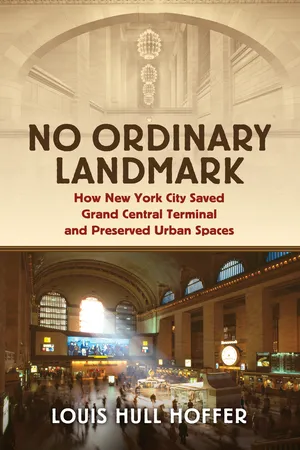
No Ordinary Landmark
eBook - ePub

No Ordinary Landmark

How New York City Saved Grand Central Terminal and Preserved Urban Spaces

  1. 270 pages
  2. English
  3. ePUB (mobile friendly)
  4. Available on iOS & Android
eBook - ePub

No Ordinary Landmark

How New York City Saved Grand Central Terminal and Preserved Urban Spaces

About this book

The dramatic story of how New Yorkers saved Grand Central Terminal and established the precedent for preserving urban landmarks.

No Ordinary Landmark tells the legal story of how Grand Central Terminal became a landmark. This is the fascinating, littleknown history of the railroad company that owned Grand Central, the architects and engineers who built it, the city that supported it, and the lawsuit that saved it. The cast of characters is immense: some familiar, like Mayor Robert Wagner and Jacqueline Kennedy Onassis, and some now obscure, like Albert Bard, father of the New York Landmarks Law. Railroad moguls, real estate barons, politicians, arts experts, and above all lawyers and judges all played vital roles. It is a story of landmark law at a critical moment in its existence and what property owners ultimately do with their assets. Finally, this is the story of one of the greatest cities in the world, in microcosm.

Opened in 1913, Grand Central Terminal (GCT) became a costly luxury for the New York Central Railroad in the postwar years, as the rise of automobile culture and interstate highway systems led to a precipitous decline in railroad use. In the 1950s, proposals were put forward to replace GCT with more lucrative buildings, including the massive Pei Tower. This led Bard in 1954 to draft an act for New York State to recognize landmarks, the Historic Preservation Enabling Act. It was passed by the legislature and signed into law in 1956, though it was not used to create the New York City Landmarks Law until 1965—by which time Pennsylvania Station had been demolished to make way for the fourth, and current, iteration of Madison Square Garden. Immediately after the landmark designation for GCT became official in 1967, New York Central Railroad merged with Pennsylvania Railroad to form Penn Central, and the new company proposed to demolish GCT the way it had Pennsylvania Station. When New York refused to consider the plans, Penn Central sued the city, thus paving way for the legal battle that the Supreme Court finally decided in 1978.

Louis Hull Hoffer sheds new light on the suit between the Pennsylvania Railroad and the City of New York, showing how this iconic legal battle pit two core values of American jurisprudence against one another: the absolute right of property owners over their property and the public’s interest in shared urban spaces. While the tension between these values persists today, Penn Central v. New York City created a new legal framework for a generation of jurists, planners, preservationists, and legal scholars.

Trusted by 375,005 students

Access to over 1.5 million titles for a fair monthly price.

Study more efficiently using our study tools.

Information

Year
2026
Print ISBN
9780700640997
9780700640980
eBook ISBN
9780700641000

Table of contents

  1. Front Cover
  2. Half Title
  3. Series Page
  4. Title Page
  5. Copyright Page
  6. Contents
  7. Series Foreword
  8. Introduction
  9. 1. The Railroad City
  10. 2. Grand Central Terminal and Penn Station
  11. 3. The Terminal in Post–World War II New York City
  12. 4. Landmark Law
  13. 5. Landmark Status for Grand Central Terminal
  14. 6. Penn Central Strikes Back
  15. 7. Appeals in the New York State Courts
  16. 8. Briefs and Oral Argument in the US Supreme Court
  17. 9. The High Court Decides
  18. 10. The Terminal After Penn Central
  19. Conclusion
  20. Chronology
  21. Bibliographic Essay
  22. Index
  23. Back Cover

Frequently asked questions

Yes, you can cancel anytime from the Subscription tab in your account settings on the Perlego website. Your subscription will stay active until the end of your current billing period. Learn how to cancel your subscription
No, books cannot be downloaded as external files, such as PDFs, for use outside of Perlego. However, you can download books within the Perlego app for offline reading on mobile or tablet. Learn how to download books offline
Perlego offers two plans: Essential and Complete
  • Essential is ideal for learners and professionals who enjoy exploring a wide range of subjects. Access the Essential Library with 800,000+ trusted titles and best-sellers across business, personal growth, and the humanities. Includes unlimited reading time and Standard Read Aloud voice.
  • Complete: Perfect for advanced learners and researchers needing full, unrestricted access. Unlock 1.5M+ books across hundreds of subjects, including academic and specialized titles. The Complete Plan also includes advanced features like Premium Read Aloud and Research Assistant.
Both plans are available with monthly, semester, or annual billing cycles.
We are an online textbook subscription service, where you can get access to an entire online library for less than the price of a single book per month. With over 1.5 million books across 990+ topics, we’ve got you covered! Learn about our mission
Look out for the read-aloud symbol on your next book to see if you can listen to it. The read-aloud tool reads text aloud for you, highlighting the text as it is being read. You can pause it, speed it up and slow it down. Learn more about Read Aloud
Yes! You can use the Perlego app on both iOS and Android devices to read anytime, anywhere — even offline. Perfect for commutes or when you’re on the go.
Please note we cannot support devices running on iOS 13 and Android 7 or earlier. Learn more about using the app
Yes, you can access No Ordinary Landmark by Louis Hull Hoffer in PDF and/or ePUB format, as well as other popular books in Architecture & Architecture General. We have over 1.5 million books available in our catalogue for you to explore.