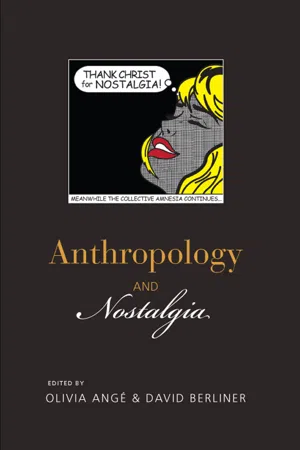
Nostalgia is intimately connected to the history of the social sciences in general and anthropology in particular, though finely grained ethnographies of nostalgia and loss are still scarce. Today, anthropologists have realized that nostalgia constitutes a fascinating object of study for exploring contemporary issues of the formation of identity in politics and history. Contributors to this volume consider the fabric of nostalgia in the fields of heritage and tourism, exile and diasporas, postcolonialism and postsocialism, business and economic exchange, social, ecological and religious movements, and nation building. They contribute to a better understanding of how individuals and groups commemorate their pasts, and how nostalgia plays a role in the process of remembering.
- 244 pages
- English
- ePUB (mobile friendly)
- Available on iOS & Android
eBook - ePub
Anthropology and Nostalgia
About this book
Trusted by 375,005 students
Access to over 1.5 million titles for a fair monthly price.
Study more efficiently using our study tools.
Information
Chapter 1
Are Anthropologists Nostalgist?
The past assailed him savagely… Now, every chair, every table gently moved its lips and, all, they spoke to him, inaudible whispers, understandable and clear to himself only. I lived in that house, he could not help thinking, something of me remained.
Zweig, Journey into the Past.1
Diagnoses of cultural loss are everywhere today. Losing culture, identity, traditions and roots and its corollary – the need to pass down – are tropes mobilized by individuals and groups throughout the world, although differently within diverse social and cultural contexts. This phenomenon is what I call the contemporary tout-perdre (losing everything), a specific posture vis-à-vis the past seen as irreversible. Suffice it to think of the heated debates on the Christian roots of Europe, the success of Roots by Alex Haley in the United States, the craze of heritage tourism and the genealogical obsession, but also the claims addressed by many to preserve their culture (from Peuples Premiers in Canada to indigenous communities in South America and passing by Jewish and Muslim families in Europe).2 Evidence suggests that cultural loss has become a politicized issue, as the concept is regularly used by politicians, local elites, UNESCO experts and some anthropologists. In Europe, right-wing politicians invoke the trope of the crisis in cultural transmission for nationalistic purposes, to reaffirm a sense of shared national ethos, to castigate so-called uprooted young immigrants, but also to patronize other countries (remember former French President Sarkozy in his memorable speech on Africa).3 Often, the theme of the ‘disappearing culture’ is deployed by ordinary men and women in a world perceived as globalizing and uprooting. In a troubling example for a European audience, two deaf Americans looked for a deaf donor in order to maximize their chance to have a deaf child. Interviewed by the press, they expressed their desire to transmit deaf culture to their child, seen here not as a handicap, but rather as a cultural identity of its own (Renaut 2010). This extreme case makes sense in the multiculturalist atmosphere prevailing in the US, but, to a larger scale, it reveals the current attachment of countless individuals to notions of ‘culture’, ‘transmission’, ‘traditions’ and ‘roots’, which are even more precious now that they are said to be threatened and to be disappearing.
As a matter of fact, many of those who desire to transmit and patrimonialize their culture today are historical victims and their descendants. Nicole Lapierre brilliantly shows how the Jews of Plock survived the Holocaust between impossible words and intolerable forgetting, and that it is precisely this ‘painful in-between’ which ‘is transmitted’ (Lapierre 2001: 31).4 For some decades now, former colonized, discriminated and exterminated populations, whether they are Aboriginal Australians, African anciens colonisés, post-Holocaust Jews or Native Americans, have sought to unveil their traumatic memories and, at the same time, to rediscover their culture before it was subject to destruction. However, such aspiration to remember and preserve far exceeds these groups of victims. In our time, anxieties about ‘losing culture’ are part of a general discourse about crisis, ‘a crisis that never ends’ (Revault d’Allonnes 2012). ‘This general crisis… has struck across the modern world and to almost all branches of human activity’, assumed Hanna Arendt (Arendt 1972: 223). Motivated by a ‘désir de catastrophe’ (Jeudy 2010), a new moralism unfolds where ethical choices and political decisions are posed a priori in reference to a concern for future generations, with a pre-apocalyptic tone. In contemporary catastrophism, the present time is already invaded by a terrible future; the worst-case scenario is not a fantasy anymore but ‘a universal category of experience’ (Foessel 2012: 7). For the children of the future, one must preserve forms of life, values, identities, roots, languages, rites, know-hows and so forth. This heritage ‘crusade’ (as David Lowenthal (1998) has put it) is not recent. In nineteenth-century Europe, conservation policies have been deployed concurrently to nationalistic projects. Combined with a sense of loss in the face of growing industrialization (Poulot 2006), they were effectively exported to the colonies. Nowadays, such global institutionalization of the preservation attitude continues via the existence of international organizations like UNESCO (Berliner 2012). Although they are much more fragmented than one might expect (between different delegations and regional offices), UNESCO policies significantly contribute to the dissemination of the trope of vanishing heritage around the world. The Intangible Cultural Heritage (ICH) paradigm itself is an institutionalized response to the worldwide diagnosis of crisis in cultural transmission. Interestingly, such booming is not only geographical, but it also colonizes new ontological areas. As clearly shown by Jean-Louis Tornatore (2010), the sense of loss and the need for transmission are not limited to past monuments and human traditions anymore, but they now encompass natural spaces and biological entities (genes, for instance) that humans seek to protect and pass on to future generations. This current entanglement of biology and heritage is highlighted, in an exemplary manner, by an internet user on a forum when asking ‘Do you get sick when you lose your roots?’
For anthropologists, although many have become increasingly uncomfortable with it, there is nothing new in this patrimonialist rhetoric. Losing culture is a nostalgic figure as old as anthropology. As much as continuity is a key idea for social scientists (Berliner 2010, Robbins 2007), our discipline has, from its birth, held on to nostalgia for disappearing worlds, far away or close to home, as in the case of folklorists (Bendix 1997).5 This article suggests, as others have already pointed out, that one considers the existence of a nostalgia that lies at the very foundation of our discipline and concerned the major anthropological traditions.6 I call it a disciplinary exo-nostalgia. In the conclusive part, I show that, often under new clothes, such nostalgic proclivity still permeates anthropologists’ postures. Obviously, the present landscape of anthropology is diverse and fragmented. Even within national traditions, there are multiple paradigmatic orientations and I do not pretend to be exhaustive in this domain.7 Yet, here, I would like to propose some avenues to explore the entanglement of anthropology and nostalgia. Although many refuse to be associated with the trope of vanishing culture, I argue that anthropologists hardly escape nostalgic forms of thinking and writing.
* * *
In a thought-provoking article, Holly High has recently suggested the existence of a ‘disciplinary melancholia’ in anthropology (High 2011). Based on the experience of mourning one of her main Lao interlocutors, Suaay, and a reading of Freud’s perspective on melancholy, High invites us to pay a particular attention to these self reproaches that very often interfere with anthropologists’ thoughts when they return from the field. She sees the anthropologist as ‘an abandoner (through withdrawal)’ who ‘calls for redemption through ethical engagement’ (ibid.: 230). Such disciplinary melancholy is indeed ubiquitous among present-day anthropologists. Post-colonial studies and the postmodern turn have certainly contributed to the spread of feelings of guilt and other moral anxieties, as Marcus and Fischer (1999) themselves admitted. However, I tend to think that such melancholy is quite a recent phenomenon. Few anthropologists voiced it before the ‘symmetrical turn’ and its ethical need for reciprocity (Scheper-Hughes 1995). On the contrary, if there is a posture that has characterized early anthropologists, it is undoubtedly ‘nostalgia’.
First, I must give some precision about the concept of nostalgia that I will use in this text. Like many other notions in the social sciences (Berliner 2005a), ‘nostalgia’ has become a catch-all to describe, in general terms, an attitude of regret for the past. In his article (this volume), Lankauskas lucidly shows, among scholars of post-communism, the tendency to gather together all discourses about the past under the label ‘nostalgia’. Dominique Boyer makes the same remark when he writes, with a certain irony, that ‘Eastern Europe is nostalgic; it yearns’ (2012: 17). He suggests that one looks at the ‘the dialogical gossamer of idiosyncratic references, interests and affects that are channeled through nostalgic discourse’ (ibid.: 20). I agree with both and suggest that we clarify the fog surrounding the notion, as I myself have tried elsewhere by revealing the multiple forms – cognitive and emotional – that nostalgia takes in a World Heritage Site of Northern Laos (Berliner 2012).
Following French philosopher Jankélévitch, who has produced one of the major texts to grasp the nostalgic experience, L’irréversible et la nostalgie, I believe that ‘the nostalgic man [is] absorbed in the auscultation of a dead past that can never be revived’ (1974: 185). At first glance, nostalgia constitutes a consuming and painful feeling born of the realization that human temporality is irreversible, that return is impossible. Obviously, I refer here to the Proustian madeleine, a perfect example of the entanglement between the involuntary resurgence of the past and a strong emotional intensity.8 However, there is a variety of nostalgic tones, with multiple cognitive and emotional investments. Some longings are more or less disconnected from intense emotional feelings. Others are slightly pleasurable, like the bittersweet rêverie I have for some unique moments of my childhood that I do not particularly want to resuscitate. Nostalgia can also be disconnected from personal experiences altogether. I am thinking here at my regret for an idealized May ’68 intellectual era that I have not lived personally. All over the world, young patriots are longing for a country they have usually not known, and that probably never existed (see Herzfeld on ‘structural nostalgia’ [1997]). Broadly speaking, one can treat nostalgia as a specific posture vis-à-vis the past seen as irreversible, a set of publicly displayed discourses, practices and emotions where the ancient is somehow glorified and considered lost forever, without necessarily implying the experience of first-hand memories. Such vicariousness goes as far as to be lamenting the vanishing of other people’s past and culture. Appadurai has coined the word ‘armchair nostalgia’ (Appadurai 1996: 78) to describe such vicarious yearning for the past, reminiscent of ‘that nostalgia for an unknown land’ (cette nostalgie du pays qu’on ignore) evoked by Baudelaire in L’invitation au voyage (1869: 49). Nowadays, the latter attitude is common among Western tourists whose externalist discourses about cultural loss do not refer to their own historical past. During my research in Luang Prabang (in Lao PDR), I remember hearing three Dutch tourists in front of a Buddhist temple who exclaimed with a disappointed tone: ‘It’s a shame. Locals do not even wear their traditional clothes anymore. Too bad. It is too late’. Is this an expression of nostalgia? I think so. Although vicarious and lower in emotional intensity, such an exclamation carries with it the idea of regret for a world imagined as disappearing, the feeling of losing something important. Often, it leads to heated conversations about cultural loss in the tropics once the tourists return home.
In short, as noted by Dominic Boyer, nostalgia is heteroglossic. It can take many forms, from the Proustian cake to the contemporary tourist experience. Thus, in order to clarify this fuzzy theoretical situation, I propose that one distinguish between two fundamental nostalgic postures: nostalgia for the past one has lived personally (what I would term ‘endo-nostalgia’), the Proustian madeleine being the reference for this kind of experience; and nostalgia for a past not experienced personally, a vicarious nostalgia that I would term ‘exo-nostalgia’, which encompasses discourses about loss detached from the direct experience of losing something personal, nonetheless triggering a whole array of affects such as indignation, anger or pain. Let us now see how this latter notion applies to the perspective of our disciplinary founders.
* * *
Undoubtedly, many anthropologists have nostalgic memories of their fieldwork. The ethnographic experience produces a great deal of endo-nostalgia for intense social events and encounters, but also for the banalities of everyday life once lived by the researcher in the field. This is not the nostalgia that I will discuss here. In this chapter, I will focus on a specific emotional and cognitive posture informing the production of anthropological knowledge in the academy. Nostalgia for disappearing ‘unknown lands’, a form of exo-nostalgia, has played a primary role in the history of anthropology. Several authors (e.g., Bendix 1997, Clifford 1986, de L’Estoile 2010, Kuklick 2008, Rosaldo 1989) have highlighted the nostalgic presuppositions of the fathers of the discipline vis-à-vis the societies they studied, from the mid nineteenth century until the Second World War and even later in some cases (France, for instance). It is risky to regroup diverse anthropological traditions under a common paradigmatic umbrella (to tackle such diversity, see Barth et al. 2010). Yet many American, British, German or French anthropologists, conducting fieldwork in the early twentieth century, used nostalgic tropes to describe so-called traditional societies. Suffice it to read Malinowski’s Argonauts (1922) or Lévi-Strauss’ Tristes Tropiques (1955) to have examples of ethnographies deploying what French ethnologist Daniel Fabre termed the ‘paradigme des derniers’ (Fabre 2008). Under the assault of Western colonialism, traditional societies were losing much of their authenticity rooted in pre-colonial times. Witnessing the end of an era, often battling against a dominant rhetoric that indigenous people had always been ‘savage’ and had nothing interesting to say to the world, anthropologists of the time emphasized the fragility of these communities in the face of new cultural contacts, imported religions and technologies. As Henrika Kuklick reminds us, ‘these peoples were destined to become extinct in cultural, if not necessarily physical terms. Thus, their distinctive characteristics must be recorded for posterity’ (Kuklick 2008: 5). This was the dominant romantic episteme through which the young Franz Boas, Bronislaw Malinowski, Edward Evans-Pritchard and Marcel Griaule described the cultures they studied. Their ethnographies quickly became ‘cultural obituaries’ (Metcalf 2002: 115) and most of their students went to the field accustomed to the idea that it might be ‘too late’ already.
Several points are to be discussed here. First of all, I wish not to minimize the historical fact that human groups were annihilated and their culture gone forever. Around the world, the Western colonial enterprise was a deadly one. Among others, the ethnocide perpetrated against Native American populations in the United States and the brutal colonization of the Aboriginal Australians constitute two telling examples of such cruelty. However, many diagnoses of cultural loss posed by ethnologists at the time proved wrong. Johannes Fabian (1983) has shown that a ‘denial of coevalness’ was central to the manner in which early anthropologists approached the native Other. Besides their denial of a common temporality, our founders also shared a specific conception of the fragility of traditional groups and cultural transmission’s mechanisms. Traditional societies were a priori treated as unable to resist changes to which they were exposed. Such assumption was based on the idea that these cultures were supposed to be in essence conservative. Marcel Mauss notes that archaic societies ‘live in a way that is so well adapted to their internal and external milieu that they only need one thing: to continue what they have always done’ (Mauss 1968: 119). In these societies, cultural...
Table of contents
- Cover
- Title Page
- Copyright Page
- Contents
- Illustrations
- Acknowledgements
- Introduction: Anthropology of Nostalgia – Anthropology as Nostalgia
- 1. Are Anthropologists Nostalgist?
- 2. Missing Socialism Again? The Malaise of Nostalgia in Post-Soviet Lithuania
- 3. The Politics of Nostalgia in the Aftermath of Socialism’s Collapse: A Case for Comparative Analysis
- 4. Why Post-imperial Trumps Post-socialist: Crying Back the National Past in Hungary
- 5. Consuming Communism: Material Cultures of Nostalgia in Former East Germany
- 6. The Key from (to) Sefarad: Nostalgia for a Lost Country
- 7. Nostalgia and the Discovery of Loss: Essentializing the Turkish Cypriot Past
- 8. Social and Economic Performativity of Nostalgic Narratives in Andean Barter Fairs
- 9. The Withering of Left-Wing Nostalgia?
- Afterword: On Anthropology’s Nostalgia – Looking Back/Seeing Ahead
- Notes on Contributors
- Index
Frequently asked questions
Yes, you can cancel anytime from the Subscription tab in your account settings on the Perlego website. Your subscription will stay active until the end of your current billing period. Learn how to cancel your subscription
No, books cannot be downloaded as external files, such as PDFs, for use outside of Perlego. However, you can download books within the Perlego app for offline reading on mobile or tablet. Learn how to download books offline
Perlego offers two plans: Essential and Complete
- Essential is ideal for learners and professionals who enjoy exploring a wide range of subjects. Access the Essential Library with 800,000+ trusted titles and best-sellers across business, personal growth, and the humanities. Includes unlimited reading time and Standard Read Aloud voice.
- Complete: Perfect for advanced learners and researchers needing full, unrestricted access. Unlock 1.5M+ books across hundreds of subjects, including academic and specialized titles. The Complete Plan also includes advanced features like Premium Read Aloud and Research Assistant.
We are an online textbook subscription service, where you can get access to an entire online library for less than the price of a single book per month. With over 1.5 million books across 990+ topics, we’ve got you covered! Learn about our mission
Look out for the read-aloud symbol on your next book to see if you can listen to it. The read-aloud tool reads text aloud for you, highlighting the text as it is being read. You can pause it, speed it up and slow it down. Learn more about Read Aloud
Yes! You can use the Perlego app on both iOS and Android devices to read anytime, anywhere — even offline. Perfect for commutes or when you’re on the go.
Please note we cannot support devices running on iOS 13 and Android 7 or earlier. Learn more about using the app
Please note we cannot support devices running on iOS 13 and Android 7 or earlier. Learn more about using the app
Yes, you can access Anthropology and Nostalgia by Olivia Angé, David Berliner, Olivia Angé,David Berliner in PDF and/or ePUB format, as well as other popular books in Social Sciences & Cultural & Social Anthropology. We have over 1.5 million books available in our catalogue for you to explore.