Sex is often regarded as a dangerous business that must be rigorously controlled, regulated, and subjected to rules. Sexual acts that defy acceptable practices may be seen as variously defiling, immoral, and even unnatural. They may challenge and subvert both cultural preconceptions and the social order in a politics of sexual transgression that threatens to transform permissible boundaries and restructure bodily engagements. This collection of essays explores acts of sexual transgression that have the power to reconfigure perceptions of bodily intimacy and the social norms of interaction. Considering issues such as domestic violence, child prostitution, health and sex, teenage sex, and sex with animals across a range of settings from contemporary Oceania, the Pacific, South Africa, and southeast Asia to Euro-America, this book should interest all those who question the "naturalness" of sex, including public health workers, clinical practitioners and students of sex, sexuality, and gender in the humanities and social sciences.
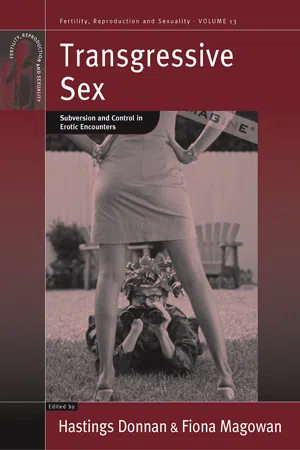
eBook - ePub
Transgressive Sex
Subversion and Control in Erotic Encounters
- 290 pages
- English
- ePUB (mobile friendly)
- Available on iOS & Android
eBook - ePub
Transgressive Sex
Subversion and Control in Erotic Encounters
About this book
Trusted by 375,005 students
Access to over 1.5 million titles for a fair monthly price.
Study more efficiently using our study tools.
Information
CHAPTER 1
SEXUAL TRANSGRESSION, SOCIAL ORDER AND THE SELF
This book is about sex that crosses or threatens to cross boundaries and about sex acts that flout social, moral and cultural convention. The topic is timely. Never before have we been so exposed to, knowledgeable about and seemingly accepting of the range of sexual practices and activities once known only to professional sexologists or contained in the erotic exotica of anthropologists. Sexual variety and experimentation have now become the everyday fare of teen magazines, television soaps and Internet chat rooms as a titillating tattle that stimulates sales and perhaps much else besides. Anything goes, and the self-gratification of what was yesterday perceived as sexual perversity has been replaced by what today is understood as the self-fulfilment that follows from the practice of sexual diversity.
These developments concern many, particularly those who see in them declining moral standards, and we examine later in the book how moral boundaries are mapped in space, regulated and policed, generating widespread alarm when they are breached and giving rise to strategies of subterfuge, evasion and subversion. But the chapters also variously explore other boundaries: those of sexual imagination and ‘good taste’ as well as those of the self and the social order, focusing on everything from sex across culture, class, gender and age to sex at the borders between human and animal species. Such sexually transgressive acts arouse passions in more ways than one and the boundaries that are violated or upheld become flashpoints of violent contest and dispute whose study, this book contends, reveals much about how social life is ordered and perceived. These acts are consequently notoriously difficult to investigate and as some of our contributors show their study raises profound methodological and ethical issues for the researcher who observes and records them and who may even become directly involved. Often they can be studied only through long-term, intense engagement with those who practise them, for they are frequently marginalised, hidden or denied, a research focus to which the ethnographic methods of the anthropologists who make up the contributors to this collection are especially well adapted.1
The work that follows, then, is the result of close association with those whose practices are described, often over many years of detailed fieldwork and careful elucidation of the broader cultural context within which certain acts take place or particular beliefs are held. Accounts from contemporary Oceania, the Pacific, South Africa and South-east Asia as well as from Euro-America clarify the forms that transgressive sex can take beyond the more usual popular emphasis on the latter and generate the potential for comparative insight into sexual diversity. This can be especially important for public health workers and clinical practitioners, who are primarily concerned with the practical health risks and emotional consequences of some kinds of sexual activity, particularly in relation to the transmission of HIV/AIDS, as well as for those whose sexual practices may put them at risk because of the cultural context in which they occur, as several of the chapters illustrate in the negotiation of gay sexuality in the Cook Islands, France and Poland. So too with the issue of young people and sex that is the central focus of three chapters (on Northern Ireland, England and South Africa), and where an anthropology that is at once localised, comparative and global sheds light on how young people's apparent escalation of sexual involvement at an ever-younger age constitutes a practical challenge not only for youth workers and parents but also for the young people themselves, albeit for different reasons and in different ways. And similarly in the chapters that examine child prostitution in Thailand and sexual violence among Australian Aborigines, forms of sexual transgression that are particularly problematic to address when they straddle the boundary between competing legal and political regimes. In each case explored in this book, the potential for over-pathologising transgressive sex is curbed by paying careful attention to all of the voices involved, including that of the anthropologist (one chapter reflects upon issues for women researchers in encountering sexual transgression during fieldwork). However, before elaborating further on the substantive themes of the chapters, we first consider the kinds of analytical approach and perspective used to study and conceptualise sexual transgression.
Perspectives on transgression
Transgression has been increasingly recognised by social scientists as a key frame of analysis through which to view social and sexual transformations of the world. Sex is a powerful mediator in transgressive contexts, since sexual encounters invoke uneasy tensions between consent, demand, resistance and reciprocity, in which elements of domination, vulnerability, risk and safety all play a part. Transgressive acts, principles and institutions highlight the cultural specificities of sexual intercourse, as the liminal position of transgressors and transgressed challenges possible and desirable sexual interactions. Sex, at first glance, might appear to be a natural bodily phenomenon, but it has been clearly argued that the experience of sexuality is produced through structures of power, knowledge and performance (see Foucault 1980; Butler 1990). Transgressive sexual acts and practices impact upon each other through ludic plays of mirroring. These mirrors of transgressive nonconformity allow us to see through issues of power and control that are variously public and private, implicit and explicit, verbalised and embodied across a range of diverse social structures and cultural forms. Sexual transgression is an enticing and hazardous proposition for reorganising human agency, perception and action as its inherent sense of crossing limits, amplifying margins and repositioning power can extend and transform the boundaries of the social body, social order and the self.
Central to the book's argument is an exploration of how sexual transgression operates at these edges of social boundary maintenance as well as how the ambiguities of the transgressive sexual body lead to processes that may dissolve, transform and reconstitute senses of self, moral action and body politics. By unravelling this nexus the contributors reveal how agents negotiate, deploy, redefine and subvert the performative possibilities of sexual bodies at their transgressive limits. They raise issues of propriety and impropriety around the visible control of sexual acts and interrogate the slipperiness of sexual transgression as an elusive and fluid concept, shimmering precariously at the peripheries of social existence, evoking uncertainty and danger.
Anthropology has long studied sexual acts that cross boundaries and that have the potential to challenge or confirm the moral, legal, social, economic, political, ethnic, racial and other limits in any particular cultural context, even if in the past such acts were not always referred to by the now fashionable term ‘transgressive’. So too in sociology a ‘weak-kneed version’ of transgression (Jenks 2003: 3) was once the focus of a ‘sociology of deviance’ that in the latter half of the last century spawned numerous qualitative studies of ‘deviant subcultures’ which violated societal norms and values, such as the subcultures associated with prostitution, promiscuity and pornography (see Gagnon and Simon 1967; Douglas 1970; Bryant 1977). But in anthropology probably the most obvious example is the incest taboo, a prohibition on sexual relations with close kin that was regarded by generations of scholars to be the very basis of a stable social order and the breach of which was thought to entail apocalyptic outcomes for society and humanity. Only the very powerful could flout such sexual prohibitions, as in the classic textbook example of Ptolemaic Egypt, where for thousands of years brother–sister marriages were famously contracted by the ruling dynasties to demonstrate and preserve their wealth and power. Different forms of power and their violation clearly come into play in related kinds of familial sexual transgression, as in parent–child incest, and in other forms of child sexual abuse, including the so-called ritual and satanic abuse in late 1980s Britain. These have also been a focus for anthropological debate, which raised questions about the practice, structure and organisation of power within the family and the household that had a public policy as well as an academic impact (La Fontaine 1990, 1994).
Of course historically anthropologists have studied many other kinds of sexual transgression in addition to incest. Often linked to the exercise and performance of power, such acts could be coercive or consensual, and could define, maintain, blur or transcend the boundaries that they crossed, which were often conceived as the structural boundaries of class or caste, or the racial boundaries across which miscegenation was proscribed, or the boundaries between Europeans and the non-Europeans they colonised and where sexual control was both an instrument and a metaphor of domination (see Stoler 1992). Sexually transgressive roles too have long attracted the anthropological gaze, from early studies of the Plains Indians berdache (or two-spirit) to research on the travestis, hijra and xanith of Brazil, India and Oman respectively, where the boundaries crossed were not just those of structure but more often those of self. In fact, the transgressive and boundary-transforming potential of so many ways of sexual being from transvestite to transgender to transsexual is now so frequently invoked that the prefix ‘trans’ is seriously in danger of being overworked.
Drawing on this long-standing interest in anthropology in what now would probably be called ‘transgressive sex’, the contributors to this book provide new cross-cultural insights into the experiences, practices and moral dilemmas raised by different kinds of sexual transgression, the categorisation of which emerges from the peculiarities of cultural and historical conditioning in each of the places where they undertook fieldwork. Johnson illustrates how the rise of ‘perversions’ in the West is a product of shifting moral codes variously based upon medical, psychological and pathological explanations. In addition, the global spread of tourism and sex commodification has meant that governments have had to address the deleterious effects of foreign sex trade on children such as in Thailand (Montgomery), while, in Britain, summer funfairs aimed at tourists have become sexual playgrounds for teenagers, who are seen to threaten the moral well-being of the nation (Clisby). Two contributions show how contravening the moral order of public spaces marks the bodies within them as respectable or vulgar (see Roche and Lindegaard and Henriksen), while one analyses how places invite bodily transformations via sexually transgressive encounters (Gaissad). What is considered transgressive may be hotly contested and Cassidy documents how responses in the USA and UK to sex with animals seem to vacillate between legislating against this minority sexual act and apparently condoning it through giving it airtime in the media. Even among those who share sexual orientation and preferences, like the Polish gay and lesbian activists described by Baer, there may be no agreement over what counts as transgressive. In other parts of the world, religion has been instrumental in shaping the concept of transgression and in the Cook Islands, Vanuatu and northern Australia, for example, traditional sexual mores have been variously influenced by modernity and Christianity, ironically inviting sexual licence as much as sexual restriction (Alexeyeff, Kristiansen, Magowan). Finally, one author takes up the challenge of reflecting upon the sexual practices of the anthropologist by considering sexual experiences between transgressors and the transgressed (Kristiansen). Each of these contributors addresses theoretical concerns in the anthropological literature on transgression whilst also critiquing and extending current perspectives on the relationship between social structure, sexual agency and erotic intersubjectivity.
Theorising transgressive sex
The theoretical possibilities of transgression, in general, and sexual transgression, in particular, have been variously interpreted by anthropologists through breaches of personal and group norms. Transgression has been marked by ‘dirt avoidance’ and ‘sex pollution’ (Douglas 1966); ‘symbolic inversions’ that highlight contradictions in cultural codes (Babcock 1978); and the excesses of classical and grotesque bodies that reveal the mediatory role of the ‘carnivalesque’.2 ‘Doubleness’ is inherent in this latter instance of bodily transgression as ‘there is no unofficial expression without a prior official one or its possibility’ (Stallybrass and White 1986: 16).
Since the early Renaissance, transgression has most commonly been analysed as a structural mode of inversion referring to ‘a turning upside down’ and ‘reversal of position, order, sequence, or relation’ (OED n.d.: 1477, cited in Babcock 1978: 15). Davis (1978: 177, 182) has argued that, in France and England in the sixteenth and seventeenth centuries, sexual inversion offered positive licence for unruly women to flourish ‘on top’ through challenging hierarchical structures and playing upon uncertainties in the distribution of power in politics and family life. Such role reversals bring into focus those who have the authority to determine what constitutes the ‘inherent dominative mode’ (Raymond Williams cited in Stallybrass and White 1986: 4) by unwittingly ensuring that the conditions are set for those who perceive themselves to be inferior to challenge the orthodoxy. Role reversals also operate as a ‘means of social control, of social protest, of social change, and of social deviance’ (Babcock 1978: 30). Babcock (1978: 22) has noted that studies which draw upon inversion generally imply perversion and primarily homosexuality and that they consider ‘role reversals’ and ‘not actual sexual practices’. These kinds of structural inequalities move away from performative analyses of transgressors to focus instead upon transgressive schemata in which social class and politics may be seen as mutually reinforcing elements in structural stability or instability.
The study of such structural reversals has a long pedigree in social anthropology, where they were often seen as a social safety valve that functions to contain conflict, and they stretch back to classic accounts of becoming king for a day through to Gluckman's (1970) analyses of ‘rituals of rebellion’. Thus Gluckman describes how in certain ritual contexts Zulu women could behave like men, commit public obscenities, go naked and sing lewd songs in a licensed vulgarity that far from subverting the social order confirmed and legitimated it. Although to some early observers such role reversals appeared to challenge the structures of power, Gluckman argued that this behaviour was rarely revolutionary but rather constituted one way in which the social order could be maintained by harnessing the potentially divisive forces of society within a ritual context that permitted their contained expression. The licensed relaxation of the usual constraints thereby merely served to emphasise them, although Gluckman stressed that these reversals were closely regulated by the rituals of which they formed a part and were permitted only when the social order was considered sufficiently resilient not to be endangered by them.
For Gluckman, then, sexual licence in the ritual context was rarely transformative in any more than the sense that it incorporated potential conflict as a functional element of a social order's cohesion and thus reproduced the balanced equilibrium that he considered lay at the heart of the societies he studied. According to many ethnographers, other aspects of popular culture that include role reversals and inversions, such as carnivals and festivals, can similarly be seen as forces of conservatism that reconfirm the existing order, although they may contain within them a utopian and egalitarian radicalism that endures beyond the event itself. The ludic enactments and heightened vulgarities that typify carnival and that are usually conceptualised as a subaltern critique of the dominant structures may be more than mere ‘play’, and may reflect an agenda with real social and political objectives, but the social order of the day is likely to resume as normal following carnival's temporary transgressions and indignities (and may even be discernible within the carnival itself; see Clisby, this volume). So too with the transgressive behaviours associated with carnival that are transformative of the self. Among the different elements of carnival that anthropologists have emphasised (see Gilmore 1988 for an overview) is the use of masquerade as a licensed cover for ordinarily proscribed bodily acts, whereby participants transformed by mask and costume engage in outlandish sensual and bodily pleasures and obscenities that are otherwise denied, and through which they are ‘reborn for new, purely human relations’ in a context where all hierarchies and quotidian selves are temporarily suspended (Bakhtin 1984: 10). After the carnival, however, it is very much business as usual, and in the end these transformations of the self are limited as a force for change by virtue of the fact that, located within the structure of carnival, they arise from a conventionalised repertoire of predictable and standardised behavioural violations (Hauser 2006: 141).
In contrast to these structural modes of inversion, theorists of sexual experience, such as Leiris and Bataille, have focused their attention on the emotion and aesthetics of erotic desire in sexual relations by exploring a ‘world of play’ that leads to the dissolution of the self (Bataille 1986: 275). For Bataille, transgression is not just about breaking rules, but about their completion, since every rule has contained within it the possibility of its violation, and every crossing constitutes its affirmation. As he puts it, ‘The transgression does not deny the taboo but transcends it and completes it’ (Bataille 1986: 63). In other words, a rule and its transgression are mutually defining. The implications of transgression here are clearly rather different from the ‘structural’ notion that we have outlined so far, for here transgression is ‘not simply a reversal, a mechanical inversion of an existing order it opposes’ but entails a mixing of categories and an interrogation of the boundaries that separate them in a process unlikely merely to return us to the status quo (Jervis 1999: 4). According to Bataille, the relationship between taboo and transgression is thus both contingent and dynamic, enabling change while simultaneously ensuring stability, in a process that once again might look as if transgression is necessary to maintain the system, although in this case ‘certainly not in functionalist terms’ (Jenks 2003: 95, 107).
This volume attempts to engage both these approaches to transgression by exploring inversions and role reversals not only as part of the social, political and cultural conditions of production but also through the erotic nature of transgressive sexual practices and experiences of actors. In other words, the book is concerned with transgressions that focus on structure and those that focus on the self, and with the relations between these. The anthropologist is also implicated in transgressive structures and their agency by reflecting upon thoughts and cultural practices that are located betwixt and between normative and transgressive life worlds of the subjects, both real and imagined. Köpping (2002: 253, 27...
Table of contents
- Cover Page
- Title Page
- Copyright Page
- Contents
- Preface
- 1. Sexual Transgression, Social Order and the Self
- 2. Sexually Active Virgins: Negotiating Adolescent Femininity, Colour and Safety in Cape Town
- 3. Summer Sex: Youth, Desire and the Carnivalesque at the English Seaside
- 4. A Curious Threesome: Transgression, Conservatism and Teenage Sex in the ‘Free House’ in Northern Ireland
- 5. Zoosex and Other Relationships with Animals
- 6. Dancing Sexuality in the Cook Islands
- 7. ‘Let Them Hear Us!’ The Politics of Same-sex Transgression in Contemporary Poland
- 8. Taming the Bush: Morality, AIDS Prevention and Gay Sex in Public Places
- 9. Transgression and the Making of ‘Western’ Sexual Sciences
- 10. What Constitutes Transgressive Sex?: The Case of Child Prostitution in Thailand
- 11. Courting Transgression: Customary Law and Sexual Violence in Aboriginal Australia
- 12. Managing Sexual Advances in Vanuatu
- Notes on Contributors
- Index
Frequently asked questions
Yes, you can cancel anytime from the Subscription tab in your account settings on the Perlego website. Your subscription will stay active until the end of your current billing period. Learn how to cancel your subscription
No, books cannot be downloaded as external files, such as PDFs, for use outside of Perlego. However, you can download books within the Perlego app for offline reading on mobile or tablet. Learn how to download books offline
Perlego offers two plans: Essential and Complete
- Essential is ideal for learners and professionals who enjoy exploring a wide range of subjects. Access the Essential Library with 800,000+ trusted titles and best-sellers across business, personal growth, and the humanities. Includes unlimited reading time and Standard Read Aloud voice.
- Complete: Perfect for advanced learners and researchers needing full, unrestricted access. Unlock 1.5M+ books across hundreds of subjects, including academic and specialized titles. The Complete Plan also includes advanced features like Premium Read Aloud and Research Assistant.
We are an online textbook subscription service, where you can get access to an entire online library for less than the price of a single book per month. With over 1.5 million books across 990+ topics, we’ve got you covered! Learn about our mission
Look out for the read-aloud symbol on your next book to see if you can listen to it. The read-aloud tool reads text aloud for you, highlighting the text as it is being read. You can pause it, speed it up and slow it down. Learn more about Read Aloud
Yes! You can use the Perlego app on both iOS and Android devices to read anytime, anywhere — even offline. Perfect for commutes or when you’re on the go.
Please note we cannot support devices running on iOS 13 and Android 7 or earlier. Learn more about using the app
Please note we cannot support devices running on iOS 13 and Android 7 or earlier. Learn more about using the app
Yes, you can access Transgressive Sex by Hastings Donnan, Fiona Magowan, Hastings Donnan,Fiona Magowan in PDF and/or ePUB format, as well as other popular books in Social Sciences & Anthropology. We have over 1.5 million books available in our catalogue for you to explore.