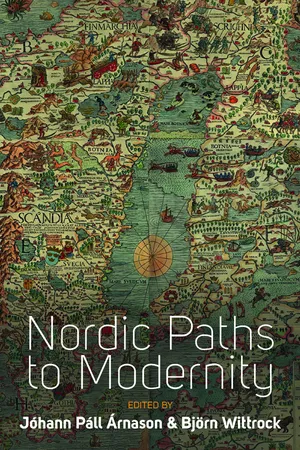
Within the growing attention to the diverse forms and trajectories of modern societies, the Nordic countries are now widely seen as a distinctive and instructive case. While discussions have centred on the 'Nordic model' of the welfare state and its record of adaptation to the changing global environment of the late twentieth century, this volume's focus goes beyond these themes. The guiding principle here is that a long-term historical-sociological perspective is needed to make sense of the Nordic paths to modernity; of their significant but not complete convergence in patterns, which for some time were perceived as aspects of a model to be emulated in other settings; and of the specific features that still set the five countries in question (Denmark, Sweden, Norway, Finland and Iceland) apart from one another. The contributors explore transformative processes, above all the change from an absolutistmilitary state to a democratic one with its welfarist phase, as well as the crucial experiences that will have significant implications on future developments.
eBook - ePub
Nordic Paths to Modernity
- 296 pages
- English
- ePUB (mobile friendly)
- Available on iOS & Android
eBook - ePub
Nordic Paths to Modernity
About this book
Trusted by 375,005 students
Access to over 1.5 million titles for a fair monthly price.
Study more efficiently using our study tools.
Information
CHAPTER 1
Nordic Modernity: Origins, Trajectories, Perspectives
The Military and Absolutist Point of Departure
Nordic modernity is often understood in terms of enlightened and progressive welfare politics and social equality. There is a more or less implicit association with images of a Social Democratic model. The aim of this article is twofold: to discuss the historical preconditions and construction of that model of progressive politics, and to discuss its relevance today and its future prospects.
Concerning the first aim, there is nothing historically predetermined about a progressive development path. Nordic modernity should not be understood as teleology or as given by a natural state of egalitarian peasant communities. On the contrary, until the Napoleonic turmoil at the beginning of the nineteenth century, Denmark-Norway, to which Iceland belonged, and Sweden-Finland had a long history of military involvement in the European wars. Sweden was ruled by royal absolutism until 1809, Denmark until 1848. The series of military defeats in the eighteenth century changed the preconditions of the warlike disposition, but in Sweden the nobility continued to play an important political, cultural and economic role. The king based his power on a popular royalism built up not least in conflict with the nobility. King, gentry and people were involved in a triangular power struggle (kungamakt, herremakt, folkmakt, monarchical power, aristocratic power, people’s power) from the seventeenth through to the nineteenth century. In Finland many of these structures remained after 1809 when it was transferred to a grand duchy under the Russian tsar, but they were more complex due to the language issue and the cultural struggle between the svekomans and the Fennomans. In Denmark-Norway the king based his absolutist regime from 1660 on a strong popular support under elimination of the political role of the nobility. Iceland is the exceptional case in this warlike and absolutist history. As a sparsely populated (less than sixty thousand inhabitants around 1850) and remote island in the Atlantic, it never developed any military or feudal structures, and distance always ensured a certain degree of autonomy within the absolutist (until 1848/1849) Danish state.
Popular royalism was in particular based on the mobilization of politically strong freeholder peasants and urban middle classes. Here it must be noted that the North, until the end of the nineteenth century, was rural, and the degree of urbanization was less than in continental Europe. Political mobilization in the nineteenth century took a nationalistic turn. Nationalistic rhetoric frequently invoked a heroic military past. In Denmark nationalism was used against the growing power of Prussia during the decades after 1848. In Sweden the perceived threat was Russia, and nationalistic activism was linked to hopes of reconquering Finland. A third variation of the nationalistic theme was Scandinavianism, which tried to unify the threats of the Danes in the South and the Swedes in the East into one Denkfigur where a common Nordic past since the Viking Age was invoked. Scandinavianism as a dynastic and nationalistic programme failed in the end because few Danes were prepared to die for Sweden in the East, and the Swedes were not prepared to die for Denmark in the South. Norway developed a specific left-oriented nationalism in the framework of the union with Sweden. It claimed more autonomy and equality for Norway in the union and turned against the dangerous military activism associated with Swedish claims of national superiority and hopes for the reconquest of Finland. Again, Iceland is an exception. Nationalism there emerged also in the 1840s, but it only slowly developed into a political programme for independence, and a target for hostility was less identifiable. However, Finland also deviated from the Scandinavian pattern of centrifugal nationalisms and the vain attempts to overcome the lack of cohesion through Scandinavianism as an alternative nationalist ideology. After 1809, Finland searched for a position as a new nation that acknowledged a certain Swedish heritage even while adapting to the Russian presence. This search provided the framework for a language struggle that intensified throughout the nineteenth century, although it always remained subordinated to the shared struggle for national autonomy.
Authoritarian versus Democratic Options
There were also factors underpinning a more progressive and egalitarian development in the North, in particular the strength of the peasant freeholders and of the (numerically small) urban middle classes. The argument in this article is that these forces in the end broke through, but not until the 1930s in response to the Great Depression. Everywhere in Norden, red-green Social Democratic–Farmers’ Party reform coalitions emerged in attempts to cope with the economic crisis. Extreme political alternatives of both the right and left were marginalized. The Social Democrats were, with the exception of Iceland, the larger party in the coalitions. In that sense there is a Scandinavian Sonderweg but, again, there was nothing teleological in that breakthrough. In Iceland, a predominantly peasant society, these forces had, in a sense, always been stronger.
In the introduction to the revised (1981) edition of The Crisis of German Ideologies, George Mosse noted that while his book appeared to have left the impression among some readers that völkisch thought must inevitably lead to Nazism, this was not his intention. Not only were ‘moderate’, mainstream conservatives in pre-1933 Germany deeply infected with völkisch thoughts, but there also existed the non-authoritarian völkische socialism of Gustav Landauer which drew on the ideal of the Volk as a democratic community of equals (Mosse 1981). Eugene Lunn (1973) has suggested that Landauer’s völkische socialism could provide an antidote to the tendency among historians to teleologically link völkische romanticism with the triumph of Hitler’s version of völkische ideology. (For a discussion of the concept of völkisch in a comparative European perspective, see Hettling 2003.) The argument in this article is that the North fits well into this alternative scenario that Mosse drafted.
Mosse contended that socialists of all countries made efforts to combine völkisch and socialist thought, and speculated that if such a blend had been successful, National Socialism might not have triumphed so easily. Lars Trägårdh has taken up and developed this idea in a comparison of völkische ideologies in two ‘Germanic’ countries, Sweden and Germany, taking 1933 as the point of departure for the analysis. The same year as Germans voted their way to völkische Nazi dictatorship, a new coalition government headed by the Social Democrats came to power in Sweden. Founded by men inspired by Lassalle, Marx, Kautsky and other luminaries of the German socialist movement, the Swedish party was in many ways modelled on the German SPD. However, by the end of the 1920s the Swedish Social Democrats began to integrate völkische and socialist themes. They redefined their party from a workers’ class-based party to a people’s party, bent upon the idea of a folkhem, a home for the people. Class alliances replaced the class struggle as the dominant strategy for achieving the socialist dream of the classless society (Trägårdh 1999). The Swedish Social Democrats appropriated the political priority of interpretation of the folk concept after a protracted discursive struggle with the conservatives who had, at the turn of the century, used the concept to develop a strategy that one of the protagonists (Rudolf Kjellén, who later became known for his geopolitical theories) labelled ‘national socialism’, an ideological instrument designed to ward off the threats of class-struggle socialism. Rudolf Kjellén was uncompromising in his opposition to class-struggle socialism as the basis for political discourse. From his conservative perspective he argued for national socialism, portraying the country as a whole in which all of the people should be involved in society. The country was supposed to be a home for the whole population. The integrative idea of the ‘folkhemmet’, in which society was organized as a family, with the home as a metaphor, subordinated the class struggle to national welfare.
When Kjellén talked about the concept of folkhemmet, folk had a different connotation from Volk in Germany. Volk was a more holistic notion inspired by Herder’s philosophy and Romanticism. Folk connoted rather the empirically derived view of a union of all social classes. Both varieties of the concept connected visions of future potential to past achievements, but Volk had more utopian and folk more empirical connotations (for the German case, see Jansen 1993).
The Swedish Social Democrats were attracted to the folkhemmet concept from an early stage, but wanted to give it another content. They rejected the conservative version as ‘the fortified poor-house’, a reference to the priority of military over social state expenditures in the conservative programme. They gradually found themselves involved in a discursive struggle about the definition of the folk. When, in the 1930s, the Social Democrats took over the folkhemmet metaphor and made it their symbol, they argued that the happiness of the lower classes, of which the working class was just one part, was based on their efforts to contribute to the folkhemmet. As expressions of traditional values, folk and folkhem were mobilized as linguistic instruments for modernization (Stråth 1996).
The Swedish case could be seen, in ideal typical terms, as representative of a broader Nordic pattern of development. The point is not only the outcome in the 1930s, but the long period of contention and social conflict about the shaping of the future before the breakthrough.
Freeholder Peasants, Education and Religion: Modernity as Individualism with Solidarity
The Enlightenment was not retarded in the Nordic peasant communities, as sometimes has been argued. However, there was a specific kind of enlightenment. The enlightenment tradition in the North contained a pragmatic, empirical and fact-finding dimension, which sometimes – in its modern and bureaucratic version – seems to come close to Max Weber’s idea of permanent disenchantment, and which was underpinned by the social sciences and by beliefs in politics for social improvement. The term social engineering has been used to describe this ethos (Marklund 2008).
In Scandinavia the tension between freedom and equality in the political culture was contained better than elsewhere. The peasant figure created by the intellectuals and the clergy in Norden, with a view to reducing the tension between freedom and equality, was not merely a romantic fiction with no relation to the real world, but was rather an increasingly active participant in economic and political processes. In most other parts of Europe, the peasant had been effectively eliminated from the political processes and was invoked as a rhetorical, even utopian, figure. The inherent tension between the concepts of freedom and equality was better controlled in the North by means of the peasant myth. The Nordic peasant was too conservative to be radical but too radical to be conservative (Witoszek 1997; cf Aronsson 1993; Karlsson 2000). The concept of freedom was less practised in the sense of Isaiah Berlin’s term ‘negative freedom’ than in terms of positive liberty connected to virtues of responsibility for co-citizens. Freedom contained a solidaristic dimension and individualistic ideals were interwoven with ideas of collective performance.
In Sweden the peasants had been represented by their own Estate in the Diet since the fifteenth century. In Denmark the last remnants of serfdom were not abandoned until 1788, but the mythical historical construction of a free peasantry with roots in the Viking Age began soon thereafter and proved successful.
Given this framework of peasant-oriented foundation myths, Nordic Romanticism was pragmatic and individual-oriented, in contrast to the more holistic community produced by the Sturm und Drang movement in the German-speaking territories. In the North the Protestant Romantic produced a specific version of the protestant ethic. The Nordic people’s, rather than populist movements, which emerged in the nineteenth century as protest movements criticizing the old society, expressed specific educational ideals. The message they mediated expressed an individual-oriented protestant responsibility and ethics rather than holistic collectivism. This individualist orientation constitutes an important element of the Nordic culture (Trägårdh 1997). The influence of the Enlightenment in the North must be seen in the context of the social communication capacity developed through the people’s movements. Education (bildning/dannelse) was a key instrument for self-realization and, in contrast to the German Bildungsbürgertum for example, was seen very much as a bottom-up process. Here we must draw attention to the development of a communicative skill of the peasantry, whose training ground was the parish meeting, and which gradually paved the way for a constructive dialogue between social democracy and a liberalism with a social rather than economic emphasis (see below). The commitment to people’s self-education, folkbildning/–dannelse within the people’s movements provided growing articulateness and ability of the peasant freeholders to negotiate their agenda. Self-education was a school of politics (Sørensen and Stråth 1997). (The argument is developed in the discussion of Grundtvig below.)
The emerging patterns of social organization merged hierarchy and centralized state authority with local community as the basis of government, alongside state church norm-setting of religious authority and pietist individualization of transcendental experiences. Over time the local farmer cooperatives ended in state corporatism, as Niels Kayser Nielsen demonstrates in this volume. Also Gunnar Skirbekk, in his contribution, emphasizes the inter-dynamics between Lutheran state officials and the people’s movements (folkbeve/æ/gelser/folkrörelser), and the connection between monoreligious cultures and religious tolerance of difference.
Social democracy as a continuation/transformation of Lutheranism and parochial political culture, and of social liberalism, as well as reform conservatism, could be seen as a particularly Scandinavian expression of how to handle the inherent tensions contained in the freedom and equality ideals. The question of whether this applies to Finland, which had gone through a civil war and had been on the brink of a fascist coup in the 1930s, must, according to Risto Alapuro’s convincing argument in this volume, be answered affirmatively. For Alapuro, the language struggles and the cultural conflict between the Swedish-speaking and the Finnish-speaking populations in the nineteenth century were less important than their shared national aspirations. Under the Grand Duchy of the Russian Empire, the Finnish-speaking free-holding peasantry and the Swedish-speaking economic and political elite combined to lay the foundations for a common political culture that paralleled the rest of Norden. This common culture embraced two competing approaches, the Fennomans emphasizing an ethnic nation and the elite emphasizing a liberal constitution. Together they contributed to the consolidation of the Grand Duchy as a separate political entity within the Russian Empire. The people’s movements in several respects bridged the oppositions. At the end of the nineteenth century, Scandinavian-type administrative and political institutions, a national economy and a small armed force confirmed the entity’s existence, adjusting to the flexible geopolitical situation in the Baltic. The Finnish destiny at the moment of independence was determined outside the country, where its historical experiences and institutions were of limited value. The civil war was a consequence of a specific political conjuncture in the wake of the Russian Revolution and the collapse of the two Baltic empires. The full force of the tensions that had been developing between Russia and Germany since the early 1890s hit Finland at the moment of independence. The clash between white guards and red guards on Finnish ground was a continuation of the violent conflict between empire and communism. The civil war made it impossible to reconcile class and nation as in the rest of Norden. Finland after 1918 was a nation opposed to class, a configuration that endured until the end of the Cold War. It was particularly distinct in the 1930s with the Lappo movement. The experiences of two wars against the Soviet Union (1939–1944), a strong Communist Party and the shadow from the East over the autonomous republic dampened flagrant expressions of autonomy. However, the wars also promoted steps towards reconciliation between nation and class, and reconnection to the Scandinavian institutional and normative pattern which had marked Finland during the nineteenth century (Alapuro in this volume; cf. Alapuro 1988).
Alapuri’s analysis of how Finland fits into a broader Nordic pattern of a long-term coming to terms with the tension between authoritarianism and democracy, between national homogeneity/collectivist approaches and individual freedom demonstrates how open the Scandinavian developments were and how close the authoritarian alternative was.1 Seen as a part of that broader Nordic pattern, the case of Finland shows how close alternative developments were and how contingent the actual development really was in, for instance, Sweden (cf. the Ådalen example in end note 1).
Therefore, the Nordic developments should not be conceptualized in terms of path dependency, because dependency on the past for future developments always comes with a degree of indeterminacy and contingency, in the sense of not necessary yet not impossible, only visible in retrospect.2
The Nordic nineteenth century, as modernization combined with a permanent peasant revolt (the people’s movements), may be seen as an alternative development both to the French, British and American standard of Enlightenment modernization, and to what Theodor Adorno and Max Horkheimer, with reference to German and Soviet developments, called the Dialectic of Enlightenment. The peasant was not only a historically derived construct. He was also a p...
Table of contents
- Cover Page
- Title Page
- Copyright Page
- Contents
- Acknowledgements
- Introduction
- 1. Nordic Modernity: Origins, Trajectories, Perspectives
- 2. The Danish Path to Modernity
- 3. Denmark 1740–1940: A Centralized Cultural Community
- 4. The Making of Sweden
- 5. History and Ethics in Pre-revolutionary Sweden
- 6. The Metamorphoses of Norwegian Reformism
- 7. Alternative Processes of Modernization?
- 8. Nordic and Finnish Modernity: A Comparison
- 9. Paradoxes of the Finnish Political Culture
- 10. Icelandic Anomalies
- 11. Icelandic Modernity and the Role of Nationalism
- Notes on Contributors
- Index
Frequently asked questions
Yes, you can cancel anytime from the Subscription tab in your account settings on the Perlego website. Your subscription will stay active until the end of your current billing period. Learn how to cancel your subscription
No, books cannot be downloaded as external files, such as PDFs, for use outside of Perlego. However, you can download books within the Perlego app for offline reading on mobile or tablet. Learn how to download books offline
Perlego offers two plans: Essential and Complete
- Essential is ideal for learners and professionals who enjoy exploring a wide range of subjects. Access the Essential Library with 800,000+ trusted titles and best-sellers across business, personal growth, and the humanities. Includes unlimited reading time and Standard Read Aloud voice.
- Complete: Perfect for advanced learners and researchers needing full, unrestricted access. Unlock 1.5M+ books across hundreds of subjects, including academic and specialized titles. The Complete Plan also includes advanced features like Premium Read Aloud and Research Assistant.
We are an online textbook subscription service, where you can get access to an entire online library for less than the price of a single book per month. With over 1.5 million books across 990+ topics, we’ve got you covered! Learn about our mission
Look out for the read-aloud symbol on your next book to see if you can listen to it. The read-aloud tool reads text aloud for you, highlighting the text as it is being read. You can pause it, speed it up and slow it down. Learn more about Read Aloud
Yes! You can use the Perlego app on both iOS and Android devices to read anytime, anywhere — even offline. Perfect for commutes or when you’re on the go.
Please note we cannot support devices running on iOS 13 and Android 7 or earlier. Learn more about using the app
Please note we cannot support devices running on iOS 13 and Android 7 or earlier. Learn more about using the app
Yes, you can access Nordic Paths to Modernity by Jóhann Páll Árnason, Björn Wittrock, Jóhann Páll Árnason,Björn Wittrock in PDF and/or ePUB format, as well as other popular books in History & European History. We have over 1.5 million books available in our catalogue for you to explore.