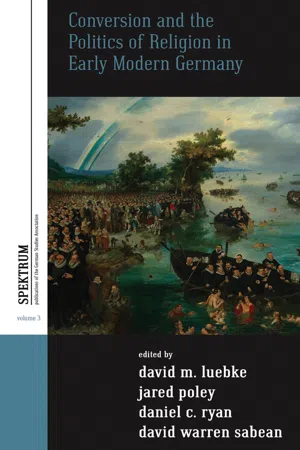
The Protestant and Catholic Reformations thrust the nature of conversion into the center of debate and politicking over religion as authorities and subjects imbued religious confession with novel meanings during the early modern era. The volume offers insights into the historicity of the very concept of "conversion." One widely accepted modern notion of the phenomenon simply expresses denominational change. Yet this concept had no bearing at the outset of the Reformation. Instead, a variety of processes, such as the consolidation of territories along confessional lines, attempts to ensure civic concord, and diplomatic quarrels helped to usher in new ideas about the nature of religious boundaries and, therefore, conversion. However conceptualized, religious change— conversion—had deep social and political implications for early modern German states and societies.
eBook - ePub
Conversion and the Politics of Religion in Early Modern Germany
- 216 pages
- English
- ePUB (mobile friendly)
- Available on iOS & Android
eBook - ePub
Conversion and the Politics of Religion in Early Modern Germany
About this book
Trusted by 375,005 students
Access to over 1.5 million titles for a fair monthly price.
Study more efficiently using our study tools.
Information
CHAPTER ONE

Paths of Salvation and
Boundaries of Belief
Spatial Discourse and the Meanings of Conversion
in Early Modern Germany
DUANE J. CORPIS
Both Catholic and Lutheran writers in the Holy Roman Empire articulated the concept of conversion after the Reformation with a cluster of related words and expressions. Conversio was the main Latin word for conversion, and its most common German equivalent was Bekehrung. Bekehrung itself possessed several nuanced meanings, denoting both the process of internal spiritual renewal experienced by a true convert and the external act of formally changing from one religion to another. But beyond Bekehrung, early modern German possessed a rich vocabulary to describe the act of conversion. One could, for example, “change” religion (die Religion wechseln or verändern); “move from one religion over to another” (von einer Religion zu einer anderen übertretten); or “take on” a new faith (eine neue Glaube annehmen).
These terms articulated a range of meanings that overlapped one another yet occupied discrete positions in the theological grammar of post-Reformation Christianity. In this essay I focus on two meanings at play in the texts of Catholic and Lutheran authors who concerned themselves with conversion and the nature of religious identity in early modern Germany. These positions corresponded roughly to a basic distinction between “intrareligious” and “interreligious” conversion. The former signifies the inner spiritual change that makes the “convert” a more committed believer but without a change of institutional religious affiliation; the latter refers to a person’s movement from one religious community to another. In this case, the convert’s choice to “take on” a new religion was typically accompanied by assertions of a profound spiritual transformation but was institutionally marked by the adoption of a new religious creed and identity.
These two meanings of conversion had existed since the early Church. Although the various terms used in German to describe conversion might refer to either of these two modalities of religious experience (or to both at the same time), the conceptual compartmentalization of the two meanings of intrareligious and interreligious conversions had become so commonplace that the distinction made its way into Johann Heinrich Zedler’s Universal-Lexicon aller Wissenschaften und Künste (Universal Lexicon of All the Sciences and Arts), an eighteenth-century encyclopedia. The Universal-Lexicon included two entries, one for Bekehrung and one for Religions-Veränderung. The description for Bekehrung offers a particularly Protestant perspective. When a person “is converted to God” (zu GOtt bekehret wird), the conversion “awakes faith in Christ the savior.”1 The act of conversion “produces a transformation (Veränderung) within the person” such that “what previously had existed [i.e., sin], is now erased, and what was once lacking [i.e., faith], is now generated.”2 As a result of this divine gift, the convert now (and only now) acquires the capacity to perform good works. The impact of this inner rebirth is so profound that a true convert “can be certain of his conversion, for whoever is converted will notice many changes in his soul.”3 The entry for Bekehrung nowhere mentions that the process might involve a change of confessional, denominational, or religious status or identity. Conversion, in this sense, meant the act of spiritual transformation that brought a person, any person, closer to Christ through the awakening of true faith.
While the word Veränderung—change or transformation—is used repeatedly in the definition for Bekehrung, the entry Religions-Veränderung offers a quite different take on an act that we today would also typically call a conversion. Immediately following the term Religions-Veränderung, the entry lists several synonyms: Religions-Änderung, Mutatio Religionis, and Mutatio Sacrorum. The text defines a Religions-Veränderung as a moment “when someone moves (übertritt) from one religion to another, and professes himself to another religion after [his] renunciation and abjuration of the religion, to which he had previously been affiliated.”4 In language that is confessionally neutral, the entry notes that such an act is fully protected by the “freedom of conscience” (Gewissens-Freyheit) promised by the Peace of Westphalia, so long as the new religion chosen by the convert was one of the three tolerated confessions of the realm, “namely the Catholic, Lutheran, or Reformed,” and that such a change should be permitted “without diminishing a person’s honor (Ehre) or dignity (Würde).”5 The entry then proceeds to discuss the problem of those people who abandon one religion for another due to secular inducements such as “money or other worldly advantages or motives,” but while it questions the authenticity of such conversions, the text never challenges the fundamental legal or religious legitimacy of multidirectional conversions among the three official confessions.6
Thus, by the eighteenth century the Universal-Lexicon distinguished between the two core meanings of conversion: an internal spiritual awakening that could take place within a person who presumably might already be a member of a Christian church, and a change of affiliation that transferred a person across a distinct religious boundary. Of course, both meanings had existed since the early Church. However, in the sixteenth century, two circumstances—the fragmentation of western Christendom and increased European contact with non-Christian cultures around the world—reconfigured these meanings in important ways. What changed was the way in which the two primary typologies of conversion were weighted in relationship to one another and the manner in which they were used to characterize relations both between Catholics and Protestants and between Christianity and the non-Christian religions of the world.
These changes played out in two stages. As the first part of this chapter shows, Lutheran reformers initially mobilized a preexisting, Catholic sense of religious conversion—essentially the “intrareligious” type of conversion—even as they reformulated the theological explanation for what initiated and caused a person to convert. The reformers offered a new model for how a person arrived at conversion, but they did not change what a true conversion fundamentally was or ought to be: it remained a movement toward God and godliness, a renewal of the soul that altered the convert’s orientation to divine grace, justification, and salvation. The more Luther’s movement became institutionalized, however, the more an “interreligious” meaning of conversion came to predominate. I argue that this shift took root partly within the context of the confessional formation that began in the latter half of the sixteenth century. Indeed, the growing discursive preeminence of interreligious conversion was itself a central part of the process of confessionalization. After the Peace of Augsburg (1555) and even more so after the Peace of Westphalia (1648), increasingly rigid confessional boundaries separated religious camps while also instantiating the possibility for interreligious conversion within Christianity, the crossing over from one Christian denomination to another.
This process of differentiation did not transpire only in the context of interconfessional polemics; rather, the polarized confessional divide that emerged between Protestantism and Catholicism also reflected Europeans’ efforts to comprehend the experience of global expansion in the early modern period. Specifically, the process of confessional differentiation unfolded within two intertwined contexts: Christendom’s own internal religious fragmentation and Europe’s intensified encounters with the broader, non-Christian world. The complex geopolitical dimensions of these two contexts produced an imaginary religious landscape filled with religious “Others” demarcated from one another by expanding and contracting borders. The second part of this chapter shows how the competing Christian confessional communities imagined religious difference in terms of a larger, worldwide struggle between the “one true faith,” whether Protestant or Catholic, and the multiple “false” religions at home and around the globe.
Conversion as Spiritual Transformation
In the Middle Ages, the concepts of intra- and interreligious conversion existed side by side. The interreligious conversion of pagans, Jews, and Muslims to Christianity entailed the adoption of new beliefs, rites, and a new institutional source of religious authority. But the broader meaning of conversion was that of intrareligious conversion, which described a Christian’s spiritual movement closer to God, culminating in the transformation and reorientation of the soul, a spiritual epiphany, or in its most extreme cases mystical contact with the divine. This definition explains why conversio was also the term used to describe the specific act of taking monastic vows and leaving the decadent, profane world behind for the spiritual refuge of the monastery.
The idea of conversion as an inner journey of spiritual renewal and movement toward God also influenced a range of medieval movements that sat precariously on the edge of Christian orthodoxy, among them the Brethren of the Free Spirit, the Beguines, and the Brethren of the Common Life. The type of inner conversion professed by members of these movements had the potentially transgressive effect of decoupling the convert from the ecclesiastical authority of the church. Karl Morrison concludes that because of its mystical dimensions, this radical model of conversion “was not bound to formal, institutional obedience”; therefore “it frequently proved subversive of formal obedience and custom.”7 Such was the case with Protestant reformers, whose understanding of inner conversion was inextricably embedded within their critiques of official church doctrine.
To blunt this critical edge, medieval authors tried to secure the orthodoxy of inner conversion through constant reference to the convert’s obedience to God and to the divinely ordained order of earthly authority. Indeed, to describe the act of taking monastic vows as conversio was itself a means to contain the threat of religious conversion by drawing the process back under the institutional church’s control. This was the case when Bernard of Clairvaux preached a sermon on conversion in 1140, which purportedly led to the spiritual conversion of over twenty men who immediately joined Bernard’s own Cistercian Order.8 Similarly, Guibert de Nogent consistently labels as converts those men who joined his monastery and led exemplary ascetic lives.9 Likewise, the fourteenth-century Dominican nun Margaret Ebner explained her gradual movement toward mystical union with Christ through the cultivation of monastic ideals such as simplicity, patience, and compassion.10 The fusion of monastic life with conversion tamed the potential threat inherent in personal spiritual experience and revelation. This union of intense, inner conversion with complete submission to the institutional authority of the church would continue in the writings of sixteenth-century Catholic figures such as Teresa of Avila and Ignatius of Loyola.
Martin Luther derived his primary understanding of conversion from medieval tropes focused on the inner transformation of the soul, even if leaving rather than entering the monastery became the symbolic act of conversion for cloistered monks who joined the reform movement. Although Luther’s usage of the term conversion changed over the course of his career as a reformer, he primarily thought about the concept in relationship to his understanding of justification by faith alone, which he posited as the sole route to salvation. For Luther, conversion was not a choice made by a person or the result of human works; it was initiated by God alone as an undeserved gift. Accordingly, a person did not convert simply by rejecting papal authority, repudiating Purgatory and the cult of the saints, or taking communion in both kinds. By themselves, these outward acts did not indicate inner conversion to God, although anyone who had in fact been converted by the grace of God would perform them as a consequence of their conversion.11
For Luth...
Table of contents
- Cover
- Half title
- Title
- Copyright
- Contents
- Preface
- Introduction. The Politics of Conversion in Early Modern Germany
- Chapter One. Paths of Salvation and Boundaries of Belief: Spatial Discourse and the Meanings of Conversion in Early Modern Germany
- Chapter Two. Conversion Concepts in Early Modern Germany: Protestant and Catholic
- Chapter Three. Turning Dutch? Conversion in Early Modern Wesel
- Chapter Four. The Right to Be Catholic—the Right to Be Protestant? Perspectives on Conversion before and after the Peace of Westphalia
- Chapter Five. Conversion and Diplomacy in Absolutist Northern Europe
- Chapter Six. Irenicism and the Challenges of Conversion in the Early Eighteenth Century
- Chapter Seven. Mish-Mash with the Enemy: Identity, Politics, Power, and the Threat of Forced Conversion in Frederick William I’s Prussia
- Chapter Eight. Pietist Conversion Narratives and Confessional Identity
- Chapter Nine. Conversion and Sarcasm in the Autobiography of Johann Christian Edelmann
- Afterword
- Bibliography
- Notes on the Contributors
- Index
Frequently asked questions
Yes, you can cancel anytime from the Subscription tab in your account settings on the Perlego website. Your subscription will stay active until the end of your current billing period. Learn how to cancel your subscription
No, books cannot be downloaded as external files, such as PDFs, for use outside of Perlego. However, you can download books within the Perlego app for offline reading on mobile or tablet. Learn how to download books offline
Perlego offers two plans: Essential and Complete
- Essential is ideal for learners and professionals who enjoy exploring a wide range of subjects. Access the Essential Library with 800,000+ trusted titles and best-sellers across business, personal growth, and the humanities. Includes unlimited reading time and Standard Read Aloud voice.
- Complete: Perfect for advanced learners and researchers needing full, unrestricted access. Unlock 1.5M+ books across hundreds of subjects, including academic and specialized titles. The Complete Plan also includes advanced features like Premium Read Aloud and Research Assistant.
We are an online textbook subscription service, where you can get access to an entire online library for less than the price of a single book per month. With over 1.5 million books across 990+ topics, we’ve got you covered! Learn about our mission
Look out for the read-aloud symbol on your next book to see if you can listen to it. The read-aloud tool reads text aloud for you, highlighting the text as it is being read. You can pause it, speed it up and slow it down. Learn more about Read Aloud
Yes! You can use the Perlego app on both iOS and Android devices to read anytime, anywhere — even offline. Perfect for commutes or when you’re on the go.
Please note we cannot support devices running on iOS 13 and Android 7 or earlier. Learn more about using the app
Please note we cannot support devices running on iOS 13 and Android 7 or earlier. Learn more about using the app
Yes, you can access Conversion and the Politics of Religion in Early Modern Germany by David M. Luebke, Jared Poley, Daniel C. Ryan, David Warren Sabean, David M. Luebke,Jared Poley,Daniel C. Ryan,David Warren Sabean in PDF and/or ePUB format, as well as other popular books in History & German History. We have over 1.5 million books available in our catalogue for you to explore.