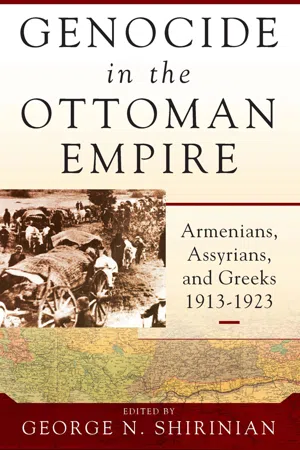
The final years of the Ottoman Empire were catastrophic ones for its non-Turkish, non-Muslim minorities. From 1913 to 1923, its rulers deported, killed, or otherwise persecuted staggering numbers of citizens in an attempt to preserve "Turkey for the Turks," setting a modern precedent for how a regime can commit genocide in pursuit of political ends while largely escaping accountability. While this brutal history is most widely known in the case of the Armenian genocide, few appreciate the extent to which the Empire's Assyrian and Greek subjects suffered and died under similar policies. This comprehensive volume is the first to broadly examine the genocides of the Armenians, Assyrians, and Greeks in comparative fashion, analyzing the similarities and differences among them and giving crucial context to present-day calls for recognition.
eBook - ePub
Genocide in the Ottoman Empire
Armenians, Assyrians, and Greeks, 1913-1923
- 444 pages
- English
- ePUB (mobile friendly)
- Available on iOS & Android
eBook - ePub
About this book
Trusted by 375,005 students
Access to over 1.5 million titles for a fair monthly price.
Study more efficiently using our study tools.
Information
PART I.
CONTEXTS
CHAPTER ONE
THE BACKGROUND TO THE LATE OTTOMAN GENOCIDES
George N. Shirinian
Introduction
Medz Yeghern, Seyfo, Megali Katastrophi. These are among the terms used by Armenians, Assyrians,1 and Greeks, respectively, for the horrific, massively destructive, and psychologically traumatic experience they underwent during the years 1913–23, an experience today we call genocide. The purpose of this study is to examine a number of interrelated factors that culminated in the Young Turks, and subsequently the Kemalist leadership, believing that the solution to Turkey’s political problems lay in the removal or destruction of its Christian citizens. We will also explore reasons the rest of the population went along with, and even participated in, this horrific policy. As this is a long and complex subject, the material presented here is selective and told in a compressed manner. Ample references are given, however, to allow the reader to pursue the various topics further.
The Political and Social Structure of the Ottoman Empire and the Status of the Non-Muslim Minorities
The political and social structure of the Ottoman Empire was based on the separation of its subjects into distinct communities (millets) along ethnic and religious lines. While this arrangement gave these communities a measure of autonomy, power and privilege rested with the “ruling nation” (millet-i hâkime), primarily ethnic Turks who were Muslim. The non-Muslim minorities—primarily Armenians, Assyrians, Greeks, and Jews—were giavours, non-believers in Islam, and conquered peoples. They had a significantly inferior status, legally, politically, and socially.
There were a number of ways in which the distinctions between Muslims and Christians were observed and enforced. These include but are not limited to the following.
It was forbidden for non-Muslim men to marry Muslim women, although Muslim men could marry non-Muslim women. Non-Muslims were repeatedly forbidden to live near mosques, or to build tall houses. Churches were not to be higher than mosques. It was not permitted for Christians to ring a bell to call the faithful to church, only to hit a wooden board with a mallet.2 Christians were not allowed to serve in the army, but had to pay a special tax for that exemption. They were not allowed to bear arms, so they could not defend their farms, property, or families when attacked by predatory nomads. If a Christian on horseback encountered a Muslim on horseback, the Christian must dismount until the Muslim passed by. The testimony of a Christian against a Muslim in court was not valid unless it had been extracted by torture.3 The punishment of a Muslim for a crime was halved if the victim was a non-Muslim.4
The complex system of clothing regulations is of special interest in this context. Up to the reforms of Sultan Mahmud II (ruled 1808–39), non-Muslims were required to dress differently from Muslims, to make their inferior status instantly recognizable. A British traveler and advisor to the Foreign Minister observed that “[t]he marks of distinction between Greek or Christian and Turk, are dress, name, and mode of salutation; the most important, however, is dress; every one must have felt this who for a day has worn the two costumes in Turkey. When these distinctions are no longer matters of right and law, they will fall into disuse….”5
In 1580, for example, “considering that their attitude from the point of view of the sheriat [Muslim holy law] and of logic should be humility and abjection,” Jews and Christians were formally forbidden to dress like Muslims, to wear silk, fur, or red shoes, and required instead to wear dark blue colors. Only Muslims could wear white or green turbans and yellow slippers. Greeks, Armenians, and Jews were distinguished respectively by sky blue, dark blue (later red), and yellow hats, and by black, violet, and blue slippers. The rules governing the costume of religious minorities were regularly reasserted, suggesting they were continuously challenged.6 Violators of the clothing laws could be executed. There was the sad case of a Christian beggar who was executed for wearing a pair of used yellow slippers—a color reserved for Muslims—that he had just received from a charitable Muslim.7 The adoption of the fez for all government employees in 1829, while supposedly intended to promote social equality, still included small badges to distinguish Christians from Muslims, at least up to the 1840s.8 Christians were even to wear signs suspended from cords around their necks, so that they might be distinguished from Muslims when undressed in a public bathhouse.9 The Amiras—wealthy bankers and moneylenders who were also an essential part of the state tax collection system, and who were mostly Armenian10—were allowed to wear special clothing that distinguished them from Muslims and non-Muslims alike.11
Such restrictions prevented Muslims and Christians from developing positive social relations with each other. The clothing regulations, for example, led many non-Muslims, especially the more prosperous ones in larger urban centers, to embrace the fez and the new official dress code as a means of escaping discrimination. Paradoxically, freed now from state-imposed clothing laws premised on religious differentiation, non-Muslims expressed their wealth visibly and publicly through their clothing. Thus, wealthy non-Muslims not only aspired to appear like their Muslim countrymen, but even competed with the highest government officials in ostentatiously differentiating themselves from ordinary people of all faiths.12
As a result of this inferior social status and visible differentiation, the Christians tended to develop social ties with other non-Muslims, who were either members of other Ottoman minorities or foreign residents of the empire, who were often connected to European embassies. This religious divide in Ottoman society was a significant factor in the social fragmentation of the empire.13 In the Ottoman concept of the social and political order, the non-Muslim subjects had their assigned place. When they were felt to be gaining too much wealth or power, it caused profound resentment among those in the ruling nation.14
The Economic Status of the Armenians and Greeks
The growth of international trade led to the non-Muslim Ottomans becoming dominant in this activity in the nineteenth century. This was especially the case after the Anglo-Ottoman commercial treaty of 1838, which led to a large influx of foreign capital into the Ottoman Empire.15 The European merchants were not as familiar with the business markets and practices locally as the native Christians. In many cases, the local markets were too small to make it worth the European merchants’ efforts. And significantly, the nature of buying and selling depended on extending credit to the local consumers, which the Ottoman Christians were able to supply. Thus, the foreign merchant and the local Christian agent complemented each other profitably.16
In Constantinople especially, the non-Muslim minorities lived close to the large European colonies. Unlike the Muslims, they had no restrictions in associating with Europeans. Jews and Christians were proficient in European languages, which enabled them to act as translators for foreign embassies and trading companies. Furthermore, European merchants were conscious that any contract entered into with a Muslim could be struck down in a Muslim court. Thus, Europeans increasingly partnered with non-Muslim merchants and helped them obtain the same economic benefits from the “capitulations” that they enjoyed, i.e. exemption from paying the poll tax, lower trade duties, and therefore lower costs.17 Perhaps even more significantly, the Europeans increasingly provided special legal protection for the non-Muslim merchants, which prevented the sultan from confiscating the latter’s wealth.18
In addition to foreign trade, the non-Muslims were well represented in finance (banking and moneylending), mechanized transport, export-oriented agriculture, and modern industries. They were also prominent in the professions, such as medicine, pharmacy, engineering, law, and teaching.19
Ottoman Christians, mainly Greeks and Armenians, represented the majority of officially registered merchants in Constantinople in 1911—as high as 90%. Two-thirds of the largest textile importers were Armenians.20 Of the 654 wholesale companies in Constantinople in 1911, 528 (81%) were owned by ethnic Greeks.21 Of the 40 private bankers in Constantinople in 1912, none had a Muslim name; of those who could be identified with reasonable confidence, 12 were Greek, 12 Armenian, 8 Jewish, and 5 Levantine or European. Of the 34 stockbrokers, 18 were Greek, 6 Jewish, 5 Armenian.22 In Smyrna, one of the principal economic centers of the Ottoman Empire and the major exporting port involved in trade with the West, Greeks made up between 40 and 50% of the city’s merchants during the second half of the nineteenth century, and shipping between Smyrna, the islands along the Anatolian coast, and with Greece was dominated by Greeks.23 Between 1880 and 1910, over 1,500 industrial plants were established in Smyrna with Greek capital.24 In the vilayet of Aydın (in which Smyrna was situated), 4,008 of the estimated 5,308 industrial establishments were owned by Greeks, some 76%, and they employed some 78% of the workers there.25 In 1915, a German observer noted, “The whole of the bazaar in Adana is Armenian. The cotton cultivation is also almost exclusively in Armenians’ hands; trade with this commodity in Greek hands.”26 The Christian minorities preferred to pay the special head tax in lieu of military service, as the possibilities of a military career were almost non-existent, and pursue more lucrative commercial careers. All this contributed to resentment by the majority population towards the non-Muslim minorities.
The Role of Education in the Status of the Armenians and Greeks
During the Reform Period (Tanzimat), 1839–76, the Christian population of the Ottoman Empire surpassed the Muslim majority in education; this, in turn, led to an increasingly dominant role for the Christians in the economy. In 1861, there were 571 primary and 94 secondary schools for Ottoman Christians, with a total of some 140,000 students, a figure that far exceeded the number of Muslim children in school during the same time. By 1895, the gap had narrowed, but still only 6.5% of Muslims attended school, compared to some 9% of non-Muslims. The non-Muslims were found especially in the foreign and medical schools.27
The Amiras built many Armenian schools and provided endowments for their continued operation. The intention was to increase the literacy of the Armenians, not only to encourage the spread of Armenian culture, but also to assist them in acquiring Western technical skills and professions.28 The American, British, and other Western missionaries set up schools that were eagerly attended by the Armenians, Assyrians, and Greeks, where they taught about such concepts as liberty, equality, and independence.
In the 1870s, there were 105 Greek schools in Constantinople alone, with fifteen thousand students, and by 1912, the number of schools grew to 113, not counting private schools.29 The Greek Orthodox maintained by far the largest number of schools among the non-Muslims at 4,390.30 It was said by one contemporary observer that “[t]h...
Table of contents
- Cover
- Title Page
- Copyright Page
- Contents
- List of Illustrations
- Preface
- Introduction
- PART I. CONTEXTS
- PART II. DOCUMENTATION AND EYEWITNESS ACCOUNTS
- PART III. LEGACIES AND INTERPRETATIONS
- Index
Frequently asked questions
Yes, you can cancel anytime from the Subscription tab in your account settings on the Perlego website. Your subscription will stay active until the end of your current billing period. Learn how to cancel your subscription
No, books cannot be downloaded as external files, such as PDFs, for use outside of Perlego. However, you can download books within the Perlego app for offline reading on mobile or tablet. Learn how to download books offline
Perlego offers two plans: Essential and Complete
- Essential is ideal for learners and professionals who enjoy exploring a wide range of subjects. Access the Essential Library with 800,000+ trusted titles and best-sellers across business, personal growth, and the humanities. Includes unlimited reading time and Standard Read Aloud voice.
- Complete: Perfect for advanced learners and researchers needing full, unrestricted access. Unlock 1.5M+ books across hundreds of subjects, including academic and specialized titles. The Complete Plan also includes advanced features like Premium Read Aloud and Research Assistant.
We are an online textbook subscription service, where you can get access to an entire online library for less than the price of a single book per month. With over 1.5 million books across 990+ topics, we’ve got you covered! Learn about our mission
Look out for the read-aloud symbol on your next book to see if you can listen to it. The read-aloud tool reads text aloud for you, highlighting the text as it is being read. You can pause it, speed it up and slow it down. Learn more about Read Aloud
Yes! You can use the Perlego app on both iOS and Android devices to read anytime, anywhere — even offline. Perfect for commutes or when you’re on the go.
Please note we cannot support devices running on iOS 13 and Android 7 or earlier. Learn more about using the app
Please note we cannot support devices running on iOS 13 and Android 7 or earlier. Learn more about using the app
Yes, you can access Genocide in the Ottoman Empire by George N. Shirinian in PDF and/or ePUB format, as well as other popular books in Politics & International Relations & Eastern European History. We have over 1.5 million books available in our catalogue for you to explore.