![]()
Chapter 1
Medicinal Plants and
Cultural Variation across
Dominican Rural, Urban, and
Transnational Landscapes
Andreana L. Ososki, Michael J. Balick,
and Douglas C. Daly
Introduction
Ethnobotanical knowledge evolves as it is exchanged, transferred, and appropriated by people adapting to new surroundings and changing environments (Lee et al. 2001; Voeks and Leony 2004). As people migrate between rural and urban environments, they exchange knowledge, cultural traditions, and medicinal plants. Fixed borders do not exist between rural, urban, and transnational groups, nor do they exist between laypeople and healers, as information is shared through various channels.
Medicinal plant knowledge is important for health care initiatives (Bodeker 1995; Bodeker and Kronenberg 2002) and conservation efforts (King 1996; Balick et al. 2002), yet our understanding of the distribution of plant knowledge within a community or across multiple communities is in its infancy (Campos and Ehringhaus 2003). Ethnobotanical studies tend to understate the variation of plant knowledge by reporting plant use information as homogeneous throughout a cultural group. Ethnobotanical knowledge is diverse and can differ markedly from one individual to another, as well as from one community to another, making it difficult to analyze. Studying cultural variation of ethnomedical knowledge gives insight into the distribution and transmission of plant use information in a community. These studies can help demonstrate the complexities and dynamics of medicinal plant knowledge and offer insight into cultural change. In addition, a description of these patterns provides a benchmark for future studies to evaluate erosion or acquisition of knowledge over time.
Dominican traditional medicine is not limited to the borders of the Dominican Republic, as New York City has a growing Dominican community that continues to maintain traditional healing practices (Balick et al. 2000; Reiff et al. 2003). When Dominicans immigrate to New York City, they continue to use traditional medical practices. Twenty-four percent of Dominicans surveyed in New York City emergency rooms in 1997 reported using complementary and alternative medicine (CAM) in the form of home remedies or traditional medicine for their presenting complaint (Allen et al. 2000).
In this chapter, we examine the differences and similarities of medicinal plant knowledge in the Dominican Republic and among Dominicans in New York City. Using ethnographic and ethnobotanical fieldwork, we highlight the richness of plant species and herbal therapies used specifically for women's health, the diversity of this knowledge across rural, urban, and transnational landscapes, and the processes affecting cultural variation.
Study Sites
Research was conducted in two provinces in the Dominican Republic and in New York City, the latter as part of an on-going project known as the Urban Ethnobotany Project, which began in 1996. Fieldwork in the Dominican Republic was conducted from September 2000 to August 2001.
New York City
New York City has the second largest Hispanic population and the largest Dominican population (an estimated 424,847 people) of any US city (US Census Bureau 2000). Dominican healers involved in the Urban Ethnobotany Project resided in Washington Heights, Inwood, and the Bronx.
Dominican Republic
The Dominican Republic (48,225 km2) occupies two-thirds of the island of Hispaniola, with Haiti occupying the remaining one-third. The population of the Dominican Republic is estimated to be slightly over 9 million (US Census Bureau 2005) with 70 percent of the population residing in urban centers. The ethnic origins of the Dominican population are 73 percent mulattos (defined as persons of mixed European and African ancestry), 16 percent of European descent, and 11 percent of African descent (Bolay 1997). The native language is Spanish and is blended with indigenous and African elements specific to the Dominican Republic (Cambeira 1997).
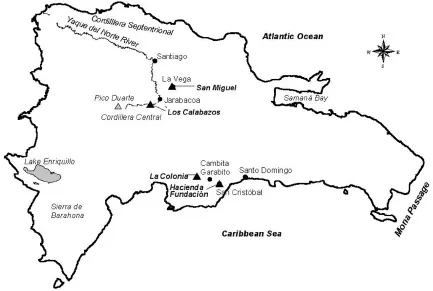
The study sites in the Dominican Republic were located in the provinces of La Vega and San Cristóbal (figure 1.1). Both a rural community and an urban community were selected in each province. La Vega is located in the central region of the country known as the Cibao, and San Cristóbal is located southwest of the capital, Santo Domingo. The study sites located in La Vega were Los Calabazos, a rural community, and the city of La Vega. Within the city, Proyecto Habitacional de San Miguel was selected as the study area. The study sites in the province of San Cristóbal were La Colonia, a rural community, and Proyecto Hacienda Fundación, a section of the city of San Cristóbal. We will refer to the urban sites as San Cristóbal and La Vega. The study sites were selected based on the following criteria: presence of a women's organization, rural and urban sites at comparable distances in both provinces, and agreement of the community to participate in the study.
Figure 1.1. Map of the Dominican Republic showing the four study sites: Los Calabazos, La Vega city (San Miguel), La Colonia, and San Cristóbal city (Hacienda Fundación)
Research Methods
Medicinal Plants and Dominicans in New York City
The Urban Ethnobotany Project has been working with Latino healers in New York City since 1996 to learn about their traditional healing practices for women's health conditions (Balick et al. 2000; Reiff et al. 2003; Fugh-Berman et al. 2004). The project has focused on the following health conditions: endometriosis (growth of endometrial tissue outside of the uterus); hot flashes (sudden brief sensations of heat often experienced during menopause); menorrhagia (excessive uterine bleeding); and uterine fibroids (benign connective tissue tumors). Most recently, this study has focused on herbal therapies for uterine fibroids and hot flashes.
Data collected from Dominican healers in New York City were based on multiple patient-healer consultations, with different patients previously diagnosed by a medical physician with the aforementioned health conditions. Following the consultations, both healers and patients were interviewed. Interviews with the healers provided additional insight into healing beliefs and practices (Reiff et al. 2003) and a more thorough understanding of medicinal plant recommendations for the patients (Balick et al. 2000). Accompanied by Dominican healers, we collected plant samples, which was a valuable and necessary component of these interviews. Fresh and dried plant samples were collected at local botánicas in New York City to verify their scientific names and to better understand how plants are selected, which parts are used, and how the plants are prepared into medicines.
Botánicas are shops that sell traditional remedies and function as herbal pharmacies providing fresh and dried herbs, mixtures, and tinctures, as well as religious and ritual items such as candles, oils, figurines of saints, and holy water (agua bendita) (Fisch 1968; Borello and Mathias 1977; Delgado and Santiago 1998). Voucher specimens, often plant fragments from botánicas, were prepared of all of the plants reported during the consultations and are stored at the herbarium of the New York Botanical Garden. In addition to traditional healers, shopkeepers and assistants, who handled the medicinal plants at botánicas, shared herbal therapies commonly prepared with Dominican plants.
Based on these initial interviews and plant collecting trips in New York City, we became familiar with common medicinal plants used and sold by Dominicans there. In addition, we conducted a comparative literature review to gather baseline data about Dominican plants used for women's health conditions, which further provided us with a working knowledge of Dominican plants, their uses, and their common names (Ososki et al. 2002). Through our literature review we found only limited discussion and minimal details provided on women's health categories suggesting the need for further investigation in this area, which led us to conduct research in the Dominican Republic and expand the number of health conditions studied to include menstruation, pregnancy, and menopause.
Medicinal Plants and Dominicans in the Dominican Republic
In the Dominican Republic, data were collected from local adult women (generalists) and healers (specialists), using a survey and an interview format. Before conducting the fieldwork, data collection instruments were reviewed and approved by the City University of New York Graduate School Institutional Review Board (IRB # 6-10-06-01). Several measures of ethnobotanical knowledge were evaluated: the number of plant species recorded per interview, the percentage of individuals who knew a remedy for a health condition, and the number of field reports for specific medicinal plants and remedies.
The sampling methods used in the Dominican Republic were structured differently than those used in New York City. The data collected from Dominican healers in New York City were obtained via multiple consultations with different patients, while that collected with Dominican healers in the Dominican Republic involved querying healers about treatments they use for a list of health conditions and did not involve patients. Six women healers participated in the study in New York City. Eleven healers, seven women and four men, were interviewed in the Dominican Republic. Because the sample sizes and data collection methods differ, comparisons can only provide a rough estimate. However, this comparison can give a basis upon which to build further studies to address questions of transmission and acquisition of plant knowledge in different environments.
The survey elicited both qualitative and quantitative information about the diversity of herbal remedies and medicinal plant species known and used for ten women's health conditions. The initial questions generated sociodemographic data such as age, birthplace, length of residence, civil status, number of children, educational level, religious affiliation, affiliation in community organizations, and occupation. A short household inventory estimated socioeconomic background.
The bulk of the survey was about medicinal plant knowledge. Each participant was asked to free-list as many medicinal plants that they knew and used. Then each participant was asked to free-list all the plants or remedies they knew for each of the women's health conditions. As needed during the survey, symptoms were elicited and discussed to further clarify the women's health conditions selected. For those plants reported for the ten health conditions, we asked about plant part used, remedy preparation, form of administration, how it treated the health condition, if it had been used by the person interviewed, how they learned about its use, any precautions when using the remedy, and other uses. Several questions on the survey elicited names of healers, midwives, or other specialists knowledgeable about medicinal plants. Additional questions concerned plant collection and health care data. Questions for this survey were developed from previous ethnobotanical studies (Brett 1994; Alexiades 1996; Balick et al. 2000), health surveys (Aday 1989), and suggestions from our Dominican collaborators. To ensure culturally appropriate survey and interview questions and relevant women's health conditions, we depended on our fieldwork in New York City with Dominican healers and piloted the questions with our collaborators in the Dominican Republic.
Semi-structured interviews were used with healers to collect data about women's health conditions, including descriptions, symptoms, causes, and treatments. Data was also collected about plant collection, preparation, and administration. Interviews took place in healers' homes and were usually followed by a walk to collect plants. Voucher specimens were made of medicinal plants reported during the study and are housed at the ...