The overwhelming majority of historical work on the late Habsburg Monarchy has focused primarily on national movements and ethnic conflicts, with the result that too little attention has been devoted to the state and ruling dynasty. This volume is the first of its kind to concentrate on attempts by the imperial government to generate a dynastic-oriented state patriotism in the multinational Habsburg Monarchy. It examines those forces in state and society which tended toward the promotion of state unity and loyalty towards the ruling house. These essays, all original contributions and written by an international group of historians, provide a critical examination of the phenomenon of "dynastic patriotism" and offer a richly nuanced treatment of the multinational empire in its final phase.
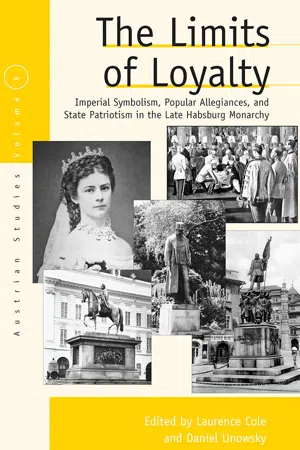
eBook - ePub
The Limits of Loyalty
Imperial Symbolism, Popular Allegiances, and State Patriotism in the Late Habsburg Monarchy
- 258 pages
- English
- ePUB (mobile friendly)
- Available on iOS & Android
eBook - ePub
The Limits of Loyalty
Imperial Symbolism, Popular Allegiances, and State Patriotism in the Late Habsburg Monarchy
About this book
Trusted by 375,005 students
Access to over 1.5 million titles for a fair monthly price.
Study more efficiently using our study tools.
Information
Chapter 1
PATRIOTIC AND NATIONAL MYTHS
National Consciousness and Elementary School Education in Imperial Austria*

Ernst Bruckmüller
The modern nation is unthinkable without a national education system: it transmits to each new generation of schoolchildren the idea of belonging to a greater, nationally delimited community, without which the existence of modern nations cannot be “imagined.”1 States seeking to transform themselves into “nation-states” assigned schools the role of teaching children a standardized national language. At the same time, language was used to disseminate a whole series of ideas, legends, stories and so on, which can be summarized under the heading of “national myths.”2 As studies of other European countries have shown, literature and history were two key disciplines in the process of creating these national mythologies.3
For a state such as the Habsburg Monarchy, the relationship between the education system and nation-building was much more complex and potentially problematic. Indeed, following Oscar Jászi’s argument, it is often assumed that the Habsburg state failed to produce a common “civic education” for its citizens.4 Schools in the Habsburg Monarchy certainly had the job of educating pupils “patriotically.” However, the fact that the Habsburg polity was not a unitary nation-state meant that a whole series of historical figures, myths, and traditions were potentially in competition with the state’s official rhetoric. For example, there already existed histories and legends associated with the old-established territories, such as the Kingdoms of Bohemia and Hungary, or the Duchies of Lower and Upper Austria, but from the first half of the nineteenth century onward, the process of “national awakening” created a new set of symbols, images, and ideas focused around linguistically based national cultures.
While a number of scholars have explored the subject of legislation on schooling,5 this article will focus on the relationship between schooling and the development of national identity in the Austrian half of the Habsburg Monarchy through an examination of school textbooks. In contrast to the Hungarian half of the Monarchy, this is a topic which has received little attention to date.6 Certainly, there is other material by which the historian might seek to reconstruct pedagogical practice in Austrian schools, such as the annual reports published by primary and secondary schools, or classroom books, which often recorded from day to day the content imparted to schoolchildren. Likewise, the autobiographical works left by contemporaries who reflected on such issues, such as Stefan Zweig, or the humorously conceived, and at the time, very well-known MEYRIAS by Oskar Kraus, also constitute useful sources.7 Nevertheless, a full analysis of such material requires a lengthier and more systematic treatment than can be offered here. More importantly, it is essential to establish first of all what the state sought to instruct and what it allowed to be published in this area. Accordingly, two main areas will be discussed here: firstly, the elementary schools (Volksschulen) will be investigated by looking at a series of primers or “reading books” in use after 1869. By making a comparison between materials in different languages, it will be possible to ascertain which historical figures and events were utilized in order to mediate a sense of identity beyond the locality and region.8 Secondly, I will examine which goals the central state set itself for the teaching of history in academic secondary schools (Gymnasien),9 and assess how it sought to control the production of classroom materials in order to guarantee the desired outcome with regard to “patriotic education.”10
1. Language and teaching in Austrian elementary schools
As Hannelore Burger has shown, the principle of monolingualism started to inform everyday practice in schools in the Austrian half of the Habsburg Monarchy from the mid-nineteenth century onward.11 Particularly in the lower reaches of the school-system, the method of instruction in just one language came to dominate and replaced almost entirely the former principle of multi- or bilingual teaching. Based on what at the time was considered to be the most up-to-date pedagogical findings, monolingualism was assumed to be the most beneficial and only possible means of teaching children effectively, but this emphasis on the mother-tongue was to have far-reaching consequences.
Following Herder, language was understood to be an expression of a “people’s spirit” (Volksgeist), whereby a particular language of instruction constituted much more than just a means of communication. Language was considered to be the most pure expression of the culture belonging to a linguistically delineated community—a community that was simultaneously understood as a community of descent. For the majority of contemporaries, this culture consisted not just of language and literature, but also folk music, specific forms of architecture and popular dress (all of which were the object of the new academic discipline of ethnography or Volkskunde), a particular mentality, and above all, a shared history. The logic of this understanding of culture meant that one language of instruction was not interchangeable with another and that the values and content of a culture could not be disseminated through other idioms; rather, it was taken for granted that cultural values and traditions were entirely bound up with languages and also varied with them. While Czech and Slovene-speaking children were to learn about the virtues of the “ancient Slavs,” German-speaking children were to be acquainted with the equally significant qualities of the “ancient Germans.” The central role attributed since the Romantic period to the place of language within the system of culture made this kind of division unavoidable.
For the Habsburg Monarchy, this situation presented a potentially enormous problem, because the multitude of languages of instruction meant that schoolchildren were presented with different sets of images and symbols when learning languages and literature. It was therefore necessary to employ additional tools in order to anchor in children’s minds the notion of state unity beyond their own national cultures, such as by drawing on the public image of the “good emperor.”12 The long-standing belief in the “salvation” (Heil) offered by the divinely ordained monarch retained a residual effectiveness right down until the collapse of the Habsburg state, albeit in a much changed, weaker form than in earlier times.13 Indeed, the force of such mechanisms was visible in the way in which Francis Joseph, who at the start of his reign had been very unpopular not just in Hungary and northern Italy, but even in Vienna, eventually became the “old Emperor,” a figure beyond criticism.14 At the same time, the cultivation of a dynastic-based “Austrian idea” placed the traditions of the Habsburg army at center stage.15 Victorious battles and commanders played an important role alongside the prominently emphasized rulers, though of course—as Ernest Renan long ago pointed out—this process involved as much forgetting as remembering of the past.16
Nevertheless, it is important to realize that these attempts at promoting a consciousness of Austria were not placed in opposition to older historical traditions or myths associated with the kingdoms and lands of the Habsburg dynasty. As this article will show, the Habsburg myth was adaptable and responsive to change, despite its basically conservative principles. For example, the “Austrian Plutarch,” written by historian, archivist, and publicist Johann von Hormayr (1781–1848) in the early part of the nineteenth century, placed Austrian rulers alongside heroes from Bohemian and Hungarian history (who were always portrayed as loyal to the Habsburgs).17 In this way, central figures in the newly emerging Czech national mythology such as Libuše and Charles IV (King of Bohemia 1346–78, Holy Roman Emperor 1355–78), who was also the father-in-law of the Habsburg ruler Rudolf IV (“the Founder,” 1358–65), could be integrated into the wider Austrian idea. It is interesting to note in this context that Franz Grillparzer, Austria’s “patriotic writer” par excellence, also wrote a drama Libussa, in which the magical princess Libuše and her tragic love for a peasant ploughman appeared on the stage with the figure of Primislaus/Přemysl, the famous founder of a dynasty and the capital of Prague. Similarly, Johann Peter Krafft’s monumental painting from the 1820s of Count Miklós Zrínyi’s defense of Sziget in the year 1566 depicted the Croatian-Hungarian hero as a loyal soldier of the Emperor, someone who barred the Ottomans’ way to Vienna.18
In all these instances, the presentation of historical events and figures underlines how important—but also how sensitive—an issue the teaching of history in schools could be. Particularly interesting here is the comparison with Hungary, where history and literature were likewise key subjects for promoting state consciousness (this was reinforced after 1868 by instruction in civil rights and duties, something which was only formally introduced in Austria after 1907).19 As Joachim von Puttkamer’s recent study shows, the Hungarian state concentrated on the idea of the unitary Magyar nation in the teaching of history. While in practice this still allowed room to mention other national cultures, particularly as long as confessional schools retained autonomy, the overall trend was towards a process of “national integration into a Hungarian nation-state,” especially after the passing in 1907 of the Lex Apponyi, which stipulated that all pupils should be able to read and write in Hungarian after four years of schooling.20 By contrast, in the Austrian half of the Habsburg Monarchy, the government did not promote the idea of an “Austrian nation” in the same way as the Hungarians did the “Magyar nation,” but rather attempted to emphasize the dynasty and by implication, the Habsburg Empire as a whole.
In Cisleithania, the Fundamental Laws of December 1867 set out the right to elementary education in the mother-tongue, provided this was one of the languages in common use in the particular crownland or province. In addition, the constitution held fast to the principle of monolingual schooling (despite the moves towards the enforcement of bilingualism in Bohemia after 1848). As mentioned above, this was in step with a fundamental pedagogical shift which took place around the mid-nineteenth century.21 It is difficult to overestimate the impact of the subsequent privileging of the mother-tongue as the sole language of instruction in schools on the intensification of nationality conflicts in late imperial Austria. Where bi- or multilingualism had been highly regarded for a long time, and the acquisition of one or more languages was seen as a desirable educational goal, this change in attitude in effect encouraged the nationalist emphasis on achieving complete mastery of the mother-tongue, while tending to devalue other languages (as well as diminishing the possibilities of communication across the monarchy as a whole). The imperial law on elementary schools (Reichsvolksschulgesetz) of 1869 respected the principles laid down in the constitution, while specifying that in practice it was now the educational authorities in each province who were responsible for determining which languages of instruction would be employed.22
Nevertheless, while undoubtedly important, language of instruction was not on its own decisive. The relationship between national cultures and “official patriotism” in the presentation of history in Austrian schoolbooks proves more complex and more subtle in form than national historiographical traditions have supposed.
2. The representation of history, country, and people in elementary schoolbooks
What did children in imperial Austria learn in elementary school about history, and about their country and people? While it remains difficult to draw hard and fast conclusions about how school life unfolded in reality, a study of contemporary textbooks...
Table of contents
- Cover
- Title
- Copyright
- Contents
- Contributor
- Illustrations
- Introduction
- 1. Patriotic and National Myths: National Consciousness and Elementary School Education in Imperial Austria
- 2. Military Veterans and Popular Patriotism in Imperial Austria, 1870–1914
- 3. Emperor Joseph II in the Austrian Imagination up to 1914
- 4. The Flyspecks on Palivec’s Portrait: Francis Joseph, the Symbols of Monarchy, and Czech Popular Loyalty
- 5. Celebrating Two Emperors and a Revolution: The Public Contest to Represent the Polish and Ruthenian Nations in 1880
- 6. Empress Elisabeth as Hungarian Queen: The Uses of Celebrity Monarchism
- 7. State Ritual and Ritual Parody: Croatian Student Protest and the Limits of Loyalty at the End of the Nineteenth Century
- 8. Collective Identifications and Austro-Hungarian Jews (1914–1918): The Contradictions and Travails of Avigdor Hameiri
- 9. Representing Constitutional Monarchy in Late Nineteenth and Early Twentieth-century Britain, Germany, and Austria
- Afterword
- Select Bibliography
- Index
Frequently asked questions
Yes, you can cancel anytime from the Subscription tab in your account settings on the Perlego website. Your subscription will stay active until the end of your current billing period. Learn how to cancel your subscription
No, books cannot be downloaded as external files, such as PDFs, for use outside of Perlego. However, you can download books within the Perlego app for offline reading on mobile or tablet. Learn how to download books offline
Perlego offers two plans: Essential and Complete
- Essential is ideal for learners and professionals who enjoy exploring a wide range of subjects. Access the Essential Library with 800,000+ trusted titles and best-sellers across business, personal growth, and the humanities. Includes unlimited reading time and Standard Read Aloud voice.
- Complete: Perfect for advanced learners and researchers needing full, unrestricted access. Unlock 1.5M+ books across hundreds of subjects, including academic and specialized titles. The Complete Plan also includes advanced features like Premium Read Aloud and Research Assistant.
We are an online textbook subscription service, where you can get access to an entire online library for less than the price of a single book per month. With over 1.5 million books across 990+ topics, we’ve got you covered! Learn about our mission
Look out for the read-aloud symbol on your next book to see if you can listen to it. The read-aloud tool reads text aloud for you, highlighting the text as it is being read. You can pause it, speed it up and slow it down. Learn more about Read Aloud
Yes! You can use the Perlego app on both iOS and Android devices to read anytime, anywhere — even offline. Perfect for commutes or when you’re on the go.
Please note we cannot support devices running on iOS 13 and Android 7 or earlier. Learn more about using the app
Please note we cannot support devices running on iOS 13 and Android 7 or earlier. Learn more about using the app
Yes, you can access The Limits of Loyalty by Laurence Cole, Daniel Unowsky, Laurence Cole,Daniel Unowsky in PDF and/or ePUB format, as well as other popular books in History & European History. We have over 1.5 million books available in our catalogue for you to explore.