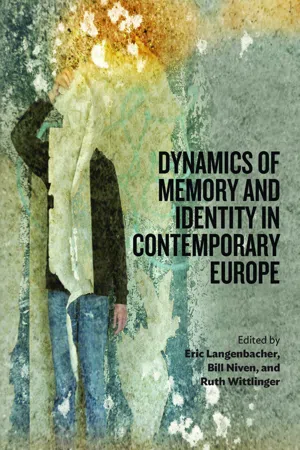
The collapse of the Iron Curtain, the renationalization of eastern Europe, and the simultaneous eastward expansion of the European Union have all impacted the way the past is remembered in today's eastern Europe. At the same time, in recent years, the Europeanization of Holocaust memory and a growing sense of the need to stage a more "self-critical" memory has significantly changed the way in which western Europe commemorates and memorializes the past. The increasing dissatisfaction among scholars with the blanket, undifferentiated use of the term "collective memory" is evolving in new directions. This volume brings the tension into focus while addressing the state of memory theory itself.
eBook - ePub
Dynamics of Memory and Identity in Contemporary Europe
- 248 pages
- English
- ePUB (mobile friendly)
- Available on iOS & Android
eBook - ePub
Dynamics of Memory and Identity in Contemporary Europe
About this book
Trusted by 375,005 students
Access to over 1.5 million titles for a fair monthly price.
Study more efficiently using our study tools.
Information
Chapter 1
DYNAMICS OF GENERATIONAL MEMORY
Understanding the East and West Divide
States have always constructed civic identity by means of unremitting defenses against the memory of their violent origins. If “blessed acts of oblivion” are crucial to ensure collective identities, the political transformations of the last two decades arguably present Europe with a challenge. Across a complex array of repressed memories, denial, victim syndromes, and atonement, Western European societies, such as Germany and France, have come to adhere to the “foundational” memory of the end of Nazism and the singularity of the Shoah.1 Genocide recognition, official apologies, and the rehabilitation of victims are all arguably a central feature for the reconstitution of democratic identity in Europe. With the end of communism, the singularity of this foundational European memory was relativized. Comparisons between the two totalitarian systems became more systematic and plausible. Western Europe has developed a culture of memorials, museums, and centers of commemoration focused on the centrality of the Shoah.2 The new members who joined the European Union in 2004, however, claim the need for the acknowledgment of differences in historical legacies. At the beginning of the twenty-first century, European memory is characterized by a deep geopolitical asymmetry. A memorandum, drafted by prominent historians from Eastern Europe, argued that the new Europe has brought new historical experience, grievances, and complaints, so far ignored in the West.3 In their view, the more established Western members have not forgotten their past. Rather, they had the opportunity to reassess it and thus have found more common values to share. Since Eastern Europeans did not participate in the process of “constructing Europe,” their experience of the shared values of Europe is bound to be thinner and so is their understanding of the informal rules and meanings. If Europe wants to unite, questions such as “What is the full history of Europe?” or “How do we deal with different histories within Europe?” have to be asked.
From the perspective of citizens of the new Europe, building European identity on strategies of forgetting appears ill-suited. On the one hand, the shaping of collective memory is required as a moral imperative and as a political necessity aimed at appeasing identity-conflicts between ethnic groups or social classes while also acknowledging wrongdoings against minorities. On the other hand, memory appears helpless against the challenge to commemorate crimes of absolute evil, to remember as “it truly was.” Precisely because memory is inherently contentious and partisan, authors, such as Tony Judt, argued that only the historian can assure that Europe’s past can furnish Europe’s present with admonitory meaning and moral purpose.4 In the center should be an “austere passion for fact, proof, evidence.”
Both positions share a central characteristic: evaluations of the past limit memory to a function of the present, an affair of the living. Moreover, any possible evaluation of Eastern European memory works within conceptual paradigms, which are hegemonically “Western.”5 The proposition I am going to defend is that if we want to understand dynamics of memory in the new Europe, we first have to examine the conditions under which narrative commitments have been made across the political evolution of postwar Europe. The shaping of memory and the perception of historical legacies are not opposites. Rather, they operate through complex interactions between biological renewal, social experience, and the search for meanings by new generations. Thus, the past is to be considered not as a bygone and well defined period but rather as a social organism in gestation.6 Following distinct but interrelated interpretive traditions established by José Ortega y Gasset, Karl Mannheim, Reinhart Koselleck, and Paul Connerton, I argue that historical judgments and political identities are culturally transmitted across generational memory. This process of cultural transmission is not simply about the construction of narratives by political elites or by professional historians. Societies are historical individuals who are initiated into memories. Societies, like individuals, “learn” habitual acts of performance by forgetting the exact circumstances. However, such practices are not always “learnt” by processes that are institutionally ordered, consensual, legally bounded, or normatively structured. Fundamentally, the renewal of generations is a source of opposition, a force of conflict, rejecting established conventions, traditions, and habits. As Reinhart Koselleck put it, “there is no collective memory but there are collective conditions of potential memories.”7
The case for generations as collective conditions for potential memories calls for the integration of biological, social, and cultural conditions of memory. Generations are carriers of ever-changing and mutually reinforcing formats of social memory and cultural memory. Only individual beings remember, yet memories can also be transmitted beyond the death of individuals. Across history, carriers of memory grow old and die whilst new people are born and enter the social world. Despite the disappearance of individual carriers of memory, there is remarkable continuity over time. This relationship between biological decline and cultural connectivity across the longue durée raises an important question: how is the perception of historical continuity communicated across biological changes? In a seminal essay on the links between the transformation of language and event-history, Reinhart Koselleck argued for the meta-historical biological preconditions for history, which precede and remain outside language.8 The time span between birth and death determines human finitude. Diachronically, the constant transitions between earlier and later are constitutive for any history to be perceived as a sequence of occurrences. This perception of temporalities is structured by the sequence of generations, often entailing different overlapping spaces of experience, which mutually exclude each other. The passing away of people (the deaths of individuals) and the rise of new generations are the anthropological preconditions for the search for meanings.
Initiating Generational Memory
Generational memories clearly contain a synchronic dimension, which refers to the contemporaneous time frame of formative experiences. Jay Winter, for instance, attributed the flourishing of cultures of memory in the twentieth century to two generations.9 The first generation was a cohort of men and women born between the 1860s and 1880s who made an impact in academic, literary, professional, and public prominence between approximately 1890 and 1925. The second generation of memory framed the period between the 1970s and 1980s, characterized by the witness of the Holocaust. However, local proximity, similar age group, and temporal congruity are not enough to achieve what Karl Mannheim called connectivity (Generationszusammenhang).10 The knowledge of one’s birth date is not sufficient to know which generation one belongs to. Class divide or ethnic differences in the same city may cause same age groups to diverge completely on their intentions. Interpretive responses to World War II, for instance, entailed atonement in Germany but denial in Japan.11 According to Mannheim, the formation of a generational unit (Generationseinheit) depends primarily on a sense of common purpose and spiritual likeness. Generations are not only biographical, demographical, or social facts but also existential communities. Born into an existing environment with established hierarchies and prevailing conventions, members, and specific events makes people reciprocate feelings and conceive of their co-existence in social environments as a problem for which they have to find a common spiritual purpose in order “to make sense of” it.
Before taking up leading positions in politics, society, or the economy, i.e., before becoming an elite, people enter wider society through adolescence, early adulthood, and maturing. According to Karl Mannheim, important occurrences during these formative years of individuals are absorbed and stored, thus becoming “the historically oldest stratum of consciousness, which tends to stabilize itself as the natural view of the world.”12 Such initiations may become socially and politically relevant because they cannot be forgotten. It is through the encounter with the social world that people make career choices, adhere to worldviews, develop aspirations, and adopt certain lifestyles. By doing this, they not only discard other career options but also critically engage with the actions and moral attitudes of the previous generation. Such “choices” are sometimes more in tune with their social environment, sometimes more radical, but always more unconscious than one would admit.
Social identities of future political elites are formed at particular junctures of individual lifecycles. Revolutionary elites seize power, for instance, when they are middle-aged men and women. Yet, what “makes” revolutionaries is the decisions underlying their absolute commitment to the revolutionary cause. Such decisions are often made in the face of deep crises of personal self-definition in the formative years of their youth—crises resolved by the selection of a subversive identity.13 The average age of the Bolshevik leadership in 1917 was thirty-nine, but most of them committed themselves totally to revolution as a way of life due to the situations they experienced at ages between fifteen and twenty.14 As Sebastian Haffner pointed out, the birth cohort 1900 to 1910 would become the genuine generation of National Socialism.15 This cohort of young Germans schoolboys absorbed the reports from the frontlines of World War I on an almost daily basis. For these boys, war was not the front experience, but consisted of the great exciting adventure; the struggle between nations loaded with strong emotions; and a positive vision of values such as honor, fatherland, and sacrifice for the nation.
Thus, it is not sufficient to focus on the specific chronological location of a generation, a cohort so to speak. A generation is not only a matter of the biography of individuals, but it requires the connection between individual consciousness and the passing of social time. As Ortega put it, one cannot really know what happened at a certain date if one does not ascertain to which generation it happened. The stakes for the young and adolescent—when confronted with social oppression, revolution, or war—are different from those for the established social elites or even the old. The same event happening to two different generations is a vital and hence historical reality which is completely different in each case.16 No major historical event can determine historical stages, political identities, or generational succession. The reason for this is that events are experienced and appropriated by people depending on the generation to which they belong.
Thomas Mann, the literary master of time, argued that biological age not only unfolds within the passing of time and the transformations of social conventions, but also with the relentless appearance of events. Mann claimed that transitions (Übergänge), not ruptures, were the essence of history. His own life span stretched over two epochs, which allowed him to experience how the seeds of the new were already alive and spiritually active within the old regime.17 Born in 1875—in the late period of the liberal epoch of peace in Europe—he confessed to have an “advantage” with regard to those born in the contemporary disintegration of order, values, and morality marked by the European civil war between 1914 and 1945. Mann’s own experiential background allowed him to understand what equilibrium, stability, and a long-lasting system of values actually meant. The meeting in Munich in 1938 between Chamberlain, the Victorian gentleman at the age of sixty-eight, and Hitler, the young warrior of World War I at the age of forty-eight, epitomizes how th...
Table of contents
- Cover
- Title Page
- Copyright Page
- Contents
- Introduction: Dynamics of Memory and Identity in Contemporary Europe
- Chapter 1. Dynamics of Generational Memory: Understanding the East and West Divide
- Chapter 2. Time-out for National Heroes? Gender as an Analytical Category in the Study of Memory Cultures
- Chapter 3. The Memory-Market Dictum: Gauging the Inherent Bias in Different Data Sources Common in Collective Memory Studies
- Chapter 4. Remembering World War II in Europe: Structures of Remembrance
- Chapter 5. Ach(tung) Europa: German Writers and the Establishment of a Cultural Memory of Europe
- Chapter 6. Critiquing the Stranger, Inventing Europe: Integration and the Fascist Legacy
- Chapter 7. The Thread That Binds Together: Lidice, Oradour, Putten, and the Memory of World War II
- Chapter 8. Memory of World War II in France: National and Transnational Dynamics
- Chapter 9. The Field of the Blackbirds and the Battle for Europe
- Chapter 10. Transformation of Memory in Croatia: Removing Yugoslav Anti-Fascism
- Chapter 11. German Victimhood Discourse in Comparative Perspective
- Chapter 12. Shaking Off the Past? The New Germany in the New Europe
- Conclusion: A Plea for an “Intergovernmental” European Memory
- Notes on Contributors
- Bibliography
- Index
Frequently asked questions
Yes, you can cancel anytime from the Subscription tab in your account settings on the Perlego website. Your subscription will stay active until the end of your current billing period. Learn how to cancel your subscription
No, books cannot be downloaded as external files, such as PDFs, for use outside of Perlego. However, you can download books within the Perlego app for offline reading on mobile or tablet. Learn how to download books offline
Perlego offers two plans: Essential and Complete
- Essential is ideal for learners and professionals who enjoy exploring a wide range of subjects. Access the Essential Library with 800,000+ trusted titles and best-sellers across business, personal growth, and the humanities. Includes unlimited reading time and Standard Read Aloud voice.
- Complete: Perfect for advanced learners and researchers needing full, unrestricted access. Unlock 1.5M+ books across hundreds of subjects, including academic and specialized titles. The Complete Plan also includes advanced features like Premium Read Aloud and Research Assistant.
We are an online textbook subscription service, where you can get access to an entire online library for less than the price of a single book per month. With over 1.5 million books across 990+ topics, we’ve got you covered! Learn about our mission
Look out for the read-aloud symbol on your next book to see if you can listen to it. The read-aloud tool reads text aloud for you, highlighting the text as it is being read. You can pause it, speed it up and slow it down. Learn more about Read Aloud
Yes! You can use the Perlego app on both iOS and Android devices to read anytime, anywhere — even offline. Perfect for commutes or when you’re on the go.
Please note we cannot support devices running on iOS 13 and Android 7 or earlier. Learn more about using the app
Please note we cannot support devices running on iOS 13 and Android 7 or earlier. Learn more about using the app
Yes, you can access Dynamics of Memory and Identity in Contemporary Europe by Eric Langenbacher, Bill Niven, Ruth Wittlinger, Eric Langenbacher,Bill Niven,Ruth Wittlinger in PDF and/or ePUB format, as well as other popular books in History & 20th Century History. We have over 1.5 million books available in our catalogue for you to explore.