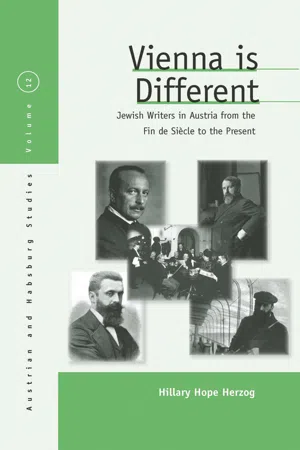
Assessing the impact of fin-de-siècle Jewish culture on subsequent developments in literature and culture, this book is the first to consider the historical trajectory of Austrian-Jewish writing across the 20th century. It examines how Vienna, the city that stood at the center of Jewish life in the Austrian Empire and later the Austrian nation, assumed a special significance in the imaginations of Jewish writers as a space and an idea. The author focuses on the special relationship between Austrian-Jewish writers and the city to reveal a century-long pattern of living in tension with the city, experiencing simultaneously acceptance and exclusion, feeling "unheimlich heimisch" (eerily at home) in Vienna.
eBook - ePub
Vienna Is Different
Jewish Writers in Austria from the Fin-de-Siècle to the Present
- 298 pages
- English
- ePUB (mobile friendly)
- Available on iOS & Android
eBook - ePub
Vienna Is Different
Jewish Writers in Austria from the Fin-de-Siècle to the Present
About this book
Trusted by 375,005 students
Access to over 1.5 million titles for a fair monthly price.
Study more efficiently using our study tools.
Information
Chapter 1
THE FIN DE SIÈCLE

The Jewish Immigrant Experience in Vienna
This study of the rich tradition of Viennese Jewish literature must begin with an account of how Vienna became established as the center of Jewish life in the Habsburg Empire. Before taking up the literature as a reflection of Central European Jewish life, therefore, I want first to address how, when, and for what reasons the Jews came to Vienna, looking first at the history of Jewish migration to the city and then examining Viennese Jewish life and the particular nature of the city the Jewish immigrants encountered. The story of twentieth-century Jewish literature in Vienna thus begins in the nineteenth century, and 1867 presents itself as perhaps the best point of departure. This year of the Compromise Agreement, or Ausgleich, which created Austria-Hungary, was also the year of the long-awaited emancipation of the Jews.1 Austria’s Liberal government lifted restrictions on occupation and residence that had been in place since the Middle Ages and set Jews on equal footing with all other Austrian citizens in terms of civil, political, and religious rights. The lifting of restrictions on Jewish residence was a tremendous impetus to Jewish migration, especially to Vienna.
The Jewish experience of modernity was deeply connected to processes of migration and urbanization. The larger phenomena of urbanization and the movement of Jews from small towns and rural areas to the cities, witnessed all across Europe, were particularly striking with respect to Jewish immigration to Vienna. During the 1860s the city’s Jewish population grew by a remarkable 46 percent each year.2 In 1857, only 1 percent of Austrian Jews were living in the capital. By 1900, this number had reached 13 percent, and by 1910, with Jews making up 13 percent of the city’s total population, Vienna was the third-largest Jewish community in the world.3
This growth of the urban Jewish population occurred at a time of tremendous general growth in cities across the Habsburg Empire. Most of the empire’s major cities doubled their populations from the late 1860s through 1910. Vienna grew by 234 percent during this period, and by 1910 the population exceeded two million.4 In this same year fewer than half of Vienna’s residents had been born in the city.5 Urbanization was thus a general trend in late nineteenth-century Austria-Hungary, and most of the urban population growth came from migration. Yet while the Jews participated in the broader progression of urbanization, the process of Jewish immigration to Vienna was fundamentally different from the migration of non-Jews in the empire. Jewish migration was prompted by circumstances distinct to the Jews—it followed its own patterns demographically and temporally—and the immigrant Jewish experience in the city differed markedly from that of other ethnic immigrant groups. These differences had a significant impact in defining the Jewish experience of Vienna.
Prior to World War I, there were three significant waves of Jewish immigration to Vienna from the Crown lands: the first wave came from Bohemia and Moravia during the 1850s and 1860s; the second, the Jews from Hungary, came through the 1880s; and the third wave, Galician Jews, came during the final decades of the Austro-Hungarian Empire. While the non-Jewish population also migrated from the provinces to the city, this migration was largely a response to agricultural crises and rural overpopulation and mainly involved people who sought new employment opportunities with the lifting of the guild restrictions and the creation of new jobs in industry. Jews of the provinces, on the other hand, were not peasants and thus were not responding to a depression in agriculture; nor were they to enter the urban proletariat in large numbers. Jews entering Vienna also sought greater economic opportunities, but of a different character. Many Jews were looking to enter professional life and increase their prestige and status through new employment, professional training, or university study. Their migration to Vienna was prompted primarily by a desire for upward mobility.
In addition to economic impulses, numerous important social and cultural factors drew Jews to Vienna. Albert Lichtblau has stressed the importance of these noneconomic factors, citing the attraction of the city itself and the vibrant cultural life that flourished in the cultural and intellectual center of the monarchy.6 He notes the importance of an already established (albeit relatively small) Jewish community, complete with social clubs, news organs, charity organizations, synagogues, hospitals, and cheders, as well as friends and relatives clustered in the Leopoldstadt, Vienna’s second district and the home to the greatest concentration of Jews from all social classes and from all over the empire. Political motivations played a role as well, as many Jews in the Crown lands sought to escape from provincial anti-Semitism. The Jews of the monarchy also identified the city of Vienna with the liberal, progressive forces that had granted them emancipation, and they certainly had hopes of encountering a more hospitable political climate than they had left behind.7 Like other late nineteenth-century immigrants to Vienna, Jews sought opportunities unavailable to them in the provinces; however these opportunities were less about economic survival and more about political, cultural, economic, and social advancement.
Jewish migration differed from immigration patterns among non-Jews not only in motivation, but also in form, in that Jews more often moved as families, rather than as individuals seeking employment in industry or domestic service. They traveled long distances and often crossed provincial borders. They were also more likely to come to Vienna from other cities and were thus generally familiar with urban life, a factor that further distinguished them from non-Jewish immigrants.8 Jews thus traveled to Vienna not only for the reasons that people throughout Europe were flocking to urban centers in the same period, but for the specific opportunities that this particular city offered them at this particular time. The story of nineteenth-century Austrian Jewish migration is not simply one of urbanization, but of “Viennaization.”
The distinctiveness evident in the immigration patterns of Jews is part of a broader trend that encompassed not only their arrival in Vienna but their integration into the city and their experiences as they established themselves there. The work of social and cultural historians has uncovered evidence in all aspects of Jewish life—economic, professional, social, cultural, political, private, and religious—indicating that during the long turn of the century the Jews in Vienna experienced the city very differently from their non-Jewish fellow citizens.9
Jews who settled in Vienna are clearly to be counted among the winners in the process of economic modernization, as were Jews elsewhere in Europe at the time. Having been previously clustered in Europe’s urban centers and concentrated in trade, Jews were better poised to adapt to the conditions of modernization. While Carl Schorkse’s influential work on the dramatic cultural developments of this period might lead us to view the occupational transformation of Viennese Jews as a wholesale withdrawal from commerce and the world of business in general to the temple of the arts, it is important to recall that this was the experience of only a small minority of the educated Jewish elite.10 As Marsha Rozenblit has argued, “The salient change precipitated by urbanization and consequent opportunities for economic and general assimilation was the transformation of a people famous for its trading ability into a clerical and managerial group.”11 The Jews thus became predominantly white-collar employees in a city of artisans and, increasingly, part of the working class. Jews took positions as clerks, salesmen, and managers in the city’s banks, insurance companies, and other large firms, raising their prestige and professional security.12 While this transformation demonstrated their acculturation, it did not amount to economic assimilation, because, again, their employment patterns were distinct. Newly immigrated Jews did not become domestic servants or join the city’s growing proletariat but, through past experience in their countries of origin, they moved in trade or, with the better education available in Vienna, into higher-paying jobs.
For many Jews, Vienna was a gateway to the liberal professions, particularly law and medicine. If we turn to the university, the Jewish presence in these fields was particularly noteworthy. In 1890, the peak of Jewish enrollment in the medical school, Jews made up a remarkable 48 percent of medical students at the University of Vienna.13 The university was especially attractive to Jewish students; half of Austria’s Jewish students chose to study in Vienna.14 The popularity of the medical school was unparalleled. Its importance as a training ground for the physicians of the empire is exemplified by the case of Arthur Schnitzler’s father, Johann, who came to Vienna from the Hungarian town of Nagy-Kanizsa nearly penniless and proceeded to put himself through medical school by tutoring students, eventually achieving prominence as a widely renowned laryngologist. Johann Schnitzler did not come to Vienna with the immediate goal of obtaining employment simply to subsist—he came to educate himself in a career in which he could advance himself professionally.
Although Johann Schnitzler is a dramatic example of upward mobility through education, Steven Beller has drawn attention to the special emphasis Jewish families generally placed on education.15 In his work Beller identifies considerable differences in attitudes towards education among Catholics and Jews, evidenced by the fact that Jews attended the city’s Gymnasien and university in numbers that far exceeded their proportion of the population. Beller traces this striking statistical difference to the central role that learning and study traditionally played in Judaism and to the gradual process by which secular studies came to replace religious study for many Jews, while retaining its centrality to the culture and the prestige with which it was viewed.
Clearly, in embracing the Enlightenment tradition of Bildung—a fusion of education, self-cultivation, and character formation—Jews were seeking to participate in a humanist tradition that resonated deeply with the German majority in Austria, and, by the nineteenth century, with the middle class in particular. George Mosse articulated the importance of Bildung in the embourgeoisement and, hence, social acceptance of the Jews. He notes, “Bildung was readily embraced by Jews as helping to complete the process of emancipation.”16 Education and the absorption of German culture was to be a path to acculturation into the German majority and an entrance ticket to the liberal middle class. Ironically, however, the Jews’ embrace of the cultural goals and ideals of the middle class again set them apart, as the zeal with which they pursued education and self-cultivation produced a quantitative difference from their Gentile counterparts.17 Beller argues, “The very strategy of assimilation through Bildung was jeopardizing the acceptance of Jews in general, by making them something special again: no longer Jewish, but not really Gentile either.”18 This serves as a reminder that the Jewish pursuit of education and participation in culture was not solely motivated by the desire to assimilate, as this pattern of behavior was clearly not the best way to fit in.
If integration into the middle class was the aim of Jewish assimilation, the family was the arena in which these processes unfolded. The creation of a cult of domesticity, establishing the home as a haven from the pressures of the outside world, was the hallmark of the bourgeois model of the family. Jewish women were at the center of the household, and they thus played a critical role as both agents of acculturation and guardians of Jewish tradition. Women were largely excluded from university study through social pressures, and their presence at home was an important status symbol. Yet since the notion of Bildung brought the project of self-cultivation and education into the home, it thus brought it into the domain of women.19 Jewish women therefore acted as the arbiters of culture and the overseers of Bildung within the family.
...Table of contents
- Cover
- Half title
- Title
- Copyright
- Contents
- Acknowledgments
- Introduction
- Chapter 1. The Fin de Siècle
- Chapter 2. Jewish Vienna Between the World Wars
- Chapter 3. Jews and the Second Republic
- Chapter 4. Viennese Jews from Waldheim to Haider and Beyond
- Conclusion
- Bibliography
- Index
Frequently asked questions
Yes, you can cancel anytime from the Subscription tab in your account settings on the Perlego website. Your subscription will stay active until the end of your current billing period. Learn how to cancel your subscription
No, books cannot be downloaded as external files, such as PDFs, for use outside of Perlego. However, you can download books within the Perlego app for offline reading on mobile or tablet. Learn how to download books offline
Perlego offers two plans: Essential and Complete
- Essential is ideal for learners and professionals who enjoy exploring a wide range of subjects. Access the Essential Library with 800,000+ trusted titles and best-sellers across business, personal growth, and the humanities. Includes unlimited reading time and Standard Read Aloud voice.
- Complete: Perfect for advanced learners and researchers needing full, unrestricted access. Unlock 1.5M+ books across hundreds of subjects, including academic and specialized titles. The Complete Plan also includes advanced features like Premium Read Aloud and Research Assistant.
We are an online textbook subscription service, where you can get access to an entire online library for less than the price of a single book per month. With over 1.5 million books across 990+ topics, we’ve got you covered! Learn about our mission
Look out for the read-aloud symbol on your next book to see if you can listen to it. The read-aloud tool reads text aloud for you, highlighting the text as it is being read. You can pause it, speed it up and slow it down. Learn more about Read Aloud
Yes! You can use the Perlego app on both iOS and Android devices to read anytime, anywhere — even offline. Perfect for commutes or when you’re on the go.
Please note we cannot support devices running on iOS 13 and Android 7 or earlier. Learn more about using the app
Please note we cannot support devices running on iOS 13 and Android 7 or earlier. Learn more about using the app
Yes, you can access Vienna Is Different by Hillary Hope Herzog in PDF and/or ePUB format, as well as other popular books in History & European History. We have over 1.5 million books available in our catalogue for you to explore.