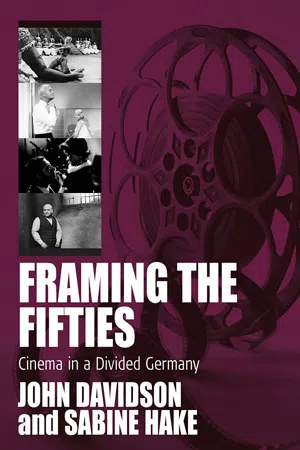
The demise of the New German Cinema and the return of popular cinema since the 1990s have led to a renewed interest in the postwar years and the complicated relationship between East and West German cinema in particular. A survey of the 1950s, as offered here for the first time, is therefore long overdue. Moving beyond the contempt for "Papa's Kino" and the nostalgia for the fifties found in much of the existing literature, this anthology explores new uncharted territories, traces hidden connections, discovers unknown treasures, and challenges conventional interpretations. Informed by cultural studies, gender studies, and the study of popular cinema, this anthology offers a more complete account by focusing on popular genres, famous stars, and dominant practices, by taking into account the complicated relationships between East vs. West German, German vs. European, and European vs. American cinemas; and by paying close attention to the economic and political conditions of film production and reception during this little-known period of German film history.
eBook - ePub
Framing the Fifties
Cinema in a Divided Germany
- 260 pages
- English
- ePUB (mobile friendly)
- Available on iOS & Android
eBook - ePub
About this book
Trusted by 375,005 students
Access to over 1.5 million titles for a fair monthly price.
Study more efficiently using our study tools.
Information
Chapter 1
THE QUESTION OF GERMAN GUILT AND
THE “GERMAN STUDENT”: POLITICIZING THE
POSTWAR UNIVERSITY IN KORTNER'S DER RUF
AND VON WANGENHIEM'S UND WIEDER 48!
THE “GERMAN STUDENT”: POLITICIZING THE
POSTWAR UNIVERSITY IN KORTNER'S DER RUF
AND VON WANGENHIEM'S UND WIEDER 48!
Early Postwar Germany and the “German Student”
The date 22 January 1946 was a day that would live on in early postwar infamy. In the Neustädter Church in Erlangen, Pastor Martin Niemöller, a former inmate of the Sachsenhausen and Dachau concentration camps (KZs), gave a guest sermon to two thousand students (according to initial reports) entitled, harmlessly, perhaps deceptively, “Lecture without a Topic” (Vortrag ohne Thema). In retrospect, the title seems either modest or misleading because Niemöller used his time in front of the students to deliver one of the most important postwar addresses on the question of German guilt (Glaser 1986: 95). The address, however, became infamous not so much for Niemöller ‘s controversial calls for acknowledging the guilt of all Germans but for contentiously including an open admission of guilt before the victims of Germany between 1933 and 1945. In the early postwar period, the sermon was described, discussed, and debated much more often and much more passionately in terms of Niemöller ‘s chosen audience—the students.
Both newspapers and Allied intelligence underscored how the students violently rejected the pious, pleading sermon. According to their reports, as Niemöller asserted that all Germans must acknowledge their guilt, he was interrupted multiple times by angry protests from the students (audible murmuring, then shouting and foot stomping); he was able to continue his address only because hosting officials appealed to the sanctity of the church venue (Die Neue Zeitung, 15 February 1946). Newspapers reported thereafter that an anti-Niemöller pamphlet espousing Nazi beliefs was found pinned to the bulletin board of the university: though the newspapers were (most likely due to preemptive self-censoring) elusive about the details of its contents, U.S. intelligence reported that it labeled Niemöller a “tool of the Allies.” Indeed, Niemöller's argument, like that of the famous Stuttgarter Erklärung (Stuttgart Declaration) cited above, did seem very close to the Allies' official policy of collective guilt.
Irrespective of the sermon's controversial negotiation of the labyrinthine questions of German guilt, the focus of the ubiquitous press reports remained on the behavior of the students. One revealing report in the Mittelbayerische Zeitung segued quickly from a report about the address and its “admission of guilt” to a lengthy castigation of the students (“Sieht so die neue akademische Jugend aus? Störungen eines Vortrages von Pastor Niemöller,” Mittelbayerische Zeitung, 25 June 1946). Particularly telling, in this title and the subsequent article, is the conceptual slippage from student to youth, a common tendency in this context on which I shall elaborate. After upbraiding the students, the report revealingly linked their behavior to Germany's problematic past: the students' protest and rejection of Niemöller was not a surprise, given how many former Nazi officers had infiltrated the ranks of those students. Another report, this one in the Frankenpost and entitled “Militaristic Student Body,” was statistically more specific than that in the Mittelbayerische Zeitung and criticized the militarism of the students, at least 50 percent, but “more likely 90 percent,” of whom were war veterans (“Militaristische Studentenschaft: Die Hochschule ist kein Unterschlupf für arbeitslose Offiziere,” Frankenpost, 13 February 1946). The hand-wringing response was not limited to Bavaria: the Frankfurter Rundschau published a letter to Niemöller from the director of the Educational and Cultural Department of the Jewish community in Marburg—the indignant official likened the “events in Erlangen” to Marburg, where Niemöller was also scheduled to speak. He suggested that Niemöller's reception among students was not so surprising given the students' unrepentant attitude, and invited Niemöller, a “fellow sufferer” of the camps as the author put it, to speak not to the students, but instead to the Jewish community (Israel Blumenfeld, “An Pfarrer Niemöller,” Frankfurter Rundschau, 12 February 1946). Thus, in a remarkable rhetorical move, a Jewish survivor proclaimed unlikely solidarity with the Evangelical pastor by casting them both as victims, first, of the Nazis and, more recently, of the Nazi-inclined students.
The considerable fallout from, and afterlife of, Niemöller's Erlangen sermon seems particularly surprising given a lengthy correction that appeared in the Süddeutsche Zeitung, among other newspapers, a few weeks later (“Von der Kollektivschuld: Zur Ansprache Pastor Niemöllers in Erlangen,” Süddeutsche Zeitung, 22 February 1946). There were probably twelve hundred students present at the sermon, only about twenty of whom actively protested Niemöller's sermon. Even Niemöller himself disputed the initial news reports and rejected their vociferous emphasis on “Nazi” attitudes and persisting militarism among the students.1 Why would this episode, then, draw such attention, evoke such hand-wringing, and enjoy such an afterlife? Because, I would argue, it executes a revealing and repeated discursive displacement, exculpatingly obscuring the central challenges of postwar Germany—guilt, Nazism, and militarism—to focus instead on one social group—the youth with whom the students were associated.
The reaction to Niemöller's sermon was so pronounced because, in the first years after the war, discourse about youth played a subtle but nonetheless central role in Germany's coming to terms with the past. The constructed discourse about postwar “German youth” became an essential means for Germany to stage and to narrate its transition from its own, suddenly dubious history; it served as a means that would propel and progress the culture out of the now tainted Wilhelmine, Weimar, and Nazi periods. Like that of the youth with whom they were deliberately associated, the crisis of Germany's postwar students became a cipher for representing a general crisis in German culture and society; more precisely, students as a site for a wider crisis served repeatedly to displace and to divert attention from the ubiquitous ruins of Germany society. By focusing on the young students, these reports about the students as the “new academic youth” shift the site of postwar contestation from difficult questions of guilt to manageable challenges of generational discipline, a discipline that would then also serve as a cornerstone for postwar national identity. Such discursive displacements and diversions became a crucial mechanism within the wider processes of Vergangenheitsbewältigung and, as I shall also argue, the production of German national identity.
In German studies and in cultural studies in general, a growing number of analyses have foregrounded the importance of youth and youth culture in the twentieth century. Recent studies, such as those by Ute Poiger, Kaspar Maase, and Heide Fehrenbach, investigate the role and significance of youth culture in the early FRG (Federal Republic of Germany) and (in Poiger's case) the GDR (German Democratic Republic) (Fehrenbach 1998, 2001; Maase 2000, 2001; Poiger 2000). Other works, such as those by Susan Wiener and Kristin Ross, have highlighted the importance of youth and youth culture in other Western European societies (Ross 1995; Wiener 2001). Almost all of these studies, however, focus on the importance of youth in the emergent consumer culture of the 1950s as young Germans were becoming an essential, if not the central, node for the translocation of such globalizing, often Americanizing, cultures to Western Europe.2 Surprisingly, none of these studies considers at length the transition from the war—largely fought, at least in the cultural imaginary, by young people—to the postwar period. In this way these studies risk reproducing the myth of a radical break with 1945 and its alleged Stunde Null (zero hour).3 A careful study of early postwar discourse about youth can augment these studies because it helps explain why the 1950s reactions to the Mischlinge (mixed race) children of American GIs, to global youth culture, and to phenomena like the Halbstarken (hooligans) became so virulent.
In this essay, I shall show how students and reeducation, particularly in the context of the debate about the university, became key ciphers for wider discourses about Nazism, guilt, exile, and, subsequently, Cold War politics. School and education constitute an indispensable yet frequently ignored aspect of cultural and social discourse: as theorists like Michel Foucault, Jacques Donzelot, and George Mosse have argued, it is precisely at the intersection of family and education that ideological battles about the young are often waged, battles that resonate constitutively with (adult) subjectivities, society, and nation.4 In the postwar period, the discursive sparks at this nexus became all the more intensified because of the widespread social dissolution and the heated debate about reeducation in postwar Germany.
Although their studies attend to the function of youth within adult society and culture, Poiger, Maase, and Fehrenbach, for instance, overlook the ubiquity and depth of the discussion about German reeducation. Reeducation became a catchall term, a synecdoche for the occupation in general, so it is impossible to analyze the role of youth in Germany's 1940s and 1950s without attending adequately to the widespread and wide-ranging debates about it. At a time when the Allies subverted German sovereignty on nearly everything—government and society as well as economy and culture—reeducation became a site at which Germans could make a last stand in defense of traditional German culture. Youth and education thus also became crucial building blocks in postwar German national identity, which had to reconstitute itself on the ruins of tainted cultural categories. Discussions about youth, students, and education served not only to help Germans come to terms with the past but also, at a more general level, to reconstitute German national identity. In fact, coming to terms with the past via the discourse about reeducation simultaneously helped select and emphasize elements of German culture around which national identity could be constituted in the future. Discourse about youth, students, and education afforded postwar projects and preoccupations that conveniently looked back to look forward.
One crucial arena for these symbolically central discourses about youth and reeducation was the postwar university. As I noted above in the segue from students to the “new academic youth,” universities count as only one aspect among many that together constituted the postwar youth problem (Jugendproblem, a term that encompasses, as well, orphans, family crises, delinquency and criminality, and elementary and secondary schools). But the university was an area that was particularly polarized and politicized, in large part because of the notorious coordination of the academy by the Nazis, the large number of students who had just returned from the war, as well as the participation of many professors and students in the public sphere. Two, almost concurrent high-profile films from the late 1940s deploy German universities and students as key ciphers through which to come to terms with the criminal past, the anarchic present, and the reconstructive future. Both Der Ruf (The Last Illusion, 1949) and Und wieder 48! (‘48 All Over Again! 1948) provided stars of the Weimar theater—Fritz Kortner and Gustav von Wangenheim—marquee entrées to the postwar public sphere, and both of these well-known figures revealingly chose the university as the cultural core and battlefield for postwar Germany.
Both films demonstrate how students and the university offered postwar Germans a politically permissible arena in which to unfold both anxieties about, and an agenda for, coming to terms with the past as well as a future German national identity. The films are also revealing for their markedly divergent approaches: Kortner had been in exile in Hollywood and von Wangenheim in the Soviet Union, and Kortner's film foregrounds its links to American reeducation, while von Wangenheim's film claims the historical tradition of classical German culture and, more specifically, the teaching of that tradition for the emerging GDR. With the opening of the Free University in West Berlin and the subsequent protest by the Soviets, tensions around the university were rampant, and the high-profile storm of protest around the (more) open politicization of education in Und wieder 48! initiated the open antagonisms of the Cold War, which was also, as Poiger has shown later in the 1950s, certainly fought on a juvenile front.
Rebuilding the University after the “Catastrophe”
Even before Germany's unconditional surrender on 8 May 1945, the Allies' policy of Umerziehung or “reeducation” had become a catchall term for their attempt to control all “information” in Germany (Glaser 1986; Hermand 1986; Tent 1982). The expression thus included but also transcended what was normally understood as Erziehung or “education,” such that it included the press and the mass media. In the American sector—whose policies eventually dominated the British and French sectors, particularly after the creation of Bizonia, the Western zone, in 1947 and after the currency reform of 1948 (Fehrenbach 1995)—the Information Control Division (ICD) oversaw the schools as well as all the press and media (Tent 1982). In the Soviet sector reeducation was similarly expansive, perhaps even more so than in the U.S. sector (Dietrich 1993; Pike 1992). In a manner probably even more pronounced than primary and secondary schools, however, the university became, as the Niemöller sermon implies, an important node for a wide variety of postwar discourses about the past as well as the future of German identity.
In a subjugated country reduced to Kulturnation (“cultural nation”)—and, after the war, peddling a highly compromised Kultur (culture)—many intellectuals opining on reconstruction came to regard the university as the core of German national identity, as one of the great, if not the greatest, contribution of Germany to the wider community of nations. For instance, in a radio address published later in Neue Auslese, Karl Mannheim called the German university—in its national function—”the highest expression of the ideal life of the nation” (1945: 50). Mannheim compared the nation's universities to the accomplishments of “German composers,” “German authors,” and “German philosophy.” Karl Jaspers, Germany's most famous living philosopher besides the highly compromised Martin Heidegger, celebrated the university's central role in Germany's past and future as Kulturnation. For Jaspers, the university could come to constitute Germany's unique contribution to the wider community of nations, where the university would simultaneously reestablish Germany as a national presence (“Die Verantwortlichkeit der Universitäten,” Die Neue Zeitung, 16 May 1947). In a decidedly more pessimistic mode, Hannah Arendt remarked in a letter to Jaspers that the university “[is] the only thing Germany has left” (Arendt and Jaspers 1992). Despite the obviously problematic link between nation and university in the wake of the Nazi regime, Mannheim even argued that the universities should grow more “national” because the task of the universities now entailed vetting, even more carefully and deliberately than before, the national tradition for good and bad culture (1945: 50). For these and for other intellectuals, the university thus served as a key means for coming to terms with a complicated past as well as a cornerstone for postwar identity—one that would require, however, the compliance of students and faculty.
Kortner's Der Ruf:
The High-Profile Exile as Cinematic Professor
The High-Profile Exile as Cinematic Professor
When Fritz Kortner, one of the biggest stars of Weimar theater and film, decided to return to Germany to shoot his first postwar film, the press reports were ecstatic that someone who so personified the “better” Germany would return to help rebuild after the catastrophe (Film Illustrierte, 12 January 1949). Vilified very early in the regime by the Nazis for his Jewish ancestry as well as for his theatrical and film work, Kortner left Germany in the early 1930s for England and then for the United States, where he worked from 1933 to 1949 with considerable success. The publicity materials on the film make it clear that Kortner orchestrated Der Ruf as a deliberately high profile homecoming for an exiled son.5 Despite the overtly autobiographical overtones, however, Kortner chose for this triumphant return, in a work that would garner much attention as well as critical praise, to cast himself as a professor returning to his students.
Although Der Ruf, as the modest scholarship on the film tends to point out (Becker and Schöll 1995: 43, 81; Shandley 2001: 108–14), purports to engage anti-Semitism and issues of exile, its student thematic serves to dilute and, ultimately, defuse both. A film about a Jewish exile, more so than many films of this period, must raise issues of anti-Semitism, but discourse about students serves, as in the Niemöller episode, to displace and obscure difficult issues of anti-Semitism and guilt for anti-Semitism's crimes. In its attempt to negotiate exile and return, Der Ruf interweaves exile and anti-Semitism with pedagogical relationships that obstruct Mauther's resumption of his position in the academy and, more generally, in his home nation. In the following section, I aim to demonstrate how important discourse about students proved to be for Kortner's orchestrated return to Germany, to the film's subtle exploration of anti-Semitism, and to its tortured confrontation of the Nazi past in general. The parallel importance of two kinds of relationship—teacher and Jewish exile—demonstrates what I have argued about here: the importance of intergenerational and pedagogical relations to stable subjectivities, looking back as well as forward, in the postwar period.
More so than Mauthner's ex-wife, Lina, or his academic colleagues—that is, key characters in Der Ruf who remained in Germany throughout the regime—the film's male German students come to represent persisting Nazism, its aggression, violence, and especially its anti-Semitism. Like much of the Niemöller debate, the film establishes a close link between male German students and the Nazi nation, one that threatens the adult male protagonist as well as disrupts the link between him and the nation. These young males, here and in their later attempts to oust
Mauthner from his resumed position, provide the film's key continuity from the Third Reich to the present postwar moment. They are almost invariably veterans of the war, as I indicated in the Niemöller episode. Also similar to the Niemöller episode, there is a self-serving tendency to treat the students as the German youth, which has to be disciplined and redomesticated after the Nazi's indoctrination and wars. Even if these students were not biologically young, the emphasis on intergenerational relations—that is, on professor-student relations as father-son ones—confirms how the films and context emphatically cast them as young. The young men in Der Ruf are thereby rendered passive carriers rather than active perpetrators of nationalist and racist evils, because casting the youth in this dubiously central role dilutes their status as racist or nationalist criminals. The young also suggest an element of passivity, of victimhood, conveniently built right into the discourse about youth. When Der Ruf associates “young” students with the Nazi nation, it deflects guilt from adults and dilutes German guilt altogether,...
Table of contents
- Cover Page
- Title Page
- Copyright Page
- Contents
- Introduction
- 1 - The Question of German Guilt and the “German Student”: Politicizing the Postwar University in Kortner's Der Ruf and von Wangenheim's Und wieder 48!
- 2 - Returning Home: The Orientalist Spectacle of Fritz Lang's Der Tiger von Eschnapur and Das indische Grabmal
- 3 - The Passenger: Ambivalences of National Identity and Masculinity in the Star Persona of Peter van Eyck
- 4 - Helmut Käutner's Epilog: Das Geheimnis der Orplid and the West German Detective Film of the 1950s
- 5 - Location Heimat: Tracking Refugee Images, from DEFA to the Heimatfilm
- 6 - “Great Truths and Minor Truths”: Kurt Maetzig's Ernst Thälmann Films, the Antifascism Myth, and the Politics of Biography in the German Democratic Republic
- 7 - The First DEFA Fairy Tales: Cold War Fantasies of the 1950s
- 8 - Visualizing the Enemy: Representations of the “Other Germany” in Documentaries Produced by the FRG and GDR in the 1950s
- 9 - The Treatment of the Past: Geza Radvanyi's Der Arzt von Stalingrad and the West German War Film
- 10 - Film und Frau and the Female Spectator of 1950s West German Cinema
- 11 - Reterritorializing Enjoyment in the Adenauer Era: Robert A. Stemmle's Toxi
- 12 - Allegories of Management: Norbert Schultze's Sound Track for Das Mädchen Rosemarie
- 13 - The Restructuring of the West German Film Industry in the 1950s
- 14 - The Other “German” Cinema
- Works Cited
- Filmography
- Notes on Contributors
- Index
Frequently asked questions
Yes, you can cancel anytime from the Subscription tab in your account settings on the Perlego website. Your subscription will stay active until the end of your current billing period. Learn how to cancel your subscription
No, books cannot be downloaded as external files, such as PDFs, for use outside of Perlego. However, you can download books within the Perlego app for offline reading on mobile or tablet. Learn how to download books offline
Perlego offers two plans: Essential and Complete
- Essential is ideal for learners and professionals who enjoy exploring a wide range of subjects. Access the Essential Library with 800,000+ trusted titles and best-sellers across business, personal growth, and the humanities. Includes unlimited reading time and Standard Read Aloud voice.
- Complete: Perfect for advanced learners and researchers needing full, unrestricted access. Unlock 1.5M+ books across hundreds of subjects, including academic and specialized titles. The Complete Plan also includes advanced features like Premium Read Aloud and Research Assistant.
We are an online textbook subscription service, where you can get access to an entire online library for less than the price of a single book per month. With over 1.5 million books across 990+ topics, we’ve got you covered! Learn about our mission
Look out for the read-aloud symbol on your next book to see if you can listen to it. The read-aloud tool reads text aloud for you, highlighting the text as it is being read. You can pause it, speed it up and slow it down. Learn more about Read Aloud
Yes! You can use the Perlego app on both iOS and Android devices to read anytime, anywhere — even offline. Perfect for commutes or when you’re on the go.
Please note we cannot support devices running on iOS 13 and Android 7 or earlier. Learn more about using the app
Please note we cannot support devices running on iOS 13 and Android 7 or earlier. Learn more about using the app
Yes, you can access Framing the Fifties by John Davidson, Sabine Hake, John Davidson,Sabine Hake in PDF and/or ePUB format, as well as other popular books in Media & Performing Arts & 20th Century History. We have over 1.5 million books available in our catalogue for you to explore.