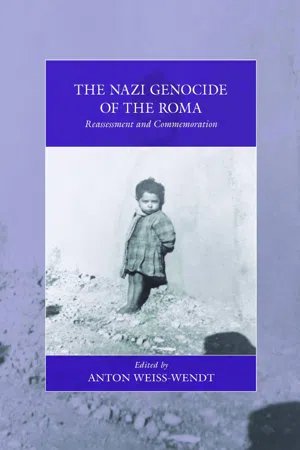
Using the framework of genocide, this volume analyzes the patterns of persecution of the Roma in Nazi-dominated Europe. Detailed case studies of France, Austria, Romania, Croatia, Ukraine, and Russia generate a critical mass of evidence that indicates criminal intent on the part of the Nazi regime to destroy the Roma as a distinct group. Other chapters examine the failure of the West German State to deliver justice, the Romani collective memory of the genocide, and the current political and historical debates. As this revealing volume shows, however inconsistent or geographically limited, over time, the mass murder acquired a systematic character and came to include ever larger segments of the Romani population regardless of the social status of individual members of the community.
- 284 pages
- English
- ePUB (mobile friendly)
- Available on iOS & Android
eBook - ePub
About this book
Trusted by 375,005 students
Access to over 1.5 million titles for a fair monthly price.
Study more efficiently using our study tools.
Information
CHAPTER 1
ASSIMILATION AND PERSECUTION
AN OVERVIEW OF ATTITUDES TOWARD GYPSIES IN FRANCE

During World War II, Gypsies in France faced identification, restrictions, arrests, internment, and death. Repressive laws and anti-Gypsy measures were nothing new for those who circulated within the country’s borders when the war broke out in 1939, however. Gypsies in France had faced discrimination and marginalization since medieval times, with the first French law aimed specifically at the mobile population appearing in 1539.1 A wave of anti-Gypsy legislation sparked by republican values, war, and French assimilationist tendencies had affected Gypsies throughout the late nineteenth and early twentieth centuries. World War II brought yet another set of circumstances and restrictive measures. The French army’s surrender in June 1940 led to Nazi occupation of three-fifths of the country and the establishment of the Vichy regime in its southern, unoccupied zone. Itinerant Gypsies thus found themselves the potential targets of two different authoritarian governments between 1940 and 1944. Known for its conservative, exclusionary politics, it seems only natural that the Vichy regime would target Gypsies as part of the National Revolution that sought to create a renovated nation purged of “undesirable” elements. Yet the reality was much more complicated and somewhat unexpected. Unlike Jews, Gypsies in France were never officially persecuted on racial grounds during the war, and the Vichy regime continually argued for the assimilation of this minority group into the mainstream. In many ways the treatment of Gypsies under the Vichy regime was a clear extension of policies initiated during the French Third Republic (1871–1940). This chapter traces the evolution of modern French attitudes towards Gypsies and demonstrates the importance of persecutory assimilation as a guiding factor in their treatment during World War II.
A History of Persecution
A policy of forced assimilation was not unique to Marshal Philippe Pétain’s wartime government. From the sixteenth century onward, assimilation attempts throughout Europe became more violent, but the Gypsies have proven to be remarkably resistant to such attempts at social integration. European marginalization in combination with Romani culture has limited the amount of interaction between the Roma and Gadje (the Rom word for non-Gypsies) resulting in the preservation of Romani language, social structures, and culture in spite of centuries of persecution.2 Despite earlier exclusionary acts against the peripatetic population, it was not until the 1860s that France first considered a national surveillance program for “Bohemians.” As a result, French and foreign travelers (ambulants) were required to carry identification papers beginning in 1863. By 1895, the government ordered a census of all “nomads, bohemians, and vagabonds” in a further surveillance attempt. Following the French loss in the Franco-Prussian war, many citizens supported such a measure that promised to help locate and identify potential “foreign” enemies.3 These actions coincided with increasing concerns about vagrancy in the Third Republic, which ultimately facilitated surveillance of Gypsies and helped further associate nomadism with criminality. Xenophobia and safety thus became the major themes of anti-Gypsy propaganda and stereotypes in the late nineteenth and early twentieth centuries.
On 16 July 1912, the government of the French Third Republic channeled these sentiments into a law with clear implications for Gypsies. The 1912 law regulated travelling professions in France, identified three different categories of itinerant merchants, and introduced a new, anthropometric identity card for “nomads.”4 The first three articles of the law differentiated between travelling salesmen (marchands ambulants), stallholders at fairs and markets (forains), and nomads (nomades). Each category was delineated by nationality, required some form of registration and/or identification, and outlined penalties for failure to conform. A travelling salesman was anyone (French or foreign) with a fixed domicile, living in France and practicing a mobile trade. These salesmen were required to make a declaration at the prefecture or subprefecture in their place of residence and would receive a receipt in exchange for the declaration. Failure to register could result in a fine of five to fifteen francs and imprisonment for one to five days. Forains were defined as French nationals who practiced a recognized profession yet were without a fixed residence. They (and their family members) were required to carry an identification card with a photograph. Public authorities could demand that an individual produce this identity card at any time. Punishment for infractions included a fine of sixteen to one hundred francs and prison time ranging from five days to one month. Finally, the law defined nomads as anyone without a fixed residence, regardless of nationality, falling into neither of the two previous categories. Nomads were required to carry anthropometric identity cards, which were to be presented upon arrival and departure in any commune as a kind of travel visa. The cards thus allowed authorities to track nomads’ movements. The law did not provide that everyone subject to Article III would be granted a card. Furthermore, all people falling into this administrative category were also required to carry a separate, collective identity card for the entire family and to display a special plate on their vehicles. The laws governing vagabondage would determine punishment in all cases of infractions related to the requirements for nomads outlined in Article III.
The 1912 law thus created a new administrative category and introduced a new type of identity card without explicitly defining who could be considered a “nomad.” The document contained neither racial references nor any ethnic identifiers (e.g., Tsigane, Gitan, Bohémien, Romanichel, or Manouche) in keeping with republican principles. Despite these omissions, it was “exactly Gypsies (Tsiganes) that the legislator meant to designate by the term ‘nomad.’”5 The vagueness of the definitions of marchands ambulants, forains, and nomades in the law also meant that mobile families of Gypsy (Roma or Sinti) heritage could be classified as forains while sedentary Gypsies would be considered travelling salesmen. The key to understanding future actions against Gypsies is recognizing that these were not absolute categories; not all Gypsies were classified as nomads though most scholars agree that all nomads were Gypsies.6 The actual categorization was determined on an individual basis by local officials and depended upon certain characteristics and perceptions that can best be labeled as racial.7 In daily practice, most ordinary people did not distinguish between ethnically Gypsy forains and nomads, but the law did.8 For these reasons, I will use the term Gypsy throughout the rest of this chapter to describe the perceived racial heritage of this group or as a general term to describe a varied population. I will employ the word nomad to reflect the official administrative terminology embodied in the French word nomade, as defined in the 1912 law.9
Nomads were viewed as “foreign” to French society regardless of their nationality; they were legally linked to criminal vagabondage by the 1912 law; the creation of anthropometric cards further underscored the government’s association of Gypsies with criminality. Recording physical characteristics previously only collected for the identification of criminals, the cards exhibited the holder’s name, date and place of birth, height, chest measurement, size of head, length of right ear, length of left middle and little fingers, length of left arm from elbow to middle fingertip, eye color, all ten fingerprints, and full-face and profile photographs.10 One goal of the 1912 law was to force nomads off the road and encourage them to acquire a permanent residence, thereby placing them within the “travelling salesman” category. In lawmakers’ eyes, conforming to the French norm of having a fixed domicile would encourage regular work and the Gypsies’ assimilation. Nomadism was not a racial but rather a social and cultural problem that could be solved.11 The Great War and the immigration concerns of the 1920s and 1930s further increased the surveillance of itinerant groups and helped crystallize the distinctions between French citizens and all types of “outsiders.”12
The Persecution of French Gypsies During World War II
The 1912 law, which remained in effect until 1969, would form the basis for Vichy’s attitudes and laws concerning Gypsies. In fact, Third Republic laws laid the foundation for the legal treatment of Gypsies during World War II, underlining the continuities between the republican and authoritarian regimes. This is not to say that the Gypsies in France did not experience additional discrimination, persecution, and extreme maltreatment during the war. Indeed, they faced surveillance, regular checks, forced immobilization, arrest, and internment in camps. However, official persecution was never explicitly racial (laws applied only to nomads and not all Gypsies) and offered the opportunity for rehabilitation—a combination that can best be described as a policy of persecutory assimilation. On 6 April 1940, after the outbreak of war in Europe but before the German invasion of France in May, President Paul Lebrun issued a law forbidding the circulation of nomads (as defined by the 1912 law) within French borders during wartime. The law, upheld by the Vichy regime after its establishment in July 1940, forced nomads to reside in a designated area under police surveillance. Nomads could move about freely only within these circumscribed areas, and they had to present themselves to the local gendarmerie within fifteen days of the law’s publication. Failure to do so would result in a one- to five-year imprisonment. The preface to the law made it clear that such measures were necessary for “national defense” since the incessant movement of nomads with no national ties presented them with ample opportunities to pass military information to the enemy.13 Xenophobia and long-standing stereotypes that associated Gypsies with spying certainly contributed to the lawmakers’ push to immobilize the peripatetic population.14
The assignment of nomads to certain areas or even to fixed residences continued after the armistice of 22 June 1940 officially ended the hostilities between France and Germany. Although the Vichy regime touted itself as fundamentally different from the decadent Third Republic and promised to renovate French society through a National Revolution that would purge the nation of undesirable elements such as Jews, Communists, and foreigners, the regime continued to support the idea of nomad assimilability throughout the war years. Ethnic Gypsies who had a fixed residence (marchands ambulants) and forains of Roma extraction were exempt from the laws related to nomads and were shielded from harsher measures as the war progressed. In other words, Vichy maintained the distinction between forains and nomads throughout the war and did not use race as a determinant for ...
Table of contents
- Cover
- Title Page
- Copyright Page
- Dedication
- Contents
- Acknowledgments
- Introduction
- Chapter 1 Assimilation and Persecution: An Overview of Attitudes toward Gypsies in France
- Chapter 2 Genocidal Trajectory: Persecution of Gypsies in Austria, 1938–1945
- Chapter 3 Ustaša Mass Violence Against Gypsies in Croatia, 1941–1942
- Chapter 4 Ethnic Cleansing or “Crime Prevention”? Deportation of Romanian Roma
- Chapter 5 Nazi Occupation Policies and the Mass Murder of the Roma in Ukraine
- Chapter 6 The Nazi Persecution of Roma in Northwestern Russia: The Operational Area of the Army Group North, 1941–1944
- Chapter 7 The Justice System of the Federal Republic of Germany and the Nazi Persecution of the Gypsies
- Chapter 8 Disentangling the Hierarchy of Victimhood: Commemorating Sinti and Roma and Jews in Germany’s National Narrative
- Chapter 9 The Aftermath of the Roma Genocide: From Implicit Memories to Commemoration
- Selected Bibliography
- Notes on Contributors
- Index
Frequently asked questions
Yes, you can cancel anytime from the Subscription tab in your account settings on the Perlego website. Your subscription will stay active until the end of your current billing period. Learn how to cancel your subscription
No, books cannot be downloaded as external files, such as PDFs, for use outside of Perlego. However, you can download books within the Perlego app for offline reading on mobile or tablet. Learn how to download books offline
Perlego offers two plans: Essential and Complete
- Essential is ideal for learners and professionals who enjoy exploring a wide range of subjects. Access the Essential Library with 800,000+ trusted titles and best-sellers across business, personal growth, and the humanities. Includes unlimited reading time and Standard Read Aloud voice.
- Complete: Perfect for advanced learners and researchers needing full, unrestricted access. Unlock 1.5M+ books across hundreds of subjects, including academic and specialized titles. The Complete Plan also includes advanced features like Premium Read Aloud and Research Assistant.
We are an online textbook subscription service, where you can get access to an entire online library for less than the price of a single book per month. With over 1.5 million books across 990+ topics, we’ve got you covered! Learn about our mission
Look out for the read-aloud symbol on your next book to see if you can listen to it. The read-aloud tool reads text aloud for you, highlighting the text as it is being read. You can pause it, speed it up and slow it down. Learn more about Read Aloud
Yes! You can use the Perlego app on both iOS and Android devices to read anytime, anywhere — even offline. Perfect for commutes or when you’re on the go.
Please note we cannot support devices running on iOS 13 and Android 7 or earlier. Learn more about using the app
Please note we cannot support devices running on iOS 13 and Android 7 or earlier. Learn more about using the app
Yes, you can access The Nazi Genocide of the Roma by Anton Weiss-Wendt in PDF and/or ePUB format, as well as other popular books in History & European History. We have over 1.5 million books available in our catalogue for you to explore.