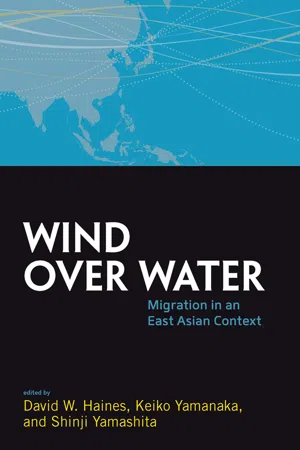
Providing a comprehensive treatment of a full range of migrant destinies in East Asia by scholars from both Asia and North America, this volume captures the way migrants are changing the face of Asia, especially in cities, such as Beijing, Hong Kong, Hamamatsu, Osaka, Tokyo, and Singapore. It investigates how the crossing of geographical boundaries should also be recognized as a crossing of cultural and social categories that reveals the extraordinary variation in the migrants' origins and trajectories. These migrants span the spectrum: from Korean bar hostesses in Osaka to African entrepreneurs in Hong Kong, from Vietnamese women seeking husbands across the Chinese border to Pakistani Muslim men marrying women in Japan, from short-term business travelers in China to long-term tourists from Japan who ultimately decide to retire overseas. Illuminating the ways in which an Asian-based analysis of migration can yield new data on global migration patterns, the contributors provide important new theoretical insights for a broader understanding of global migration, and innovative methodological approaches to the spatial and temporal complexity of human migration.
Trusted by 375,005 students
Access to over 1.5 million titles for a fair monthly price.
Our topic in this study, trafficking in persons, is being done in large scale. Pirates disembarked spontaneously, attacked villages and withdrew … taking young men and women as prisoners to sell them at the markets of the Celestial Empire. In land, they had correspondents [that] attracted Annamese girls in lovers’ appointments, took their service as maids or bought children from parents. (Paulus 1885: 45)
If one looks at the archives, it is clear that history can be a useful tool in the understanding of the modern phenomena of human trafficking. These practices, widespread over the Indochinese peninsula a century ago, and so aptly described by colonial administrators, have not disappeared from contemporary Asia according to observers, researchers, and anti-trafficking campaigners. In fact, today’s practices resemble what was taking place a hundred years ago to such a great extent that the arguments of those aid organizations who claim this problem is anchored in recent processes of globalization must be challenged. Instead, the similarities and parallels between the colonial period and the present one are striking, emphasizing durability as well as change.
The objective of this chapter is to map this institution of trading human beings at the intersection of the nineteenth and twentieth centuries, providing a specific Vietnamese example of the more general need to consider historical precursors to contemporary migration patterns. The chapter will begin by describing the major national and transnational trafficking routes, pointing out the details of crossing points and dispersal markets. As will be shown, those trafficked were Vietnamese, but also Cantonese, Japanese, and European. Then, the nature of this human trade will be assessed by focusing on its different resulting social forms, particularly adoption, concubinage, and prostitution. Finally, French policies to suppress piracy in Tonkin1 and to manage prostitution – considered as a “necessary evil” – will be outlined.
The period covered by this chapter ranges from 1863, when an anonymous author published Note sur l’Esclavage, to 1941, date of the publication of Andre Baudrit’s book La Femme et l’Enfant dans l’Indochine Française et dans la Chine du Sud (Rapt-Vente-Infanticide). Secondary sources comprise published historical papers and books as well as reports from French colonial administrators. Primary sources include reports of proceedings and administrative letters from French Consuls in China from the National Archives Center No. 1 in Hà N
i. Given that the sources are disparate in nature and quality, the images drawn are necessarily partial. The goal is not to offer a definitive picture of the situation, but to explore a research perspective on human trafficking that emphasizes historical similarities and parallels. One should keep in mind that all these sources bear the stamp of colonialism (Delaye 2005), whether in justifying the system or in the interventionist intentions of narrators who hoped their testimony could relieve human injustice and “heal a wound that the flag could not cover up” (Paulus 1885: 49). One should also bear in mind that, just as in the prolific contemporary literature on trafficking from the media, aid organizations, and national agencies, the voices of those actually trafficked are usually absent. The women and children tricked, kidnapped, sold, exploited, or thrown into the Gulf of Tonkin rarely leave their own testimony. Some, then as now, disappear into the red light districts of urban centers while others succeed in finding a relatively stable new life or returning home to their villages.
Mechanisms and Routes
Numerous complaints and newspaper accounts from the colonial period tell of child abductions in the Red River delta. Children of indigent Vietnamese or Chinese families continuously disappeared without leaving a trace. Kidnappers used a wide range of techniques to abduct their prey: enticing promises for work or marriage, candies to lure young children, chloroform to put victims to sleep, brutal raids and kidnappings, bandit attacks on coastal villages. Once deceived, victims were usually moved from one intermediary place to another before being sold in border towns or northern ports like H
i Phòng. On 2 January 1936, the newspaper Annam Nouveau offered figures on reported disappearances: 172 in 1933, 134 in 1934, and 236 in 1935, yielding an average of 180 missing children per year. The French colonial justice system was at first inadequately equipped to deal with these offenses, although over the years it adopted a more active approach (as shall be discussed).
We lack reliable data about the prices paid for these individuals as well as stable reference points to set up comparative tables of the currencies, whether Chinese silver tael, French Indochinese Union piaster, French francs, Hong Kong dollars, or thirty gram “ounces” of gold. The price of each person was calculated according to criteria of ethnic origin, gender, age, health and physical condition, and educational level. For women, virginity was an added criterion of value. Factors related to market supply and demand also affected price. In general, women were more expensive than men because they were perceived as being more malleable and entrepreneurial as workers and because they could also become spouses or concubines. Those who were sold were often later exchanged for money, rice, salt, cattle, weapons and ammunition, opium, or for other individuals. In 1883, Taboulet (1883: 117) indicated prices in piasters as follows: a child of ten to twelve cost fifteen to eighteen piasters, at fifteen a boy’s value climbed to twenty piasters and a girl’s could climb to thirty or forty piasters if pretty. The markup in price was considerable. In 1906, for example, the price of a Vietnamese child bought for one piaster in Vietnam could reach one or two hundred Hong Kong dollars. In 1941, Baudrit (1941: 118) states that the price of a Tonkinois child was between six and fifteen dollars when first purchased, but the value could reach thirty to one hundred Hong Kong dollars on the island market. These figures indicate the substantial profits that were generated by the trade in humans at that time.
Generally, agents who abducted the women and children were not those who exploited them. Victims were commonly sold and resold through a chain of intermediaries that generated profit in each transaction. In Tonkin, the identification of potential victims was usually accomplished by local women traders who had little difficulty in identifying prey for themselves or in assisting other captors. These women, who acted as brokers, often bought children for small amounts of money and then raised them in their houses. The children destined to be sent to China, for example, were dressed with Chinese-style clothing, their hair arranged with Chinese-style braids, and their teeth were whitened if they had been previously lacquered in black. While being raised, children were prepared for the fate that awaited them. For the majority, that was domestic service, prostitution, or marriage-like unions. Generally they stayed with the brokers for a period of between six months and two years. After that, children were sent to Chinatowns in Hà N
i or Sài Gòn, or to southern China. The youngest recruits were prized by Chinese residents or Cantonese traders traveling in Indochina. Some young women might also marry French administrators. It was possible for those who benefited from the company of these women during their sojourns in Indochina to do so without knowing their companion’s true origin.
In the late nineteenth century, human trafficking in northern Vietnam seems to have been in the hands of Vietnamese and Chinese bandits. Some of these worked with German or British merchants by subcontracting the shipment of the merchandise. In the South China Sea, complex alliances developed among organized criminal groups, fortune pirates, and shipping traders, all under the eyes of powerless French authorities.
The actual routes of human trafficking were multiple. Tonkinois recruits were transferred to China by both sea and land. By sea, women from the Red River delta were routed to H
i Phòng either by land or by small rivers that pour out into the gulf. From there they were shipped to Pakhoi in Guangxi province. Sometimes they were hidden in bunkers or “ostensibly taken by parents of alleged Chinese which for the occasion had changed the national costume for a disguise that gave them the appearance of Chinese girls” or “with legal passports issued by the Residences where it was clearly mentioned with their own children.”2 From Pakhoi, they were sent to the port of Haikou in the island province of Hainan (formerly Hoi Hao) and then transferred to Macao or Hong Kong. Arrests were frequent in H
i Phòng after the promulgation of a decree in December 1912 that strengthened controls on suspicious vessels. As a consequence, smugglers started to use more discreet sampans, carrying small numbers of persons to circumvent H
Long Bay, Cát Bà, or Ke Bao islands.3 By day, children were hidden in caves, and by night they traveled on junks or were hidden in steamship holds. Given these circumstances, trips to China could last for several days; many died of hunger, exhaustion, or drowning after being thrown into the sea by the sailors. The Franco-Vietnamese press nicknamed pirates from the Gulf of Tonkin the “dogs of the sea” (chiens de la mer) because they never hesitated to throw victims, tied up, into the water when French sea police patrols approached.4
By land, convoys took isolated trails to cross the mountainous provinces of Đông Tri
u, B
c Giang, and L
ng S
n towards Guangxi. If departing from Hà N
i, convoys moved towards Tuyên Quang, then crossed the Lào Cai Chinese border with Yunnan to reach Mong Tseu. Most of the women traveling by land supplied the demand for marriages and adoptions in Guangxi province.
Trading Women for What Purposes?
Why did Chinese need to import Vietnamese women? Did China lack for females? H
i D
ng Resident Massimy asserted various reasons (Baudrit 1941: 90). First, Chinese women caught on the spot knew the region and could easily escape, whereas Vietnamese women sent far from their homeland could not. Second, men preferred not to buy Chinese compatriots because they felt more sympathy for them than for their Vietnamese counterparts. Third, Chinese employers enjoyed greater freedom with Vietnamese employees than with Chinese. Fourth, Vietnamese women were easier and cheaper to acquire than Chinese women.
Although most of these arguments seem plausible, one is highly questionable. The fact that Vietnamese women were cheaper than Chinese, more easily subjected to all kinds of tasks, and less tempted to escape, all seems reasonable. But to argue that Chinese did not want to buy fellow Chinese due to sympathy or compassion seems to contradict the mui tsai system (literally “little sister” or “small servant” in Cantonese dialect) that developed in southern China in the late nineteenth and early twentieth century. This system was grounded in poverty and only worsened during periods of famine, epidemics and natural disasters, and after the two opium wars. The mui tsai system actually generated the first international campaign against what was labeled “child slavery” (Haslewood 1930). It is believed that hundreds of thousands of the young and destitute from southern China provinces were sold as wives, concubines, or prostitutes at that time. The youngest (the mui tsai) were sent to work as domestic employees for wealthy owners in Canton, Hong Kong, Malaysia, or Singapore. Transactions were usually subject to written contracts. A mui tsai could become either a servant or a concubine, and the purchaser had the right to re-sell her, marry her, or make her his concubine. The servant had to perform domestic chores and she usually received little or no financial reward (Chin 2002, Haslewood 1930, Jaschok 1988, Warren 1993).
Buying servants, wives, or concubines must be distinguished from prostitution. Silvestre’s (1880) report about slavery and forms of servitude in Cochinchina, Landes’s (1880) letter about prostitution in Ch
L
n, and Hardy’s article (1994) about military brothels or BMC (Bordel Militaire de Campagne) all portrayed a complex situation: Chinese brothels employing Cantonese children, Japanese and European prostitutes serving French troops, and trafficking of Chinese and Vietnamese women to Singapore. In 1880, Ch
L
n Mayor Landes described the traffic of young girls being employed as maids or prostitutes in the Chinese municipality.5 Like northern female brokers, Ch
L
n Madams raised their recruits, mostly...
Table of contents
Cover Page
Title Page
Copyright Page
Contents
List of Tables
List of Figures
Preface
Acknowledgments
Introduction
Part I: Migrants, States, and Cities
Part II: Family, Gender, Lifestyle, and Culture
Part III: Work, Ethnicity, and Nationality
Conclusion
About the Contributors
Index
Frequently asked questions
Yes, you can cancel anytime from the Subscription tab in your account settings on the Perlego website. Your subscription will stay active until the end of your current billing period. Learn how to cancel your subscription
No, books cannot be downloaded as external files, such as PDFs, for use outside of Perlego. However, you can download books within the Perlego app for offline reading on mobile or tablet. Learn how to download books offline
Perlego offers two plans: Essential and Complete
Essential is ideal for learners and professionals who enjoy exploring a wide range of subjects. Access the Essential Library with 800,000+ trusted titles and best-sellers across business, personal growth, and the humanities. Includes unlimited reading time and Standard Read Aloud voice.
Complete: Perfect for advanced learners and researchers needing full, unrestricted access. Unlock 1.5M+ books across hundreds of subjects, including academic and specialized titles. The Complete Plan also includes advanced features like Premium Read Aloud and Research Assistant.
Both plans are available with monthly, semester, or annual billing cycles.
We are an online textbook subscription service, where you can get access to an entire online library for less than the price of a single book per month. With over 1.5 million books across 990+ topics, we’ve got you covered! Learn about our mission
Look out for the read-aloud symbol on your next book to see if you can listen to it. The read-aloud tool reads text aloud for you, highlighting the text as it is being read. You can pause it, speed it up and slow it down. Learn more about Read Aloud
Yes! You can use the Perlego app on both iOS and Android devices to read anytime, anywhere — even offline. Perfect for commutes or when you’re on the go. Please note we cannot support devices running on iOS 13 and Android 7 or earlier. Learn more about using the app
Yes, you can access Wind Over Water by David W. Haines, Keiko Yamanaka, Shinji Yamashita, David W. Haines,Keiko Yamanaka,Shinji Yamashita in PDF and/or ePUB format, as well as other popular books in Social Sciences & Cultural & Social Anthropology. We have over 1.5 million books available in our catalogue for you to explore.