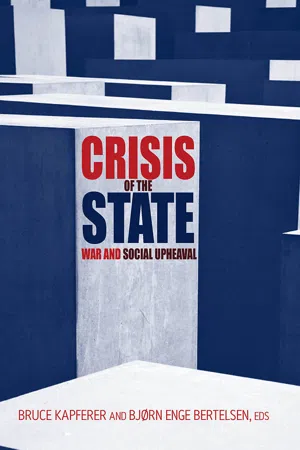
Analyzing both historical contexts and geographical locations, this volume explores the continuous reformation of state power and its potential in situations of violent conflict. The state, otherwise understood as an abstract and transcendent concept in many works on globalization in political philosophy, is instead located and analyzed here as an embedded part of lived reality. This relationship to the state is exposed as an integral factor to the formation of the social – whether in Africa, the Middle East, South America or the United States. Through the examination of these particular empirical settings of war or war-like situations, the book further argues for the continued importance of the state in shifting social and political circumstances. In doing so, the authors provide a critical contribution to debates within a broad spectrum of fields that are concerned with the future of the state, the nature of sovereignty, and globalization.
eBook - ePub
Crisis of the State
War and Social Upheaval
- 338 pages
- English
- ePUB (mobile friendly)
- Available on iOS & Android
eBook - ePub
Crisis of the State
War and Social Upheaval
About this book
Trusted by 375,005 students
Access to over 1.5 million titles for a fair monthly price.
Study more efficiently using our study tools.
Information
Section III
SOVEREIGN LOGICS

Chapter Seven
THE SOVEREIGN AS SAVAGE
The Pathos of Ethno-Nationalist Passion
Very frequently in the past and even today, the term state has been used where the term government would serve just as well if not better. This is the gist of an observation by Radcliffe-Brown in an early article (Radcliffe-Brown 1940). More recently, scholars of the state such as Abrams (1988) and Trouillot (2001) have seconded the objection raised by Radcliffe-Brown and have pointed out that power, construed very broadly, constitutes the central issue in understanding the state. In situating power at the center of analysis, these theorists follow the path blazed by Michel Foucault (1977). For Foucault there is no individual subject constructed in the absence of power, and there is no social institution or cultural construction that does not bear the imprint of historical struggles over power. In essence, power takes over at the micro level in the constitution of human subjectivity and at the macro level in the execution of collective action. With power so pervasively infusing human experience, there appears to be no middle ground, nothing between micro and macro where power is not the ultimate determining variable and therefore, no need of talking about anything else. Power is here; power is there. It is everywhere. History is the chronicle of the struggle for power among individuals and groups. Taken to its logical conclusion, this perspective on human social life closely resembles the Hobbesian “war of each against all.”
However, it could very well be that this vision of things is a culture-bound one, steeped in the individualistic ontology of Western capitalist society. One could pose the question of whether power covers all the bases, whether it by itself tells us all that we need to know in the course of social analysis. It is clear for an anthropologist like Pierre Clastres that some peoples in the world refuse the organization of society on the sole basis of power (1974). They refuse master/slave ideology and all the narratives spun from its fibers. From his work among the stateless societies of the Amazon basin, Clastres shows that many peoples reject the command/obedience dichotomy and the power of one over many. Chiefs among the Guayaki, for example, have prestige and can practice polygyny, but they must be good orators and be generous. Yet, for all their oratorical skills, their speeches are usually ignored; and, for all their generosity—or rather because of it—they are usually the most impoverished members of their communities. For these peoples, what has been perennially viewed as an absence—the lack of a state—should be seen as a presence, that is, the choice of a life where no human being rules over another. Although these societies certainly have politics, it is a politics inextricably bound up with and enracinated in the social. As Clastres terms it, these are societies against the state (1974).
Parallel to Clastres, in Marshall Sahlins’ earlier work on the “domestic mode of production” (2000 [1972]), we see that, in contrast to all depictions of “primitive” economies as economies of deprivation, the people who actually live in such societies procure their subsistence with an average of less than three hours of work per day. These are economies rooted in and encompassed within the social, and it is this social factor that is their driving force rather than their by-product. These are economies against economism.
According to Sahlins’ more recent work, the current Foucauldian-inspired preoccupation with power is influenced by a notion of the individual as perpetually inadequate and derives much of its impetus from Judeo-Christian cosmology (2000 [1996]). Sahlins maintains that these culture-bound assumptions underlie Western social science models that begin at the axiomatic base of the individual as a needful being. Society then, becomes either the instrument by which individual needs can be satisfied—Malinowski—or the mechanism through which conflicting individual demands can be regulated and held in check by collective constraint and pressure—Durkheim. Aspects of similar notions resurface in Foucault and others who see struggle at the basis of all human interaction. We struggle against each other in social life and even with ourselves as every individual consciousness is divided and conflictual. Although Foucault differs from Durkheim in many respects, the two thinkers share these ontological notions. In Durkheim the basis of morality lies in the collective, while for Foucault there is no so-called moral discourse outside of power/knowledge nexi that both reflect and reproduce cleavages between the empowered and the disempowered. If there are differences in the posited mechanics of repression, the two share a fundamental vision: for Durkheim, collective representations constrain and coerce; for Foucault, society is a disciplinary apparatus. In either case, the self remains the seat of desire while the collective is the locus of desire’s regulation or control.
If Clastres and Sahlins are correct in their thinking, as I believe they are, there must be in addition to societies who categorically refuse the state and to those who refuse economism, state societies that cannot be adequately understood solely through the lens of a universalized homo economicus or a universalized homo politicus. Such state societies may well have been numerous in the non-Western world; it is likely that the premodern society of Rwanda was one of them. My second contention is that if we want to understand the social and cultural specifics of how war is enacted by such non-Western states, we need to understand not only the events of war, not only the political and economic calculus of maximizing individuals and their conflicting discourses, but also the ontological underpinnings of moral personhood in these societies as this is deployed in war. In this specific instance, I will attempt to show that the echoes of moral personhood as evinced in the institution of sacred kingship and in the rituals of the premodern Rwandan state were heard in the genocidal war waged by the modern Rwandan state against its Tutsi citizens. Of course, many things have changed in Rwanda over the course of the last one hundred years as a result of Rwanda’s experience with colonialism, Christian evangelization, and integration into the world capitalist economy, but this does not mean that all precolonial notions of the person have been effaced, particularly where this concerns the relation of leader to polity.
One expectation, consistent with precolonial notions of the person but perhaps never stated nor ever fully manifest in postcolonial times, is that the Rwandan leader be the polity’s most giving being and that the concern of prosperity for all be his foremost concern.
Violence and the State
When violence is conducted by the state, it spares no effort in legitimizing this violence according to local moral perceptions that are in harmony with subjacent cultural codes. This means that at one level the state’s organized violence is supported and institutionalized by ideologies that make destructive acts appear justified for the maintenance of collective well-being. Frequently, public rituals serve as the means by which these ideologies are validated and communicated to the mass of the state’s citizens. At another level, and more importantly for our purposes, these rituals convey less apprehensible messages reflecting the community’s deep desires and sentiments. These latter are less accessible to conscious apperception, more archetypal in nature, and less likely to be construed by social actors as having obvious and clear-cut ideological content.
Following Aijmer’s discussion of violence (2000), whose analytical scheme bears close resemblance to that used by Godelier (1996) in an apparently unrelated matter—the ambiguities left unresolved in Mauss’s discussion of the gift—one could posit the existence of three dimensions to state violence and to the political rituals that enact or serve to justify state violence: the imaginary, the symbolic, and the real. At the least apprehensible level is what Godelier terms the “imaginary.” The imaginary consists of iconic symbols more or less organized into diffuse cultural codes. These constitute the base of the social imagination in its envisioning of possible worlds. This material is only intuitively cognized by social actors and consists of what Roy Wagner (1986) would call “symbols that stand for themselves,” or, in other words, symbols that are not readily translatable into a verbal or discursive idiom. These symbols and diffuse codes constitute the body of any community’s tacit assumptions about itself and the world, while subtly and almost imperceptibly revealing its profoundest fears and desires. This level is the least accessible to the social actors themselves and to their exegesis. In those instances when an outsider indicates material from this level to the social actors who actually live it, their verbal responses are likely to be ad hoc rationalizations or secondary elaborations (Aijmer, op. cit.). Despite the relative inaccessibility of this iconic imaginary base to the persons who embody it, it precedes and conditions everything that is more conscious in nature. In this respect Godelier explicitly marks his difference from both Lacan and Lévi-Strauss, who see the symbolic as logically prior to both the imaginary and the real (1996).
At the next level, what Aijmer terms the “discursive” and Godelier terms the “symbolic,” verbal elements come to the fore. It is here that agentive phenomena are manifest as social actors verbalize what their intentions are and act out these intentions in consonance with avowed pragmatic ends. This is the domain of language, discourse, and narrative. People will usually be able to identify and verbalize what the ideologies of their supporters and opponents are and explain the pragmatic ends that are served with any particular statement or action. It is here that strategization is most apparent as social actors weigh the consequences of one course of action against others and then behave accordingly. This is also the level where disagreement, conflict, and struggle are most manifest.
The most visible level of state violence is what Aijmer calls the “ethological” and which corresponds to what Godelier calls the “real.” Violence has very real biological and psychological effects upon the people against whom it is applied—suffering, pain, injury, and death. Yet, even this level is dependent upon its interaction with the other two levels in order for violent acts to attain their full amplitude of social meanings. It may not be sufficient, for example, to kill one’s opponent; it may be necessary to mutilate, to destroy, or to dispose of the body in such a way that the victim’s spirit not return to wreak vengeance on the perpetrator of the violence. As Aijmer puts it, while physical death may be irrevocable and nonnegotiable, social death may not (2000).
Although both Godelier and Aijmer posit the primacy of the imaginary, certainly these three levels are not hermetically sealed off from one another. It is possible for people to become aware of the iconic symbols that constitute their imaginary. Certain members of a collectivity, as with individuals in psychoanalysis, may have a “prise de conscience” in which the deeper levels of their socially shared fears and desires become manifest. When this happens, the iconic enters the realm of the symbolic and becomes susceptible to verbalization. The pre-discursive rises to the discursive. In like fashion, this process can go the other way. Discursive material that had once been verbalized in the form of ideological statements and narratives can become so habitual as to become virtually unconscious. What was once stated and debated becomes tacit and implicit, joining the ranks of other phenomena constituting the habitus or the “things that go without saying” (Bourdieu 1977). Finally, it is also possible that at the level of the real or the ethological, the performance of violence radically reconstitutes the social and cultural order. In such a case, the older ideologies and deeper cultural layers may lose their salience, being replaced by something new. This is why we need historical as well as social analysis. In the case of Rwanda, in order to understand something about the changing relationship of the imaginary to the symbolic and to the real, we need to know something about its history as a state.
As I will demonstrate below, despite the radical changes that came in the wake of violence and revolution during the early 1960s, much of the cultural imagining of the state and the place of the sovereign in the state persisted into the 1990s.
The Premodern Rwandan State
The political entity Rwanda traces its foundation as a state to the seventeenth century C.E., when Ruganzu Ndori, coming from Karagwe-Ndorwa (present-day eastern Tanzania and southwestern Uganda), entered the central regions of what is now Rwanda and established a kingdom there (Vansina 2000). Small independent polities had existed in this area prior to Ndori’s arrival. These consisted of both stateless societies and states such as that of the Renge, reputedly the most ancient, comprising much of present ...
Table of contents
- Cover
- Half title
- Title
- Copyright
- Contents
- List of Tables and Figures
- Acknowledgements
- Introduction: The Crisis of Power and Reformations of the State in Globalizing Realities
- Section I. Transformations of Sovereignty, Empire, State
- Section II. War Zone
- Section III. Sovereign Logics
- Contributors
- Index
Frequently asked questions
Yes, you can cancel anytime from the Subscription tab in your account settings on the Perlego website. Your subscription will stay active until the end of your current billing period. Learn how to cancel your subscription
No, books cannot be downloaded as external files, such as PDFs, for use outside of Perlego. However, you can download books within the Perlego app for offline reading on mobile or tablet. Learn how to download books offline
Perlego offers two plans: Essential and Complete
- Essential is ideal for learners and professionals who enjoy exploring a wide range of subjects. Access the Essential Library with 800,000+ trusted titles and best-sellers across business, personal growth, and the humanities. Includes unlimited reading time and Standard Read Aloud voice.
- Complete: Perfect for advanced learners and researchers needing full, unrestricted access. Unlock 1.5M+ books across hundreds of subjects, including academic and specialized titles. The Complete Plan also includes advanced features like Premium Read Aloud and Research Assistant.
We are an online textbook subscription service, where you can get access to an entire online library for less than the price of a single book per month. With over 1.5 million books across 990+ topics, we’ve got you covered! Learn about our mission
Look out for the read-aloud symbol on your next book to see if you can listen to it. The read-aloud tool reads text aloud for you, highlighting the text as it is being read. You can pause it, speed it up and slow it down. Learn more about Read Aloud
Yes! You can use the Perlego app on both iOS and Android devices to read anytime, anywhere — even offline. Perfect for commutes or when you’re on the go.
Please note we cannot support devices running on iOS 13 and Android 7 or earlier. Learn more about using the app
Please note we cannot support devices running on iOS 13 and Android 7 or earlier. Learn more about using the app
Yes, you can access Crisis of the State by Bruce Kapferer, Bjørn Enge Bertelsen, Bruce Kapferer,Bjørn Enge Bertelsen in PDF and/or ePUB format, as well as other popular books in Social Sciences & Political Freedom. We have over 1.5 million books available in our catalogue for you to explore.