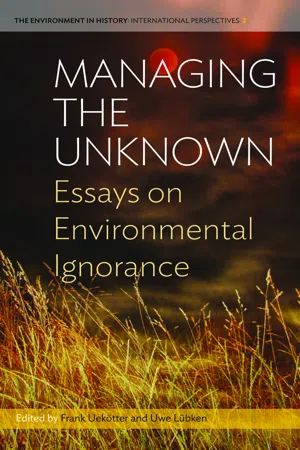
Information is crucial when it comes to the management of resources. But what if knowledge is incomplete, or biased, or otherwise deficient? How did people define patterns of proper use in the absence of cognitive certainty? Discussing this challenge for a diverse set of resources from fish to rubber, these essays show that deficient knowledge is a far more pervasive challenge in resource history than conventional readings suggest. Furthermore, environmental ignorance does not inevitably shrink with the march of scientific progress: these essays suggest more of a dialectical relationship between knowledge and ignorance that has different shapes and trajectories. With its combination of empirical case studies and theoretical reflection, the essays make a significant contribution to the interdisciplinary debate on the production and resilience of ignorance. At the same time, this volume combines insights from different continents as well as the seas in between and thus sketches outlines of an emerging global resource history.
Trusted by 375,005 students
Access to over 1.5 million titles for a fair monthly price.
Lost Knowledge and Struggles for a Natural Rubber Reserve in the American West
Mark R. Finlay
Soon after the 1929 stock market collapse, U.S. President Herbert Hoover and a rubber company executive met in the White House and hatched a plan to create a vast natural and living reserve of an obscure rubber-bearing desert shrub called guayule. George Carnahan, president of the Intercontinental Rubber Company (IRC) persuaded Hoover to support his vision that vast reserves of guayule should be planted in the American West as an alternative source of natural rubber, one that could ameliorate a rubber shortage emergency caused by war or economic crisis.1 To confirm the plan’s feasibility, the United States Army sent a young major, Dwight D. Eisenhower, on a month-long, five-thousand mile expedition that took him from his Washington desk job through the IRC’s experimental, agricultural, and processing operations in California, Texas, and Mexico. As they had intended—particularly with the Plant Patent Bill about to pass the U.S. Congress—the IRC officials impressed upon Eisenhower the confidential and proprietary nature of these knowledge systems, and that only they had the expertise, experience, and seeds necessary to make guayule a viable alternative source of American rubber.2
In the confidential report that Eisenhower and his traveling partner, Major Gilbert Van B. Wilkes, submitted on June 6, 1930 (exactly fourteen years before D-Day) the officers endorsed guayule almost unequivocally. “No other desert plant,” they asserted, “has been made the subject of so much research and study and offers such possibilities” for the American Southwest. The two majors recommended government support for a new industry based upon the shrub for several reasons: it offered potential employment to thousands of needy Americans; it could provide an alternative crop for American farmers whose overproduction of cotton and grain crops commonly brought low prices; it could help consumers through an overall reduction in the demand for imported rubber; and it could become a permanent addition to the rural economy in arid regions of the United States. Further, because guayule required four to six years to reach maturity, they argued that the time had already arrived for the United States to establish a permanent and natural domestic rubber reserve. Thus they endorsed price guarantees that would encourage the planting and maintenance of a living reserve of about 400,000 acres of guayule. If harvested on a rotating basis every four years, the scheme could contribute about 160,000,000 pounds of rubber annually, or about one-fifth of the nation’s annual consumption. “Under real encouragement,” Eisenhower and Wilkes boldly concluded, “the production of guayule would develop rapidly into an important industry in the United States.”3 Despite these persuasive arguments, however, it seems that this report gathered dust in government filing cabinets, and its existence was forgotten or ignored until 1943, when the nation faced a very real rubber crisis.4
The repeated demise of this kind of environmental knowledge fits a model that historians Robert Proctor and Londa Schiebinger have recently described as “agnotology,” or the social construction of ignorance. Competing and dynamic social pressures, they argue, ensure that at least some scientific knowledge is continually suppressed, censored, or never learned in the first place.5 This project also borrows from Naomi Oreskes and Erik Conway, co-authors of the recent work Merchants of Doubt, which reveals how many participants in scientific discourse are more interested in obscuring, confusing, and obfuscating scientific facts than in uncovering them.6 The case of guayule shows elements of these roots of scientific ignorance, but perhaps an even more prominent thread is that of “scientific amnesia.” In this essay, the active suppression of knowledge is apparent at times, but so is a continual pattern of ignoring and forgetting what previous scientists had learned, forcing another generation of scholars to re-learn much of the same material.7
The history of guayule also serves as a lens through which to examine connections between sustainability and national defense. Although underappreciated in most historical accounts, efforts to control strategically important plants have been fundamental tools of economic and political power since the very origins of western hegemony. As historian Joachim Radkau has shown, the triumph of an inorganic economy has been slow and incomplete as modern farmers and industrialists continue to maximize their mastery of organic resources. Many plants and agricultural products remained at the core of Western power and wealth well into the industrial age; cotton, sugar, timber, flax, hemp, indigo, madder, wheat, and other plants proved as vital to western industrialization as coal and iron.8 Because synthetic substitutes for many of these natural products did not exist until the twentieth century, agricultural shortages could be devastating to the industrial economy or to military operations. Cognizant of this risk, western leaders and entrepreneurs used various strategies of trade, plunder, exploitation, and investment to get their hands on valuable botanic and agricultural resources, particularly those native to their colonies and other tropical regions. In the words of historian Philip Pauly, many also “envisioned a future of horticultural independence” and embraced proposals to develop domestic resources for valuable plant material that might yield essential raw materials.9 In many cases, although with few successes, they also called for the establishment of natural reserves of strategically important crops and biomass resources, living botanical stockpiles that might sustain the industrial economy in the case of military or economic crisis.
This article focuses on a handful of efforts to establish natural reserves of strategic rubber plants. Unlike traditional ecological reserves, these buffer zones were to be artificial creations, collections of plants that could be tapped to sustain local and traditional economies in time of need.10 In an era before Americans turned in the direction of nonrenewable and non-sustainable resources to serve industrial, military, and consumer demands, the soil was the first place to look.
The twentieth-century search for permanent natural rubber resources fits into such questions, for virtually all natural rubber, then as now, comes from a small corner of the world in Southeast Asia. Latin American rubber production collapsed early in the twentieth century and never has made a successful comeback. Synthetic rubber derived from petroleum products emerged since World War II as an apparent panacea, one based on a steady stream of raw materials unaffected by weather, seasons, or other variables of nature. Yet only natural rubber has the qualities and properties necessary for airplane tires, portions of automobile tires, condoms, surgical gloves, and scores of other applications. As a result, natural rubber—now mainly from Thailand, Indonesia, and Malaysia—still captures about forty percent of the market, and natural rubber production continues to set new records every year.11
But new agricultural crops like guayule faced countless cognitive, political, and economic challenges, and they continually encountered problems of lost, ignored, and suppressed knowledge. Despite the confidence that Carnahan, Eisenhower and Wilkes, and other guayule enthusiasts expressed, they remained ignorant of a great deal. Virtually any attempt to introduce a new agricultural crop is fraught with profound problems, for even the best-designed research project generally requires an entire growing season to yield meaningful results. Bringing new crops into the commercial marketplace is even more difficult, for it has taken decades, if not millennia, to develop the confluence of breeding, planting, harvesting, and marketing technologies that make just a few crops account for the majority of the entire globe’s agricultural production. At least in the United States, political pressures exacerbate the problem, as only five crops—corn, wheat, cotton, soybeans, and rice—account for ninety-three percent of the direct subsidies in the 2007 U.S. farm bill.12 There is little incentive to investigate, promote, or invest in the crops about which little is known. As this case will show, and despite several outbreaks of guayule fever, repeated efforts to make American rubber crops viable fell short of their goals.
The Plant, and the Idea of a Natural Reserve
Like Eisenhower and Wilkes’s report, this chapter focuses on the desert plant guayule, (Parthenium argentatum Gray). Guayule is a woody shrub, about two feet tall, with silvery-olive leaves, small yellowish flowers, and deep and extensive root systems. A drought-resistant native of the elevated deserts of northern Mexico and a small corner of southwest Texas, guayule is a long-lived plant that matures and reproduces quite slowly. During a guayule boom of the early twentieth century, it took little time at all for aggressive harvesters in Mexico and Texas to make the extinction of wild guayule seem imminent. Then the Mexican Revolution brought the issue home, as revolutionaries continually attacked American-owned guayule operations like the IRC, in part because of this industry’s impacts upon native societies and environments. To keep the industry afloat, the IRC hired botanists and agricultural experts who tried to engineer new propagation techniques, cultivation methods, and new habitats within the borders of the United States, first in southern California, then southern Arizona, then northern California. Other Americans intermittently sought to create a guayule rubber industry in South Texas. After decades of trial and error, IRC experts developed tedious and expensive strategies to germinate selected seed in nursery beds, to carefully transplant the seedlings to the field, and to maintain the plants for years in semiarid and isolated environments. Because the plant could live in lands that competed with few other commercial crops, guayule enthusiasts argued it could be an important addition to the agricultural economy of the American Southwest, one that might even bring profit to farmers during times of high rubber prices. Alternatively, some argued that the plant could become a permanent and natural reserve that stored valuable rubber in an untended biomass, left idle in western deserts for some unknown future need.13
The unknowns that surrounded guayule were extensive and significant. Because the plant requires four to five years to reach maturity, guayule reserves would have to become part of an ambiguous, minimally-developed landscape. Planners had to imagine a resource that could be planted in arid lands and left to fend for itself for an indeterminate length of time, under some form of quasi-public management, with loose assurances of government purchase during some unpredictable future emergency. Further complicating matters, the IRC, the firm that controlled virtually all of the nation’s guayule seeds and know-how, held out the hope that guayule could become a viable commercial product and earn dividends for its Wall Street investors. In an era when no patent law could protect the company’s work with guayule germplasm, the IRC called for an artificial kind of natural reserve in which one company controlled both the cognitive and physical environments. Power over the knowledge it had accumulated could not have been more important to the IRC, even as its proposals for private and public investments tested others for their tolerance of the unknown.
Guayule Reserves: World War I to World War II
Notions of a natural reserve of guayule tended to vary according to changes in the rubber market and threats of war. In 1916, for instance, with American entry into World War I looming, the IRC promised to vastly expand its domestic operations by clearing some two thousand acres near a new company town called Continental, Arizona, deep in the rough and uncharted desert environment of southern Arizona.14 The slow-growing plant made no impact on the war, but by 1920 the IRC committed to a new round of research that it promised would make their work “the most important agricultural e...
Table of contents
Cover Page
Title Page
Copyright Page
Contents
Acknowledgments
Introduction. The Social Functions of Ignorance
1. Guayule Fever: Lost Knowledge and Struggles for a Natural Rubber Reserve in the American West
2. Thinking in Cycles: Flows of Nitrogen and Sustainable Uses of the Environment
3. The Forests of Canada: Seeing the Forests for the Trees
4. Forest Law in Mandate Palestine: Colonial Conservation in a Unique Context
5. Perception and Use of Marine Biological Resources under National Socialist Autarky Policy
6. Ignorance Is Strength: Science-based Agriculture and the Merits of Incomplete Knowledge
7. Expert Estimates of Oil-Reserves and the Transformation of “Petroknowledge” in the Western World from the 1950s to the 1970s
8. Reducing Uncertainties with Scenarios?
Notes on Contributors
Selected Bibliography
Index
Frequently asked questions
Yes, you can cancel anytime from the Subscription tab in your account settings on the Perlego website. Your subscription will stay active until the end of your current billing period. Learn how to cancel your subscription
No, books cannot be downloaded as external files, such as PDFs, for use outside of Perlego. However, you can download books within the Perlego app for offline reading on mobile or tablet. Learn how to download books offline
Perlego offers two plans: Essential and Complete
Essential is ideal for learners and professionals who enjoy exploring a wide range of subjects. Access the Essential Library with 800,000+ trusted titles and best-sellers across business, personal growth, and the humanities. Includes unlimited reading time and Standard Read Aloud voice.
Complete: Perfect for advanced learners and researchers needing full, unrestricted access. Unlock 1.5M+ books across hundreds of subjects, including academic and specialized titles. The Complete Plan also includes advanced features like Premium Read Aloud and Research Assistant.
Both plans are available with monthly, semester, or annual billing cycles.
We are an online textbook subscription service, where you can get access to an entire online library for less than the price of a single book per month. With over 1.5 million books across 990+ topics, we’ve got you covered! Learn about our mission
Look out for the read-aloud symbol on your next book to see if you can listen to it. The read-aloud tool reads text aloud for you, highlighting the text as it is being read. You can pause it, speed it up and slow it down. Learn more about Read Aloud
Yes! You can use the Perlego app on both iOS and Android devices to read anytime, anywhere — even offline. Perfect for commutes or when you’re on the go. Please note we cannot support devices running on iOS 13 and Android 7 or earlier. Learn more about using the app
Yes, you can access Managing the Unknown by Frank Uekötter, Uwe Lübken, Frank Uekötter,Uwe Lübken in PDF and/or ePUB format, as well as other popular books in Biological Sciences & World History. We have over 1.5 million books available in our catalogue for you to explore.