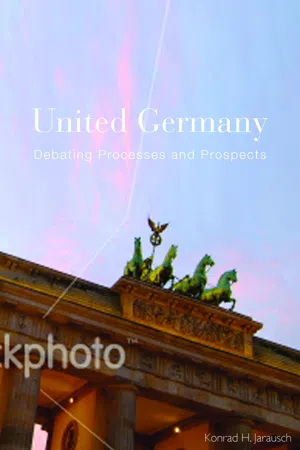
Since the attempt to unite two parts of a country divided for four decades yielded contradictory results, this volume provides a balance sheet of the successes and failures of German unification during the first quarter century after the fall of the Wall. Five themes, ranging from the transfer of political institutions to the economic crisis, from the social upheaval for women's movements to the cultural efforts at interpretation and the changes in foreign policy have been chosen to illustrate the complexity of the process. The contributors represent a broad interdisciplinary mix of political scientists, historians, and literary scholars. Because personal experiences tend to color scholarly judgments, they are drawn from West Germany, East Germany, and the United States. This collection is the most up-to-date and comprehensive assessment of the political, social, and intellectual consequences of the efforts to regain German unity.
- 300 pages
- English
- ePUB (mobile friendly)
- Available on iOS & Android
eBook - ePub
About this book
Trusted by 375,005 students
Access to over 1.5 million titles for a fair monthly price.
Study more efficiently using our study tools.
Information
Political Processes
Chapter One
Two Decades of Unity
Continuity and Change in Political Institutions
The historical and political conditions that governed the transformation of the GDR into a democracy differ on essential points from those generally involved in the collapse of the socialist camp in Europe. Most of the former Warsaw Pact states embedded the transformation of their political and economic systems into a concept of reconstructing their nation. In contrast, the conditions in Germany were determined by the situation of a divided country on whose soil two states existed. The one, the Federal Republic of Germany (FRG), belonged to the Western Alliance under the leadership of the United States, and the other, the German Democratic Republic (GDR), to the Soviet-led alliance. The collapse of the GDR, beginning in 1989, led not to a new state but rather, after a brief orientation phase in October 1990, to unification with the other German state.1 Therefore, the case of the GDR indeed constitutes a system transformation, but it did not result in a state with a new political and economic system. Rather, after the rapid transformation of the GDR to a democracy, the division of the country ended in the fall of 1990 with the unification of both states, through which the new East German states joined the Federal Republic on the basis of Article 23 of the Basic Law. With that, the GDR ceased to exist.
This unification cannot be seen as a simple reunification. For roughly forty-five years, two German states existed with different political, economic, social, legal, and cultural systems, and ultimately, societies, on a territory smaller than that of previous state, the German Reich. The one failed, while the other succeeded in the confrontation of systems. The institutions of the FRG along with its different subsystems determined the integration of East German society. This process was facilitated by the commonalities which had remained, such as the same language, common history before 1945, cultural and academic traditions, and familial ties. In this respect, on 3 October 1990 “two patterns of socialization”2 were brought together. In the end, however, the result was a new “Berlin Republic,” i.e., the new Federal Republic of Germany.
The illusion of independent GDR development lasted only for a few weeks after the beginning of the peaceful revolution. When West German Chancellor Helmut Kohl decided on the strategy of unifying Germany and received the approval of President George Bush and General Secretary Gorbachev, hopes of an independent existence for the GDR in Europe ended. The course of the transformation led quickly to the radical change of structure and of political institutions.3 An attempt by East German politicians to negotiate the terms of unification on the basis of their own draft constitution failed, as did other later initiatives.4 A majority of politicians and the East German populace accepted unification on the basis of the provisions of the Federal Republic’s constitution. With that, the West German political system and its constitutional order determined the direction and content of development. The negotiations between both German governments, most importantly with the state treaty of 18 May 1990 and the unification treaty of 20 August 1990, as well as between them and the victorious powers of the Second World War (the “Two-Plus-Four negotiations”), created further preconditions for unification. The prerequisite for unity was the contractually agreed-upon economic and currency union.
Unification led to an enlargement of the Bundestag—instead of 497 seats as in 1987, there were now 692 delegates—and of the Bundesrat: to the previous eleven states five new ones were added. Theoretically, the latter expansion meant more difficulties for the federal government in certain legislative procedures, while the enlargement of the Bundestag offered a wider range of political careers. East Germans’ expectations that some of their own institutions could survive in an altered environment were not fulfilled. The Round Table, at which the representatives of the old GDR and the citizens’ movements and opposition parties had negotiated arrangements for the transformation of their system, was preserved merely as a symbol. Only two institutions outlived the GDR. One preserved the secret documents of the Ministry for State Security for later analysis; it exists today as the Federal Authority for the Documents of the Former Ministry for State Security (BStU).5 The second was the Trusteeship Agency (Treuhandanstalt). It had already been established in connection with the privatization of the GDR economy by a decision of the government on 1 March 1990; after 3 October 1990 it was subordinated to the Federal Ministry of Finance and ceased its operation four years later. The Trusteeship Agency had the task of reorganizing and privatizing GDR state assets according to the principles of the social market economy. Critics reproached the institution for continuing centralistic structures as well as for dismantling industry in the East German states and squandering formerly public property in the interest of individual, mainly West German, actors.
The Political Systems of the GDR and FRG
Since their founding in 1949, the Federal Republic of Germany and the GDR opposed one another as political, economic, and social competitors—and from1955/56 on as military opponents through their membership in military alliances. Furthermore, the Federal Republic insisted that there was but one German nation and that it alone represented Germany. For a long time it therefore refused to recognize the GDR as an independent state. After the commencement of intergovernmental relations in 1974, it declared that special relations would prevail between both German states. The GDR leadership disagreed with this view, yet tolerated it in order to achieve its goal of gaining de facto diplomatic recognition. It could then claim that its population constituted an independent “socialist nation.”
The organizations of the states were based on different political concepts. The political system of the GDR corresponded in its essential features to the Soviet model, but with a noncompetitive multiparty system in which the socialist party held the key position. The state was structured in a centralistic manner and had territorial-administrative subdivisions with fewer decision-making powers. The system called itself a socialist democracy. In fact, it was an authoritarian regime at whose top the highest decision-making unit of the ruling socialist party, the Politbüro, concentrated political power. From 1946 until the fall of the Berlin Wall in November 1989, this system nonetheless retained several parties and nominal parliamentary institutions. The party structure was a so-called bloc system and consisted of the Socialist Unity Party (SED), the Christian Democratic Union (CDU), and the Liberal Democratic Party (LDP), as well as the National Democratic Party (NDP) and the Democratic Farmers’ Party of Germany (DBD). Parliamentary institutions existed on the national (People’s Chamber) as well as regional (District Council) and local (County Council) levels. The SED dominated all levels of the system and all its institutions, determined the number of seats in the parliaments, and decided, with the help of a nomenclature, appointments to positions in the state apparatus, economic management, and the educational and cultural institutions. The other parties recognized, formally and practically, the leading role of the SED and acted under its supervision and guidance as organizations for particular societal groups (Christians, craftspeople, private entrepreneurs, etc.). Despite formal elections, there was neither a democratic contest among parties nor a programmatic competition, much less a political opposition or social movement outside of the established system of the “National Front”6 under the leadership of the SED. Possibilities for the population to influence politics were strictly regulated and highly formalized. Basic political rights were not guaranteed; criticism of politics was either instrumentalized for party-political purposes or practiced through West German media. The system avoided revolts and internal unrest, with one exception in 1953. Beyond the Stasi, its stability was based, among other things, on the fact that the discontented could leave the country illegally until the construction of the Berlin Wall in 1961, and thereafter, the population was promised social benefits in order to keep them quiet.
The Federal Republic of Germany was a federal state with a parliamentary democratic system. Created after the end of the Second World War in part by the policies of the Western allies, it was also based in part on experiences of the first German democracy from 1919 until 1932 and on the tradition of German federalism. Unlike in the Weimar Republic, the role of parties was strengthened and they were granted quasi-constitutional status in the Basic Law. Administration, like parliament, functioned practically as party-state institutions and the parties dominated the allocation of positions in the government sector.
The party system was geared toward competition. In 1949 ten parties and voters’ associations were represented in the Bundestag. In 1980 there were just three—the Christian Democratic Union (CDU)7 and its Bavarian sister, the Christian Social Union (CSU), the Social Democratic Party of Germany (SPD), and the Free Democratic Party (FDP). None of the other parties gained more than 5 percent, the share of votes necessary to send delegates to the parliament. In 1983 four parties were represented in the Bundestag when the Greens arrived as a new party. This party had emerged at the end of the 1970s from various new social movements, especially the anti-nuclear power movement, the women’s movement, and the peace movement, as well as environmental initiatives.
For the first quarter century, the Center-Right camp dominated the West German party competition, because the CDU and CSU as well as the FDP were supported by a bourgeois majority in the electorate. But thereafter, the polarization in the party system declined, because in 1959 the SPD had undertaken a programmatic change of course away from a socialist and toward a social democratic party on the basis of a pluralistic understanding of democratic socialism. This shift opened it up to new voting blocs and thereby contributed to the gradual decline in the sharpness of the disputes as well as differences among the parties.8 The reforms paid off when the SPD became the governing party in a coalition with the FDP from 1969 until 1982; the CDU started its modernization of party politics and organization only in the late 1970s.
In the party system after 1983 the Social Democrats and the Greens on the one side and the Union on the other reflected opposing poles in the various policy fields. Until 1953, there was a decidedly leftist party in the form of the Communist Party. It had been banned in 1956, and in 1968 a refounded German Communist Party achieved no political or electoral success. Although in 1969 a right-extremist party, the National Democratic Party of Germany (NPD) which had formed from small nationalist parties five years earlier, profited from an economic crisis, it succeeded neither then nor at any point thereafter in gaining entry into the Bundestag.
The Development of Democracy in United Germany
During the transformation, the GDR had created the legal preconditions for democratic elections with the passage of an electoral law and a political party law. The three elections that took place in GDR territory in 1990—the People’s Chamber election in March, local elections in May, state elections in October—followed to a large degree the standard of the electoral system of the Federal Republic. The sole exception was the omission of the 5-percent hurdle in the People’s Chamber election, designed to exclude splinter parties. In December 1990, the fourth election was at the same time the first all-German election. With this, there was an unusual feature. Two election areas were created: the Western area encompassed the “old” West German states and the Eastern election area the “new” East German states. In order to avoid diminishing the chances of the small parties from the East, a 5-percent hurdle was established for each election area. A party whose percentage of second votes amounted to just above 5 percent could thereby send delegates to the Bundestag even if this proportion, projected onto the national level, would have amounted to less than 5 percent. The East German Party of Democratic Socialism (PDS), as the successor party of the former governing SED, profited from this rule. Its nominal West German branch clea...
Table of contents
- Cover Page
- Title Page
- Copyright Page
- Contents
- Preface
- Introduction Growing Together? Processes and Problems of German Unification
- Part I. Political Processes
- Part II. Economic Problems
- Part III. Social Upheaval
- Part IV. Cultural Conflict
- Part V. International Normalization
- Note on Contributors
- Selected Bibliography
- Index
Frequently asked questions
Yes, you can cancel anytime from the Subscription tab in your account settings on the Perlego website. Your subscription will stay active until the end of your current billing period. Learn how to cancel your subscription
No, books cannot be downloaded as external files, such as PDFs, for use outside of Perlego. However, you can download books within the Perlego app for offline reading on mobile or tablet. Learn how to download books offline
Perlego offers two plans: Essential and Complete
- Essential is ideal for learners and professionals who enjoy exploring a wide range of subjects. Access the Essential Library with 800,000+ trusted titles and best-sellers across business, personal growth, and the humanities. Includes unlimited reading time and Standard Read Aloud voice.
- Complete: Perfect for advanced learners and researchers needing full, unrestricted access. Unlock 1.5M+ books across hundreds of subjects, including academic and specialized titles. The Complete Plan also includes advanced features like Premium Read Aloud and Research Assistant.
We are an online textbook subscription service, where you can get access to an entire online library for less than the price of a single book per month. With over 1.5 million books across 990+ topics, we’ve got you covered! Learn about our mission
Look out for the read-aloud symbol on your next book to see if you can listen to it. The read-aloud tool reads text aloud for you, highlighting the text as it is being read. You can pause it, speed it up and slow it down. Learn more about Read Aloud
Yes! You can use the Perlego app on both iOS and Android devices to read anytime, anywhere — even offline. Perfect for commutes or when you’re on the go.
Please note we cannot support devices running on iOS 13 and Android 7 or earlier. Learn more about using the app
Please note we cannot support devices running on iOS 13 and Android 7 or earlier. Learn more about using the app
Yes, you can access United Germany by Konrad H. Jarausch in PDF and/or ePUB format, as well as other popular books in History & 20th Century History. We have over 1.5 million books available in our catalogue for you to explore.