In 1908, Arthur Maurice Hocart and William Halse Rivers Rivers conducted fieldwork in the Solomon Islands and elsewhere in Island Melanesia that served as the turning point in the development of modern anthropology. The work of these two anthropological pioneers on the small island of Simbo brought about the development of participant observation as a methodological hallmark of social anthropology. This would have implications for Rivers' later work in psychiatry and psychology, and Hocart's work as a comparativist, for which both would largely be remembered despite the novelty of that independent fieldwork on remote Pacific islands in the early years of the 20th Century. Contributors to this volume—who have all carried out fieldwork in those Melanesian locations where Hocart and Rivers worked—give a critical examination of the research that took place in 1908, situating those efforts in the broadest possible contexts of colonial history, imperialism, the history of ideas and scholarly practice within and beyond anthropology.
eBook - ePub
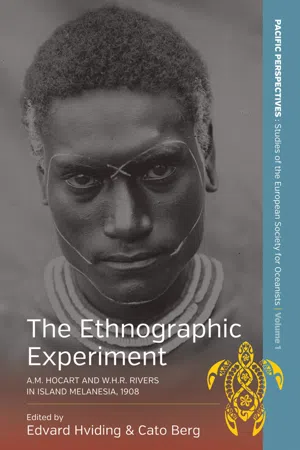
The Ethnographic Experiment
A.M. Hocart and W.H.R. Rivers in Island Melanesia, 1908
- 336 pages
- English
- ePUB (mobile friendly)
- Available on iOS & Android
eBook - ePub
The Ethnographic Experiment
A.M. Hocart and W.H.R. Rivers in Island Melanesia, 1908
About this book
Trusted by 375,005 students
Access to over 1.5 million titles for a fair monthly price.
Study more efficiently using our study tools.
Information
1
Acknowledging Ancestors
The Vexations of Representation

A theorist is a child of his own times, or rather a brother of his own, and the child of former ones.
—A.M. Hocart
Ancestral Issues
How to write about W.H.R. Rivers’s and A.M. Hocart’s 1908 Percy Sladen Trust Expedition to the Solomon Islands? The mere title of their undertaking – an expedition – evokes a journey into a recently pacified area aboard a colonial mission yacht in order to investigate a social evolutionist project on ‘mother-right’ societies, as Rivers called them (see also Hviding and Berg, Berg, Rio and Eriksen, this volume). On one hand, the expedition is a case of colonial and social evolutionist anthropology, with implications of cultural and racial ranking. On the other hand, it was an under-appreciated contribution to the development of participant-observation fieldwork and anthropology’s focal shift from social evolution to social organisation. Either way, our disciplinary imperative to place people in their social, cultural and temporal worlds requires more than stereotype.
This is not simple. Describing early anthropologists as people of their time risks dismissing awkward questions about the discipline’s colonial roots and eliding the ways in which they were more than people of their time. The problem, then, is one of wending a way between hagiography and defamation, acknowledgement and dismissal. In a context of contemporary concern with representation and anxiety about what it means to be an anthropologist, it is relatively easy to ‘use and distance’ – exploiting their materials while hedging that usage with disclaimers about their shortcomings. As one who has repeatedly drawn upon Hocart’s and Rivers’s Solomons corpus, I find myself increasingly uneasy with such approaches.
This chapter rehearses some of these issues with reference to Rivers’s and Hocart’s research on Simbo,1 issues that scholarly politics render inseparable from questions of how to regard them, themselves. I take my own anthropological biography as partially standing for the experiences of a particular generation of Antipodean anthropologists, and begin with two anecdotes about my encounter with postmodernist anthropology.
In 1988, after some two years absence from university, I commenced doctoral studies. Visiting the university bookshop, I found a window display of Clifford and Marcus’s Writing Culture (1986), which I soon heard other anthropology postgraduates discussing and was encouraged to read. When I did so, like others, I was plunged into profound uncertainty about a discipline that I had regarded as the left, critical one (cf. Roseberry 1996: 5).
Then, in the early 1990s, midway through my doctoral fieldwork, I attended the annual conference of the Australian Anthropological Society (AAS) at which one paper analysed an early–mid-twentieth-century government anthropologist. It made important arguments about anthropology’s relationship with colonial administrations, and its location in a world in which access and funding often depend on those whose policies we oppose (see also Kuklick 1991; Pels 2008). The paper was convincing, and its concerns remain with me, but as I listened to the discussion of governance, representation and careers, I became uncomfortable about another kind of representation – specifically of the dead anthropologist in question. During questions, I tentatively suggested some contextualisation: beyond the knowledge/power issues and the textual residua of his advice on government policy, why was this man a government anthropologist? What was his sense of anthropology, its relationship to colonialism, and the place of his research in the lives of those about whom he made recommendations? Are dead anthropologists no more than the texts they leave behind, as later reinterpreted? Such questions of how to contextualise scholarly practice continue to discomfort me.2 So does the answer I received: ‘I don’t know what you want to do with these people – celebrate them … ?’ Indeed, what to do with them? And how to use their materials, a question not just about their methodological and theoretical credibility, but of their authors’ political being.
My life as an anthropologist has been lived largely in the context and wake of critiques represented by Writing Culture and the presentation just mentioned, in the context of Rivers’s and Hocart’s ethnographic materials juxtapositioned with my own research, as a citizen and resident of two settler societies, and in silently contemplating the issues I address here. My primary concerns are with Hocart’s and Rivers’s fieldwork relationships and methods, their representational practices and the ethics of how to treat them. I address their work partly via reflections on alternate disciplinary histories, in an era of ‘transformations within anthropology that have shifted perspective and emphasis from the “primitive” to the “postcolonial”’ (Knauft 1999: 3), and partly by considering how contemporary Christian Tinoni Simbo (people [of] Simbo) deal with the difficulties of appraising their own ancestors. In both cases, our forebears undertook foundational work upon which we rely in the present, although we now reject their premises and practices. Tracking from modernist to postmodernist to post-postmodern anthropology, I outline how a pre-1980s disciplinary history might have treated Rivers and Hocart before critically deconstructing their work. I then address these opposed approaches by reference to Simbo conceptualisations of their ancestors as ‘good sinners’, before asking how to regard Hocart and Rivers in post-postmodern times.
Admiring Histories
Rivers and Hocart verge on prominence in disciplinary histories, almost but never quite among the greats. They are generally represented as brilliant anthropologists, somewhat out of step with their times, whose potential contributions to the discipline were averted by their abrupt, early deaths – Rivers at 58 in 1922; Hocart at 53 in 1939 – and by their problematic academic trajectories – Rivers into the cul-de-sac of diffusionism, and Hocart into maverick interests and prolonged difficulties in securing an academic position. Sapir (2006: 72) captures something of both of them in characterising Rivers as ‘brilliant and unconvincing’.
Stocking observes of Rivers that he was ‘maltreated in the disciplinary memory – attacked, misappreciated, neglected, repressed’ (Stocking 1995: 199–200). He and others have suggested that Rivers’s contributions to methodology and theories of social organisation are ‘obscured’ by the ways in which Radcliffe-Brown and Malinowski are credited with developing approaches and techniques that he pioneered, such as prolonged intensive fieldwork. Certainly, Rivers saw the New Georgia research as an instance of this (Stocking 1995; Urry 1972; Langham 1981; Barth 2005). Somewhat like Stocking’s point about Rivers’s legacy, Lucien Scubla describes Hocart’s contribution as ignored by a triumphant structural-functionalism, whose practitioners abandoned the ‘accumulated wisdom’ of ‘their predecessors [relegating them] to the prehistory of the discipline’ (Scubla 2002: 360). Influencing Sahlins, and a neglected precursor of Lévi-Strauss and Dumont, his credibility is only secondarily attested through his contribution to their work (Scubla 2002).
Against concerns about their neglect, Hocart and Rivers can incite hagiography.3 Richard Slobodin’s (1997) biography of Rivers apparently aspires to represent a Renaissance figure of psychology and ethnology. Arthur Kleinman, one of the foremost medical anthropologists of our time, characterises Rivers as his model anthropologist, a polymath and ‘exemplar of remaking moral experience by living a moral life’, who constantly reinvented himself in order to best engage the issues of his time (Kleinman 2006: 201). For Scubla, Hocart’s death symbolised anthropology’s theoretical decline, and he was one of ‘a few exceptional souls [who] escape the general dumbing down’. He suggests that renewed attention to Hocart’s work would have an effect on anthropology akin to ‘the prodigious rise of the physico-mathematical sciences’ following the ‘rediscovery of the works of Archimedes’ (Scubla 2002: 361, 374).
More measured accounts note the quality of Rivers’s and Hocart’s fieldwork, Stocking depicting them as, ‘by present standards, quite competent ethnographers’ (Stocking 1995: 119). He characterises Hocart as ‘the most complete anthropologist’ of his time, highlighting his extensive fieldwork and celebrating the ‘unusually sensitive’ research of one who, ‘[t]rying to understand the native culture “from within” … [was] quite remarkably “reflexive”’ (1995: 232).
In Rivers’s case, appreciation of his research qualities is augmented by acknowledgement of his influence on the consolidation of fieldwork through his contributions to successive editions of Notes and Queries, and as one who used his Cambridge position to train a generation of fieldworkers (Stocking 1995; Urry 1972; Barth 2005). Against the repeated characterisation of Rivers as establishing the legitimacy of participant observation, Barth grants Hocart that credit, suggesting that Rivers’s ‘most enduring effect … resulted from his painstaking conceptual work on social organization’ (Barth 2005: 16), which grew out of his efforts to deal with his Melanesian materials. Given such acknowledgements of Rivers’s and Hocart’s innovations, what, then, of their Solomons work?
The development of fieldwork around 1900 reflected a growing concern with ‘facts’. Rivers recognised that facts alone were less important than ‘the manner in which they were collected’, hence his stress on prolonged fieldwork in the interests of scientific accuracy (Urry 1972: 50, 52). At this ‘rather shadowy’ point in disciplinary history, when social evolutionism was in decline and structural-functionalism had not yet emerged (Urry 1972; Langham 1981; Stocking 1995: 14), Rivers was a central figure in bridging the two. Indeed, at about the time of the Solomons fieldwork, he ‘was teetering on the great divide between the nineteenth-century tradition of explanation in terms of survivals and … the typical twentieth-century form of explanation in terms of the presently functioning social order’ (Langham 1981: 84; see also Urry 1972).
In New Georgia, Hocart and Rivers continued the colour testing that Rivers had pursued in the Torres Strait Islands in 1898, and Rivers collected material with his genealogical method. They worked largely through interpreters, but Hocart, in particular, developed considerable linguistic understanding. Although they divided the research, they were aware that this approach had shortcomings. As Hocart noted of the division of labour on Simbo – ‘Dr Rivers taking kinship, social organization, ghosts, gods, and other subjects, while I took death, fishing, warfare; a few subjects, such as the house, were joint’ – ‘these divisions were rather artificial’ (Hocart 1922: 71–72). They also took different skills and interests to New Georgia. One was testing his theories and practising a methodology developed elsewhere; the other, on his maiden fieldwork, was ‘inclined … to a very different style of fieldwork from [Rivers] … rather than asking detailed questions, he listened’ (Stocking 1995: 221).
Rivers’s and Hocart’s fieldwork must have been generally harmonious. Fred Green, a trader resident and married on Simbo, suggests in a letter to Rivers that they had left ‘many friends behind you both White and Black’. Green describes Hocart as ‘still in raptures with [Simbo] … and [longing] to be with the savages again’, stressing his rapport with Tinoni Simbo.4 Their engagement with New Georgia went beyond a passion for fieldwork, suggesting an appreciation for native capacities and cultures at odds with contemporary colonial attitudes. This was particularly so of Hocart. Shortly after his Solomons research, for example, he criticised Methodist missionaries in Fiji for their ‘distant & superior reserve which riles me more than all the straightforward abuse of a Solomon Island trader’.5 For Rivers (1926: 39), Simbo understandings of death disproved scholarly characterisations of primitive thought as ‘prelogical’, one instance of a career-long assumption of ‘minor differences yet basic similarities’ in human perception (Bayliss-Smith, this volume). In later years, Hocart, more vehemently, protested Eurocentric perceptions of native illogic and irrationality. Typically:
What I object to is the suggestion that the savage (if there is such a thing) stands quite apart in his inability to answer a difficult question … or in his tendency to invent an explanation … Put the same sort of question to any intelligent European … and he will either have no answer, or else invent some reason. (Hocart 1935: 343)
His example is of how he and his Fijian informant, drawing on their own explanatory frameworks, had different explanations for the origins of a cave they were discussing.
We ought not overdo this celebration. Hocart clearly thought his own understanding superior; he was, then, reflective for his time. Overall, though, within the constraints of their perception and political position, their fieldwork can be celebrated for its humane approach and its opposition to Eurocentrism and colonial insensitivity.
I also admire the quality of their fieldwork, especially as revealed in Hocart’s practice. His New Georgian writing is highly empirical. In some respects, it reads like the nineteenth-century collection of facts-upon-facts that he later rejected (e.g. Hocart 1933). In other respects, it speaks to Rivers’s ideal of the systematic collection of well-contextualised facts, itself reflecting his insistence on careful analysis of evidence over deduction or speculation (Langham 1981: 125–26). The links between ethnographic work and generalisation are explicit and detailed, albeit threatening to drown anyone not specifically interested in the small island of Simbo. These accounts contain limited theoretical development, although their influence is discernible in Hocart’s later, more analytical, works, his most developed Simbo papers (Hocart 1922, 1931) prefiguring his theories of divine kingship and ritual violence. Further, the expedition materials have contributed to later theoretical developments. To cite two examples, Rivers’s Simbo-based kindred continues to inform kinship theory (e.g. Hviding 2003) and Roger Keesing’s (1984; see also Dureau 2000) crucial reconceptualisation of Melanesian mana depends on Hocart’s many translations of Simbo prayers, with their closing invocations to the ancestors, mu mana tu (‘you be efficacious’).
From the perspective of a later fieldworker interested in social change, the redundancy in Hocart’s materials is remarkably helpful. Consider the issue of leadership. During my first fieldwork, I was struck by the extent of contention about baŋara (sing., pl., leaders, chiefs). Some insisted that these were patrilineally inherited positions, although baŋara genealogies suggested both tendencies to sister’s son succession and the adoption of outsiders if no one within the lineage was appropriate to the position, implying the significance of competence over heredity. Others disputed the principles and protocols of succession, enactments and entitlements of respect to baŋara and the grounds for moral evaluation of contemporary office-holders. One of the few things common to the various positions, including those who insisted that there has always been a paramount chieftainship (Solomon Islands Pijin: paramaon cif), was the avowal that their vision reflected ‘ancient Simbo custom’ (na hahanana Simbo podelai kame rane sosoto, lit. ‘Simbo ways beginning long ago’). Different understandings of the binaŋara (leadership, chieftainship) – more or less hereditary, appointed or popularly proclaimed, degrees of achieved versus ascribed authority, the extent and kinds of mutual obligation between baŋara and followers – inflected many aspects of social life. To give one minor example, was Ami, having given birth only a few weeks earlier, required to pay compensation for walking across a pathway that led past a baŋara’s house several metres away? Was her walking there and reluctance to pay a sign of the deterioration of kastom? Or did the baŋara’s demand signify hunger for respect or the greediness characteristic of the present, to be understood in contradistinction to times when baŋara attracted respect by virtue of the powerful nurturance they extended to their followers?
The sheer array of contending claims raised questions about how to understand historical shifts and continuities on Simbo in the context of contemporary scholarly arguments about social coherence and fragmentation. Simbo seemed to encapsulate new critiques of a homogenising ethnography that had been overly focused on order and regularity. Or perhaps the untidy social claims about the baŋara demonstrated the social unravelling caused by a century of rapid historical changes? Certainly, widespread nos...
Table of contents
- Cover Page
- Title Page
- Copyright Page
- Contents
- List of Figures and Tables
- Preface
- Acknowledgements
- Introduction The Ethnographic Experiment in Island Melanesia
- 1 Acknowledging Ancestors The Vexations of Representation
- 2 Across the New Georgia Group A.M. Hocart’s Fieldwork as Inter-island Practice
- 3 The Genealogical Method Vella Lavella Reconsidered
- 4 Rivers and the Study of Kinship on Ambrym Mother Right and Father Right Revisited
- 5 A House upon Pacific Sand W.H.R. Rivers and His 1908 Ethnographic Survey Work
- 6 Colonialism as Shell Shock W.H.R. Rivers’s Explanations for Depopulation in Melanesia
- 7 A Vanishing People or a Vanishing Discourse? W.H.R. Rivers’s ‘Psychological Factor’ and Depopulation in the Solomon Islands and the New Hebrides
- 8 Objects and Photographs from the Percy Sladen Trust Expedition
- Appendix 1 Unpublished Reports by W.H.R. Rivers to the Trustees of the Percy Sladen Memorial Trust Fund
- Appendix 2 Materials in Archives from the 1908 Percy Sladen Trust Expedition
- Appendix 3 Planning the Expedition: Letters Written before the Fieldwork Began
- Notes on Contributors
- Index
Frequently asked questions
Yes, you can cancel anytime from the Subscription tab in your account settings on the Perlego website. Your subscription will stay active until the end of your current billing period. Learn how to cancel your subscription
No, books cannot be downloaded as external files, such as PDFs, for use outside of Perlego. However, you can download books within the Perlego app for offline reading on mobile or tablet. Learn how to download books offline
Perlego offers two plans: Essential and Complete
- Essential is ideal for learners and professionals who enjoy exploring a wide range of subjects. Access the Essential Library with 800,000+ trusted titles and best-sellers across business, personal growth, and the humanities. Includes unlimited reading time and Standard Read Aloud voice.
- Complete: Perfect for advanced learners and researchers needing full, unrestricted access. Unlock 1.5M+ books across hundreds of subjects, including academic and specialized titles. The Complete Plan also includes advanced features like Premium Read Aloud and Research Assistant.
We are an online textbook subscription service, where you can get access to an entire online library for less than the price of a single book per month. With over 1.5 million books across 990+ topics, we’ve got you covered! Learn about our mission
Look out for the read-aloud symbol on your next book to see if you can listen to it. The read-aloud tool reads text aloud for you, highlighting the text as it is being read. You can pause it, speed it up and slow it down. Learn more about Read Aloud
Yes! You can use the Perlego app on both iOS and Android devices to read anytime, anywhere — even offline. Perfect for commutes or when you’re on the go.
Please note we cannot support devices running on iOS 13 and Android 7 or earlier. Learn more about using the app
Please note we cannot support devices running on iOS 13 and Android 7 or earlier. Learn more about using the app
Yes, you can access The Ethnographic Experiment by Edvard Hviding, Cato Berg, Edvard Hviding,Cato Berg in PDF and/or ePUB format, as well as other popular books in Social Sciences & Australian & Oceanian History. We have over 1.5 million books available in our catalogue for you to explore.