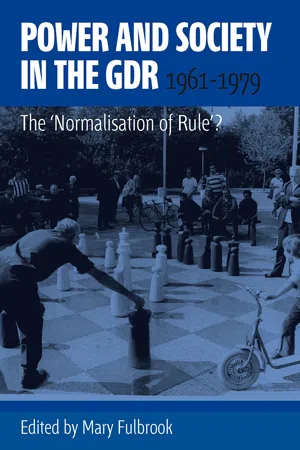
The communist German Democratic Republic, founded in 1949 in the Soviet-occupied zone of post-war Germany is, for many people, epitomized by the Berlin Wall; Soviet tanks and surveillance by the secret security police, the Stasi, appear to be central. But is this really all there is to the GDR¹s history? How did people come to terms with their situation and make new lives behind the Wall? When the social history of the GDR in the 1960s and 1970s is explored, new patterns become evident. A fragile stability emerged in a period characterized by 'consumer socialism', international recognition and détente. Growing participation in the micro-structures of power, and conformity to the unwritten rules of an increasingly predictable system, suggest increasing accommodation to dominant norms and conceptions of socialist 'normality'. By exploring the ways in which lower-level functionaries and people at the grass roots contributed to the formation and transformation of the GDR from industry and agriculture, through popular sport and cultural life, to the passage of generations and varieties of social experience the contributors collectively develop a more complex approach to the history of East Germany.
- 348 pages
- English
- ePUB (mobile friendly)
- Available on iOS & Android
eBook - ePub
About this book
Trusted by 375,005 students
Access to over 1.5 million titles for a fair monthly price.
Study more efficiently using our study tools.
Information
Chapter 1
The Concept of
‘Normalisation’ and the GDR
in Comparative Perspective

The German Democratic Republic was a forcibly imposed state, founded in the context of a divided post-war society. And it was founded in not just any post-war society: it was founded on the ruins of Hitler’s Third Reich, among a people who had, in their millions, supported Hitler’s crusade against Bolshevism. The battles between Nazis and Communists of preceding decades continued, in altered forms, in the mutual dislike and distrust between ‘ordinary Germans’ and the new Communist regime. Only a small minority of Germans crawling out of hiding, being released from Nazi concentration camps, or returning to the Soviet zone from exile abroad, were genuinely committed supporters of the new and allegedly ‘better’ Germany that was to be built in East Germany. And they had good reason, rooted in recent bitter and murderous experience, to be highly suspicious of their fellow Germans. There were few good grounds for placing much trust in the ‘democratic will of the people’ in these circumstances. Meanwhile, Germans who had earlier enthusiastically supported Hitler conveniently recast themselves in the roles of ‘victims’, whether of air-raids, expulsion, flight, hunger, loss of homes, family members, and friends—and now also as victims of a new ‘totalitarian’ regime in communist colours. An implicit form of continuing civil war between the opposing political groupings and ideologies of preceding decades was thus built into the very foundations of the GDR, transmogrified into new forms under the conditions of defeat, Soviet-backed communist domination, and radical restructuring of politics and society. For nearly half a century thereafter, until the collapse of communist rule in the GDR and the more general implosion of the Soviet bloc in 1989–90, force was an ever-present factor in East German politics; visibly manifest in the highly fortified inner-German border holding East Germans effectively prisoners within their state, less visibly but no less inhumanely in the ubiquitous surveillance measures and malign interventions on the part of the State Security Service or Staatssicherheitsdienst, widely known as the Stasi. Until the building of the Berlin Wall in August 1961, around three million citizens took the opportunity to flee to what they hoped would be a better life in the west; and once the Iron Curtain began to crumble in the summer of 1989, mass exodus precipitated the final challenge to communist rule in the GDR.
How then, in this context, could one possibly want to apply any concept of ‘normalisation’ to the history of the GDR?
In this chapter, I shall first outline the way in which this highly contested concept has in fact been widely deployed to analyse periods variously designated by ruling elites and/or by members of the population as a ‘return to normal’ after periods of crisis, with respect both to post-war western European democratic states (notably West Germany in the 1950s) and eastern European communist states following the forcible suppression of challenges to Soviet domination (notably Poland, Hungary, and Czechoslovakia). I shall then go on to propose a more abstract notion of normalisation as a theoretical concept or ‘ideal type’, which can in principle be applied widely across historical periods and places, and which serves to link the levels of structure, action, subjective experience, and perceptions framed within the discourses of the time. Finally, I shall seek to place the history of the GDR within the broader comparative framework of both eastern and western Europe in the light of this conceptual approach.
The Contested Concept of ‘Normalisation’: Contrasting Usages in Cold War Europe
There is in many quarters an almost immediate reaction of outrage when the word ‘normalisation’ comes anywhere near the term ‘GDR’. How could an artificially created rump state, lacking any kind of either national or democratic legitimacy, sustained by Soviet occupation and the threat or use of indigenous force, with a supposedly terrified population watched over by the Stasi and imprisoned by the infamous Wall, be in any way referred to in the same breath as the word ‘normal’—unless, of course, by some unreconstructed apologist blinded by ideological brainwashing and communist propaganda? Conveniently forgetting that there is no such thing as a ‘normal’ state—the notion of the modern democratic nation state which implicitly underlies this reaction of outrage is itself, we have to remember, a fragile and recent invention and in a tiny minority in any kind of world-historical comparison—such gut reactions allow personal political preferences to preclude the possibility of scholarly analysis of historical experiences. ‘Normal’ is, on this view, essentially ‘A Good Thing’; and the GDR, clearly ‘abnormal’ by the standards of a democratic nation state, should not be considered in relation to any such concept.1 Such reactions fail, however, to appreciate the anthropological, historical, and political scope of the term as an analytic concept, caught as they are in their own implicit assumptions and normative prejudices about what constitutes ‘normality’. It is necessary, therefore, to look more explicitly at the varied meanings and usages of the term.
‘Normalisation’ is an intrinsically relational, comparative term, with an element of movement or time frame involved: returning to, or making conform to, or aspiring to, some conception of ‘normality’. Within the very word itself are built in notions of what would constitute ‘deviance from’ or challenges to some state of presumed ‘normality’, conceived as a ‘healthy’ state; or, put differently, notions of ‘normalisation’ inevitably entail also assumptions about what would constitute ‘abnormality’. This close entanglement with potentially invidious comparisons, intrinsic to the term itself, renders the notion of normalisation problematic as a theoretical concept to be applied in historical research. This is particularly the case when the concept is lifted, un-problematised, from everyday usages of the term—and even more so if those everyday usages are those only of particular political actors, with their own, contested, views of what would be a desirable or ‘normal’ state of affairs.
Scholarly approaches, in consequence, differ quite remarkably on the usages of the term ‘normalisation’, on occasion using it relatively unthinkingly as though what is meant is self-evident, at other times more explicitly as a concept perhaps derived from the usages of contemporaries, but raised to attention as in some sense problematic. There is an additional twist relating to its application to the GDR. The history of the GDR is located in—or, frequently, is lost between—the ‘double’ comparative context of the histories of both its western twin, the increasingly affluent democratic Federal Republic of Germany, and of the other Eastern European states with which the GDR shared the fate of being under Soviet domination and influence. Curiously, the concept of ‘normalisation’ has been applied to both these spheres, yet with widely different meanings in each case. While analysts of West German history have picked up on the notion of normalisation as a ‘bottom up’ concept widely deployed by ordinary people to refer to continual improvements in their private lives in the 1950s, Eastern European specialists have focussed rather on the use of the term to refer to top-down Soviet policies of repression following challenges to communist rule from the 1950s to the 1980s. On both sides, there have been varying degrees of awareness of the intrinsically loaded and normative character of any usage by contemporaries, whether from ‘above’ or ‘below’; the loaded character tends to be somewhat more evident to scholars discussing Eastern Europe, given the evident dissonance between official claims to ‘normalisation’ and what should be seen as an entirely ‘abnormal’ deployment of force. The contrast between the two usages appears at first glance to be significant: bottom-up versus top-down, experienced reality of improvements in everyday life versus the claimed restoration of repressive rule against the express will of the people. On closer inspection, however, wide variations in substantive usage may be rooted in similar underlying theoretical issues, as will be explored further in a moment. First, a brief survey of the current range of usage will be helpful.
‘Normalisation’ is, for historians of Western Europe, particularly associated with the relative peace and growing prosperity of the 1950s, after decades of instability and violence in the preceding ‘Thirty Years War’ from 1914 to 1945, and most particularly after the horrors of the Second World War and genocide. Across Western Europe, as Richard Bessel and Dirk Schumann comment:
One of the most striking characteristics of the period that followed the ‘decade of violence’ was its relative peacefulness, stability and conservatism—not only in terms of politics but also in terms of social and cultural life. If the 1940s may described as the ‘decade of violence’, the 1950s arguably may be described as the ‘decade of normality’—a decade in which one saw an apparent ‘normalization’ and stabilisation of political, social, and cultural relationships . . . However, the normality of the 1950s—coming as it did after the greatest outpouring of violence in human history—was anything but normal. It was, both collectively and individually, life after death.2
The ‘return to normality’, in terms of the (re-)building of shattered private lives, the reunions of families, and the reconstructions of the physical infrastructure under peace-time conditions, had common elements across post-war Western Europe.
West Germany, shattered as it was in some areas by massive bombing raids, and subjected to the further constraints of defeat and occupation, shared these wider elements of physical rebuilding, economic recovery, and the associated construction of what was perceived as ‘normal life’ in the ‘private sphere’. It was massively helped in this by the influx of both political and economic aid under the auspices of the Marshall Plan, from which it was the greatest beneficiary. But in Germany, the term had an extra, if largely suppressed (and hence all the more sinister) twist. Among contemporaries, conceptions of a supposed ‘return to normality’ in the Federal Republic of the 1950s referred to improvements in their private lives, with increasing affluence, job security, stable family lives, better living conditions, and enhanced leisure activities in the course of the ‘economic miracle’—accompanied in many quarters by a degree of silence about the recent past. The term should thus not be taken entirely at face value, or lifted un-problematically from the usage of contemporaries, as Hanna Schissler points out:
‘Normality’ and ‘normalization’ were code words of the 1950s. They were part of the collective symbolism of the time. . . . Germans had lived through the rigors of war, including Allied bombardments. Millions had been displaced from their homes; hunger had become a common experience. The revelations of Germany’s genocidal policies had shocked them. Now people were longing for a return to ‘normality’ . . . The frequent and matter-of-fact use of the terms ‘normality’ and ‘normalization” in everyday life during the 1950s renders the project of ‘normalization’ highly suspicious and demands explanation. ‘Normality’ and ‘normalization’ are loaded ideological terms . . . Because ‘normality’ supposedly does not need explanation or justification, the normativity that was attached to the normalization project was (at least partly) veiled . . . [This] is precisely what made it such a powerful tool in the social and ideological reality of the 1950s.3
Lutz Niethammer similarly points out that normalisation is a term that has to be treated with care in a longer-term historical perspective:
The need for liberating experience beyond certain ideological guiding concepts is easily recognizable in the catchword of the 1950s: ‘normalization’. It is one of the most important code words used in both self-understandings and contemporary historical characterizations of that decade. It is even recognized in economic-historical debates on the reconstruction period as a major subconscious category. But what does it actually express? Does its definition of ‘normal’ extend only to the fact that at this time people were crawling out the cellars and no longer ate out of tin dishes? Doesn’t it label in fact as ‘normal’ the entire dramatic change in German society—at least in the West—after World War II? . . . According to which operative norms did the 1950s ‘return to normal’?4
For the working class Germans in the Ruhr area on whose experiences Niethammer’s observations were based, such conceptions actually have as an implicit reference point the ‘silent years’ or ‘good years’ of a return to full employment under Hitler in the peace-time years of the 1930s, and not the ‘normality’ of poverty, or of political and economic chaos that formed the widespread experience of the 1920s in this area.
From another perspective, such conceptions among large numbers of Germans in the 1950s display an extraordinary (and indeed by their indifference arguably callous) self-centredness and disregard for the millions of victims of the Nazi regime. The physical rebuilding from the ruins could never make life ‘normal’ again for those who would never return to their former homes and homeland, whether because they had been murdered in the Holocaust or had managed to flee abroad to try to make new lives in foreign places; nor could life within post-Holocaust Germany ever be the same again, or develop in patterns expected before the Nazi takeover, for the often deeply traumatised survivors and friends. Post-war relationships with fellow (but non-Jewish) Germans could ‘never again be normalised’, as one close friend of a woman murdered in Auschwitz later explicitly reflected; ‘it was not made good again’ was her acerbic comment on the supposed restitution or ‘Wiedergutmachung’ trumpeted by Adenauer’s Germany.5 ‘Normalisation’ for many post-war West Germans, as essentially a good experience, was thus predicated not merely on the earlier exploitation, exclusion, and murder of millions of those considered to be ‘racially inferior’, but also on varying degrees of post-war silence or repression of any prior knowledge of or complicity in these crimes and their long-lasting consequences. The desire to be ‘normal’ was hence not merely a desire to pick up again on strands of family life that had been disrupted by war, flight, and hunger, but also, if less consciously expressed at the time, the desire not to have been associated with the horrendous experiences and actions of the Nazi era; to pick up the pieces as if nothing had happened. It was thus predicated on a silent non-recognition of the fact that Germans were now inhabiting a society which had been successfully ‘purged’ of distinctive groups among its prewar population (and very significant percentages of the population in cities such as Frankfurt and Berlin), representing also a dramatic shift in Germany’s social, intellectual, and cultural profile. At intervals, nevertheless, tensions erupted as challenges rooted in the realities of the past disturbed the comfortable materialism and affluent superficiality of the present.
Aspirations for some form of ‘normality’ with respect to the Nazi past were never completely submerged in public discourse over the years, as any even cursory glance at West Germany’s ‘policies with respect to the past’ (Vergangenheitspolitik) will readily reveal. From Adenauer’s gestures towards ‘restitution’ and proclamations of public shame without personal responsibility in the 1950s, through the debates on the war crimes trials and the issue of limitations on liability to prosecution for murder in the 1960s, to the widespread discussion of recapitulations of the Nazi past in films, documentaries, and historical analyses from the later 1960s onward, the notion of being a ‘normal’ nation persistently dogged West German discourses over ‘German identity’ both past and present.6 This was, in Ernst Nolte’s infamous phrase, the ‘past that would not pass away’ (die Vergangenheit, die nicht vergehen will). Thus, the concept of ‘normalisation’ returned explicitly as a term of public debate in the Helmut Kohl era of mid 1980s West Germany. Conservative historians and philosophers—Andreas Hillgruber, Michael Stürmer, Ernst Nolte—called for a ‘normalisation’ of the treatment of the Third Reich, arguing that it was time for Germany to be a ‘normal nation’ again, understood as a nation with a past in which Germans could take some pride, just as other nations allegedly could take pride in the deeds and achievements of their own respective forefathers. This proposed relativisation of the crimes of the Holocaust provoked widespread outrage on the part of Jürgen Habermas and many others, reaching its peak in the notorious ‘historians’ dispute’ or Historikerstreit of 1986–87.7 While the focus in this debate was on whether German history itself could in any way be treated as a ‘normal’ past rather than as a subject for constant shame and outrage, a somewhat different focus was to be found in the debate between Saul Friedländer and Martin Broszat over the proposed ‘historicisation’ of approaches to the Third Reich. The key issue in that debate was over whether historians could or should adopt ‘normal’ historical methods and approaches to a period that was, on both sides of this debate, recognised as ‘abnormal’ on any measure of the scale of the crimes committed.
So, for West Germany, issues of ‘normalisation’ revolved around the early development of the materialistic, affluent society, with appeals regarding the alleged ‘return to normality’ of everyday life—at least for ‘Aryan’ survivors, including not only those who had personally remained at a distance (both politically and geographically) from complicity in Nazi crimes, but also many former perpetrators and accomplices in Nazi policies of genocide—and also around later appeals for there to be, finally, a ‘line drawn’ (Schlußstrich) under this unsavoury ‘episode’ of an otherwise entirely ‘normal’ national history. A trivial footnote, perhaps, to the tale of ‘normalisation’ in the West lies in the extraordinarily late revelation, in an autobiography published in the summer of 2006, on the part of the renowned writer and generally acclaimed ‘moral voice of ...
Table of contents
- Cover
- Half title
- Title
- Copyright
- Contents
- Abbreviations
- 1. The Concept of ‘Normalisation’ and the GDR in Comparative Perspective
- Part I Normalisation as Stabilisation and Routinisation? Systemic Parameters and the Roles of Functionaries
- Part II Normalisation as Internalisation? Conformity, ‘Normality’, and ‘Playing the Rules’
- List of Contributors
- Bibliography
- Index
Frequently asked questions
Yes, you can cancel anytime from the Subscription tab in your account settings on the Perlego website. Your subscription will stay active until the end of your current billing period. Learn how to cancel your subscription
No, books cannot be downloaded as external files, such as PDFs, for use outside of Perlego. However, you can download books within the Perlego app for offline reading on mobile or tablet. Learn how to download books offline
Perlego offers two plans: Essential and Complete
- Essential is ideal for learners and professionals who enjoy exploring a wide range of subjects. Access the Essential Library with 800,000+ trusted titles and best-sellers across business, personal growth, and the humanities. Includes unlimited reading time and Standard Read Aloud voice.
- Complete: Perfect for advanced learners and researchers needing full, unrestricted access. Unlock 1.5M+ books across hundreds of subjects, including academic and specialized titles. The Complete Plan also includes advanced features like Premium Read Aloud and Research Assistant.
We are an online textbook subscription service, where you can get access to an entire online library for less than the price of a single book per month. With over 1.5 million books across 990+ topics, we’ve got you covered! Learn about our mission
Look out for the read-aloud symbol on your next book to see if you can listen to it. The read-aloud tool reads text aloud for you, highlighting the text as it is being read. You can pause it, speed it up and slow it down. Learn more about Read Aloud
Yes! You can use the Perlego app on both iOS and Android devices to read anytime, anywhere — even offline. Perfect for commutes or when you’re on the go.
Please note we cannot support devices running on iOS 13 and Android 7 or earlier. Learn more about using the app
Please note we cannot support devices running on iOS 13 and Android 7 or earlier. Learn more about using the app
Yes, you can access Power and Society in the GDR, 1961-1979 by Mary Fulbrook in PDF and/or ePUB format, as well as other popular books in History & 20th Century History. We have over 1.5 million books available in our catalogue for you to explore.