Anthropological interest in mass communication and media has exploded in the last two decades, engaging and challenging the work on the media in mass communications, cultural studies, sociology and other disciplines. This is the first book to offer a systematic overview of the themes, topics and methodologies in the emerging dialogue between anthropologists studying mass communication and media analysts turning to ethnography and cultural analysis. Drawing on dozens of semiotic, ethnographic and cross-cultural studies of mass media, it offers new insights into the analysis of media texts, offers models for the ethnographic study of media production and consumption, and suggests approaches for understanding media in the modern world system. Placing the anthropological study of mass media into historical and interdisciplinary perspectives, this book examines how work in cultural studies, sociology, mass communication and other disciplines has helped shape the re-emerging interest in media by anthropologists.
eBook - ePub
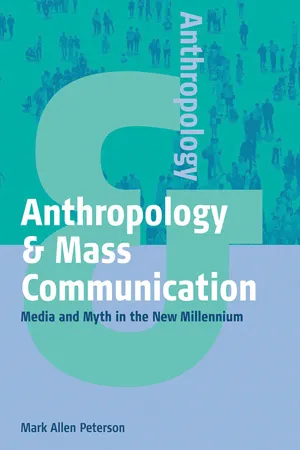
Anthropology and Mass Communication
Media and Myth in the New Millennium
- 340 pages
- English
- ePUB (mobile friendly)
- Available on iOS & Android
eBook - ePub
About this book
Trusted by 375,005 students
Access to over 1.5 million titles for a fair monthly price.
Study more efficiently using our study tools.
Information
Chapter 1

MASS MEDIATIONS
In the rainforests of Brazil, members of the Kayapo tribe are preparing for a ritual performance. The performers have shed their T-shirts and shorts and donned ceremonial garb while the musicians gathered their instruments and took their places. There is a brief delay while they wait for another necessary participant. Finally, he arrives, the son of one of the community’s political leaders, carrying a videocamera. He takes a position, looks through the viewfinder, and gives a wave. The ritual can now start. The tape of this ritual will join the others in the community’s video library of ceremonies.1
In Cairo, a young man and woman alight from a taxi and push their way through the crowd milling about outside the theater, waiting to see the newest comedy by ‘Adil Imam, one of Egypt’s most famous actors. The young man slides a handful of pound notes to the ticketseller and takes his two tickets. He looks about. Already some of the young men in the crowd are making eyes and not-too-quiet remarks about his date. Like many Egyptian women, she pretends they do not exist—that she cannot hear what they are saying—while she keeps her eyes firmly fixed on her boyfriend. Forcing a smile, he takes her inside to get a table in the lobby, which is reserved for those who buy refreshments. The prices are three times what they would cost anywhere else but at least they can be alone for a few minutes before the show starts. This night will cost him a week’s pay. In a society where middle class young people are bombarded with mixed messages about premarital behavior and modern romance, the movies—at least, certain theaters showing certain kinds of films—offer one of the few places where unmarried couples can go to “try out” dating and being together.2
In a suburban neighborhood in the eastern United States, three nine-year-old boys are hammering out the framework of their play. As they argue about which child will be which Mighty Morphin Power Ranger, they are approached by two neighbor girls who demand to be included in the play. For a moment the boys are nonplussed; there are girl power rangers, after all. They quiz the two sisters: who will be the pink ranger and who the yellow? Do they know the characters’ names? Which zords do the respective girls drive? Do the girls have action figures of “their” rangers? The last question is not answered at once; now it is the girls’ turn to be at a loss. Their tastes run more to Barbie dolls than superhero action figures. They run to their house and emerge triumphantly a few moments later: they have action figures, recent acquisitions courtesy of McDonald’s Happy Meals. Theirs are half the size and possess fewer joints than those of the boys, but they are unmistakably the right characters. Play commences, to be interrupted fifteen minutes later when the mother of one of the boys calls out that the television series Goosebumps is starting. All five children race to the boy’s house and clamber inside, speculating loudly as to which of the popular paperback books will be dramatized in this afternoon’s episode.3
Throughout the world, media have become a part of the rhythms of human life. As means of communication, as symbols for modernity and transformation, and as resources for cultural action, they have become part of human culture. Media consumption throughout the world involves not only passive viewing but ritual activity, ways of speaking, play, and forms of social organization. In recent decades, anthropologists, as students of human culture, have begun to pay increasing attention to the ways media operates in the lives of human beings throughout the world. If the mass media have not yet created a “global village” (McLuhan 1989), they have nonetheless touched the lives of everyone on the globe—albeit in very different ways and at different levels.
In spite of the ubiquity of mass media, anthropologists have until recently done an astoundingly good job of ignoring it. There is a well-known Gary Larson cartoon that shows a group of grass-skirted hut-dwelling “natives” scrambling to hide their technological appliances—including a television set—before the anthropologists arrive. But in real life, the “natives,” whoever they may be, have not needed to hide their televisions. Anthropologists have done it for them by selectively choosing what they will or will not pay attention to in their ethnographies. Even as anthropologists spent decades insisting that their discipline was not the study of “primitive” cultures, and criticizing notions of unchanging tradition and stable authenticity, they have collectively as a discipline “selected out” or marginalized many aspects of the social lives of the people they studied, particularly where these involved the media.
Since the mid 1980s, however, anthropologists have begun to pay increasing attention to the mass media. A number of statements have appeared describing what an anthropology of mass communication might look like or how it should proceed (Lyons 1990; Drummond 1992; Spitulnik 1993; Abu-Lughod 1997; Dickey 1997; Herzfeld 2001; Askew 2002; Ginsburg 2002a). At the turn of the millennium, more than one hundred academically employed anthropologists declared mass media or popular culture as among their research and teaching interests in the American Anthropological Association’s Guide to Departments. Several major anthropology journals routinely publish articles on mass media and the number of interdisciplinary journals to which anthropologists contribute media studies continues to grow.
Yet as anthropology rediscovers the mass media, there are already in place a series of disciplines for which the mass media have long been objects of study. Mass communication, sociology, gender studies, political science, performance theory, cultural studies, and critical theory have all developed methods for defining the mass media as objects of study and have formulated theories for understanding media’s roles in social life. In the face of the longstanding theoretical positions and commitments established by these disciplines, what does anthropology have to offer?
This book will attempt to answer this question by offering a systematic overview of the themes, topics, and methodologies emerging in this dialogue between anthropologists studying mass communication and media analysts turning to ethnography and cultural analysis. In this chapter I will focus on three primary elements that anthropology brings to the study of mass media: ethnography, cross-cultural comparison, and alternative theoretical paradigms. First, however, it is necessary to clarify what we will mean here by media and by mass communication.
Mediations and Meanings
Media is the plural of medium which, according to the New American Heritage Dictionary, is an “agency . . . by means of which something is accomplished, conveyed, or transferred.” Communications media are vehicles for the transmission of symbols. The natural medium for human communication, given to us by our own evolutionary biology, is the vocal-auditory apparatus, that complex of lungs, larynx, ears, cranial cavities, teeth, lips, palate, and so forth which enable speech to take place. Other media are technological enhancements or modifications of this primary medium.
The vocal-auditory medium of speech has certain implications for how people typically communicate in face-to-face interaction. Several of these implications have been described by Charles Hockett (1977) as “design features of human language.” One such implication is that linguistic signals are broadcast in all directions, although they are heard as coming from one particular place. This feature, which Hockett calls broadcast transmission and directional reception, means that a message intended for a particular person can nonetheless be overheard by anyone within the range of the speaker’s voice, including people of whom the speaker may be unaware. The sender of a linguistic signal also receives the message he or she sends—a feature Hockett calls complete feedback. Speakers can therefore adjust their messages—control volume, pitch, and so forth—in response to their assessments of their own voices. A third feature of the vocal-auditory apparatus is rapid fading. The sounds of spoken signals cannot be heard for long—they vanish as discrete units almost as soon as they leave our mouths. And because almost all human beings are born with the same biological equipment, speaker and listener positions are interchangeable; adult members of any speech community can be both senders and receivers of linguistic signals. Finally, human language is specialized for communication. Linguistic signals meet no human needs except communication; they have little direct physical effect on the environment. As Hockett observed, the “sound of a heated conversation does not raise the temperature of a room enough to benefit those in it” (1977: 134).4
The normal setting for human speech is the dyadic or small group speech act, in which a speaker addresses a small number of other listeners (all of whom are also at least potential speakers). In this setting, physical cues come into play alongside verbal signals. People negotiate their meanings not only through talk but through facial expression, gesture, stance, and physical proximity. Speakers not only receive feedback by hearing their own voices but through the myriad signals being sent to them through nonverbal means. These physical cues serve as metamessages, telling senders how others are interpreting their messages, and, because they take place in a different channel, are capable of being generated at the same time as, and parallel to, the spoken message. Face-to-face interaction involves multiple levels of communication—visual, aural and kinesic—which provide multiple levels of feedback loops. Conversation analysts and ethnographers of communication have emphasized the fundamentally interactive nature of face-to-face human communication, drawing our attention to the overlaps, repairs, and clarifications that emerge in even the smoothest of casual conversations. The sheer volume of information expressed in even the shortest conversations is staggering. Thus Moerman (1988) can build a lengthy article out of the analysis of a three-minute conversation between a handful of Thai villagers, a district official and himself, while Tannen (1984) can construct an entire book around a two-hour Thanksgiving dinner conversation.
Mass media involve technological transformations of this system of communication in various ways and to different ends. The media thus include not only books, films, television, videos, magazines, newspapers, and radio, but billboards, comic books, e-mail, the World Wide Web, telephones, and many other technologies. The key questions for the anthropologist are how these technologies operate to mediate human communication, and how such mediation is embedded in broader social and historical processes.
In this sense, something as simple as a soapbox can be understood as media. By raising the speaker above his or her audience, the soapbox extends the feature of broadcast transmission, allowing the voice to penetrate further. But even while extending the speaker’s auditory reach, the soapbox at the same time constrains the speaker. The subtle cues that are available in small-group interactions are muted here; the speaker may be able to see only those nearest to the soapbox and must rely less on immediate feedback cues and more on general assumptions about how to best communicate with an audience. Successful speakers must develop special knowledge—special competence in “oration”—which is quite different than the skills required to hold a conversation. In turn, societies enable and constrain mediated communication technologies as places are made to accommodate new media. In Edwardian England, orating from a soapbox in the middle of Hyde Park was not only permissible, but served as a form of entertainment and as a sign of Britain’s commitment to free speech. Orating from a soapbox in the heart of the financial district was illegal, a deliberate challenge to orthodoxy that was likely to get one arrested as a “public nuisance.”
The breach between the sender and the receiver is central to most forms of technological mediation. One of the fundamental reasons for mediating communication through technology is to increase the number of persons to whom a sender can transmit messages. The term “mass” in mass communication was intended in this way to refer to the large, undifferentiated aggregate of people whom technologically mediated communication was supposed to reach. The idea of the mass audience assumes an aggregate of individuals who are largely unconnected to one another except through their common reception of mediated messages. So defined, it was assumed that mass communication was a means of joining disparate people, whether to sell products or increase social control.
But there are serious problems with this assumption. If media texts carry with them their own contexts of interpretation, then it means something to speak of a mass audience because all receivers will interpret, or be affected by, the same messages in very similar ways. If, on the other hand, people interpret the same messages differently, the idea becomes much more problematic. The total number of receivers of a set of messages, already differentiated by gender, class, ethnicity, language, caste, status, age, education, and other distinctions, cannot be said to constitute an audience in any meaningful sense of the term if these distinctions affect the ways they interpret the messages. If the social experience of growing up as a woman gives an individual a different set of interpretive frames for making sense of messages than one who has grown up as a man, in what sense are they “joined” by mass communication?5 In what sense is their experience common? Multiply this example by considering the possible intersections of social identities—contrasting, for example, the interpretation of a particular television program by a poor, black woman with that of a rich, white man or that of a female bilingual Hispanic college professor with that of a white, rural male high school dropout—and we begin to see what Raymond Williams meant when he said “there are no masses, only ways of seeing people as masses” (1958: 289).
What is important about the mass concept is not its notion about the aggregation of the audience but its recognition that the break between sender and receiver is crucial to understanding mass media as different from face-to-face communication. A better name for this design feature might be anonymity, since the breach allows the possibility of persons to send messages to unknown receivers and vice versa. Anonymity engages the imagination in a very different way than face-to-face communication. It is a feature possessed equally by broadcast media (such as television and radio), circulated media (such as magazines, newspapers, and books), displayed media (such as billboards, posters, hoardings, and wall newspapers) and interactive media (such as internet chat rooms).
This typology—broadcast, circulated, displayed, and interactive—is dependent on the presence or absence of another design feature of many forms of mass media, that of fixedness. Many media produce physical texts that are not subject to the rapid fading of human speech. Such messages are not lost after having been produced; they hang about in various forms. Not all media possess this feature—live television broadcasts and telephone conversations may have the same rapid fading as speech. Other media, like Web pages, offer texts which are extraordinarily malleable, and which can be changed without leaving traces, each text having the appearance of completeness. Unfixed media can often be readily transformed into fixed media through various technologies: a Web page can be saved or printed, and later compared with the version that replaces it on the Web. Chat room dialogues can be (and frequently are) archived. Telephone conversations can be recorded by one party or the other, or by an outside party unknown to either conversant. Television and radio broadcasts are recorded on tape, and so forth. Such “fixing” however, involves transforming texts of one kind into another.
Finally, it is worth noting that Hockett described other design features less directly related to the organs of speech that may be nonetheless affected by different technologies. One of these is arbitrariness, the fact that there is no necessary connection between a spoken sound and the concept to which it refers. In spoken language, the words horse, hassan, equus and cheval can thus all refer to the same category of animal. However, many media depend not on verbal arbitrariness but on resemblance. The photographic image of a horse does not bear the same relation to the subject that the words horse, hassan, equus, and cheval do. Many of the visual images of television and movies, or the sound effects on the radio, resemble the things to which they refer. It may not be unreasonable to consider iconicity a central feature of mediated communication.
Thus far I have focused on the immediate affects of technology on the act of communicating. In speaking of mass communication as mediated by the technologies that enable it, however, it is useful to speak of at least two levels of technological mediation. I refer to the extensions and disruptions of the design features of language as primary mediation. The enhancement of broadcast reach and the disabling of complete feedback for the soapbox orator are examples of this primary mediation. But there is a secondary form of mediation as well. Communication is also mediated by the relations of production that are associated in a given time and place with particular media technologies. Mass communication technologies are embedded in particular modes of production that tie the specific means of production—the technologies and knowledge of how to use t...
Table of contents
- Cover
- Half title
- Title
- Copyright
- Contents
- Dedication
- Acknowledgements
- Introduction
- Chapter 1 Mass Mediations
- Chapter 2 Whatever Happened to the Anthropology of Media?
- Chapter 3 Media Texts
- Chapter 4 The Power of the Text
- Chapter 5 Media as Myth
- Chapter 6 The Ethnography of Audiences
- Chapter 7 The Ethnography of Media Production
- Chapter 8 Cottage Culture Industries
- Chapter 9 Mapping the Mediascape
- Chapter 10 Mediated Worlds
- References
- Index
Frequently asked questions
Yes, you can cancel anytime from the Subscription tab in your account settings on the Perlego website. Your subscription will stay active until the end of your current billing period. Learn how to cancel your subscription
No, books cannot be downloaded as external files, such as PDFs, for use outside of Perlego. However, you can download books within the Perlego app for offline reading on mobile or tablet. Learn how to download books offline
Perlego offers two plans: Essential and Complete
- Essential is ideal for learners and professionals who enjoy exploring a wide range of subjects. Access the Essential Library with 800,000+ trusted titles and best-sellers across business, personal growth, and the humanities. Includes unlimited reading time and Standard Read Aloud voice.
- Complete: Perfect for advanced learners and researchers needing full, unrestricted access. Unlock 1.5M+ books across hundreds of subjects, including academic and specialized titles. The Complete Plan also includes advanced features like Premium Read Aloud and Research Assistant.
We are an online textbook subscription service, where you can get access to an entire online library for less than the price of a single book per month. With over 1.5 million books across 990+ topics, we’ve got you covered! Learn about our mission
Look out for the read-aloud symbol on your next book to see if you can listen to it. The read-aloud tool reads text aloud for you, highlighting the text as it is being read. You can pause it, speed it up and slow it down. Learn more about Read Aloud
Yes! You can use the Perlego app on both iOS and Android devices to read anytime, anywhere — even offline. Perfect for commutes or when you’re on the go.
Please note we cannot support devices running on iOS 13 and Android 7 or earlier. Learn more about using the app
Please note we cannot support devices running on iOS 13 and Android 7 or earlier. Learn more about using the app
Yes, you can access Anthropology and Mass Communication by Mark Allen Peterson in PDF and/or ePUB format, as well as other popular books in Social Sciences & Anthropology. We have over 1.5 million books available in our catalogue for you to explore.