Germany remains a leader in Europe, as demonstrated by its influential role in the on-going policy challenges in response to the post 2008 financial and economic crises. Rarely does the composition of a national government matter as much as Germany's did following the 2009 Bundestag election. This volume, which brings together established and up-and coming academics from both sides of the Atlantic, delves into the dynamics and consequences surrounding this fateful election: How successful was Chancellor Angela Merkel's leadership of the Grand Coalition and what does her new partnership with the Free Democrats auger? In the face economic crisis, why did German voters empower a center-right market-liberal coalition? Why did the SPD, one of the oldest and most distinguished parties in the world self-destruct and what are the chances that it will recover? The chapters go beyond the contemporary situation and provide deeper analyses of the long-term decline of the catchall parties, structural changes in the party system, electoral behavior, the evolution of perceptions of gender in campaigns, and the use of new social media in German politics.
eBook - ePub
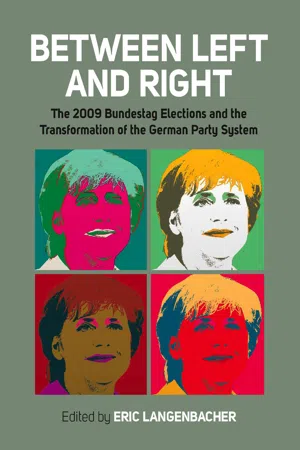
Between Left and Right
The 2009 Bundestag Elections and the Transformation of the German Party System
- 210 pages
- English
- ePUB (mobile friendly)
- Available on iOS & Android
eBook - ePub
Between Left and Right
The 2009 Bundestag Elections and the Transformation of the German Party System
About this book
Trusted by 375,005 students
Access to over 1.5 million titles for a fair monthly price.
Study more efficiently using our study tools.
Information
Chapter 1
LOSE-LOSE PROPOSITION
Policy Change and Party Politics in the Grand Coalition

Introduction
Grand coalitions between a parliament’s two largest parties enjoy the capacity to enact major change, whether such power sharing arrangements are common, as in Austria, or mere episodic experiments, as in countries ranging from Iceland to Israel—and Germany. For where more narrowly based governments run afoul of the Federal Republic’s “institutional pluralism,” an alliance of Christian Democratic Union/Christian Social Union (CDU/CSU) and Social Democratic Party (SPD) can “avoid or overcome structural gridlock” due to a huge Bundestag majority and enough Bundesrat seats to pass any bill.1 Less clear is whether two traditional co-equal rivals will agree on policy change. One view is that sharing the risks and benefits of power leads both to see it as a possible win-win proposition, thus fostering cooperation. A second perspective, by contrast, suggests that the two partners instead see all policy outcomes in zero-sum terms, and, thus, seek to block each other, polarizing partisan competition and yielding stalemate.2 A third position is that variables like programmatic convergence, interest alliances, domination of each party by its more moderate elements, a weak opposition, and leadership skill determine whether there is agreement or gridlock.3
For some, the first federal grand coalition’s “rather impressive” record from 1966-1969 vindicates the optimistic view.4 Despite reneging on a promised electoral law change, it would prove modern Germany’s “most successful long-term reform alliance.”5 Indeed, some saw the duopoly as so efficient that it endangered democracy by overpowering parliamentary opposition and indulging anti-democratic longings for consensus, “a substitute for the strong man.”6 To be sure, the 1960s grand coalition was “ready and willing to act” on domestic issues by “expanding the state,” but “fundamental polarization” did prevent an historic breakthrough in foreign affairs (Ostpolitik).7 Moreover, facing weak mainstream opposition, the Union and SPD eventually drew apart as each sought to keep some supporters from defecting to more radical anti-system rivals.8 Still, their alliance “optimally served the short and long term aims of both parties”—indeed, each gained votes in the 1969 Bundestag election.9
The second grand coalition formed by Angela Merkel in 2005 has drawn more critical reviews. With 73 percent of the Bundestag seats (448 out of 614), the government could pass any bill and—given that the Union, SPD, or both ran enough Land governments—had scant fear of a Bundesrat veto (until Hesse’s 2009 election shifted the balance). Moreover, as a result of both majorities, it even had little reason for concern about the powerful Constitutional Court.10 Yet, within the first year, Der Spiegel found this “coalition of the powerless” to lack decisiveness or readiness to accept any kind of risk, asking “who is governing Germany?” By late 2008, the liberal weekly newspaper Die Zeit accepted that the alliance was “pretty much over.”11 Scholars like Wolfgang Rudzio classify “the quality of its output as mixed,” a “hodgepodge” that left key policy questions unresolved, or “reached solutions hardly capable of functioning.”12 Reimut Zohlnhöfer notes that the Grand Coalition did not use its power to pass many structural reforms, settling instead for “patch up jobs,” many “partially contradictory.”13 While Merkel would defend her government’s preference for “small steps” over bold leaps, others saw it as staggering and stumbling.
Blame for this record has been placed on polarized partisan competition. Zohlnhöfer highlights highly divergent positions: “the Grand Coalition’s partners themselves blocked … significant reform measures.”14 Journalists accused the Union and SPD of “doing nothing that could help the other side more than its own,” as “black and red … remained alien worlds.”15 Electoral considerations are likewise cited, mainly a scramble for centrist, swing voters that diminished any zeal for bold ventures.16 Also, both Union and SPD entered the Grand Coalition at a time and as a result of declining support, having between them captured barely 70 percent of the popular vote (compared with 90 percent in the 1960s and 1970s). In a more fragmented party system, they faced three Bundestag rivals, each angling to lure away disaffected supporters. Finally, unlike in the 1960s, this Grand Coalition’s partners had not sought to govern with each other, and settled for doing so out of desperation. That made for “an uninterrupted campaign,” as each positioned itself for the next election and, ideally, thereafter a new liaison: for the Union, an alliance with the center-right, free-market Liberals (the Free Democrats or FDP); and for the SPD a duo with the environmental Greens (with whom they had co-governed from 1998 until 2005) alone if possible, and, if not, conceivably a three-way center or even all-left coalition including the Left Party.17
Yet, had interparty friction alone been decisive in constraining policy change under Merkel’s Grand Coalition, one partner would have more often stood united against the other, generating gridlock. That was rare, or often merely a proximate cause of its “hodgepodge.” The ultimate source was generally intraparty paralysis, with neither camp’s leaders able to advance ideas that enjoyed solid support in its own ranks. In short, the Grand Coalition’s main problem lay less in its own dynamic than at one level lower.
Three Partners in Crisis: The Parties of Merkel’s Coalition
Fully explaining the policy record of Merkel government thus requires seeing it not only as two co-equal rivals waging a “War of the Roses,” but as more fragmented with differences inside the CDU/CSU and SPD often as deep as those between them. For this Grand Coalition coincided with—and would exacerbate—an identity crisis within each of its camps. The root cause lay in societal changes that weakened the size and loyalty of each party’s traditional support, making it vital, if not easy, to woo more swing voters away from each other, while simultaneously fending off three smaller rivals. This resulted in conflicts over orientation that fueled—and were, in turn, fueled by—strategic dilemmas and leadership struggles.
The CDU
Merkel’s CDU entered the Grand Coalition amid unprecedented uncertainty about its traditional identity. For decades this broad center-right party had thrived (even coming close to an absolute electoral majority at times) based on representing Christian social values, economic liberalism, and cultural conservatism, a programmatic balance preserved by giving each faction an implicit veto. Yet, the social wing—protector of solidarity-based welfare state policies—had lost influence as Germany’s Catholic labor movement (anchored in the Christian Democratic Employees Association) waned in the 1980s and 1990s, and it could no longer count on patronage long provided by Helmut Kohl after his 1998 defeat and tarnished reputation in light of the donations scandal. Meanwhile, the CDU’s pro-business market wing had drawn more adherents as a neoliberal discourse gained currency in Europe amid stagnation and joblessness blamed on welfare state spending.18 Seeking to trump reforms pushed by the SPD-led government, Merkel (Chairwoman of the CDU since 2000) had prodded her party to pursue a “fundamentally new policy,” altering its old “social-market” balance by making an even bolder neoliberal shift. Her 2003 Leipzig Program proposed slashing labor costs (through more individual provision of social security), loosening job protections, cutting benefits, and reducing taxes. What she labeled “the most comprehensive reform package in history” was, others agreed, “all about upheaval, not continuity”—and it galvanized the market wing.19 CDU fiscal conservatives—well-represented in the Bundestag caucus and among its regional minister-presidents—joined in, stipulating that any cuts in payroll or income taxes be offset so as not to increase debt.20 Others went along mainly in the hopes that it would one-up the SPD and keep the party at 40 percent voter support.
This neoliberal turn seemingly invigorated the CDU in 2004-2005, but doubts soon mounted. Given SPD charges and voter concerns that the platform would gut welfare state benefits, the social wing urged shelving key parts and fiscal conservatives grew warier that bold reform might mean larger deficits after all. Market wing leaders had to fight to keep Leipzig at the heart of the 2005 Union campaign manifesto. But, as the party’s huge initial opinion poll lead waned over the summer and it won just 35 percent of the vote in September, recriminations flew. The social wing blamed the manifesto’s “lack of compassion” for scaring centrist voters.21 A defensive market wing retorted that CDU half-heartedness had driven pro-reform voters to the FDP. Bitter though the Union was at having to settle for a grand coalition, Leipzig’s now isolated advocates were poorly positioned to insist that Merkel press it. She all but dropped most planks in her bid to lead the new government, reaching a deal with the SPD by instead giving fiscal consolidation—even tax hikes—top priority.
Intraparty debate would thus rage during the Grand Coalition. Social wing leaders insisted on returning to “balance” and solidarity, even to a critique of capitalism. While not going that far, fiscal conservatives also repudiated large parts of the Leipzig Program. Thus, the market wing, while still better represented among party activists, could only deplore this CDU shift “away from a market-oriented policy.”22 Grand Coalition politics added to the confusion. Outflanking its new governing partner, the CDU Dresden Congress in late 2006 voted to reverse even a key part of SPD-implemented reforms already in law. A year later in Hanover, the party adopted a new Basic Program again granting “justice” and “solidarity” equal weight with “freedom” among key CDU principles. It also gave the party a greener image by stressing environmental themes. By contrast, Leipzig proposals would appear only in vague form, if at all. Market wing leaders kept pressing the CDU to avoid further “social democratizing” itself. Yet, any momentum for returning to a pro-business or neoliberal path was blunted by the 2008 global financial crisis—instead it fueled fresh agonizing over where the party stood regarding its basic views on state intervention in the economy.
The CDU identity crisis had a second dimension. In opposition before 2005, the party had begun to revise its traditionally conservative cultural profile on family and immigration issues above all. This process accelerated in the Grand Coalition. Younger, culturally liberal Christian Democrats aligned with Merkel pushed such “modernization,” insisting that their party recognize societal realities—the rising share of working women, single parent households, unwed couples, and gay partnerships, as well as a need to better integrate residents and citizens with migration backgrounds. They argued that adaptation would impress centrist voters and blunt efforts to depict the CDU as reactionary. Cultural conservatives fiercely resisted such “pandering” to the Zeitgeist and argued that abandoning the “family silver” of traditional religious or national values would demoralize core supporters, driving many into the ranks of non-voters or to radical fringe groups. While this wing in...
Table of contents
- Cover
- Title
- Copyright
- Contents
- Introduction
- Chapter 1 Lose-Lose Proposition: Policy Change and Party Politics in the Grand Coalition
- Chapter 2 The Shrinking Elephants: The 2009 Election and the Changing Party System
- Chapter 3 Bundestag Election 2009: Solidifying the Five Party System
- Chapter 4 The SPD and the Debacle of the 2009 German Federal Election: An Opportunity for Renewal
- Chapter 5 Coalition Governance under Chancellor Merkel’s Grand Coalition: A Comparison of the Cabinets Merkel I and Merkel II
- Chapter 6 Coalitions and Camps in the German Party System after the 2009 Bundestag Election
- Chapter 7 Coalition Dynamics and the Changing German Party System
- Chapter 8 Gender Quota Compliance and Contagion in the 2009 Bundestag Election
- Chapter 9 The Internet, Political Participation and Election Turnout: A Case Study of Germany’s www.abgeordnetenwatch.de
- Chapter 10 The Role of Foreign Policy in the 2009 Campaign and the Black-Yellow Future
- Contributors
- Index
Frequently asked questions
Yes, you can cancel anytime from the Subscription tab in your account settings on the Perlego website. Your subscription will stay active until the end of your current billing period. Learn how to cancel your subscription
No, books cannot be downloaded as external files, such as PDFs, for use outside of Perlego. However, you can download books within the Perlego app for offline reading on mobile or tablet. Learn how to download books offline
Perlego offers two plans: Essential and Complete
- Essential is ideal for learners and professionals who enjoy exploring a wide range of subjects. Access the Essential Library with 800,000+ trusted titles and best-sellers across business, personal growth, and the humanities. Includes unlimited reading time and Standard Read Aloud voice.
- Complete: Perfect for advanced learners and researchers needing full, unrestricted access. Unlock 1.5M+ books across hundreds of subjects, including academic and specialized titles. The Complete Plan also includes advanced features like Premium Read Aloud and Research Assistant.
We are an online textbook subscription service, where you can get access to an entire online library for less than the price of a single book per month. With over 1.5 million books across 990+ topics, we’ve got you covered! Learn about our mission
Look out for the read-aloud symbol on your next book to see if you can listen to it. The read-aloud tool reads text aloud for you, highlighting the text as it is being read. You can pause it, speed it up and slow it down. Learn more about Read Aloud
Yes! You can use the Perlego app on both iOS and Android devices to read anytime, anywhere — even offline. Perfect for commutes or when you’re on the go.
Please note we cannot support devices running on iOS 13 and Android 7 or earlier. Learn more about using the app
Please note we cannot support devices running on iOS 13 and Android 7 or earlier. Learn more about using the app
Yes, you can access Between Left and Right by Eric Langenbacher in PDF and/or ePUB format, as well as other popular books in History & German History. We have over 1.5 million books available in our catalogue for you to explore.