What makes people lose faith in democratic statecraft? The question seems an urgent one. In the first decades of the twenty-first century, citizens across the world have grown increasingly disillusioned with what was once a cherished ideal. Setting out an original theoretical model that explores the relations between democracy, subjectivity and sociality, and exploring its relevance to countries ranging from Kenya to Peru, The State We're In is a must-read for all political theorists, scholars of democracy, and readers concerned for the future of the democratic ideal.
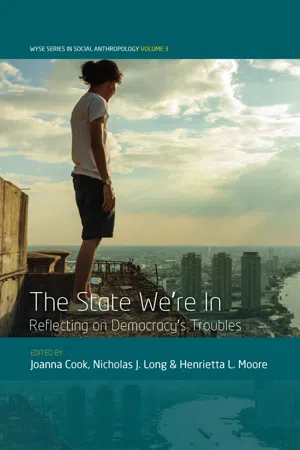
eBook - ePub
The State We're In
Reflecting on Democracy's Troubles
- 228 pages
- English
- ePUB (mobile friendly)
- Available on iOS & Android
eBook - ePub
The State We're In
Reflecting on Democracy's Troubles
About this book
Trusted by 375,005 students
Access to over 1.5 million titles for a fair monthly price.
Study more efficiently using our study tools.
Information
1
After (?) Democracy
Time, Space and Affect in Peruvian Political Imaginaries
The opening decades of the twenty-first century have been witness to what many regard as a sea change in the principles of political legitimacy. A fundamental breakdown of trust between politicians and electorates is said to have given rise to a widespread sense of ‘malaise’ and disaffection among the citizens of democratic polities (Kupchan 2012). For some scholars (cf. Diamond 2008), these developments represent a ‘recession’ of democratic ideals and practices. For many other scholars (cf. Fraser 2014), however, contemporary developments are more serious than the term ‘recession’ implies. Only the notion of ‘democratic crisis’, they argue, can capture the scope and scale of the sweeping transformations taking place in political life.
In the pages that follow I argue that the crisis of democracy interpretation, while important, does not provide a wholly adequate explanation for why so many people of late appear to have rejected the democratic ideal. Drawing on ethnographic materials from the northern Peruvian Andes during the middle decades of the twentieth century, I explore this point by focusing on the temporality of democracy that is implicit in the crisis view, and the normative claims associated with that temporality. My argument has several components. First, I show that the crisis interpretation, while accurate in many respects, is also partial and incomplete. The notion that democracy is in crisis is anything but a recent development. To the contrary: extreme scepticism about the merits of the democratic ideal, and about the future of democracy, has been widespread and continuous, virtually since this form of political order became institutionalised in select countries of the North Atlantic in the late eighteenth century. Indeed, as I shall argue, in democratic social orders crisis is inevitable rather than exceptional.
The second component of my argument builds on this first one to show that perceptions of crisis – even when they are as widespread as they are today – are embedded in a more complex field of responses to democracy. Multiple understandings of the democratic ideal, I suggest, generally coexist within the same social field, and vie with one another for public support and recognition. Among the most interesting aspects of these different views of democracy is that they often contradict one another. With respect to the notion that we have entered into a period of crisis, however, what is relevant about these different forms of democracy is that each has its own distinctive temporality. What may appear to be a post-democratic moment for some, for example, is often regarded as a democratic or even a pre-democratic moment by others.
I argue that there is much to be gained by recognising the full range of democracies and democratic temporalities that characterise any given social context. I argue that it is equally important to pay close attention to the antinomies between these coexisting democracies. Doing so allows us to understand democracy as a contested field of legitimating claims and understandings (Roseberry 1994) rather than a set of institutions, conditions or social accomplishments. As I will show presently, the very same institutions, conditions and accomplishments may be interpreted in very different terms – as democratic, non-democratic, pre-democratic or post-democratic – by different constituencies, each of which may have its own understanding of the democratic ideal. As a result, these constituencies may renounce some versions of democracy even as they embrace others. Rejection of any particular form of expression of democracy does not mean rejection of democracy.
From this perspective, it would be important to subject to careful scrutiny all claims about the temporality of democracy – to ask, for example, who argues that we are in the midst of a sea change in political legitimacy. It would be equally important to ask what kind of work is performed, what kinds of legitimating claims are being made, by means of such an assertion. It would also be important to explore the possibility that other forms and other temporalities of democracy exist alongside the form that is said to be in crisis – to ask what views are rendered opaque or invisible by asserting that we are passing out of democracy and into something post-democratic. To fail to ask these questions is to neglect the full range of moral and political imaginaries that are expressed through the democratic ideal. It is also to assert a particular, and quite interested understanding of democracy and its history as normative (cf. Nugent 2008) – a point to which I will return. Finally, it is to silence the many alternative voices that view the temporality and spatiality of democratic social processes in ways that cannot be captured by the thesis of epochal change.
Democracy as Ideal and as Practice
Later in the chapter I present a brief discussion of the multiple temporalities of democracy that coexisted in northern Peru during the middle decades of the twentieth century. Before doing so, however, I offer some preliminary thoughts about democracy as a conceptual category – thoughts that have been provoked by the unusually interesting way in which the editors of this volume have framed our project in theoretical terms. In describing the book’s orientations and aims, the editors emphasise that the point of our discussions is not simply to explore why people become dissatisfied with this or that set of political circumstances or forms of statecraft. Instead of solely focusing on democracy as a set of institutions or social conditions, the editors explain, they would also like us to engage with the problem of democracy as an ideal. They would like us to analyse people’s changing relationships to democracy as an ideal – to explore why they are led, in some times and places, to reject the entire notion of democracy. I will use this distinction between ideal and practice as my point of departure for the discussion that follows. I will begin with democracy as political and cultural ideal.
It is in the very nature of ideals, of course, to be unrealisable in practice. Democracy is no exception. But democracy is no ordinary ideal. The first task we face in seeking to understand people’s changing relationships to democracy as an ideal is to understand the specific kind of ideal that democracy is. What makes democracy distinctive as an ideal, I argue, is that it is not only an ideal. In addition, it has also acted as a core principle of political legitimacy across much of the globe for at least a century.
Because democracy-as-ideal has been so extensively used as a means of legitimation, and in such widely different circumstances, the term has been used to refer to a startlingly broad range of social conditions and political practices (see below). This fact alone adds greatly to the complexities involved in thinking through the significance of the crisis that democracy is currently undergoing in some parts of the world. But the challenges of doing so do not end here. Because of its double life as an ideal and as a means of legitimation, democracy has also been employed to defend a great range of context-specific (and often opposed) claims concerning how political life should be, could be, might be, must be, used to be and is sure to be lived. Democracy has been used in an equally broad range of settings, however, to defend a very different set of assertions – concerning how life should never be, could never be, should not currently be and never will be lived.
In some contexts, democracy is described as an aspiration – as a passionate, heartfelt desire for an imagined state that is absent rather than present, one that would help liberate people from conditions of servitude or oppression. But in other contexts democracy is characterised as the culmination of such a process of struggle and emancipation – not as a wish but as a fact, as a political state, which has been won through great sacrifice, and is present rather than absent.
In still other contexts, however, democracy signals neither aspiration nor a state of emancipation but a set of institutions and political processes, often (but not always) those associated with elections and representation. A related but distinct use of democracy is to refer to a category of nation state, as in the common reference to the ‘established democracies’ – a term that invokes a global hierarchy of polities, some of which are more securely democratic (and legitimate) than others. Finally, democracy is commonly used to refer to what a particular regime, time period, etc., fails to be when it fails to live up to people’s material and moral-ethical expectations – when it fails to provide them with what they believe they are entitled to.
In these latter circumstances, democracy is viewed not as something that lies ahead of people, something they should reach toward, something they should work hard to achieve. Rather, democracy is seen as something that people should distance themselves from, something they should put behind them. It is seen as something that should be a part of their past, that may unfortunately be a part of their present, but that should definitely not be a part of their future.
What is revealed about democracy by even this cursory examination of some of the diverse ways in which it is mobilised and imagined? Democracy may be used to refer at once to an emotion and an institution, to conditions desired and those rejected, to a category of polity and a state of being. Indeed, because democracy is used in such a promiscuous manner, a striking range of what are often mutually incompatible institutions, conditions, practices and accomplishments have come to be associated with this term. Small wonder, then, that it is so difficult (but also so productive) to analyse people’s changing relationships to democracy, both as ideal and as practice. For it is not at all clear what the referent of the term is.
The fact that this one term is used to refer such a wide range of activities, aspirations, conditions, accomplishments and failures speaks to the importance of democracy as a category of cultural meaning – one that is involved in framing a great many contemporary political and moral imaginaries. Indeed, whether it is regarded as a force for good or evil, as something to be accepted or rejected, it would appear that democracy is an unusually powerful and compelling principle of order. The fact that it is so, and is also an unattainable ideal or aspiration, is important in understanding people’s relationships to democracy as an ideal. For it means that people’s experiences of democracy are almost inevitably accompanied by a sense of something missing, something incomplete. But this is more than something that is simply absent. Because of the power of democracy as a legitimating principle, it is also a sense of something absent that should be present.
As a result, democracy often finds itself in question. The unresolved tension between the ‘should’ and the ‘is’ of this form of political life means that some constituencies are forever finding democracy wanting, are continually led to re-imagine its contours, at times (as of late) to reject it outright. Indeed, it is democracy’s failure to be what it is supposed to be that has led many (but not all) people in the contemporary world to wash their hands of it – to discard democracy completely.
Democracy, Capitalism and Inequality
The sense that there is something missing in contemporary manifestations of democracy is a function of more, however, than the disjuncture between should and is. Equally important is the particular form of political practice that has come to be regarded as democracy in much of the world, and the relationship between this normative form of democracy (Nugent 2008) and capitalism. In that contemporary discussions of crisis focus on one or more aspects of this specific expression of the democratic ideal it is worth examining this form of practice in more detail. Doing so will make it possible to ‘provincialise’ (cf. Chakrabarty 2000) this particular expression of democracy – to distinguish between it and Democracy with a capital D. Doing so will also help clarify what is at stake when crisis theorists invoke the demise of this form of political practice as signalling the end of democracy itself.
As noted by a number of scholars (cf. Wood 1994), the birth of capitalism in the North Atlantic in the eighteenth century coincides with the institutionalisation of a particular form of political practice – what has come to be known in the scholarly literature as liberal representative democracy. This form of democratic practice is not of one piece. Rather, it is made up of separate components, which together constitute an odd hybrid of unrelated rights and rituals that we have come to think of as a single undifferentiated whole. These rights and rituals have little to do with the original meaning of democracy – in the sense of rule by the people, or the demos. Each of the different components that make up the hybrid that is liberal representative democracy stands in a different relationship to the principles of popular rule. It is to this topic that I now turn.
One of the components that make up liberal representative democracy is the liberal component – a term that refers to the rights and protections enshrined in the constitutions of many countries around the world. These rights originally took shape in Western Europe, in the early modern period. They did so as the ascending commercial classes associated with the rise of market capitalism successfully challenged the position of centralising states and powerful agrarian elites, and in the process opened up a new political space. The commercial classes did so by consolidating a group of entitlements (that we call ‘individual rights and protections’), a set of social institutions (civil society; cf. Keane 1998), and also a public sphere (cf. Habermas 1989), that was autonomous of, and that set real limits to state power.
It was these entitlements, etc. that came to form part of the core of modern democratic citizenship, that helped establish the institutions of political democracy, and that remain central to what democracy means to many people today. These liberal entitlements included, for example, the ‘freedoms of’ speech, religion, movement (of people, commodities, ideas, messages), etc. They included as well the ‘freedoms from’ (arbitrary search and seizure, etc.), and protections of person and property. They also established the autonomous (white, bourgeois male) individual as the sovereign holder of jural rights. Overall, these entitlements set legal and practical limits on the ability of government officials to interfere with everyday social life.
Part of the origin myth of Euro-American democracy is that it is the most recent manifestation of a millennia-long democratic tradition that originated with the Greeks in ancient Athens. It is interesting to compare democracy in these two settings; as such, a comparison brings out just how distinctive Euro-American democracy is. Actually, the liberal rights that make up this component of Euro-American democracy have little if anything to do with popular understandings of Athenian democracy. What we are taught about democracy in ancient Athens is that it was based on citizen control, on insuring that the citizenry exercised a direct and powerful voice in all community affairs. That is, Athenian democracy sought to guarantee extensive ‘input from below’ – from the mass of the population, who were to determine the conditions of their own existence. Liberal rights, however, address a quite different problem. They are focused on the state rather than the citizenry, and seek to limit ‘input from above’. In other words, liberal rights seek to map out a terrain where state power may not be exercised. They are intended as, and developed historically as, brakes on the centralisation of power (Wood 1994). They have little to do with democracy understood as ‘rule by the people’.
A second component of the hybrid mix of unrelated practices that has come together to form liberal representative democracy concerns the processes associated with representation. The representative component of liberal representative democracy refers to the highly ritualised process by which individuals (or groups) cede or relinquish direct decision-making power to other individuals, who go on to make key decisions in the political arena. Unlike the liberal component, this one is directly concerned with the problem of democracy – with the ability of the citizenry to exercise a voice in political affairs. As is widely recognised, the representative component of liberal representative democracy significantly disempowers those who are compelled to relinquish their voice. In relation to the problematic of rule by the people, it is worth noting that processes of representation were viewed with outright disdain in ancient Athens, as was voting more generally (cf. Wood 1988).
As many scholars have shown, ‘representation’ favours the maintenance of inequalities in power and wealth. This is because it is generally members of the privileged classes who succeed in dominating positions of representation. In this regard it is revealing that, historically, elite groups have viewed more direct, participatory forms of democracy with outright horror (cf. Linebaugh and Rediker 2000). Elite groups have been strong advocates of representative democracy, however, as it offers an effective means of maintaining their positions of privilege in the face of democratising demands ‘from below’.
Understanding the hybrid nature of liberal representative democracy thus requires that we distinguish between its liberal and its representative components. Doing so provides us with a vantage point from which we may better understand the challenges involved in interpreting people’s acceptance or rejection of democracy. For these two components of liberal representative democracy may combine in distinctive ways to confront people with qualitatively different institutional environments. Because all tend to travel under the name of democracy, however, people use the same term to refer to quite different phenomena.
Regardless of the conclusions that people reach about the particular practices that (are said to) represent democracy – whether democracy should be embraced or abandoned, rejected or reformed – two facts seem salient. First, the practices to which the groups in these various circumstances respond are not the same – even though they are treated as if they were. Second, the groups in question do not draw upon a shared vocabulary or set of meanings when they make their assessments of the practices that represent democr...
Table of contents
- Cover Page
- Title Page
- Copyright Page
- Contents
- List of Figures
- Acknowledgments
- Introduction: When Democracy ‘Goes Wrong’
- 1. After (?) Democracy: Time, Space and Affect in Peruvian Political Imaginaries
- 2. Democracy and the Ethical Imagination
- 3. Why Indonesians Turn Against Democracy
- 4. Opposition and Group Formation: Authoritarianism Yesterday and Today
- 5. Rejecting or Remaking Democratic Practices? Experiences during Times of Crisis in Italy
- 6. ‘The People’ and Political Opposition in Post-democracy: Reflections on the Hollowing of Democracy in Greece and Europe
- 7. Debt Society Consolidated? Post-democratic Subjectivity and its Discontents
- 8. Politics after Democracy: Experiments in Horizontality
- Index
Frequently asked questions
Yes, you can cancel anytime from the Subscription tab in your account settings on the Perlego website. Your subscription will stay active until the end of your current billing period. Learn how to cancel your subscription
No, books cannot be downloaded as external files, such as PDFs, for use outside of Perlego. However, you can download books within the Perlego app for offline reading on mobile or tablet. Learn how to download books offline
Perlego offers two plans: Essential and Complete
- Essential is ideal for learners and professionals who enjoy exploring a wide range of subjects. Access the Essential Library with 800,000+ trusted titles and best-sellers across business, personal growth, and the humanities. Includes unlimited reading time and Standard Read Aloud voice.
- Complete: Perfect for advanced learners and researchers needing full, unrestricted access. Unlock 1.5M+ books across hundreds of subjects, including academic and specialized titles. The Complete Plan also includes advanced features like Premium Read Aloud and Research Assistant.
We are an online textbook subscription service, where you can get access to an entire online library for less than the price of a single book per month. With over 1.5 million books across 990+ topics, we’ve got you covered! Learn about our mission
Look out for the read-aloud symbol on your next book to see if you can listen to it. The read-aloud tool reads text aloud for you, highlighting the text as it is being read. You can pause it, speed it up and slow it down. Learn more about Read Aloud
Yes! You can use the Perlego app on both iOS and Android devices to read anytime, anywhere — even offline. Perfect for commutes or when you’re on the go.
Please note we cannot support devices running on iOS 13 and Android 7 or earlier. Learn more about using the app
Please note we cannot support devices running on iOS 13 and Android 7 or earlier. Learn more about using the app
Yes, you can access The State We're In by Joanna Cook, Nicholas J. Long, Henrietta L. Moore, Joanna Cook,Nicholas J. Long,Henrietta L. Moore in PDF and/or ePUB format, as well as other popular books in Social Sciences & Democracy. We have over 1.5 million books available in our catalogue for you to explore.