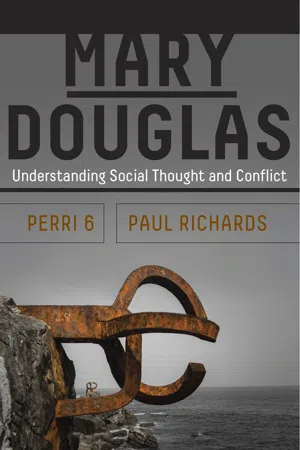
Mary Douglas's innovative explanations for styles of human thought and for the dynamics of institutional change have furnished a distinctive and powerful theory of how conflicts are managed, yet her work remains astonishingly poorly appreciated in social science disciplines. This volume introduces Douglas's theories, and outlines the ways in which her work is of continuing importance for the future of the social sciences. Mary Douglas: Understanding Human Thought and Conflict shows how Douglas laid out the agenda for revitalizing social science by reworking Durkheim's legacy for today, and reviews the growing body of research across the social sciences which has used, tested or developed her approach.
- 256 pages
- English
- ePUB (mobile friendly)
- Available on iOS & Android
eBook - ePub
About this book
Trusted by 375,005 students
Access to over 1.5 million titles for a fair monthly price.
Study more efficiently using our study tools.
Information

SOCIAL ORGANIZATION IN MICROCOSM
Anomalies and Ritual Concentrate Conflict
This chapter examines the development of Douglas’ method and theory between the mid 1950s and 1970. It concentrates on her theoretical use of her own ethnographic work on the Lele of the Kasai.1 Douglas laid the foundations for, but could not yet construct, the fully developed body of theory presented in the 1980s. Key concepts were forged in the microcosm of the ethnographic studies in the 1940s and 1950s. In the 1960s, she began to use these concepts in comparative analysis. What remained to be developed was a fully causal and dynamic theory. This chapter traces the development of her conceptual framework and, in particular, it examines the centrality of her concepts of classification, symbolization, meaning, ritual and anomaly. The notion of an anomaly became central both to her theory of conflict and to her analytic method for designing research.
Institutional Intricacy in Containing Conflict
For a social theorist, the point of ethnography is not just to gather data about a particular case, but also to use this case as a microcosm for a much more general and, by implication, comparative argument. Douglas used her detailed ethnographic work on the Lele, a people living in what is now the Democratic Republic of the Congo, to support her general arguments in later works. A book on the Lele was published in 1963, fully ten years after the first draft of the material had been submitted as her doctoral thesis at Oxford. The monograph was preceded by a series of articles and papers covering parts of the same ground. Here, we consider these writings together.
In 1949, the Lele constituted a group of about thirty thousand people, inhabiting a small part of the southern edge of the African equatorial forest on the left bank of the Kasai River. Villages were small, averaging about two hundred inhabitants. Population density was low, at about two people per square kilometre. The men cleared small patches of land for women to farm, but spent most of their time hunting and weaving raffia cloth. Elders settled blood debts and administered a complex system of marriage transactions.
The Lele lived according to ‘standards of suavely controlled behaviour’ (Douglas, 1977 [1963], 7). Yet they were also beset by problems of accident, sickness and sudden death. Fears of sorcery, the presumed cause of these problems, gripped their imaginations, and from time to time convulsed the smooth surface of daily life.
Douglas focused first on the Lele economy. She contrasted the Lele with their linguistically related neighbours, the Bushong (Douglas, 1962; 1977 [1963], 1, 18–23, 41–51). The Bushong had well-organized chiefdoms, a strong work ethic and a great desire to acquire wealth. The Lele were less tightly ordered, worked less hard and lacked markets or money. Prestige based on virility and respect for age counted for more among Lele male elders than economic achievement.
One area where the Lele outshone the Bushong was in the production of raffia cloth (Douglas, 1958). This was of high quality and the main medium for payment of marriage fees, fines, and cult dues, as well as for bartering against outside necessities. When not engaged in planning wars and abductions, at least prior to prohibitions enforced by the Belgian colonial rulers after 1925, or in hunting and matchmaking, Lele men were primarily engaged in weaving the raffia cloth they needed for barter and social exchange. The accumulation of cloth from cult and marriage fees supported the senior men, leading Douglas to wonder whether Lele society had saddled itself with a pension scheme it could ill afford. Certainly, demand for cloth made it hard for Lele men to marry young. This explained the emergence of a form of polyandry known as the ‘village wife’, by which young men who were unable to acquire a wife by other means could be provided with quasi-marital support. This institution was the subject of her first major academic paper (Douglas, 1951).
In the field of marriage, the transactional complexity of Lele society became fully apparent. In Douglas’ account, it proved to be an intricate marvel. A key reason for her examining the Lele, urged upon her by her supervisors and colleagues, was that in 1950 little research had been done on matrilineal communities. Matrilineal kinship in a male-dominated society posed certain challenges of group cohesion. In contributing a solution to the so-called ‘matrilineal puzzle’, Douglas (1969) suggested that matriliny had some advantages over patriliny. Notably, it achieved wider distribution of men, who constituted a key productive asset, and also of food, the principal consumption asset. The matrilineal clans of the Lele offered a man the option of remaining with his father in his place of birth or of moving to the village of his mother’s clan, of which he was a member. He might be fed by the wife his father had helped him acquire or he might move to seek help from his matrikin, thus serving the cause of flexible adjustment in an impoverished forest-edge environment.
Superimposed on this system of flexible matrilineal connections was a patron-client system of mind-bending complexity. Douglas called these patrons ‘lords’. A Lele lord was an elder from a matriclan with some kind of claim to precedence, such as first-comer rights to land. But a lord exercised little power beyond the capacity to assign marriage rights in young women born to his clients. This capacity was used to attract young men to a community. Clients, or ‘pawns’ in the terminology that Douglas later came to favour (1964), are described as being of semi-servile status. Yet Lele clients were routinely able to extract so many benefits from their lords that it is unclear who was more deeply bound to whom. Although in the 1950s and 1960s, Douglas was still years away from developing her concept of hierarchy, in retrospect her account of lordship and pawnship seems to exhibit some of its features, notably the combination of strong social integration and strong social regulation of the upper and lower ranks within Lele social organization. Clearly, the pawns were subaltern, but it is interesting to note the extent to which the pre-eminence of the lords was also subject to detailed prescription. On the other hand, strains of domination are also present in her account, with the relationship between the ranks apparently exhibiting hybridity with some isolate and despotic forms. Nonetheless, at least in the 1950s, the dangers of incipient isolate and despotic ordering were carefully contained by offsetting institutions of other forms.
The clientship system, as Douglas encountered it, reflected local exigencies. People became clients when a lord saved them from war, sickness or famine. But in other cases, clients had caused a death by accident or sorcery. To the Lele, almost every death was the result of human agency, whether overt or occult. Someone was to blame. In precolonial times, the Lele poison ordeal revealed the true cause and also administered the sentence. Some suspects merely vomited, which constituted proof of innocence. Others collapsed and died, which provided proof of their sorcery. The ordeal was an ingenious biophysical device reducing the blame game to a lottery. The decision brooked no argument; it was ‘God’s medicine’ (Douglas, 1977 [1963], 241). Douglas failed to identify the plant involved, but Jan Vansina, a fellow anthropologist who worked among the neighbouring Bushong, suggested (although he too had few authoritative sources) that it may well have been either Strychnos icaja or Erythrophleum guineense (Vansina, 1979 [1969]; 1990, 300). E. guineense provides the poison for the sasswood ordeal known widely throughout the African forest margins as far as the Upper Guinea coast.
Because by the time of her fieldwork the colonial authorities had banned the ordeal, along with slavery (Douglas, 1960), Douglas had no observation-based data on how it was administered. Her brief account is based on a key informant, Makaka, a village leader who had twice taken the ordeal and survived (Douglas, 1977 [1963], 242). Its loss had severe consequences for Lele ideas of justice because, without it, responsibility for unexplained misfortune was now much harder to assign. Henceforth, lengthy forensic procedures based on divination were needed to judge guilt. Condemned people paid off their debt to Lele society by becoming clients. But the system was so much more complicated and time-consuming than it had previously been. Arguments about whether a person was truly a witch could drag on because detecting sorcery depended on divination, and Lele diviners were also suspected of being sorcerers, so they tended to deliver less clear-cut verdicts than the ordeal had done.
As was common in many western African forest-edge societies, the Lele also had important cults or sodalities linking elites and commoners. Lele cult rituals ensured health, fertility and success in hunting. The cults of the begetters and the pangolin, a mammal distinctively covered in reptilian scales, celebrated virility. The father of a first child would seek initiation into the begetters cult. Having acquired both male and female children, a father could seek to join the pangolin cult (see below). Parents of twins belonged to the twins cult. Diviners (sixteen of forty men in one small Lele village) might receive their vocation in a dream. Older diviners were frequently suspected of sorcery, a testimony to the fragility of their grip on power. From time to time, witch-finding cults directed against sorcerers threatened to convulse Lele society.
The monograph on the Lele introduced many of the themes of Douglas’ later work. She paid close attention to the intricate ways in which respect for elders was prevented from becoming oppressive through the licensing of special cult opportunities for young men. This relationship formed part of the conception that she would later develop of hierarchical relations as reciprocal but asymmetrically ordered systems of social integration, and not merely and certainly not fundamentally based on orders issuing from a chain of command.
The study also opened up the examination of blame, and the problem of how to manage and contain blame, to prevent it giving rise to corrosive conflict, mistrust and fear, leading in turn to violence. Although in the early 1960s Douglas had no general theory of blame, her analysis of the problem of control of sorcery accusations stated the theoretical issue clearly enough. Accusations proliferated in situations in which tensions erupted among groups in Lele society subject to quite different accountabilities. The poison oracle provided a forensic procedure by which adjudication of accusations could be undertaken with the appearance of independence from any of the conflicting parties and indeed with the appearance of independence from human institutions altogether. The link between the danger that sorcery represented, the institution of blame and accusation, and the centrality of a forensic procedure was established in Douglas’ 1960s account of Lele life, and was ready and waiting to be recast nearly thirty years later in the light of her subsequent work on risk more generally.
Moreover, Douglas showed that individual blame is incipient general political conflict, where people lack or are deprived of the institutional means through which to exercise care and thus to prevent misfortune. With the poison oracle unavailable to defuse such accusations, a runaway process led, during the 1950s, to fervent, emotional anti-sorcery movements sweeping through Lele communities with violent consequences (Douglas, 1977 [1963], 257). Blame, sectarianism and conflict were already linked by the dynamics of what she would later learn, from the cybernetic tradition of analysis, to call ‘positive feedback’. She had also encountered the idea in Durkheim’s passages on what he termed ‘sacred contagion’, though at first she was rather reluctant to adopt Durkheim’s formulation (see, for example, her preface to the first edition of Implicit Meanings, where she imposed an inappropriate interpretation of Durkheim’s term related to notions of infection, an error she would correct in her last works). She returned to the problem of blame in the 1980s and 1990s. The ways in which cult rivalries can be attenuated and channelled became one of the main themes of her late work on ancient Israel.
The sheer intricacy of the mutually offsetting processes in Lele social organization fascinated Douglas. She was equally alive to their fragility. Even in the 1950s, delicate intricacy did not suffice to stave off the dangerous collective effervescence of anti-sorcery cults among Lele people. As she published her monograph in 1963, not yet having encountered the developments in cybernetic theory and its vocabulary of ‘requisite variety’ that reshaped social scientific understanding of control systems, and still reliant on her Oxford anthropological training in functional analysis, she lacked a theoretical explanation for these balancing yet not entirely stable relations other than the often rigid structural-functionalism of her anthropological forebears. In that approach, every discernible set of practices or beliefs was thought to further the maintenance and reproduction of specific social forms. Yet even if this could account for offsetting, it had no explanation for instability or its possible consequences. In particular, anthropological structural-functionalism was manifestly inadequate to handle the obvious deep conflicts that shaped and convulsively reshaped Lele society. Nonetheless, the monograph on the Lele provided her with a case on which she would reflect for decades concerning institutional hybridity, whereby a provisional settlement could emerge among several distinct and rival institutional imperatives and commitments, embodying informal norms and tacit practices. Nonetheless, the instability of these settlements had already presented her with a case on which to examine the problem of what Thompson and Wildavsky (her student and collaborator, respectively) would later call ‘viability’. By this, they meant the set of relations among mutually cantankerous institutions that might somehow prevent complete breakdown. A key question is then posed in the final pages of her monograph (e.g. Douglas, 1977 [1963], 258) – whether there might be other coarser and more robust ways in which institutions in friction could develop viable accommodations or whether such outcomes might be worse than the gridlock they replaced.
At the end of her life, Douglas would implicitly compare the Lele, with their rich plethora of institutional imperatives around age, matriclan, chieftaincy, intervillage accounting, problems of witchcraft and demons, institutions of divination and oracular judicial procedure, with the appearance of institutional sparseness and simplicity found in ancient Israel. It was a comparison she had already encountered in the work of her teacher, Evans-Pritchard, in the contrast implied by his ethnographies of the agricultural Azande and pastoral Nuer. Her purpose was to ask what subterranean and visible institutions would be both possible and necessary if an appearance of institutional austerity were to be sustained.
In particular, the Lele provided her with a series of examples of ways in which institutional rules were adapted to provide for special exceptions, in order to deal with what would otherwise be difficult contradictions, tensions or threats of conflict from rival, latent claims. The monograph on the Lele documented these with respect to what she would later in the 1960s call ‘anomalies’ in marriage, in relations between age groups and in the role of the poison oracle in defusing blame and accusation. The ways in which such anomalies could be generated by institutions, and managed (or not) by further institutions, would increasingly become central to her method and thus to her general theory of social conflict and of change.
Anomalies, Rituals and Dangerous Solidarities
After completing her work on the Lele material, Douglas pursued comparative studies with the purpose of building social theory. However, she continued to draw upon her African ethnography either directly or indirectly for the rest of her life.
Purity and Danger (1966) was the first major fruit of her comparative theorizing. It is still her best-known work. Sections and chapters from the book were widely anthologized, especially material from Chapters 3 and 10 on the abominations of Leviticus and on the Lele pangolin cult. She eventually placed a moratorium on further reprinting of excerpts because the practice tore these arguments from the context of the book’s argument as a whole (Fardon, 1999, 83–99).
The core of the book was a reworking of several explanations first developed by Durkheim. Here, Douglas drew almost exclusively on Durkheim’s (1995 [1912]) Elementary Forms and with occasional reference to the distinction Durkheim makes in Division (1984 [1893]) between mechanical solidarity, based on similarity, which might be enforced if found necessary, and organic solidarity, based on accommodation of difference. Her account of religion, ritual, symbol and classification in Purity and Danger argues, following Durkheim’s arguments, that people ritually enact their social organization and develop classifications collectively to represent, in transposed form, aspects of the structure of that organization. Too often Douglas’ book is misremembered as if it had proposed that symbolism explains action, when her point was exactly the reverse.
Purity and Danger began with an attack upon the unjustified distinction between ‘primitive’ and ‘modern’ thinking, which social science had been given by nineteenth-century thinkers. That distinction had become entrenched by Weber’s thesis of ‘rationalization’ and the ‘disenchantment’ of a supposedly purely secular and ritual-free world achieved between the Renaissance and the Enlightenment in Europe (Weber, 1978; Schluchter, 1981 [1979]). Douglas argued that, on the contrary, all ways of apprehending the world depend, as Kant had claimed, on the deployment of prior categories. However, in considering the nature of these categories, she followed Durkheim’s suggestion that they are moulded and sustained by social forces of ritual action in which symbols are deployed.
She then made her first foray into biblical studies, later to be an important ethnographic domain more accessible to her than the Congo. For the third chapter of Purity and Danger offered an interpretation of Jewish dietary laws – for instance, the ban on pork or certain kinds of seafood, or certain combinations of foods – as set out in the Book of Leviticus. She argued that these laws should be understood as a symbolic aide-memoire for the way in which society is organized, and not a reflection on the inherent or literal uncleanness of pigs. Each of the unclean animals is really anomalous. But anomaly only makes sense within a system of classification. In turn, those systems of classification reflect the system of societal organization, if not directly, then as transposed into an ideal form that the religion defends. Classifications inevitably face anomalies, meaning things that are classified in two or more rival ways or that cannot clearly be classified at all. Recognition of such things as salient will be driven by conflicts in social organization. People could, in principle, manage entities that appear anomalous in various ways; they might celebrate them, exploit them, prohibit or expunge them, suppress and debar them as dangerous or evil, or develop special institutions to treat them as exceptions to be controlled in reserved institutional locales. In Purity and Danger, Douglas’ focus was principally on the contrast between the latter two. Her argument in 1966 seemed to regard debarring anomalies by prohibition as the signature of mechanical solidarity, and special accommodation as the hallmark of organic solidarity. The ‘abomination’ pronounced by Leviticus is the debarring of anomaly by prohibiting dissimilar things from coming into contact.
The reason why this chapter was so widely anthologized was that it set out for the first time Douglas’ Durkheimian argument that social organization, not biology, explained cognition. What was not much commented upon at the time was that it also presented her methodological programme in miniature. Her argument here is that we understand correctly the kind of social organization driving the tribes of Israel only when we do what today would be called ‘causal process tracing’ – to develop and then test against data rival hypotheses about causal mechanisms at work, first in producing anomalies in classification and then in leading people to adopt particular strategies for dealing with those anomalies. If the Lele could at least sometimes proliferate special rules to handle exceptions (and she acknowledged that they sometimes engaged in seeking to suppress anomalies or to forbid or obliterate them from memory), Leviticus adopts a different strategy. The book instead specifies prohibitions in which anomalous things are eschewed as marks of the distinctiveness of the Jewish people. In her later works, she would extend this method by treating risks in technologically developed settings as anomalous things, for which the very same repertoire of basic strategies for managing them would be available, and the strategy selected would depend on the prevailing form of social organization. This would be true, she...
Table of contents
- Cover
- Title Page
- Copyright Page
- Contents
- List of Figures
- Preface
- Acknowledgements
- Introduction
- Chapter 1: Social Organization in Microcosm: Anomalies and Ritual Concentrate Conflict
- Chapter 2: Comparing on a Grand Scale: Elementary Forms Do the Organizing
- Chapter 3: Building Fundamental Explanations: Rituals Do the Institutionalizing, and Institutions Make Change
- Chapter 4: Analytic Method is Also Ritual Peace Making: Thinking in Circles Helps to Defuse Conflict
- Chapter 5: Douglas’ Contribution to Understanding Social Thought and Conflict
- Coda
- References
- Index
Frequently asked questions
Yes, you can cancel anytime from the Subscription tab in your account settings on the Perlego website. Your subscription will stay active until the end of your current billing period. Learn how to cancel your subscription
No, books cannot be downloaded as external files, such as PDFs, for use outside of Perlego. However, you can download books within the Perlego app for offline reading on mobile or tablet. Learn how to download books offline
Perlego offers two plans: Essential and Complete
- Essential is ideal for learners and professionals who enjoy exploring a wide range of subjects. Access the Essential Library with 800,000+ trusted titles and best-sellers across business, personal growth, and the humanities. Includes unlimited reading time and Standard Read Aloud voice.
- Complete: Perfect for advanced learners and researchers needing full, unrestricted access. Unlock 1.5M+ books across hundreds of subjects, including academic and specialized titles. The Complete Plan also includes advanced features like Premium Read Aloud and Research Assistant.
We are an online textbook subscription service, where you can get access to an entire online library for less than the price of a single book per month. With over 1.5 million books across 990+ topics, we’ve got you covered! Learn about our mission
Look out for the read-aloud symbol on your next book to see if you can listen to it. The read-aloud tool reads text aloud for you, highlighting the text as it is being read. You can pause it, speed it up and slow it down. Learn more about Read Aloud
Yes! You can use the Perlego app on both iOS and Android devices to read anytime, anywhere — even offline. Perfect for commutes or when you’re on the go.
Please note we cannot support devices running on iOS 13 and Android 7 or earlier. Learn more about using the app
Please note we cannot support devices running on iOS 13 and Android 7 or earlier. Learn more about using the app
Yes, you can access Mary Douglas by Perri 6,Paul Richards in PDF and/or ePUB format, as well as other popular books in Social Sciences & Cultural & Social Anthropology. We have over 1.5 million books available in our catalogue for you to explore.