- 284 pages
- English
- PDF
- Available on iOS & Android
About this book
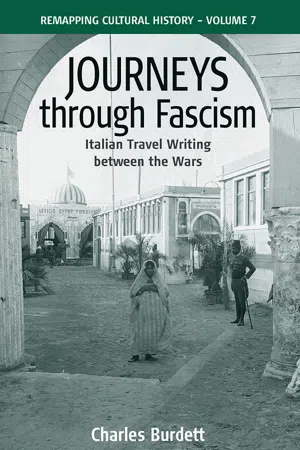
During the twenty years of Mussolini's rule a huge number of travel texts were written of journeys made during the interwar period to the sacred sites of Fascist Italy, Mussolini's newly conquered African empire, Spain during the Civil War, Nazi Germany, Communist Russia and the America of the New Deal. Examining these observations by writers and journalists, the author throws new light on the evolving ideology of Fascism, how it was experienced and propagated by prominent figures of the time; how the regime created a utopian vision of the Roman past and the imperial future; and how it interpreted the attractions and dangers of other totalitarian cultures.
The book helps gain a better understanding of the evolving concepts of imperialism, which were at the heart of Italian Fascism, and thus shows that travel writing can offer an important contribution to historical analysis.
Frequently asked questions
- Essential is ideal for learners and professionals who enjoy exploring a wide range of subjects. Access the Essential Library with 800,000+ trusted titles and best-sellers across business, personal growth, and the humanities. Includes unlimited reading time and Standard Read Aloud voice.
- Complete: Perfect for advanced learners and researchers needing full, unrestricted access. Unlock 1.4M+ books across hundreds of subjects, including academic and specialized titles. The Complete Plan also includes advanced features like Premium Read Aloud and Research Assistant.
Please note we cannot support devices running on iOS 13 and Android 7 or earlier. Learn more about using the app.
Information
Table of contents
- Journeys through Fascism
- Contents
- List of Illustrations
- Acknowledgements
- Introduction
- Chapter 1. Signs of Roman Rule
- Chapter 2. Fascination and Hostility
- Chapter 3. The Other Spaces of Fascist Italy
- Chapter 4. Narratives of Settlement in Italian East Africa 1936–1941
- Chapter 5. Itineraries through Melodrama
- Chapter 6. Representing Rapprochement with Nazi Germany
- Chapter 7. Competing Models of Humanity
- Conclusion
- Index