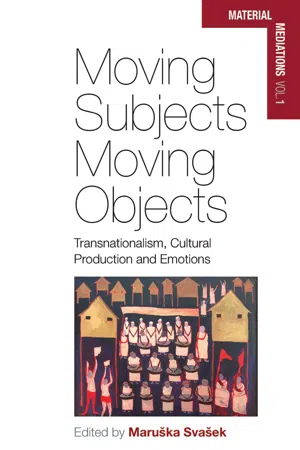
In recent years an increasing number of scholars have incorporated a focus on emotions in their theories of material culture, transnationalism and globalization, and this book aims to contribute to this field of inquiry. It examines how 'emotions' can be theorized, and serves as a useful analytical tool for understanding the interrelated mobility of humans, objects and images. Ethnographically rich, and theoretically grounded case studies offer new perspectives on the relations between migration, material culture and emotions. While some chapters address the many different ways in which migrants and migrant artists express their emotions through objects and images in transnational contexts, other chapters focus on how particular works of art, everyday objects and artefacts can evoke feelings specific to particular migrant groups and communities. Case studies also analyse how artists, academics and policy makers can stimulate positive interaction between migrants and non-migrant communities.
eBook - ePub
Moving Subjects, Moving Objects
Transnationalism, Cultural Production and Emotions
- 296 pages
- English
- ePUB (mobile friendly)
- Available on iOS & Android
eBook - ePub
About this book
Trusted by 375,005 students
Access to over 1.5 million titles for a fair monthly price.
Study more efficiently using our study tools.
Information
1
MATERIALITY, MEMORIES AND EMOTIONS:
A VIEW ON MIGRATION FROM A STREET IN SOUTH LONDON

Introduction
This chapter explores how memories and emotions evoked by mundane possessions such as photographs, furniture, music and clothing can illuminate ‘the complex forms of subjectivity and feeling that emerge through geographical mobility’ (Conradson and McKay 2007: 167; see also Rapport and Dawson 1998). I draw on recent approaches to materiality, which emphasize how sensation and emotion need to be thought about together as responses to objects (Dudley 2010; Edwards 2010), and use this approach to develop the study of migratory life histories that have become central to anthropological accounts of the complexity of migrant identities (Gardner 2002; Chamberlain and Leydesdorff 2004; Burrell 2006).
The data for this chapter are taken from an eighteen-month long ethnographic study of loss and change among eighty households on a street in South London, carried out in collaboration with Daniel Miller (Miller and Parrott 2007; Parrott 2007; Miller 2008). A street of terraced houses was selected that led between two high streets with differing class and ethnic characters. Individuals and households were invited to participate through a process of door-to-door recruitment, with 90 per cent agreeing to participate once the project was explained. This was complemented by weekly attendance at the church and pub, and my sublet of a bedroom in a shared house, which enabled me to live on the street for three months. Of the people from the eighty households who agreed to participate, less than a third had grown up in London, over a third had migrated from within the UK and a further third had moved internationally. In addition, one needs to also consider migration in previous generations, visiting patterns and second or family homes in other countries: elderly Caribbean and Irish migrants, resident for thirty years or more, were some of the most ‘local’ residents. A quarter of younger participants had moved off the street a year after fieldwork was completed suggesting that mobility in the job and housing market was the majority rule (Cameron 1998).
From the perspective of the researcher entering the different houses on this street, simple definitions of migration, return, community, transience and localism broke down. What emerged from this street-based ethnography was a sense of the impact and experience of international mobility, transnationalism and migration. Mobility did not merely influence peoples’ relationships to objects; this sense of movement was experienced bodily and conceptually through my interactions with people, their things and their itineraries. As Hastrup says of her work with Arctic peoples, ‘Itineraries make people; they emerge along the way of their dwellings’ (Hastrup 2010: 197).
The emotions have been marginalized in fieldwork, yet attention to the interlocutory nature of emotions in fieldwork may provide sources of insight and critical reflection (Davies 2010). Engaging with peoples’ domestic objects and the memories and stories associated with those things did not immerse me more strongly in the space of the street, it made me more aware that the spatial parameters of peoples’ social life were to be found as part of composite worlds. These dialogues with people about their things variously left me with a sense of peoples’ feelings of possibility, disjuncture and contradiction. It is these three aspects of participants’ responses to their possessions and their experience of mobility that I focus on in this chapter. Such feelings emerged from what Hastrup has described as the structuring of peoples’ ‘emotional topographies’ (Hastrup 2010: 197).
My sense of the street as a place, generated through fieldwork relationships with over a hundred people living so close together, diverged more and more completely from most of my participants own sense or indeed my own experience of living elsewhere in London. Elsewhere I rarely knew more than a few neighbours. In this respect, immersion did not lead to integration but generated a peculiar vantage point from which to grasp a small part of the entity ‘London’, and its mix of inhabitants often taken as evidence of its growing character (Wallman 1984; Hall 2000; Reed 2008). Moving between households led me to move between accounts of migratory trends – such as post-war Southern European and Commonwealth migration, recent Australasian professional migration or high gay mobility – which I note in this chapter to help illuminate the lives of those living in this small part of South London over the course of the field research.
Meaning, Feeling and Sensation
Leavitt has argued that what Western social scientists call emotions, and what tends to be ‘recognized’ as emotions in other cultures, consists of ‘experiences that involve both meaning and feeling, both mind and body, and that therefore cross-cut divisions that continue to mark theoretical thought’ (Leavitt 1996: 516). Leavitt acknowledged that the experience and expression of emotion does not always take place in explicit categories and vocabularies, as work on the cultural explication of emotion concepts has sometimes implied (e.g., Lutz and White 1986). As Edwards suggests, this less linguistically orientated approach offers a useful starting point from which to examine the emotional impact of objects (Edwards 2010).
Accounts of sensory perception, experienced as part of encounters with objects and places, parallel this discussion of the interlocutory nature of emotions (see Pink 2009). Dudley, in her account of museum objects, emphasizes that emotion, affect, memory and sensation are all part of the experience of objects (Dudley 2010: 8). Edwards, drawing on Leavitt’s work, argues that sensation and emotion, feeling as well as meaning, need to be thought about together when exploring the role of photographs in museums (Edwards 2010). Following these authors, the domestic keepsakes and photographs described in this chapter are approached as part of what Leavitt calls ‘recurrent situations intended to call forth certain meaning/feeling responses we recognize as emotions’ (Leavitt 1996: 524). Objects and their sensory character are involved in the transaction of feelings and emotions with others. This includes fieldwork encounters. By making these exchanges explicit, these can be read as more than the ‘naive’ description of the emotional (and sensory impacts) of objects on others, or the projection of the authors’ responses (ibid.: 518).
This work on bridging the division of meaning and feeling, emotion and sensation, would suggest that it is not enough to theorize artefacts as ‘carriers’ of personal or collective significance, identity markers that offer the possibility of objectifying a stable self in the face of destabilizing movement (e.g., Mehta and Belk 1991; Belk 1992; Parkin 1999). The advantage of a more developed material-culture approach should be that the contradictions of gain and loss, dissolving, retaining and gaining of affective ties and emotional states are evident in the experience and encounters with objects through which they are differentially expressed.
Possibility
One of the dimensions commented upon in accounts of migrant experience is the sense of possibility that movement has the potential to grant, whether by learning new things (Bravo-Moreno 2006), or in the expectation of new modes of feeling and being relating to the encounter with new lifestyles and the transformation of kin relations that accompanies geographical separation (Conradson and Latham 2007). Although it was part of many people’s experience of moving to London, these feelings were emphasized among the skilled, young Antipodean and gay migrants of diverse backgrounds who participated in the research in their relationships to their possessions. It was most extreme when these two identities converged. The fieldwork area was known for its gay community fostered through migration (Kelley, Peabody and Scott 1996), and as one of the various locations favored by Antipodean migrants (Conradson and Latham 2007), but it was nevertheless the case that those scattered among the street’s households rarely knew of each other’s existence.
James, who was renting a room in a friend’s house, had moved to London from Christchurch, New Zealand, when he was twenty-one years old. He was anticipating his return when we met. James made sense of the reasons for his move almost entirely through the feeling of personal transformation that he sought to retain, in part, through mementos of his experience. His tone of voice was soft but forceful when he said he wanted to talk about what he would take with him, not what he had brought from New Zealand:
As much as I can fit in! You’re better off asking me about what I would take with me here in England and not about New Zealand. This is where my life began as far as I’m concerned, in England not New Zealand. So everything I can fit in I will.
He emphasized how he would keep objects which were not usually classified as items of emotional attachment, such as a chequebook. Having only ever perceived my chequebook as a financial instrument, I looked afresh at James’s, whose crisp pages and black printed name and bank address seemed, under his touch and vision, part of a pattern of experience and memory of where ‘life began’.
James described his home town as ‘too small’. He valued these beginnings as the point of transformation. His relationship to the things he had gathered during his time in London had much in common with Conradson and Latham’s study of the practice of young New Zealanders and other Antipodean transnationals who spent time in Britain during their twenties and thirties to seek out a sense of energy, happiness and experiential attractions they associated with London (Conradson and Latham 2007). James’s experience also involved changes in how he saw himself and how others responded to him as a gay man. Finding some measure of geographical distance helped him renegotiate the terms of his relationships with family and friends in his hometown.
Manalansan (2005) emphasizes the importance of accessing quotidian gay migrant experience in his writing on aspects such as dress and apartment interiors among Philippine gay migrants in New York. Similarly, a focus on mobile possessions not only gives insight into the dynamics of these affective attachments but also the shape that future modes of remembrance will take (see Marcoux 2001). James sought ways to make his experiences in London last through things that materialized his intention to remember. Some things were also display objects, such as ornaments and photographs. By displaying and talking, with words and the sound of emotions, gestures of pride and worldliness, James may have anticipated that he could use these ‘objects incarnating remembrance and feeling’ on his return in ‘the exchange of sensory memories and emotions’ with others (Seremetakis 1996: 37).
James’s expectation of return to a New Zealand lifestyle – ‘going to the beach’, ‘space’ and opening his own hairdressing salon – allows him to reorientate his belongings and his feelings to the respective places with the sense that it is the right time to go back. As Conradson and Latham comment, the degree of possibility of self-invention and cosmopolitanism is also linked to the relatively short-term nature of most Australasian sojourns (Conradson and Latham 2007: 238). James contrasts himself with his sister, whose stay was made more permanent by marriage and having children with a man she met in the UK, and relates this to her sentimentality towards goods sent over from New Zealand:
I think she doesn’t particularly like it here. I want to go now too. But she’s got kids. She’s trapped here. She has a lot of stuff from New Zealand sent over from the parents and grandparents but I’m not sentimental like that.
James’s experience may be briefly compared with interviews with other gay male migrants. Craig, for example, illustrated how a pattern of continual movement and accompanying divestment and ordering of one’s things can become central to a person’s lifestyle. Over the last ten years he has regularly moved between Europe – mainly London, where he rents a room in a friend’s flat – and various parts of Australia. Movement seemed to provide Craig with a catalyst for a degree of self-invention and a selective return or search for new forms of authenticity. Facilitated by his dual citizenship – he has an English father and an Australian Aboriginal mother – he oscillated between the lifestyle of London, including its permissive gay scene, and his work with remote Aboriginal communities.
The weight of Craig’s possessions connected his freedom to move and his commitment to remain mobile with the sensory character of his possessions. Every object was assessed; every unnecessary part was jettisoned. With music, first the CDs were separated from their cases and covers, the CDs themselves were given away as he digitized the collection: ‘Whoosh, out they go!’ He aimed to minimize his accumulation in every way: ‘All the time, I’m constantly – why do I need this? Is it important to the future?’ Craig gave away his father and grandmother’s ‘heavy’ furniture and decorative objects but continuously archived his digital photographs, documents and e-mails, just as he cared for his mother’s family archives, a process that selectively linked the different facets of his personal and family history.
For Jean-Pierre and Ian, one of three gay couples who participated in the research, the sense of possibility and new modes of feeling and being was found through their relationship with each other, as much as with their respective mobility. James grew up in Manchester with his evangelist mother and Jean-Pierre, of French origin, grew up in the Ivory Coast. Their case illustrates how the exchange of sensory memories and emotions associated with music can be part of the establishment of shared origins or destiny.
The process of establishing a shared story of a relationship is an important part of couple formation (Halbwachs 1992; Parrott 2007). Part of their story was the sound of the music of Manchester in the late 1980s, involving bands such as New Order. They took great pleasure in describing how, while Ian was working as a teenager at the bar at the Hacienda (the club at the centre of the music movement in Manchester), Jean Pierre was ‘dancing to the same music on the beach’. The mass-produced and distributed nature of this music helped shape its impact as a shared memory that reached back into the past to give their relationship a unique or pre-ordained path and commitment opposed to the quality of an everyday random encounter free from emotional obligations (see Shokeid 2007). Each seemed to draw a different kind of embodied authenticity from this, bringing it to the relationship: Jean Pierre a sense of cosmopolitanism; Ian his first-hand experience of the metropolis and its permissive scene.
It is not always the case that the meaning and emotional effects of objects may be as controlled as the previous examples of migration and mobility as a route into new forms of selfhood, including the selective appropriation of personal or shared origins, imply. As I discuss in the following section, things may come to provoke acute feelings concerning the difference between one’s ideal and one’s actual situation (Parrott 2005).
Disjuncture
For some migrants who participated in the study, possessions brought with them to bring comfort become the site of the experience of disjuncture in their new surroundings. This was particularly so for Mai, a graduate from Singapore, who we met soon after she moved to a flat on the street with her English boyfriend. They had met in Singapore where many Britons migrate for short-term work opportunities and lived together for two years, but Mai’s partner became homesick and took a job in London and Mai enrolled on an MA. It was possible to obtain a student visa but this position only provided Mai with a temporary measure of security and she was uncertain about the future.
Mai found her circumstances isolating. Those who attended her course lived in different parts of London and she found it frustrating that those who she heard speaking Malay or Mandarin on the street would not reply to her when she tried to talk to them there. In contrast, most of Mai’s possessions that she brought with her were associated with her sociability. Yet in these circumstances, these things doubly draw attention to feelings of strangeness, loneliness and isolation. It is not only their memories and associations that provoke an emotive response but even their material and sensory character felt out of place. For example, she brought clothes and dresses with her that she would wear to go out with her friends in Singapore. She recall...
Table of contents
- Cover Page
- Title Page
- Copyright Page
- Contents
- List of Figures
- Acknowledgements
- Introduction Affective Moves: Transit, Transition and Transformation
- 1. Materiality, Memories and Emotions: A View on Migration from a Street in South London
- 2 The Objects of Christmas: The Politics of Festive Materiality in the Lives of Polish Immigrants
- 3 From Shop to Chapel: The Changing Emotional Efficacy of the Statue of the Virgin Mary of El Rocío within a Spanish Community in Belgium
- 4 Sweater Business: Commodity Exchange and the Mediation of Agency in the Tibetan Itinerant Sweater Trade in India
- 5 Moving Tamils, Moving Amulets: Creating Self-identity, Belonging and Emotional Well-being
- 6 The Price of Progress: ‘Dying Arts’ among the Karen of the Andaman Islands, India
- 7 Artefacts as Mediators through Time and Space: The Reproduction of Roots in the Diaspora of Lussignani
- 8 Making Connections: Biography, Art, Affect and Politics
- 9 Crossing Borders: Migration, Memory and the Artist’s Book
- 10 The Emotions and Ethnicity in the Indo-Caribbean
- 11 ‘What You Perceive Is What You Conceive’. Evaluating Subjects and Objects through Emotions
- Notes on Contributors
- Index
Frequently asked questions
Yes, you can cancel anytime from the Subscription tab in your account settings on the Perlego website. Your subscription will stay active until the end of your current billing period. Learn how to cancel your subscription
No, books cannot be downloaded as external files, such as PDFs, for use outside of Perlego. However, you can download books within the Perlego app for offline reading on mobile or tablet. Learn how to download books offline
Perlego offers two plans: Essential and Complete
- Essential is ideal for learners and professionals who enjoy exploring a wide range of subjects. Access the Essential Library with 800,000+ trusted titles and best-sellers across business, personal growth, and the humanities. Includes unlimited reading time and Standard Read Aloud voice.
- Complete: Perfect for advanced learners and researchers needing full, unrestricted access. Unlock 1.5M+ books across hundreds of subjects, including academic and specialized titles. The Complete Plan also includes advanced features like Premium Read Aloud and Research Assistant.
We are an online textbook subscription service, where you can get access to an entire online library for less than the price of a single book per month. With over 1.5 million books across 990+ topics, we’ve got you covered! Learn about our mission
Look out for the read-aloud symbol on your next book to see if you can listen to it. The read-aloud tool reads text aloud for you, highlighting the text as it is being read. You can pause it, speed it up and slow it down. Learn more about Read Aloud
Yes! You can use the Perlego app on both iOS and Android devices to read anytime, anywhere — even offline. Perfect for commutes or when you’re on the go.
Please note we cannot support devices running on iOS 13 and Android 7 or earlier. Learn more about using the app
Please note we cannot support devices running on iOS 13 and Android 7 or earlier. Learn more about using the app
Yes, you can access Moving Subjects, Moving Objects by Maruška Svašek in PDF and/or ePUB format, as well as other popular books in Social Sciences & Social History. We have over 1.5 million books available in our catalogue for you to explore.