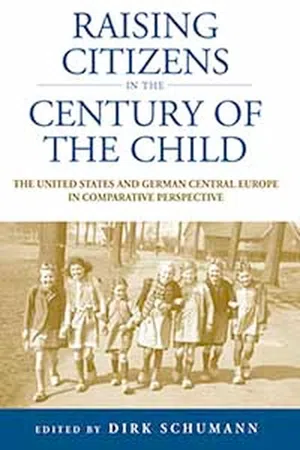
The 20th century, declared at its start to be the "Century of the Child" by Swedish author Ellen Key, saw an unprecedented expansion of state activity in and expert knowledge on child-rearing on both sides of the Atlantic. Children were seen as a crucial national resource whose care could not be left to families alone. However, the exact scope and degree of state intervention and expert influence as well as the rights and roles of mothers and fathers remained subjects of heated debates throughout the century. While there is a growing scholarly interest in the history of childhood, research in the field remains focused on national narratives. This volume compares the impact of state intervention and expert influence on theories and practices of raising children in the U.S. and German Central Europe. In particular, the contributors focus on institutions such as kindergartens and schools where the private and the public spheres intersected, on notions of "race" and "ethnicity," "normality" and "deviance," and on the impact of wars and changes in political regimes.
eBook - ePub
Raising Citizens in the 'Century of the Child'
The United States and German Central Europe in Comparative Perspective
- 280 pages
- English
- ePUB (mobile friendly)
- Available on iOS & Android
eBook - ePub
Raising Citizens in the 'Century of the Child'
The United States and German Central Europe in Comparative Perspective
About this book
Trusted by 375,005 students
Access to over 1.5 million titles for a fair monthly price.
Study more efficiently using our study tools.
Information
Part I
FOUNDATIONS

Chapter 1
CHILDREN AND THE NATIONAL INTEREST
Sonya Michel, with Eszter Varsa
As the title of this volume suggests, child-rearing in the twentieth century was not the exclusive province of parents: when it came to raising citizens, states were likely to become involved. This was certainly true in the cases discussed in the essays that follow. But this observation also prompts a question about timing: was the nationalization of child-rearing in the US and Europe strictly a twentieth-century phenomenon? Not entirely, in our view. This chapter argues that concerns about the relationship between children and the “national interest” are as old as nations themselves. During the “long nineteenth century,” which saw the rise of the modern nations of the West, those concerns came well to the fore. Notably, however, they were less prominent in parts of German Central Europe where nation-states had not yet fully formed.1 Thus a comparison between the United States and Western Europe, on the one hand, and German Central Europe on the other, throws into relief the degree to which children and nationalism became mutually imbricated, and the ways in which the focus on children served to strengthen nations, and vice-versa.
Nations expressed their interest in children in a variety of ways. Historians have readily linked the rise of public schools with the growth of nations,2 but they have been less likely to see child welfare policy in the same light. Instead, many contend, shifting approaches to child welfare policy were driven by “internalist” forces—the identification of specific problems, the proliferation of knowledges, the visions and values of reformers, and the professionalization of social services; or by local conditions—a focus on poverty, illness, illegitimacy, crime, or delinquency. Since Anna Davin published her pathbreaking article “Imperialism and Motherhood” in 1978, however, historians have also understood the importance of national interest in reproducing workers, soldiers, and managers of empires; increasing populations and/or improving their quality; and encouraging or discouraging the growth of particular racial, class, religious, or ethnic groups. “Healthier babies,” Davin wrote, “were required not only for the maintenance of [the British] empire but also for production under the changing conditions made necessary by imperialist competition.”3 Over the course of the long nineteenth century, as she and others have documented in Britain and elsewhere, such imperatives led to greater surveillance of families, the erosion or blurring of presumed boundaries between “public” and “private,” and a weakening of parental rights, producing ideologies, policies and practices that affected parents as well as children and “fused” child health and welfare “with the broader political health of the nation.”4
Adding child welfare policy to education meant that reformers could refine their methods and attempt to mold children as citizens of a specific nation.5 During the first half of the nineteenth century, the two approaches were often combined in institutions such as boarding schools, orphanages, and houses of refuge, which, according to their promoters, had the advantage of separating children from “unwholesome” parents and environments and thus afforded more latitude for achieving national goals. By the last quarter of the century, however, reformers were turning from institutional toward more individualized—and more invasive—approaches that positioned professionals as authorities in relation to the families they were pledged to preserve.6
In the first decades of the twentieth century, as discourses shifted to incorporate the terminology of the new social and behavioral sciences, the national interest remained central, gaining fresh energy from the eugenics movements emerging throughout Europe and the United States.7 The embrace of eugenics was but one of many parallels in education and child welfare policy across societies. These were not coincidental, but nor were they the result of some sort of inevitable convergence of the forces of modernization. Rather, they emerged from robust international conversations among reformers and professionals that not only served to convey information but produced standards that could serve as useful tools in national debates over policy.8
Such developments were inherently political and must be analyzed as such.9 This is not to say that internalist factors had no impact on conceptions of childhood and trends in child welfare policy; reformers were also interested in creating a nurturing environment for children and in helping them to develop themselves. Rather, these goals frequently became bound up with national and, increasingly, transnational interests that not only shaped views of specific groups of children and skewed welfare policies in certain directions but lent force to demands for greater resources for and state control over children and families. As reformers and politicians across societies asserted that the future of nations lay in children, they came to be viewed as “national assets,” a site of “national investment.”10 The linkage between children and the national interest became productive: of “truths” about children;11 of institutions, bureaucracies and apparatuses; and ultimately of nations themselves. While national interest alone may not have directly shaped reforms or specified their content, it is probably safe to say that major reforms were unlikely to be undertaken if they were perceived as inimical to the national interest. At the same time, in the absence of a strongly articulated national interest (as in much of nineteenth-century Central and Eastern Europe), child welfare and education were likely to develop much more slowly, remaining privatized, often under religious rather than secular auspices.12
Reforms dealing with children held particular importance for women, changing the meaning of motherhood and turning “private family responsibilities into political and social concerns.”13 Historians debate whether this shift to “maternalism” actually increased women’s political power. Ann Taylor Allen, for example, finds that it had mixed results: “Maternal roles in the family, though in one sense limiting women’s possibilities, in another sense provided a model of empowerment and ethical autonomy.”14 While some scholars argue that women played a major role in shaping social policy across Europe and North America,15 others contend that it was male politicians and officials who ultimately set the public agenda and held the purse strings, more often working through, rather than with, women.16 This does not mean that maternalism had no impact on social policy; to the contrary, maternalists often self-consciously tacked to catch the winds of nationalism in their institutional and ideological sails. But nationalism could turn into the doldrums for maternalists who disagreed with its aims.
This chapter examines the relationship between children and the national interest during the nineteenth century in the United States and the countries of German Central Europe. We also discuss more briefly Britain, France, Romania, and the Soviet Union. While this broad range somewhat exceeds the focus of the present volume, the inclusion of the additional cases allows us both to document more fully the pervasiveness of certain patterns and draw attention to continuities and connections across societies. Though this chapter lacks the rich archival texture of those that follow, it is intended to sketch the historical background for the developments that they document.
New Citizens for a New Nation
For Americans, most historians would agree, the focus on children dates back to the very birth of the nation: indeed, the colonists’ revolt against the British was closely related to their revolt against stringent Calvinist precepts of child-rearing. Throughout the colonial period Americans used Lockean discourses to challenge the authority of not only actual fathers but their political “father,” George III. Soon after the Revolution, however, a search for order, coupled with anxieties sparked by the French Revolution and a rapid rise in immigration, led to a familial counterrevolution, with reformers and cultural leaders seeking ways to restore parental authority over children.17
The counterrevolution lasted at least as long as the initial revolt, and although much of its emphasis was on the mother’s—rather than the father’s—role in child-rearing, its tone was anything but Lockean. To take just one example, the popular author Lydia Sigourney, in her 1838 book Letters to Mothers, expressed her anxiety about “the influx of untutored foreigners” to the US and instructed American women as follows:
Obedience in families, respect to magistrates, and love of country, should … be inculcated with increased energy by those who have earliest access to the mind …. Let [the mother] come forth with vigour and vigilance, at the call of her country … like the mother of Washington, feeling that the first lesson to every incipient ruler should be, “how to obey.”18
Sigourney’s emphasis on obedience was part of her more general insistence that women had a key role to play in producing good citizens. “A barrier to the torrent of corruption, and a guard over the strongholds of knowledge and of virtue, may be placed by the mother, as she watches over her cradled son … The degree of her diligence in preparing her children to be good subjects of a just government, will be the true measure of her patriotism.”19
Sigourney was but one of a long line of commentators and civic leaders who produced what historian Linda Kerber has called the discourse of “republican motherhood,” one that linked mothering directly to the political health of the new nation and imbued women’s domestic labors with a significance that extended well beyond the home.20 This discourse, self-consciously reflective of Rousseau, expressed Americans’ more general understanding of the connection between families and the health of the polity, which came into sharper focus after the Revolution. Whether the well-ordered family was seen as the wellspring of good citizenship, as in Sigourney, or a model, either literal or metaphorical, of a good society, American elites regarded it as an essential component of the new political order.21
The centerpiece of these model families was, of course, the children—children who would soon take their place in the new nation. From the outset, their futures were both raced and gendered, since the Constitution and the laws of the land barred enslaved African Americans from citizenship and strictly delimited white women’s rights. The discourse of republican motherhood assumed that white male children would become rational, self-sufficient adults who could shoulder the responsibilities of participating in a democratic polity, while white female children would grow up to become the kind of mothers who could reproduce good male citizens. The futures of African American and Native American children were not considered.
While the discourse of republican motherhood was implicitly addressed to mothers of the middling and elite classes, another, very different, set of public discourses focused on parents and children of the popular classes, namely, those of poverty relief. From the early nineteenth century on, the numbers and visibility of Americans who were “living poor” grew,22 and with them public attention to the issue. Poverty troubled civic leaders less because of the suffering it caused than because it rendered citizens—men, that is—economically dependent and therefore incapable of carrying out impartially the responsibilities of political participation.23 Thus relief was aimed at preventing the poor (especially able-bodied men) from becoming paupers (permanently dependent on the public purse), lest they lose their economic self-sufficiency, which, for the early nationalists, was closely bound up with political autonomy. In keeping with this goal, reformers believed that it was essential to reach children early, in order to put them “on the right path” toward sobriety and self-discipline by training them to make a living (if they were boys) or to support themselves and maintain their respectability until mar...
Table of contents
- Cover
- Title
- Copyright
- Contents
- List of Figures
- Introduction: Child-Rearing and Citizenship in the Twentieth Century
- Part I. Foundations
- Part II. New Beginnings
- Part III. Redefining Parents’ Roles
- Part IV. Parental Rights and State Demands
- Select Bibliography
- Contributors
- Index
Frequently asked questions
Yes, you can cancel anytime from the Subscription tab in your account settings on the Perlego website. Your subscription will stay active until the end of your current billing period. Learn how to cancel your subscription
No, books cannot be downloaded as external files, such as PDFs, for use outside of Perlego. However, you can download books within the Perlego app for offline reading on mobile or tablet. Learn how to download books offline
Perlego offers two plans: Essential and Complete
- Essential is ideal for learners and professionals who enjoy exploring a wide range of subjects. Access the Essential Library with 800,000+ trusted titles and best-sellers across business, personal growth, and the humanities. Includes unlimited reading time and Standard Read Aloud voice.
- Complete: Perfect for advanced learners and researchers needing full, unrestricted access. Unlock 1.5M+ books across hundreds of subjects, including academic and specialized titles. The Complete Plan also includes advanced features like Premium Read Aloud and Research Assistant.
We are an online textbook subscription service, where you can get access to an entire online library for less than the price of a single book per month. With over 1.5 million books across 990+ topics, we’ve got you covered! Learn about our mission
Look out for the read-aloud symbol on your next book to see if you can listen to it. The read-aloud tool reads text aloud for you, highlighting the text as it is being read. You can pause it, speed it up and slow it down. Learn more about Read Aloud
Yes! You can use the Perlego app on both iOS and Android devices to read anytime, anywhere — even offline. Perfect for commutes or when you’re on the go.
Please note we cannot support devices running on iOS 13 and Android 7 or earlier. Learn more about using the app
Please note we cannot support devices running on iOS 13 and Android 7 or earlier. Learn more about using the app
Yes, you can access Raising Citizens in the 'Century of the Child' by Dirk Schumann in PDF and/or ePUB format, as well as other popular books in History & 20th Century History. We have over 1.5 million books available in our catalogue for you to explore.