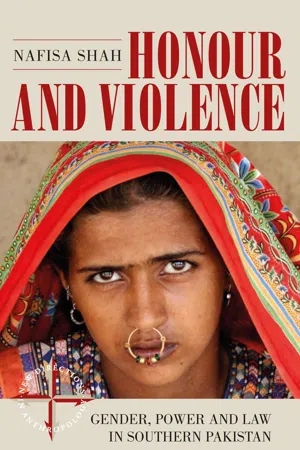
The practice of karo kari allows family, especially fathers, brothers and sons, to take the lives of their daughters, sisters and mothers if they are accused of adultery. This volume examines the central position of karo kari in the social, political and juridical structures in Upper Sindh, Pakistan. Drawing connections between local contests over marriage and resources, Nafisa Shah unearths deep historical processes and power relations. In particular, she explores how the state justice system and informal mediations inform each other in state responses to karo kari, and how modern law is implicated in this seemingly ancient cultural practice.
- 302 pages
- English
- ePUB (mobile friendly)
- Available on iOS & Android
eBook - ePub
About this book
Trusted by 375,005 students
Access to over 1.5 million titles for a fair monthly price.
Study more efficiently using our study tools.
Information
PART I
A FRONTIER OF HONOUR VIOLENCE

THE PROBLEM OF KARO KARI IN UPPER SINDH
Chapter 1
GHAIRAT, KARO KARI AND THE SPECTACLES OF VIOLENCE
HOW MEN AND WOMEN BECOME BLACK
Karo kari is an old custom. I don’t know who invented it.
– Sardar Lutuf Ulro1
What do they mean when they say kari ? Who is a kari? What is that anyway?
– Dr Naila2
In Upper Sindh, not a single day passes without reports of the killing of a woman or a man under the ostensible karo kari slogan, implying that those concerned were sexual transgressors. On average, approximately two hundred cases arise every year, and the police records for the ten years from 1995 to 2004 show 1,482 cases registered, with deaths totalling more than 1,600, roughly two-thirds of them of women. Generally speaking, more cases are reported in the northern districts of Upper Sindh, with the highest number reported from the northernmost district of Jacobabad, followed by Larkano, Shikarpur, Ghotki, and lastly Sukkur and Khairpur (see the data in Chapter 3). There are geographical variations within districts as well, with kacho areas having a higher rate of violence than urban areas. Although honour violence takes place all over Pakistan, the scale of violence in Upper Sindh is much higher, to the extent that karo kari has now become a generic name for all honour killings in Pakistan.
Karo kari is defined as a riwaj or rasam, translated as custom or tradition, of Upper Sindh. People describe it as a ‘spillover’ of the Baloch custom of siyahkari (which also means ‘being black’). Although it is considered to be ‘originally’ a part of the Baloch honour system, it also takes place widely among the Samatr, who are considered native to Sindh. Professionals, students, politicians and even tribal chiefs admit that this custom is used for objectives other than honour revenge. Is karo kari a timeless custom, or have other factors given this phenomenon its frequency and form? In order to approach this question, I will look at karo kari through both discourses and practices in contemporary Upper Sindh.
This chapter introduces the phenomenon of karo kari as it happens in everyday life in Upper Sindh, describing local economic relations and social ideologies that shape social relations. I show how karo kari is practised, experienced, ritualized, and communicated in Upper Sindh. The representation of karo kari in the media is also examined, as it makes this form of violence a mass spectacle, an experience circulated far beyond the villages where it takes place.
The key ideas in Upper Sindh that invest karo kari with moral power and social sanction are ghairat, the local honour ideology, and avezo, the ideology of exchange and equivalence in marriage and material goods. The practice of honour violence may be persistent historically, but I show here that karo kari is embedded in present-day social life and may hence be understood as a dynamic cultural product within which contemporary social contests are played out as, for instance, marriage disputes, material incentives and vigilante actions to assert local power.3
Karo kari: Inscribing Blackness and Branding Bodies
We got the body in pieces.
– villagers after the murder of a young man as karo
It is better to chop off the rotten finger.
– a mother who had participated in her daughter’s killing
Karo kari is a complex system of sexual/social sanction that is considered a part of the moral ideology of honour – ghairat – a value that encompasses emotion, anger and even shame. In Upper Sindh, women signify ghairat, and honour is violated if they are perceived as having sexual relations with men other than their husbands. This practice is locally situated as a part of the local norms and practices, collectively called ra`juni. I have not, thus far, encountered any karo kari rhetoric within the Hindu community, although I have been told of Hindu shopkeepers who have been asked by Muslim accusers to pay fines in the Jacobabad area, but this is anecdotal.
All allegations of everyday adultery practices in different parts of Pakistan invoke the symbolism of the colour ‘black’ to label the adulterers (cf. Campbell 1964: 271). In the local understanding, black symbolizes sin and pollution. The local phrase ‘he has a black face’ is used of someone who is sinful and morally weak. In the same vein, saying that a person is black implies guilt. In older local forms of punishments, any violators of the local rules – thieves, adulterers, liars – would have their face blackened and sometimes be forced to ride a donkey down the street amidst jeering (see Burton 1877). As opposed to black, the symbolic colour for innocence is red, `garho. An accused man may claim his innocence by stating that he is in fact `garho, not karo.
To declare men and women karo and kari respectively is to signify their moral outcastness and punishment. The first step is to label men and women ‘black’, as if they were being branded. The colour symbolism of ‘black,’ even though metaphorical, works like an indelible mark, almost as if it were real, since it works to identify and separate the transgressors from the rest of society by marking them out as different. In addition, the communities also describe it as ‘branding’ and often call it ‘karhain jo tiko’ – the mark of blackness. Tiko has a dual implication. It means a tattoo or mark; hence, inscription and branding both become relevant terms here. However, tiko is also a primary decorative mark on a bride, not to be confused with the tiko as representing a polluted woman, the antithesis of the bride.
Having identified the transgressors through this tiko, the social world’s the next step is to sever them from society. This is achieved either by killing the couple together, if so found, which is the ideal form of riwaj; or, should either escape, then by taking the woman to a mediator or marrying her to someone in a far-off village, and banishing the man from the community. The second option is still the preferred and more commonly used one in Upper Sindh.
The killing or expelling of women takes place within the family in most cases, and the ones who carry out either of these two actions are usually the brothers, husband or father4 of the woman who is accused of sexual transgression.5 Bodily metaphors of pollution are used to describe black women, yet at the same time purifying metaphors seem to make karo kari a cleansing ritual. A woman who assisted in the slaughter of her childless daughter, when interviewed, justified her daughter’s death by saying ‘Kini an`gur kati bhalli’ – ‘it is better to chop off a rotten finger’, implying that the purity of the rest of the body is retained. When blackened women are thrown out of the community, it is said that ‘`bahan kadhi se’, ‘we took our arm out’, where the ‘arm’ is a metaphor for the woman. Those who collude in the violence refer to the incident as if they were dismembering or amputating parts of their own body, the body being a metaphor for the family. In this way, the accused are first branded, then separated, and lastly objectified. This allows relatives to show alienation and a lack of attachment to the person concerned.
The public declaration that someone is a kari or a karo also gives the accuser the moral power and authority to inflict violence, and no resistance is theoretically encountered against any action taken. The pronouncement of blackness may happen formally in a meeting of village elders where the entire community can consensually declare a man and a woman black, but it is more common for the husband, brother or father of a woman to declare her to be black in front of close kin. Such a pronouncement is enough for the community to know that the persons are guilty, and the sentence of killing is then anticipated. It may take a few hours, days or even weeks or months before a shot is heard in the dark, followed by the news that the sentence has been carried out, but the accusation is not inevitably followed by the act of killing, as there are several intervening mechanisms, as I will explain later.
Subsequent to the act of killing, these words are declared: ‘Kari!’ for women and ‘assanjo karo a!’, ‘he is our black man’. These are stated publicly as slogans, while any weapons – axes, guns or rifles – the killers may be carrying are displayed. The possessive in the term assanjo – ours – makes the black man defenceless, as he is now declared a culprit. These announcements are often loud enough for people in the public space to hear, almost as if the killers were creating a witnessing space to lend cultural legitimacy to their act of violence.
The karo kari act finds justification in the family or community, making it a collective act even when performed by an individual, and the method of eliciting support makes the execution an act that takes place in the public domain (Faqir 2001). For instance, the accused women lose their lives in a public place while washing clothes, working in the fields or fetching water. Men may be killed while watering their fields or going to court, work, and so on. This public articulation serves to build collective anger and instigate collective violence in a Durkheimian logic of reinforcing consensus by eliminating deviance.
Desecration of the body may be carried out during either the act of violence itself or the burial rituals. The earlier method of punishing adulterers was ‘to cut them up’ with sharp agricultural implements, usually axes or hatchets. Men and women caught in flagrante delicto would be locked up, community help sought and a collective execution carried out. Such a spectacle of violence is a public performance enacted to silence deviance or resistance for the benefit of the witnessing society, but such killings, as the elders say, have been indeed rare. More frequently, karo would be banished and kari would be taken out of the community through divorce and remarriage to a distant cousin residing in another village.
Similar spectacles of violence also occur today. One that I encountered was that of a Khokhar woman in Khairpur who was slaughtered by her relatives after she had been publicly dragged out of her house, beaten by several people, kicked down the street and trampled. ‘They continued to hit her even after she had died’, a woman councillor of the area recounted. She had returned to her husband after a formal separation endorsed by the community, so she was castigated as a ‘black woman’. Her husband was also beaten and left in critical condition.
In another instance, a young man was killed by three men and his body mutilated. The villagers described the details of the physical violence: ‘Three of them [accusers and killers] came while three hid in the bushes. The ones in the bush each carried a Kalashnikov, while another had a two-edged sword. They struck him, and he fell, they slashed him in several places, chopped off his arms and legs and finally severed his head. We got the body in pieces. Never in the memory of this village has such cruelty taken place’. Such a graphic account is impersonal and objective, as if the body and its parts were objects and distant from the self.
Though archaic agricultural implements are used as traditional instruments of revenge, the use of guns, rifles, pistols and Kalashnikovs is now more common. Perhaps the persistence of the former can be attributed to the fact that killing with these tools is less harshly punished, as there are stricter laws for inflicting death with modern especially automatic weapons.6 The police data from the districts (see Appendix IIIB) reveal that gunshot injuries account for the majority of karo kari deaths, followed by hatchet deaths, pistol deaths, strangulation and beating with sticks and canes.
There is an imaginative romanticizing of these events, and journalists, poets, and local tribesmen come up with emotive accounts spiced up with details that, though difficult to verify, are an intrinsic part of the way in which the practice is imagined. For instance, I have been told that women are first dressed as brides before they are killed, although in my entire time in the field I never came across such a case. I was also informed that the killer tells the accused to recite the kalima, the basic initiation rite of a Muslim, before he inflicts the final death blow. Interestingly, during the ritual sacrifices of animals, the person who slaughters them also recites the kalima. In some tribes, the Jatoi for example, I was told that women ‘prefer heroic deaths’ to rallhi ji maut – death of old age under the quilt – thus providing an alternate moral discourse for kari deaths as ‘heroic’ (cf. Pehrson 1966). In some narratives, I was informed that after the killing, the avenger drank sweet milk – mitho kheer – as he would then become cool, his honour having been avenged.
After the incident of physical violence, in which the community, family and society are largely complicit, there is a social silence about both the existence and nonexistence of the ostracized men and women. For instance, the case stories introduced in subsequent chapters concern women, and sometimes men, who have been branded as moral outcasts and banished from society. However, the difference between expulsion and death is ultimately both vague and irrelevant, as in either case black men and women are categorized as socially dead, and the knowledge of whether they lived or died is neither discussed nor admitted (cf. Boehm 1985). Often I noted that it was difficult to obtain any information from the local village once the incident had occurred, and that the social silence accompanying a karo kari death was often marked and impenetrable.
The above account is formalized and theoretical, providing a neat and stepwise description of the unfolding of karo kari. In daily life in Upper Sindh, there are deviations from these coherently narrated norms. For instance, men and women are seldom killed together. Women are killed and then later it is reported as a karo kari death, and in most cases the men are not killed, just fined. Often, women and men are casually accused of being black, but this is not followed up with any violence. In fact, the number and frequency of accusations is so widespread and casual that even a small domestic fight between two women c...
Table of contents
- Cover
- Title Page
- Copyright Page
- Dedication
- Contents
- List of Figures, Maps and Tables
- Preface
- Acknowledgements
- Note on Sindhi Language and Transliteration
- List of Abbreviations
- Introduction. Honour Violence, Law and Power in Upper Sindh
- PART I: A Frontier of Honour Violence: The Problem of Karo kari in Upper Sindh
- PART II: Honour, Moral Power and Law: Mirroring of Law in the Forms of Violence
- PART III: Normalizing Violence: The Everyday World of Upper Sindh
- Conclusion. Karyan Ja Kabrustan: The Imaginary Burial Grounds for Black Women
- Appendices
- Glossary
- Bibliography
- Index
Frequently asked questions
Yes, you can cancel anytime from the Subscription tab in your account settings on the Perlego website. Your subscription will stay active until the end of your current billing period. Learn how to cancel your subscription
No, books cannot be downloaded as external files, such as PDFs, for use outside of Perlego. However, you can download books within the Perlego app for offline reading on mobile or tablet. Learn how to download books offline
Perlego offers two plans: Essential and Complete
- Essential is ideal for learners and professionals who enjoy exploring a wide range of subjects. Access the Essential Library with 800,000+ trusted titles and best-sellers across business, personal growth, and the humanities. Includes unlimited reading time and Standard Read Aloud voice.
- Complete: Perfect for advanced learners and researchers needing full, unrestricted access. Unlock 1.5M+ books across hundreds of subjects, including academic and specialized titles. The Complete Plan also includes advanced features like Premium Read Aloud and Research Assistant.
We are an online textbook subscription service, where you can get access to an entire online library for less than the price of a single book per month. With over 1.5 million books across 990+ topics, we’ve got you covered! Learn about our mission
Look out for the read-aloud symbol on your next book to see if you can listen to it. The read-aloud tool reads text aloud for you, highlighting the text as it is being read. You can pause it, speed it up and slow it down. Learn more about Read Aloud
Yes! You can use the Perlego app on both iOS and Android devices to read anytime, anywhere — even offline. Perfect for commutes or when you’re on the go.
Please note we cannot support devices running on iOS 13 and Android 7 or earlier. Learn more about using the app
Please note we cannot support devices running on iOS 13 and Android 7 or earlier. Learn more about using the app
Yes, you can access Honour and Violence by Nafisa Shah in PDF and/or ePUB format, as well as other popular books in Social Sciences & Cultural & Social Anthropology. We have over 1.5 million books available in our catalogue for you to explore.