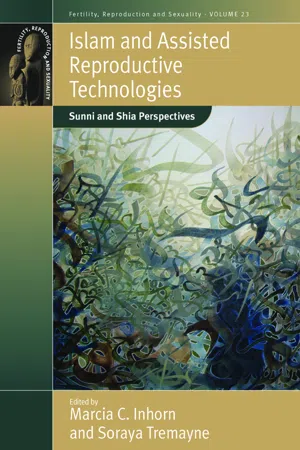
How and to what extent have Islamic legal scholars and Middle Eastern lawmakers, as well as Middle Eastern Muslim physicians and patients, grappled with the complex bioethical, legal, and social issues that are raised in the process of attempting to conceive life in the face of infertility? This path-breaking volume explores the influence of Islamic attitudes on Assisted Reproductive Technologies (ARTs) and reveals the variations in both the Islamic jurisprudence and the cultural responses to ARTs.
Trusted by 375,005 students
Access to over 1.5 million titles for a fair monthly price.
Let me begin this introduction to Islam and assisted reproductive technologies by looking somewhat generally at the way in which Islamic law deals with legal issues surrounding marriage and procreation. The guiding principle in almost all of the individual rules of sharia around such subjects as marriage, divorce, or inheritance is to allow a clear and unambiguous identification of a person’s father. Islamic family law is first of all patrilineal family law. If, as a student of Islamic law, one ever feels unsure as to which ruling applies to a certain case of family law, it is always a good guess to choose that one which creates the most certainty about the identity of the father. At any given time period, women are only allowed to have sex with one man, which is a rule that men are not bound to. Women must wait for as long as it takes to show the effects of a pregnancy before they can remarry, while men are not restricted by any waiting period. This strong sense of patrilineality is clearly a part of Islam and stood at times in contrast to the customary law of some pre-Islamic societies.
For some Islamic societies Islamization meant the transition from matrilineality to patrilineality. In certain West African countries, for instance, rulership passed along matrilineal lines, meaning it passes from a male ruler, not to his son, but to his nephew, i.e., the son of his sister. The reason for this was, of course, the uncertainty of any given father-son relationship in a premodern society without the possibility of DNA evidence. While there is always some element of uncertainty in the identity of one’s father, there can be hardly any uncertainty about who one’s mother is. Matrilineality establishes family rights along the biological relationship of a mother to her sons and daughters. We can think of a strong matrilineal society where one’s closest relatives are the mother and after her all the children she gave birth to, i.e., one’s siblings and possibly half-siblings, while the biological father has no established rights over his children.
In Islamic law that would be, of course, unthinkable. Given that we always know a person’s mother, there must be a certain order to her sexual relations that allows the establishment of who the father is. Like most legal systems in premodern Western countries, Islamic law chose the pattern of time frames. If the mother is married, all the children that she bears during marriage and during the nine months after a possible divorce are considered children of her husband, no matter what opinion one might have about the biological father. Given the natural limitations in any premodern society, classical Islamic law aims at creating an order that always allows the establishment of the identity of a single father, and this is what is meant by nasab. It is implied that this father by nasab need not be the biological father. It seems almost that in premodern sharia there is no concept of a biological father. A man could claim any children born by his married wives and his slaves as his own—even if he knew he was not the biological father.
This principle is valid for all four schools of law, and the Hanbalis of the thirteenth and fourteenth centuries make no exception. Thomas Eich, in his illuminating chapter on “Constructing Kinship in Sunni Islamic Legal Texts,” says that Ibn Taymiyya and Ibn Qayyim al-Jawziyya “went a step further and stated explicitly that a child born out of wedlock could be attached to his or her biological father if there was no firash, i.e., if the woman was neither married nor a slave who had been penetrated licitly.” Ibn Taymiyya’s and Ibn Qayyim’s “biological” criterion applies only to women who are not in a legal sexual relationship to a man. If they were, biology would again be overruled by the legal rights of their husband or, in the case of slaves, their owner. But what does “biological criterion” mean here? Ibn Taymiyya and Ibn Qayyim had no way of knowing with certainty who fathered the offspring of an unmarried woman. As far as I know, all four schools accept in such cases that the father or the mother, ideally both, identify the father—a system that does not necessarily lead to establishing the “biological” father.
Eich is right to point out that the Hanbalis of the thirteenth and fourteenth century do change the rules about incestuous relationships and consider biological father-daughter relationships where other schools would still apply the sometimes fictional husband-offspring relationship dictated by the law. It is unclear whether this has been triggered by an increasing awareness of biology. Rather, it may be due to the literalism of the Hanbali school, who take the words “your daughters” in the legal sources more seriously than the other schools.
Sandra Houot looks at the contemporary period, particularly at the rulings of the legal body connected to the Islamic World League and the Syrian jurist Muhammad Sa’id al-Buti (1929–), who is a Hanafi. Al-Buti brings in maslaha, an important legal category that, broadly speaking, did not exist before the eleventh century. While maslaha is not considered one of the four sources of Islamic law, it nevertheless assumes the role of a source of law after the twelfth and thirteenth centuries. In the modern period it becomes a very important source of law and is often seen as a vehicle for legal change. Creating offspring is one of the five “necessities” that, according to al-Ghazzali, maslaha must serve. However, it is unlikely that a consideration of maslaha would overrule other objections against, for instance, the use of sperm or egg donors. One should not forget that for Muslim jurists of the classical period, maslaha means to safeguard not the creation of any children, but only those who have sound nasab. Once we know with certainty that children are not in blood relationships with one of their parents, there is no sound nasab, and one can no longer invoke the principle of maslaha.
Farouk Mahmoud’s chapter brings up the question of the flexibility of Islamic law. Here, Sunni Islamic scholars tend to apply the strategy of staying clear from the fence: if there are doubts about the legality of a practice, better be on the safe side and declare it illicit. One should not forget that for believing Muslims the stakes are high: it is an eternity either spent in heaven or in hell. Thus, it is unlikely that Sunni Muslim scholars will easily come around to the point of view of their Shia counterparts, who have allowed third-party assisted conception. For one, Sunnis have always polemicized against the practice of mut’a (a fixed term contract of temporary marriage in Shia Islam) as legitimizing prostitution. Second, clarity about one’s nasab is an important principle in Islamic law that the jurists cannot easily throw overboard. One’s nasab, here the paternal lineage, is part and parcel of a Muslim’s identity. Declaring it inferior to the relationship one has to the person that takes care of one’s upbringing is not all that easy, neither for a society that has put so much stress on nasab, nor for the individuals who would be affected by such a change.
Chapter 1
CONSTRUCTING KINSHIP IN SUNNI ISLAMIC LEGAL TEXTS1
Thomas Eich
About 85 to 90 percent of the over 1 billion Muslims today are Sunnis, approximately 10 percent Shia and a small percentage followers of other denominations, with the Sunni-Shia divide going back to a religious-political schism during the first decades of Islamic history in the seventh century. Islamic law (sharia) has developed as a reflection on the correct application of rulings and principles laid down in a set of texts to a historically changing social and political reality. All Muslims agree that one of these texts is the Qur’an, which they believe to have been fixed during the seventh century as the text we know today. Sunnis and Shia differ considerably about the second textual source of Islamic law, which is the collection of authoritative statements and the recorded exemplary deeds of the Prophet and a group of other people of early Islamic history. Because of their differing assessments of the first decades of that history, the Sunnis and Shia differ as to who these other people are and who was a trustworthy transmitter of the words and deeds of the Prophet. The Sunnis accept especially pious contemporaries of Muhammad and several rulers who followed him as political leaders of the Muslim community after his death. The Shia view many from this group as nonexemplary and developed the so-called Imamate concept in which political authority and religious excellence were inherited through the line of descendants from the marriage between Muhammad’s daughter Fatima and his cousin ‘Alī b. Abī Óālib (d.661). These charismatic leaders were called imams. According to the concept of history of the largest Shia group there were twelve infallible imams, the twelfth imam being labeled as “hidden,” because he did not die but waits in a hidden place until the end of the world approaches. A decisive person in the development of Twelver Shia legal discourse was the sixth imam, Ja’far al-Sádiq (d.765), who collected many authoritative sayings. Because of the overarching importance of Ja’far al-Sádiq for Twelver Shia jurisprudence (fiqh), it is sometimes labeled as “the madhhab (legal school) of Ja’far” (for example, in Article Twelve o...
Table of contents
Cover Page
Title Page
Copyright Page
Contents
List of Figures
Acknowledgments
Glossary of Arabic, Persian, and Turkish Terms
Introduction: Islam and Assisted Reproductive Technologies
PART I Islamic Legal Thought and ARTs: Marriage, Morality, and Clinical Conundrums
PART II From Sperm Donation to Stem Cells: The Iranian ART Revolution
PART III Islamic Biopolitics and the “Modern” Nation-state: Comparative Case Studies of ART
Notes on Contributors
Index
Frequently asked questions
Yes, you can cancel anytime from the Subscription tab in your account settings on the Perlego website. Your subscription will stay active until the end of your current billing period. Learn how to cancel your subscription
No, books cannot be downloaded as external files, such as PDFs, for use outside of Perlego. However, you can download books within the Perlego app for offline reading on mobile or tablet. Learn how to download books offline
Perlego offers two plans: Essential and Complete
Essential is ideal for learners and professionals who enjoy exploring a wide range of subjects. Access the Essential Library with 800,000+ trusted titles and best-sellers across business, personal growth, and the humanities. Includes unlimited reading time and Standard Read Aloud voice.
Complete: Perfect for advanced learners and researchers needing full, unrestricted access. Unlock 1.5M+ books across hundreds of subjects, including academic and specialized titles. The Complete Plan also includes advanced features like Premium Read Aloud and Research Assistant.
Both plans are available with monthly, semester, or annual billing cycles.
We are an online textbook subscription service, where you can get access to an entire online library for less than the price of a single book per month. With over 1.5 million books across 990+ topics, we’ve got you covered! Learn about our mission
Look out for the read-aloud symbol on your next book to see if you can listen to it. The read-aloud tool reads text aloud for you, highlighting the text as it is being read. You can pause it, speed it up and slow it down. Learn more about Read Aloud
Yes! You can use the Perlego app on both iOS and Android devices to read anytime, anywhere — even offline. Perfect for commutes or when you’re on the go. Please note we cannot support devices running on iOS 13 and Android 7 or earlier. Learn more about using the app
Yes, you can access Islam and Assisted Reproductive Technologies by Marcia C. Inhorn, Soraya Tremayne, Marcia C. Inhorn,Soraya Tremayne in PDF and/or ePUB format, as well as other popular books in Medicine & Gynecology, Obstetrics & Midwifery. We have over 1.5 million books available in our catalogue for you to explore.