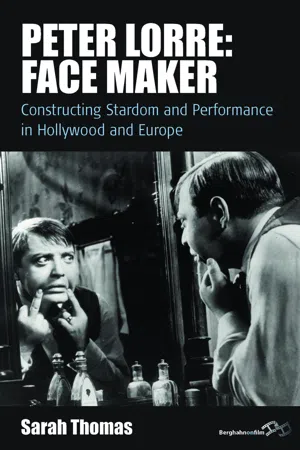
Peter Lorre described himself as merely a 'face maker'. His own negative attitude also characterizes traditional perspectives which position Lorre as a tragic figure within film history: the promising European artist reduced to a Hollywood gimmick, unable to escape the murderous image of his role in Fritz Lang's M. This book shows that the life of Peter Lorre cannot be reduced to a series of simplistic oppositions. It reveals that, despite the limitations of his macabre star image, Lorre's screen performances were highly ambitious, and the terms of his employment were rarely restrictive. Lorre's career was a complex negotiation between transnational identity, Hollywood filmmaking practices, the ownership of star images and the mechanics of screen performance.
eBook - ePub
Peter Lorre: Face Maker
Constructing Stardom and Performance in Hollywood and Europe
- 222 pages
- English
- ePUB (mobile friendly)
- Available on iOS & Android
eBook - ePub
About this book
Trusted by 375,005 students
Access to over 1.5 million titles for a fair monthly price.
Study more efficiently using our study tools.
Information
Chapter 1
LORRE AND THE EUROPEAN STAGE (1922–1931)

The initial part of this chapter will cover the non-cinematic aspects of Lorre's work, through his theatrical career (antecedent to his on-screen fame) in the experimental atmosphere of the theatres of central Europe throughout the 1920s and early 1930s, concentrating on the two figures of Bertolt Brecht and Jacob Levi Moreno – prior to the release of M (1931). An analysis of the developmental stages of Lorre's acting career and the potential recognition of a dominant non-naturalistic performative style preferred by the actor also enables a more balanced interpretation of his cinematic labour and experiences. The latter part of the chapter will then return to focus on film, momentarily disrupting the overall chronological structure of this book, in order to consider how Lorre's experiences in European theatre might be discerned within his American screen work, using The Beast with Five Fingers (1946): a performance which has variously been dismissed as unskilled, incoherent and repetitive in comparison to Lorre's more noted film appearances.
Appraisals of Lorre often underplay the value to be found in Hollywood performances such as the one in The Beast with Five Fingers. Instead, the performative value identified around Lorre is more firmly associated with products of European art traditions: expressionistic Weimar cinema such as M, and the German stage of the same period, especially productions associated with Bertolt Brecht. The figure of Brecht plays a major role when considering the performance history of Peter Lorre. It is relatively common to find references to Brecht within critical literature on Lorre, and there are two reasons for this underlying presence. Firstly, the two men had a close working relationship from 1929 onwards which culminated in a notorious production of Brecht's play Mann ist Mann (Man Equals Man) in 1931, and their friendship continued during their exile in Hollywood (until Brecht's return to Berlin in 1948) in spite of Brecht's apparent disdain for Lorre's American film work. Secondly, there is the significant place that Brecht occupies within twentieth-century culture and the depth of critical work devoted to examining his works and theories. Not only does the immense research conducted on Brecht's early works and his position as an exile reveal much about Lorre (by proxy), but the cultural legitimacy of Brecht as a subject also influences perceptions about Lorre as a potentially legitimate subject for serious scholarly study.
The two essays, Gerd Gemünden's ‘From “Mr M” to “Mr Murder”’ (2003) and Christopher McCullough's ‘Peter Lorre (and his friend Bert Brecht)’ (2004), both begin by invoking Brecht. In particular, they cite a poem written by Brecht and widely assumed to be about Lorre, entitled ‘Der Sumpf’ (The Swamp), in order to highlight the disparaging attitude of the playwright to Lorre's Hollywood work.1 Both works aim to legitimize studies of Lorre by revealing the inherent complexities to be found in his otherwise misunderstood Hollywood performances via Lorre's own established European theatrical heritage. This is achieved by identifying how experimental techniques that were associated with Brechtian practice, such as duality or alienation, were echoed in the way that Lorre worked in Hollywood, and suggesting how subsequent screen performances can be read as allegories of exile where political and social situations are revealed. In both instances, Brecht provides an appropriately scholarly framework with which to explore the career of the screen actor.
However, it is not useful or accurate to wholly reduce Lorre's career to a direct application of Brechtian theories. To demonstrate that Lorre's work with Brecht constituted just one aspect within a ten-year period of important theatrical experimentation which saw Lorre collaborate with other significant innovators and producers, as well as establish himself as a critically rated stage performer, I will highlight Lorre's main achievements and explore his professional relationship with a second figure – Jacob Levi Moreno. Moreno was a social psychiatrist whose work was founded upon the use of group-based dramatic reconstruction and who employed Lorre's services as an actor between 1922 and 1924; in other words, at least five years before the actor met Brecht.
Jacob Levi Moreno, the Stegreiftheater
and ‘Psychodrama’: 1922–1924
Jacob Levi Moreno (1889–1974) was a noted figure in twentieth-century social psychiatry, and was a pioneer of social psychological therapies and quantitative methodologies, including ‘psychodrama’, early forms of group psychotherapy, and ‘sociometry’. With the financial support of his younger brother, William, Moreno first began to practise his theories of psychodrama whilst living in Vienna in the late 1910s and early 1920s, observing both the aftermath of the First World War and the interactions of children in public groups. In 1925, his emigration to the United States gave him the opportunity to combine his own teaching and research with practical counselling experience in an appropriate setting. In its early stages, the practice of psychodrama relied heavily on dramatic performance and reconstruction. In keeping with this, Moreno initially experimented with ideas of ‘drama-as-therapy’ and continued to maintain his career as a therapist. However, in 1922 he founded a theatrical group called the Stegreiftheater (Theatre of Spontaneity), based in Vienna. It gave gifted and unconventional actors, including Lorre, the opportunity to find employment on the stage.
In the same year, Lorre was introduced to Moreno by William, who had encountered the impoverished young would-be-actor within the city's coffee-house society. Moreno's bohemian theatrical group gave Lorre his first professional experiences of acting. As outlined by Stephen D. Youngkin (2005: 16), Moreno was drawn to the maverick performer who had ‘a curious smile and an unforgettable face’, just as Lorre appeared to find solace with the ‘social misfits, malcontents and psychological rebels’, and the natural yet unorthodox actors who were also involved in the theatre. Lorre later remembered his time with Moreno as an ‘ideal school of acting’ as it allowed him to develop his own natural talent through innovative practical means rather than through conventional teaching methods (ibid.: 17). It was also during this period of employment with the Stegreiftheater that, on the advice of Moreno, the young man who was born László Loewenstein took the stage name ‘Peter Lorre’ (ibid.: 19).2
The innovative nature of Moreno's theatre existed on two fronts. Firstly from a psychiatric perspective, Moreno wanted to expand his own style of therapy using group-based practical performative methodologies. Secondly, he wanted to confront what he perceived to be the stale and degraded Viennese theatre, believing his methods which favoured impromptu acting would restore a sense of immediacy, vitality and imagination to the dramatic form. The narratives of the Stegreiftheater's shows were constructed through improvizations or suggestions from the audiences, and were often informed by news stories or issues pertaining to the modern urban atmosphere. This was in keeping with Moreno's aesthetic desire to challenge theatrical traditions through the creation of an interactive theatre, where the division between spectator and actor was removed and both became involved in the construction of the drama. He perceived that this mode of performance and consumption might enable the theatre to be seen as a democratic force for social change and debate. Through the creation of this type of interactive relationship, Moreno hoped to be able to explore the shared values or prejudices of a particular social group made up from both audience members and the Stegreiftheater's actors.
Fundamental to Moreno's ideas about ways in which to combine therapy and performance was the role played by the individual within a group setting. Many of the onstage performances and rehearsal exercises were constructed around different forms of this type of social interaction. Youngkin highlights that Lorre was particularly adept at this mode of performance and he cites instances where Lorre acted as an individual catalyst whose improvizations could provoke certain ‘healing reactions’ in those who shared the stage with him. Through a series of interviews with Moreno's widow, Youngkin (2005: 18) also makes a connection between Lorre's experiences with the Stegreiftheater and a ‘psychological’ mode of performance where the actor learnt ‘to be in the core of the role…[to] swap skins with another's feelings and being’. This description is reminiscent of descriptions of naturalistic modes of performance (particularly those derived from the writings of Constantin Stanislavsky), which aim to subsume the identity of the actor behind the role in order to present the ‘psychological truth’ of the character.
Whilst this may be an accurate summation of the desired outcome of a psychodramatic performance – whereby an audience, comprising both performers and spectators, is able to share an otherwise unfamiliar psychology or behaviour (as directed by one or more individual's performance) – it is perhaps an oversimplification both of the way that Moreno trained and directed his actors, at least in the early stages of his career as a psychodramatist when therapy was explicitly combined with professional performance, and of Lorre's own style, as evidenced by the later work of the actor. Considering the techniques employed by Moreno (particularly in the context of how they were subsequently defined and utilized within psychodramatic practices), one can determine a careful strategy which aimed to train the actor through a variety of subjective and objective exercises, during which the performers engaged with, and also remained distant from, their roles. Moreno did not merely advocate an intense understanding of one particular character on the part of the actor, as this was not a technique which lent itself successfully to social understanding or group-based psychiatric practices. Instead his aim was to focus on individual growth in and by the group. Therefore, even at this early stage in his practical research, Moreno encouraged the development of diagnostic ability and the capacity for observation and identification between all participants within a group.
Moreno used a series of exercises in order to prepare his actors for onstage performances, with the aim of encouraging his actors to comprehend contrasting and complex perspectives. Although there is no direct connection between the two (apart from the figure of Lorre), some of the exercises presaged Brecht's theories of epic theatre, particularly methods which broke down linear time into ‘moments’ and the use of non-verbal gestures to express abstract concepts. Specific psychodramatic rehearsal practices were later incorporated into Moreno's therapeutic teachings, and the rehearsal exercises contemporary to Lorre's involvement in the Stegreiftheater were subsequently termed ‘role reversal’, ‘doubling’ and ‘mirroring’ within psychiatric (rather than theatrical) applications of psychodrama. In each case, the focus of the various exercises was to foster a deep understanding of the social processes at work within their (or their character's) lives through the presentation of alternative perspectives, and also to encourage an accurate psychological understanding of a character by the actor involved in the performance whilst purposefully creating an objective awareness of performance techniques and character by having other figures double, mimic or comment upon that performance.3 Although these tactics are primarily associated with therapeutic practice, they were developed out of the Moreno's theatrical experiment at the Stegreiftheater and therefore enable an insight (albeit a limited one) into the types of training available to Lorre during this period.
Whilst Moreno's backstage techniques appear closely regimented in order to maintain both a subjective and objective mode of performance on the part of his actors, the onstage performances were much less rigidly monitored. Taking their cues from improvization and suggestion allowed the shows to live up to the troupe's prescribed ‘spontaneous’ image, and it was in this liberating atmosphere that Lorre flourished. The few recorded examples of Lorre's roles and performances reveal that the actor relished the challenge posed by the remit of the theatre which sought to combine the therapeutic value of acting out conflicts in a public sphere with entertaining characterizations and sketches. Moreno (1946: 4) outlined one such conflict, which Youngkin (2005: 17–19) has since recorded as involving Lorre, whereby the personal psychological fears of one actress were aided by the performance of a scenario in which an ‘apache’ (Lorre) attacked and murdered the actress, allowing her to confront her problems onstage.
This scene was specifically suggested and directed by Moreno, but there are less psychologically-motivated (and less brutal) examples which involved Lorre taking more responsibility for the direction of his own performance. It should be noted that this independence was a tactic employed by Lorre throughout his career in Hollywood, and many established directors, including John Huston, Frank Capra, Jean Negulesco and Roger Corman, have explicitly stated that they did not influence the actor's performance during their collaborations.4 As Capra described, in relation to Lorre's work on Arsenic and Old Lace (1944): ‘[Lorre] was a remarkable innovator…a man who built his part. You're so grateful to him that his part just grows because he is making it into a real character. That is acting before your eyes!’ (Youngkin 2005: 200).
During his time at the Stegreiftheater, two instances reveal how Lorre took control over his own performances, partly in the way he developed his sketches in order to offer his performance as a spectacle that was expressly designed to ‘entertain’ rather than ‘heal’. In addition, they also illustrate that he strove to create a certain relationship between himself (as an ‘actor’ rather than as a ‘character’) and his audience by stepping outside of a particular narrative context to facilitate a certain form of engagement with his audience.
One of [Lorre's] best roles was that of a wealthy miser who lived, however, in abject poverty and whose sole reason for living was to count his money, neatly stacking his coins and from time to time letting them run through his hands as if they were water. His delight in this was captivatingly infectious. (Youngkin 2005: 17)
Peter Lorre performed in an act of his own, soon to become a favourite of the audience – ‘How to catch a Louse’. This sketch, in addition to allowing Peter Lorre to make fun of people in the audience may have had a direct relationship to his original name, Ladislaus Löwenstein. (Marineau 1989: 72)
Even in these brief examples, a performance style that has been influenced by both subjective and objective perspective training can be discerned. There is an attempt to present a meaningful and colourful characterization (particularly in the first example), but there is also evidence that the relationship Lorre maintained with his audience seemed to occur through the acknowledgement of his status as a ‘performer’ as well as through the presentation of his ‘character’. He appeared to use a self-reflexive mode of performance; commenting on his own circumstances through the pun on his name or signalling that the ‘entertainment’ should be found in how he constructed the role (such as his use of the coins as a prop) rather than in the character itself. It is not known to what extent these limited examples are indicative of all of Lorre's performances for the Stegreiftheater, but it remains significant that these are suggested to be the most memorable or popular, and that they clearly demonstrate a performance style that is repeated throughout Lorre's later screen work.
Lorre's time in Moreno's experimental theatre group was also profitable because it enabled him to become a professional actor and to establish himself as a visible presence within the Viennese theatrical environment. More than this, his popularity allowed him to continue his career plans and to expand his horizons. Lorre left the Stegreiftheater in 1924, along with many of the other members of the troupe. René Marineau discusses the break-up of the Stegreiftheater in relation to Moreno's own career as, by 1924, the psychodramatist had decided to return his focus to that of psychological therapy instead of theatrical innovation (Marineau 1989: 76). This shift jarred with many of his actors who were unwilling to use their own lives as psychiatric ‘props’ for Moreno's continuing exploration of social psychological relations, and many resigned soon after the changes were implemented.
Whilst it would be fitting to believe that Lorre shared this artistic stance regarding a necessary level of objectivity within performance, especially given the characteristics of his own acting style, the explanation offered by Youngkin (2005: 19) as to why he left the Stegreiftheater is far more likely: that a combination of ambition and the need to earn more money inspired Lorre to seek new employment. Between 1924 and 1926, Lorre worked in repertory theatre in Breslau and Zurich, before returning to Vienna between 1926 and 1929. In doing so, he gained vast experience and met with varying degrees of success. In March 1929, Lorre made a permanent move to Berlin, where, almost immediately, he auditioned at the Theater am Schiffbauerdamm for Bertolt Brecht.
Bertolt Brecht, the Theater am Schiffbauerdamm
and ‘Epic Theatre’: 1929–1931
The particular relationship that Lorre had with Brecht (both on a professional and personal basis) is a complex one: Lorre starred in a number of theatrical productions at Brecht's Theater am Schiffbauerdamm in the early 1930s, and they remained close friends during their exile in the United States until Brecht returned to Germany in the late 1940s. My focus here is restricted to only one aspect of their lives together: the early theories of ‘epic theatre’ which were put into practice during the most widely discussed of their theatrical collaborations, the ‘epic’ production of Mann ist Mann in 1931.
In 1928, Brecht had made a spectacular impact on the theatre of Berlin with his production of Die Dreigroschenoper (The Threepenny Opera), and was subsequently seen as a revolutionary theatrical force. One of the ways in which he strove to achieve this potential for revolution was to favour a style and technique which sought to politicize the theatre. This coincided with a general resurgence of politics within the German theatre due to the increasingly precarious political and economic state of the country. Brecht moved towards a Marxist/Communist perspective regarding both subject matter and modes of representation. In direct contrast to Moreno, Brecht wanted to communicate a viewpoint that confronted social or historical conditions rather than psychological conditions, and it was in accordance with this agenda that he developed his theories of epic theatre between the late 1920s and early 1930s.
Despite these very different objectives, it is possible to see certain parallels between the theatrical practices of Brecht and Moreno. They both perceived their theatrical experiments to be a challenge to the dominant mainstream theatrical form: Moreno sought to restore vitality to the staid Viennese theatre, and many of Brecht's theories were intended to be an antithesis to Aristotelian drama or Stanislavskian performance which aimed to create an illusion of reality for the audience.5 Both innovators attempted to construct an alternative type of relationship between performer and audience that rejected the passivity of conventional realist performance. Both men perceived that the theatre could be revealed as a site for potential social change through an increasingly interactive relationship between actor and spectator (although in very different ways). In addition to this, both of them attempted to develop a performance style which combined subjective and objective elements regarding methods of characterization.
Lorre successfully auditioned for Brecht at the Theater am Schiffbauerdamm for a role in the play Pioniere in Ingolstadt (Engineers in Ingolstadt), written by Marieluise Fleisser and directed by Jakob Geis, ...
Table of contents
- Cover Page
- Title Page
- Copyright Page
- Contents
- List of Illustrations
- Acknowledgements
- Introduction
- 1. Lorre and the European Stage (1922–1931)
- 2. M, Fritz Lang and Hans Beckert (1931)
- 3. The Hollywood Leading Roles (1935–1941)
- 4. The Supporting Actor (1941–1946)
- 5. Der Verlorene (The Lost One) (1951)
- 6. The Final Screen Roles (1954–1964)
- 7. Alternative 'Hollywood' Media Contexts
- Conclusion
- Bibliography
- Index
Frequently asked questions
Yes, you can cancel anytime from the Subscription tab in your account settings on the Perlego website. Your subscription will stay active until the end of your current billing period. Learn how to cancel your subscription
No, books cannot be downloaded as external files, such as PDFs, for use outside of Perlego. However, you can download books within the Perlego app for offline reading on mobile or tablet. Learn how to download books offline
Perlego offers two plans: Essential and Complete
- Essential is ideal for learners and professionals who enjoy exploring a wide range of subjects. Access the Essential Library with 800,000+ trusted titles and best-sellers across business, personal growth, and the humanities. Includes unlimited reading time and Standard Read Aloud voice.
- Complete: Perfect for advanced learners and researchers needing full, unrestricted access. Unlock 1.5M+ books across hundreds of subjects, including academic and specialized titles. The Complete Plan also includes advanced features like Premium Read Aloud and Research Assistant.
We are an online textbook subscription service, where you can get access to an entire online library for less than the price of a single book per month. With over 1.5 million books across 990+ topics, we’ve got you covered! Learn about our mission
Look out for the read-aloud symbol on your next book to see if you can listen to it. The read-aloud tool reads text aloud for you, highlighting the text as it is being read. You can pause it, speed it up and slow it down. Learn more about Read Aloud
Yes! You can use the Perlego app on both iOS and Android devices to read anytime, anywhere — even offline. Perfect for commutes or when you’re on the go.
Please note we cannot support devices running on iOS 13 and Android 7 or earlier. Learn more about using the app
Please note we cannot support devices running on iOS 13 and Android 7 or earlier. Learn more about using the app
Yes, you can access Peter Lorre: Face Maker by Sarah Thomas in PDF and/or ePUB format, as well as other popular books in Médias et arts de la scène & Film et vidéo. We have over 1.5 million books available in our catalogue for you to explore.