The family can be viewed as one of the links in a "golden chain" connecting individuals, the private sphere, civil society, and the democratic state; as potentially an important source of energy for social activity; and as the primary institution that socializes and diffuses the values and norms that are of fundamental importance for civil society. Yet much of the literature on civil society pays very little attention to the complex relations between civil society and the family. These two spheres constitute a central element in democratic development and culture and form a counterweight to some of the most distressing aspects of modernity, such as the excessive privatization of home life and the unceasing work-and-spend routines. This volume offers historical perspectives on the role of families and their members in the processes of a liberal and democratic civil society, the question of boundaries and intersections of the private and public domains, and the interventions of state institutions.
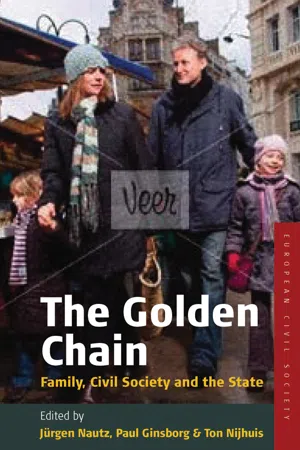
eBook - PDF
The Golden Chain
Family, Civil Society and the State
- 304 pages
- English
- PDF
- Available on iOS & Android
eBook - PDF
About this book
Information
Table of contents
- The Golden Chain
- CONTENTS
- LIST OF FIGURES AND TABLES
- ACKNOWLEDGEMENTS
- EDITORS’ PREFACE
- PART I: Introduction and Overview
- INTRODUCTION: Jürgen Nautz, Paul Ginsborg and Ton Nijhuis
- Chapter 1: UNCHARTED TERRITORIES
- PART II: Feminist Historical Views
- Chapter 2: GENDERED BOUNDARIES
- Chapter 3: THE FAMILY, CIVIL SOCIETY AND SOCIAL POLICY
- Chapter 4: FEMINIST MOBILISATION AND FAMILY CHANGE
- Part III: Family and Society in South and Western Europe
- Chapter 5: Corporate Birthmarks of Civil Society
- Chapter 6: STATE, SOCIETY AND FAMILY CHANGE IN TWENTIETH-CENTURY SPAIN
- Chapter 7: THE FOUNDATION OF CIVILISED SOCIETY
- Chapter 8: CHILDREN AND CIVIL SOCIETY
- PART IV: State and Changing Families in Eastern Europe and the Middle East
- Chapter 9: THE FAILURES OF MODERNITY
- Chapter 10: ISRAEL AND PALESTINE THROUGH FAMILY, CIVIL SOCIETY AND STATE
- Chapter 11: GENDERED BOUNDARIES BETWEEN THE STATE, FAMILY AND CIVIL SOCIETY
- Chapter 12: FAMILY STRUCTURES AND CIVIL SOCIETY PERSPECTIVES IN PRESENT-DAY SERBIA
- NOTES ON CONTRIBUTORS
- INDEX
Trusted by 375,005 students
Access to over 1.5 million titles for a fair monthly price.
Study more efficiently using our study tools.
Frequently asked questions
Yes, you can cancel anytime from the Subscription tab in your account settings on the Perlego website. Your subscription will stay active until the end of your current billing period. Learn how to cancel your subscription
No, books cannot be downloaded as external files, such as PDFs, for use outside of Perlego. However, you can download books within the Perlego app for offline reading on mobile or tablet. Learn how to download books offline
Perlego offers two plans: Essential and Complete
- Essential is ideal for learners and professionals who enjoy exploring a wide range of subjects. Access the Essential Library with 800,000+ trusted titles and best-sellers across business, personal growth, and the humanities. Includes unlimited reading time and Standard Read Aloud voice.
- Complete: Perfect for advanced learners and researchers needing full, unrestricted access. Unlock 1.5M+ books across hundreds of subjects, including academic and specialized titles. The Complete Plan also includes advanced features like Premium Read Aloud and Research Assistant.
We are an online textbook subscription service, where you can get access to an entire online library for less than the price of a single book per month. With over 1.5 million books across 990+ topics, we’ve got you covered! Learn about our mission
Look out for the read-aloud symbol on your next book to see if you can listen to it. The read-aloud tool reads text aloud for you, highlighting the text as it is being read. You can pause it, speed it up and slow it down. Learn more about Read Aloud
Yes! You can use the Perlego app on both iOS and Android devices to read anytime, anywhere — even offline. Perfect for commutes or when you’re on the go.
Please note we cannot support devices running on iOS 13 and Android 7 or earlier. Learn more about using the app
Please note we cannot support devices running on iOS 13 and Android 7 or earlier. Learn more about using the app
Yes, you can access The Golden Chain by Jürgen Nautz,Paul Ginsborg,Ton Nijhuis in PDF and/or ePUB format, as well as other popular books in Politics & International Relations & Social History. We have over 1.5 million books available in our catalogue for you to explore.