Writing on the history of German women has - like women's history elsewhere - undergone remarkable expansion and change since it began in the late 1960s. Today Women's history still continues to flourish alongside gender history but the focus of research has increasingly shifted from women to gender. This shift has made it possible to make men and masculinity objects of historical research too. After more than thirty years of research, it is time for a critical stocktaking of the "gendering" of the historiography on nineteenth and twentieth century Germany. To provide a critical overview in a comparative German-American perspective is the main aim of this volume, which brings together leading experts from both sides of the Atlantic. They discuss in their essays the state of historiography and reflect on problems of theory and methodology. Through compelling case studies, focusing on the nation and nationalism, military and war, colonialism, politics and protest, class and citizenship, religion, Jewish and non-Jewish Germans, the Holocaust, the body and sexuality and the family, this volume demonstrates the extraordinary power of the gender perspective to challenge existing interpretations and rewrite mainstream arguments.
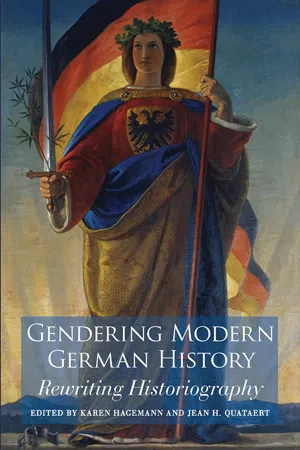
eBook - ePub
Gendering Modern German History
Rewriting Historiography
- 312 pages
- English
- ePUB (mobile friendly)
- Available on iOS & Android
eBook - ePub
Gendering Modern German History
Rewriting Historiography
About this book
Trusted by 375,005 students
Access to over 1.5 million titles for a fair monthly price.
Study more efficiently using our study tools.
Information
1
GENDERING MODERN GERMAN HISTORY
Comparing Historiographies and Academic Cultures in Germany and the United States through the Lens of Gender

Gendering Modern German History assesses the cumulative impact of the new gender research on the writing of German history. The book departs from the approaches of many recent edited collections and journal volumes dedicated to gender analysis. These publications typically are organized around a common theme, which then is explored in different geographical regions and through national as well as culturally specific case studies.1 The reader, however, has the difficult task of determining the validity of the implicit comparisons; left unanswered in this approach, too, are the impacts of the particular research findings on the larger national historiography.
Our book seeks to overcome precisely these shortcomings. Within a single national frame, it examines the many changes in the historiographies of modern Germany over the last several decades. And, by comparing the scholarship on modern Germany produced in Germany as well as in the United States, it deepens understandings of how different institutional settings, professional requirements, and historical traditions shape the writing of history. Through detailed comparisons of the receptivity of gender methodologies in important subfields of history, it captures the dynamic changes that currently are transforming the wider discipline. In our two geographical settings, this book also follows the ties and tensions between gender analysis and the methodological and research agendas of women's history.
In many ways, it is highly fitting to use Germany as a case study for a rewriting of historiographies. German history raises many issues that are important to historians of other societies in the nineteenth and twentieth centuries, the main time frame for this book. It shares with them the social disruptions in industrial development and nation-state building, the contradictions of modernity, the problems of citizenship and contested identities, and the Cold War pressures and gender tensions accompanying the transitions to the post- Cold War era. Given the particular extremes of German history, German women's and gender historians have grappled more openly with problems of war—victims and perpetrators, collective memory debates, including guilt and redress, which make the historiography especially rich and instructive for other national histories. Alternatively, the focus on Germany opens unique opportunities to explore gender history under different political regimes, whether limited representative government under monarchy, democracy, fascism, or communism. These insights, too, have resonance for historians, social scientists, and political and cultural theorists outside German history. In addition to scholarly interest, there also is a large lay readership on Nazism and comparative fascisms, the Second World War, and the tragedies of the Holocaust. We note here only a few examples as illustrations, but they speak to widespread interest by contemporary readers in Germany's past.
German historiography also has played an important role in the development of the historical profession. Academic history owes its origins in good measure to the German post-Enlightenment traditions of researching and writing history. The best-known example is Leopold von Ranke, who, from his base in the University of Berlin in the mid 1820s, set a normative model for academic history in the West, with its emphasis on archival research and primary source reading, meticulous training in the graduate seminar and, importantly, the elevation of the new nation-state as the primary subject of historical inquiry. In short, Ranke helped establish professional history as the narrative of the emerging nation-state. In her contribution to this collection, Angelika Schaser shows that historiography and the nation-state “developed parallel to each other”; in Germany, this intersection led to the “Prussianization of the German image of history,” which continues to this day to shape a powerful tradition of national history in Germany with a focus on the kleindeutsche territories and the exclusion of Austria from German history even for the nineteenth century.2 More generally, this linkage gave rise to dominant assumptions about what constituted the proper subject matter of history, which was defined originally as the study of high politics and diplomacy, the national economy, and military developments, as well as warfare. This focus, in turn, produced a set of relevant although limited conceptual and analytical tools to use in writing historical narratives, including notions of significance and methods of designating historical periods and turning points. Needless to say, the whole project was about men's public worlds, although not acknowledged as such. This highly gendered narrative was presented as general history.
These developments in the field of academic history mark the shared starting point for each of the contributors to this book. We acknowledge, however, an unresolved paradox in our project. On the one hand, the book is about rewriting the history of Germany—a space that of course has been defined in many different ways over the last two centuries. In that sense, our book reaffirms the traditional emphasis on the nation in history. On the other, gender analysis, our prime tool in writing and reading this history, erodes these very borders as it pushes toward cross-disciplinary and transnational dialogues. As we show below, it has transformed—in some instances quite considerably—the content of many of the standard subfields of the discipline, while maintaining these divisions at the same time. It also challenges mainstream interpretations, even as some practitioners argue for the importance of writing new metanarratives, which have the power to frame a people's identity.3 Through the German case, we hope to capture some of the complexities and contradictions of modern historiography in the early twenty-first century.
Comparing Gendered Historiographies and Academic Cultures
This book brings together eleven American and German scholars in the field of German women's and gender history. It is a product of what have been very energetic transatlantic crossings of historians and their ideas, methods, and practices back and forth over the past thirty years primarily between the United States and Germany. Without fully neglecting other sites, we focus on German women's and gender history written in these two countries.4 As editors, we proceed from our respective knowledge-base in the American and German university systems to illuminate the many phases of intellectual and institutional interactions that have shaped this work in German history.
Out of our separate histories and recent experiences of collaboration, we have developed a comparative analytic framework, which we bring to this study of historiographies and academic cultures. Our arguments will be spelled out more fully in the sections of our introduction that follow. Here we note only briefly the seven variables of our comparative analysis:
First, we recognize that gender is both a subject of historical investigation and a method of doing historical research. “Women” and “men” constitute identifiable classes of historical subjects; gender also is used as a theoretical and methodological framework. In addition to maintaining a focus on women, gender makes men and masculinity too objects of historical research. Gender is not only a constitutive element of social relationships based on perceived differences between the sexes, it also is a primary way of signifying relationships of power. It is of crucial importance for the creation of meaning in social and political life far beyond gender itself.
Second, work in gender maintains the deep connections of women's history to feminist agendas, although in complicated ways. Like the pioneers of women's history, gender historians are committed to the social projects of equality and justice. But this project is practiced in complex ways, not at least because in a global dialogue gender sheds light on both the class, cultural, and racial limitations of early “second wave” Western feminism and its historians and critiques the hegemonic claims of Western civilization as normative, somehow, for all peoples around the world.5
Third, we argue that the traditions and political agendas of the national feminist movements have far-reaching consequences for feminist academic politics and thereby for the integration of women's and gender history into the universities. The comparison between the United States and Germany shows that it makes a difference if feminists aim for change inside established institutions or if they want to create their own institutions outside the academy.
Fourth, institutions matter. We recognize that history is much more than an intellectual discipline, continuously reshaped by the rigors of research and intertextual analysis. It also is a profession, rooted in university life and training and, thus, subject to bureaucratic power and struggles over resources. The opportunities for university positions and the number of departments and research options are diverse in the United States and Germany, with a profound impact on the fate of the intellectual work and that of the historians as well. Institutional practices also solidify cultural assumptions about motherhood and child-rearing responsibilities.
Furthermore, institutional authority speaks also to the staying power of historiographical traditions, our fifth variable. The profession's openness to new methods, ideas and cross-disciplinary dialogues—to the possibilities, for example, of a paradigm shift through gender—reflects the institutional context of teaching and research. The large, decentralized, demand-driven university setting in the United States is one context; the state-financed federative German university system with developed state control and hierarchical university structures is another one.
Sixth, we draw attention to language itself. The fact that in German the term Geschlecht means both sex and gender while English separates the two words is vital for conceptualizing and writing about the field. But, also, words and the grammatical structure of a language form our thinking and perception of the world. The difference between languages is therefore an important variable for creative research and debates across national borders. But language differences also can be barriers, which constrain the international communication between scholars as well as the perception of scholarly work in foreign languages. “Translation” is necessary for a successful international discussion—not only translation of words and meanings, but also of different traditions in academic cultures.
Seventh, and finally, as in every other field of research, international communication in the field of women's and gender history is not devoid of tensions, however much the scholarship owes to mutual debts. The difficulty is exacerbated in part by the increasing use of English as the lingua franca of the field, which seems to make it less necessary for the Anglophone scholars to read the research written in other languages or quote it in their own studies. This situation creates imbalances in the recognition of research and also intellectual hierarchies.
These seven variables frame the comparative argumentation in our introduction and also help to organize this book. In our book, we have worked actively to incorporate a vast amount of scholarship produced on both sides of the Atlantic. We asked the authors to assess to what extent the scholars in their field saw their own projects in relation to their understanding of the research agendas, methods, and questions being produced abroad, in particular on the other side of the Atlantic. In retrospect, these currents crossing the Atlantic occasioned ongoing reflections on the wider historiography. This is an important factor because the main question of the book is the extent to which women's and gender history in Germany and the United States has been able to influence and shape mainstream historical narratives. The discussion indeed hinges on the question: what is the meaning of mainstream?
Mainstream and the Politics of History
The notion of a mainstream history is widely used yet analytically imprecise. Structurally, mainstream partially is a function of the institutional and historiographical frameworks of power noted above, shaped and measured among other criteria by access to academic positions inside the university system and thereby to school and university curricula, to research funds, to journals and publication series, professional meetings and conferences, and last but not least, public history. Yet, our authors show that even in one national setting there is not simply one “mainstream” or national paradigm, but rather the coexistence of different competing interpretations, methods, and approaches. Moreover, the subdisciplines of history have dominant, if shifting, schools of interpretation. Our task is to explore to what extent gender has entered these “mainstreams” since 1980 and assess the debates among women's and gender historians about doing so.
The mainstreams in history are very much influenced by and, in turn, affect the politics of doing history. The writing of German history not only in Germany itself but also in the United States is a very political enterprise. But there are obvious differences. Importantly, it matters if an historian writes about the history of his or her own country or another country. In the case of Germany, much of the West German historiography after 1945 involved “coming to grips” with the Nazi era and Holocaust in an effort to write a “serviceable” past to guide (West) German democratic developments and subsequent integration into Europe. No wonder that these interpretations often became powerful master narratives. Following their own political dictates, many American historians, in turn, who worked on German history after 1945 often chose Germany as a subject of their research because they had German ancestors who were forced to leave Germany during the Third Reich. Therefore, for them too one main field of interest was the history of Weimar and Nazi Germany—but from a very different perspective.
This political (and personal) preoccupation helps explain the intensity that historians have brought to matters of interpretation. This is true of the Fischer controversy in the early 1960s6; the challenges launched by David Blackbourn and Geoff Eley, then both in England, in the Peculiarities of German History (1984), which took on the Sonderweg thesis of structural continuity between Imperial Germany and the Nazi era7; and also, more recently, the interpretive controversies around Daniel Goldhagen's book Hitler's Willing Executioners: Ordinary Germans and the Holocaust (1996).8 Women's voices were not absent from these wider controversies, at times generating their own Historikerinnenstreit (“women historians quarrel”), most notably between the American historian Claudia Koonz and the German historian Gisela Bock, over whether German women, oppressed in Hitler's racial state, could be perpetrators in the horrors of National Socialism.9 These Historikerinnenstreit reflected very different conceptions of feminism in the two countries (our third variable). Many of the authors in our collection examine the importance of these debates for their time and place.
Moreover, the mainstreams are produced by historical fashions. Here again we see an important difference between academic cultures in Germany and the United States. Because the German academic system is more traditional and less market driven, these historical “fashions” for a long time were less important. There was competition between different “schools” of history writing. Scholars differed about the leading factors that influenced history, but at the same time they often shared deep suspicion about quick changes of fashions in writing history. From a German perspective, it appears that the market-driven system of the U.S. academic culture forces young scholars, who want to get public recognition and positioning in the American academic system, to follow these fashions more readily than in Germany.
Questions and Structures of the Arguments and Their Uses
To provide coherence to this volume, as noted, we asked each contributor to respond to a set of questions about historiographical developments in his or her respective thematic field. We wanted to know what contributions women's and gender history have made to the literature; the developments and current state of research; the main research desiderata; and the theoretical and methodological problems. We also asked to what extent the work on women's and gender history ...
Table of contents
- Cover Page
- Title Page
- Copyright Page
- Contents
- Preface
- 1 - Gendering Modern German History: Comparing Historiographies and Academic Cultures in Germany and the United States through the Lens of Gender
- 2 - The Challenge of Gender: National Historiography, Nationalism, and National Identities
- 3 - Military, War, and the Mainstreams: Gendering Modern German Military History
- 4 - Blind Spots: Empire, Colonies, and Ethnic Identities in Modern German History
- 5 - The Personal is Political: Gender, Politics, and Political Activism in Modern German History
- 6 - The Order of Terms: Class, Citizenship, and Welfare State in German Gender History
- 7 - A Tributary and A Mainstream: Gender, Public Memory, and Historiography of Nazi Germany
- 8 - Jews, Women, and Germans: Jewish and German Historiographies in a Transatlantic Perspective
- 9 - Religion and Gender in Modern German History: A Historiographical Perspective
- 10 - Continuities and Ruptures: Sexuality in Twentieth-Century Germany: Historiography and its Discontents
- 11 - The Elephant in the Living Room: Or Why the History of Twentieth-Century Germany Should Be a Family Affair
- Selected Bibliography
- Contributing Authors
- Index
Frequently asked questions
Yes, you can cancel anytime from the Subscription tab in your account settings on the Perlego website. Your subscription will stay active until the end of your current billing period. Learn how to cancel your subscription
No, books cannot be downloaded as external files, such as PDFs, for use outside of Perlego. However, you can download books within the Perlego app for offline reading on mobile or tablet. Learn how to download books offline
Perlego offers two plans: Essential and Complete
- Essential is ideal for learners and professionals who enjoy exploring a wide range of subjects. Access the Essential Library with 800,000+ trusted titles and best-sellers across business, personal growth, and the humanities. Includes unlimited reading time and Standard Read Aloud voice.
- Complete: Perfect for advanced learners and researchers needing full, unrestricted access. Unlock 1.5M+ books across hundreds of subjects, including academic and specialized titles. The Complete Plan also includes advanced features like Premium Read Aloud and Research Assistant.
We are an online textbook subscription service, where you can get access to an entire online library for less than the price of a single book per month. With over 1.5 million books across 990+ topics, we’ve got you covered! Learn about our mission
Look out for the read-aloud symbol on your next book to see if you can listen to it. The read-aloud tool reads text aloud for you, highlighting the text as it is being read. You can pause it, speed it up and slow it down. Learn more about Read Aloud
Yes! You can use the Perlego app on both iOS and Android devices to read anytime, anywhere — even offline. Perfect for commutes or when you’re on the go.
Please note we cannot support devices running on iOS 13 and Android 7 or earlier. Learn more about using the app
Please note we cannot support devices running on iOS 13 and Android 7 or earlier. Learn more about using the app
Yes, you can access Gendering Modern German History by Karen Hagemann, Jean H. Quataert, Karen Hagemann,Jean H. Quataert in PDF and/or ePUB format, as well as other popular books in Social Sciences & German History. We have over 1.5 million books available in our catalogue for you to explore.