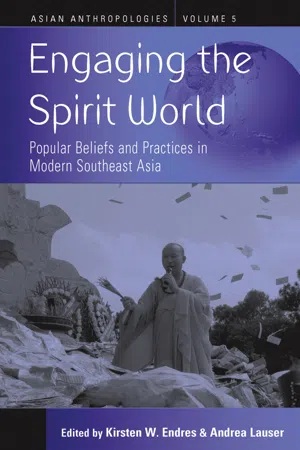
In many parts of the contemporary world, spirit beliefs and practices have taken on a pivotal role in addressing the discontinuities and uncertainties of modern life. The myriad ways in which devotees engage the spirit world show the tremendous creative potential of these practices and their innate adaptability to changing times and circumstances. Through in-depth anthropological case studies from Indonesia, Malaysia, Thailand, Myanmar, Laos, and Vietnam, the contributors to this book investigate the role and impact of different social, political, and economic dynamics in the reconfiguration of local spirit worlds in modern Southeast Asia. Their findings contribute to the re-enchantment debate by revealing that the "spirited modernities" that have emerged in the process not only embody a distinct feature of the contemporary moment, but also invite a critical rethinking of the concept of modernity itself.
eBook - ePub
Engaging the Spirit World
Popular Beliefs and Practices in Modern Southeast Asia
- 238 pages
- English
- ePUB (mobile friendly)
- Available on iOS & Android
eBook - ePub
Engaging the Spirit World
Popular Beliefs and Practices in Modern Southeast Asia
About this book
Trusted by 375,005 students
Access to over 1.5 million titles for a fair monthly price.
Study more efficiently using our study tools.
Information
1

CAN THINGS REACH THE DEAD? THE ONTOLOGICAL STATUS OF OBJECTS AND THE STUDY OF LAO BUDDHIST RITUALS FOR THE SPIRITS OF THE DECEASED
Introduction
During my fieldwork in one of the Buddhist monasteries in Vientiane,1 I witnessed several cases of lay people coming to a monk and handing him an object. Often it was an umbrella, a shirt, a cooking pot or another item of everyday use. I was told that most of these lay people had had a dream in which one of their deceased kin appeared. Often the deceased person was lacking something in this dream. In the understanding of the lay person, the monk then ritually “transferred” the object to the deceased. The ritual transfer of objects to the spirits of the deceased also plays a crucial role in larger rituals that are part of the Lao ritual cycle such as boun khau salak, the festival of baskets drawn by lot.2 Moreover, family rituals for honoring a deceased person, sometimes performed many years after their death, follow a similar pattern. In a ritual I observed in Luang Prabang in 2007, family and friends bought a small model house (huean pa) and filled it with items of everyday use. The monks then transferred the house to the deceased so that they could profit from it in the afterlife. In both cases, the transfer of objects to non-human beings plays a crucial role in establishing a link between humans and the spirits of the dead. Although the “reality” of this transfer is rarely discussed among the Lao themselves, more orthodox Buddhist monks and some lay people see these practices as “folk Buddhism” and deny the transferability of the object itself. Instead, they argue, it is only the merit (boun, Pali: punna) from this karmically skilful act of generosity that is transferred to the deceased. In this interpretation, the gifts remain in this world and are actually intended for the monks.
Over the last two decades, some of the major trends in social anthropology have focused on two concepts, which I would like to employ in order to explore some methodological and theoretical issues relevant to studying the ritual transfer of objects to the deceased among the ethnic Lao, and contextualize them in terms of Buddhist practice. The first concept, ontology, entered the subject in the early 1990s largely via Bruno Latour's (1993) exchanges with anthropologists such as Eduardo Viveiros de Castro (1998) and Philippe Descola (1998).3 Both have applied the notion of ontology to the study of spirits (Descola 2007; Viveiros de Castro 2007). The second concept, materiality, is linked to the first one. The return of the material derives from the critique of allegedly anthropocentric, subject-oriented understanding in the social sciences. Actor-Network Theory and other critiques of the nature/culture divide look at the wider interactions of humans with non-humans and the material world. Here, it is not exclusively the human subject that molds the material world through its agency, or projects meaning onto the object, thereby making it a representation or symbol. Instead, there are efforts to restore the role of objects and non-human entities beyond dead matter, fetishism, or representations and symbols (Gell 1998; Miller 2005; Keane 2005, 2006). A recent volume by Henare, Holbraad, and Wastell (2007), on which I draw, connects ontology and materiality. All these approaches in their own way aim at a wider understanding of objects, leaving space for their agency, power, and mediating capacities.
Instead of seeing spirits solely as objects of study, I would like to propose that a look at their ontological status and their involvement with materiality might enhance an understanding of spirits as social beings that are in dialogue with humans. In the first part of this chapter I suggest that despite their invisibility, the “traces” spirits leave in the material domain are important for understanding their needs, desires, and interactions with humans. I do not reject understandings of spirits and ghosts as representations, symbols, or symptoms of something else, but taking the materiality and ontological status of these beings seriously is—beyond all the theoretical apparatus to be used—also a methodological question. I then develop this theoretical discussion with regard to the two ethnographic examples from Laos I mentioned in the opening paragraph. Here I look at the transfer of objects (baskets and model houses) between the living and the dead with Buddhist monks acting in both cases as ritual mediators. I will then discuss differences in ideas regarding the ontological status of these spirits held by orthodox Buddhist monks and “modern Buddhists” on the one hand, and elderly lay people on the other. Some monks (and more rarely lay people) deny the transferability of objects, whereas more “traditional” lay people understand the objects as actually reaching the dead. I will argue that this modern understanding of communication with the ancestors can be understood as a result of what Latour has called “purification” (Latour 1993: 10), an ontological separation of and distinction made between humans and non-humans. I argue that this process is grounded in a rationalization of Buddhism through socialist politics and the influence of Buddhist modernism and doctrinal orthodoxy. Throughout this chapter, my emphasis will be more on the theoretical and methodological aspects of the issues, and the ethnography will remain focused on specific ritual events without referring to the role of spirits of the deceased in other parts of the Lao ritual cycle.
Taking Ontology and Materiality Seriously
Most of us have encountered situations in the field in which certain “things” are imbued with special qualities, in which objects in specific contexts and events become living beings or take on roles that are beyond their everyday use. There are numerous examples of what could be called “ontological shifts”: people slipping from one form of being into another, passing from one sphere to another, or subjects becoming objects. In Amazonia, people are said to have “unstable bodies” and can transform themselves into animals (Vilaça 2005); among the Nuer, birds are sometimes regarded as being human twins (Evans Pritchard 1966); or certain gods in Nepal are ritually invited and then “live” in a statue (Ortner 1975). In the region I work in, statues of the Buddha made out of concrete are endowed with life in extremely elaborate consecration rituals and are regarded afterwards as living entities (Swearer 2004).
Anthropologists of different generations have usually followed one of the following ways of understanding these phenomena: either there is a purpose connected to these transformations (functionalism), they show how the brain works (cognitivism), they have to be interpreted (interpretivism), or these transformations have a metaphorical nature (symbolism) (GDAT 2010: 183). Early anthropology understood these phenomena of non-distinction as a mentalité primitive (Lévy-Bruhl 1975), in which a sort of prelogical confusion produces an inability to delineate between dream and reality, between subject and object. Other accounts have described these cases for Melanesia as being founded on socio-cosmic principles, in which humans and non-humans share certain substances that are the basis of their transformations (Leenhardt 1979). Some of these heavily criticized accounts of “primitive thinking” could in my opinion undergo a fruitful revision.4 More widely accepted and rehearsed has been the contribution of Mauss (1990), whose ideas about exchange are based on a participation of a certain principle or substance related to persons and things.
Focusing here only on objects that are used to connect human and non-human entities, the most widely accepted ideas about “explaining” these phenomena are related to the concept of representation. In the Durkheimian tradition,5 these objects are primarily of interest because they “materialize and express otherwise immaterial or abstract entities, organizing subjects’ perpetual experiences and clarifying their cognitions. The very materiality of objects, their availability to the senses, is of interest primarily as the condition for the knowability of otherwise abstract or otherwise invisible structure” (Keane 2005: 198). Webb Keane and other proponents of the ontological turn in anthropology argue that this understanding reduces objects to our modern way of thinking in which the material world becomes a passive matrix of projection. According to Eduardo Viveiros de Castro, the conditions of knowability (using Keane's words) are also questions regarding epistemology and representation. He states that with modernity we witness a “massive conversion of ontological into epistemological questions—that is, questions of representation [in which] objects or things have been pacified—retreating to the exterior, silent, and uniform world of nature” (Viveiros de Castro 2004: 480). He then outlines the significance of the concept of ontology for going beyond this approach:
I think that the language of ontology is important for one specific and, one might say, tactical reason. It acts as a counter-measure to a de-realizing trick frequently played against natives’ thinking, which turns their thought into a sustained fantasy by reducing it to the dimensions of a form of knowledge or representation—that is, to an “epistemology” or a “worldview.” (Viveiros de Castro 2003: 18)
At a recent discussion of the ontological turn held in Manchester (GDAT 2010), some participants stated that the study of culture is in many ways merely the study of meaning and interpretation of peoples’ epistemes, and neglects ontological questions. Quoting Tim Ingold, some participants argued that in this sense, culture is “conceived to hover over the material world, but not to permeate it” (Ingold 2000: 349). Another contributor said that “by contrast, ontology is an attempt to take others and their real difference seriously” (GDAT 2010: 175). At the same event, the claim was made that “an ontological approach, more than any other within anthropology, takes things encountered in the field ‘seriously’” (ibid.: 154). Henare, Holbraad, and Wastell, referring to the link between ontology and materiality, argue in the same vein for taking a fresh look at objects: “The aim of this method is to take ‘things’ encountered in the field as they present themselves, rather than immediately assuming that they signify, represent or stand for something else” (Henare, Holbraad, and Wastell 2007: 2). How can materiality and its connection to ontology then be taken “seriously” as a method? How can we understand objects and the way they present themselves without directly launching a project of symbolization and representation? And how can this illuminate the ways in which ghosts, spirits, and other non-human entities are studied?
When we stick to the claims made above, one could say that in anthropological analysis spirits, ghosts, and the material objects attached to their apparition and worship often have suffered the fate of too quickly becoming representations and symbols. Heonik Kwon, examining the ghosts of war in Vietnam, argues that apparitions also continue to play a role in the “modern” world, but that “their enduring existence is often unrecognized in modern societies because its domain of existence has changed from the natural to the symbolic” (Kwon 2008: 16). Again, then, spirits only “symbolize” and stand for something else. To make myself clear: I think there is essentially nothing wrong with interpreting spirits, ghosts, and the objects surrounding them as symbols or representations of something else. Our job as anthropologists demands such work, and the most illuminating studies of spirits and ghosts have followed this method in various forms. Aihwa Ong's study of the possession of female factory workers in Malaysia takes spirits to be a sign of resistance to industrial discipline (Ong 1987). Janet Carsten argues that spectral apparitions are often linked to loss and memory and proposes that “excesses of grief cause these ghosts to appear” (Carsten 2007: 7). Heonik Kwon sees ghosts and their haunting as expressions of traumatic events, violence, and socially unprocessed deaths (Kwon 2008). Ghosts, on a larger comparative level, often stand for something that cannot be expressed otherwise; one could say that the “ghost embodies the disruption and alienation of that other which resists assimilation” (Buse and Stott 1999: 137).
However, I think that before we undertake an analysis of more abstracted representations and interpretations, it is worth keeping in mind that the first encounter with ghosts and other spirit entities in the field should be guided by taking their ontological status seriously. Ghosts can be beings with desires, with taste, with biographies. They appear in specific ways, at certain places at a certain time; they slip into objects, they live in them, they consume things and demand a certain treatment as social beings. A detailed and multifaceted interpretation or analysis of their representative qualities, their symptomatic nature, and their “meaning” can only be carried out with these things in mind. I think that the place for an ontological approach to spirits, and of their involvement with the material world, is the point from which we have to start understanding them, before we write about what they stand for and symbolize.
Invisibility, Traces, and Materiality.
Lao Spirits of the Deceased
The problem we very often have is that the encounters with beings subsumed under the category of spirits or ghosts are marked by non-visibility and non-materiality, at least for most people and anthropologists. Some of our informants might regularly see ghosts and spirits, get possessed by them, talk to them, or even marry them. Unfortunately, this hasn’t happened to me yet. While working on a research project at the University of Bristol concerned with Buddhist funeral cultures of Southeast Asia and China, my colleagues and I at one point realized that the main actors of our research were never present in the conventional sense. The deceased, ancestors, ghosts, or the spirits of people who died a bad death were in some sense omnipresent because all the things we researched (rituals, narratives, offerings, prayers, and so on) happened because of them, but they were not to be seen. This is a paradox that marks every religion to a more or less intense degree: “Humanity constantly returns to projects devoted to immateriality, whether as religion, philosophy…But all of these rest upon the same paradox: that immateriality can only be expressed through materiality…The more humanity reaches toward the conceptualization of the immaterial, the more important the specific forms of materialization” (Miller 2005: 28).
One way to study immaterial beings and take their apparitions seriously would be to analyze under which circumstances they appear to which people, or how images of them are, for example, caught on media. Gregory Delaplace has developed this idea in relation to spirits in Mongolia and has proposed a notion he labels “regimes of communicability.”6 Regarding the materiality of these invisible beings, I would like to use the idea of the “trace,” which I also take as being part of a regime of communicability. Ghosts and spirits leave material traces in this world. A trace might indicate the places where they appear, the materiality of the ritual items to deal with them, or with the offerings they receive. The trace is in a sense a track, a footprint, or an imprint—a sign left in the material domain of something that by its nature is not graspable for those people not endowed with the special capacities to do so. The trace is never a “direct” reference to the being in question. The trace as I use it as a concept is only partial, never revealing the whole being, but nevertheless pointing to certain features of the entity and its way of being.7
In the context of the above-mentioned project on death rituals, we decided to look at the materiality surrounding the apparition of non-human entities. However immaterial these beings might be, they must find expression in the material world. In my own research, I explored one Buddhist festival for the deceased that marks the end of a period of two weeks (usually in September) in which an intensified communication between the living and the dead takes place: the aforementioned boun khau salak. In this ritual, food, but also other objects of exchange, are constitutive of the communication between the living and the dead. In addition, I also looked at a ritual I researched in Luang Prabang in 2007 that aims at honoring a deceased ancestor by providing a small model house filled with item...
Table of contents
- Cover Page
- Title Page
- Copyright Page
- Contents
- List of Figures
- Preface
- Introduction - Multivocal Arenas of Modern Enchantment in Southeast Asia
- Chapter One - Can Things Reach the Dead? The Ontological Status of Objects and the Study of Lao Buddhist Rituals for the Spirits of the Deceased
- Chapter Two - Spirited Warriors: Conspiracy and Protection on Lombok
- Chapter Three - From the Mystical to the Molecular: Modernity, Martial Arts, and Agency in Java
- Chapter Four - Changing Spirit Identities: Rethinking the Four Palaces’ Spirit Representations in Northern Vietnam
- Chapter Five - Gods, Gifts, Markets, and Superstition: Spirited Consumption from Korea to Vietnam
- Chapter Six - Contests of Commemoration: Virgin War Martyrs, State Memorials, and the Invocation of the Spirit World in Contemporary Vietnam
- Chapter Seven - Spirit Cults and Construction Sites: Trans-ethnic Popular Religion and Keramat Symbolism in Contemporary Malaysia
- Chapter Eight - Being a Spirit Medium in Contemporary Burma
- Chapter Nine - Reconfiguring Manora Rongkru: Ancestor Worship and Spirit Possession in Southern Thailand
- Chapter Ten - The Horror of the Modern: Violation, Violence, and Rampaging Urban Youths in Contemporary Thai Ghost Films
- Notes on Contributors
- Index
Frequently asked questions
Yes, you can cancel anytime from the Subscription tab in your account settings on the Perlego website. Your subscription will stay active until the end of your current billing period. Learn how to cancel your subscription
No, books cannot be downloaded as external files, such as PDFs, for use outside of Perlego. However, you can download books within the Perlego app for offline reading on mobile or tablet. Learn how to download books offline
Perlego offers two plans: Essential and Complete
- Essential is ideal for learners and professionals who enjoy exploring a wide range of subjects. Access the Essential Library with 800,000+ trusted titles and best-sellers across business, personal growth, and the humanities. Includes unlimited reading time and Standard Read Aloud voice.
- Complete: Perfect for advanced learners and researchers needing full, unrestricted access. Unlock 1.5M+ books across hundreds of subjects, including academic and specialized titles. The Complete Plan also includes advanced features like Premium Read Aloud and Research Assistant.
We are an online textbook subscription service, where you can get access to an entire online library for less than the price of a single book per month. With over 1.5 million books across 990+ topics, we’ve got you covered! Learn about our mission
Look out for the read-aloud symbol on your next book to see if you can listen to it. The read-aloud tool reads text aloud for you, highlighting the text as it is being read. You can pause it, speed it up and slow it down. Learn more about Read Aloud
Yes! You can use the Perlego app on both iOS and Android devices to read anytime, anywhere — even offline. Perfect for commutes or when you’re on the go.
Please note we cannot support devices running on iOS 13 and Android 7 or earlier. Learn more about using the app
Please note we cannot support devices running on iOS 13 and Android 7 or earlier. Learn more about using the app
Yes, you can access Engaging the Spirit World by Kirsten W. Endres, Andrea Lauser, Kirsten W. Endres,Andrea Lauser in PDF and/or ePUB format, as well as other popular books in Social Sciences & Religion. We have over 1.5 million books available in our catalogue for you to explore.