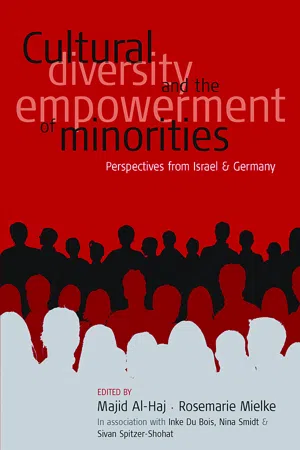
Conflicts between different racial, ethnic, national and other social groups are becoming more and more salient. One of the main sources of these internal conflicts is social and economic inequality, in particular the increasing disparities between majority and minority groups. Even societies that had been successful in dealing with external conflicts and making the transition from war to peace have realized that this does not automatically resolve internal conflicts. On the contrary, the resolution of external conflicts may even sharpen the internal ones. This volume, a joint publication of the University of Haifa and the International Center for Graduate Studies (ICGS) at the University of Hamburg, addresses questions of how to deal with internal issues of social inequality and cultural diversity and, at the same time, how to build a shared civility among their different national, ethnic, religious and social groups.
eBook - PDF
Cultural Diversity and the Empowerment of Minorities
Perspectives from Israel and Germany
- 304 pages
- English
- PDF
- Available on iOS & Android
eBook - PDF
Cultural Diversity and the Empowerment of Minorities
Perspectives from Israel and Germany
About this book
Information
Table of contents
- Title Page
- Copyright Page
- Table of Contents
- Preface
- Introduction
- Part I: General Overview
- Chapter 1 Stories of Struggle: Transnational Advocacy and Democracy Education
- Chapter 2 What's Going on Between Members of Majorities? Contributions from Social Psychology
- Chapter 3 Talking at Cross-purposes: Misunderstanding in Intercultural Communication
- Part II: The Israeli Case
- Chapter 4 A Curriculum Between Conflict and Peace: The Teaching of History in Jewish and Arab Schools in Israel
- Chapter 5 The Evolving Arab Reception of the Holocaust and Palestinian Textbooks: A Contribution to Democracy and Peace Education?
- Chapter 6 Police-Minority Relations in a Multicultural Society: The Israeli Case
- Chapter 7 On the Central Role of "Threat Perception" in Mediating the Influence of Socioeconomic Factors on Xenophobic Attitudes
- Chapter 8 A Multimedia Lexicon as a Tool for Increasing Societal Tolerance
- Chapter 9 When Gender Differences Surpass Cultural Differences in Personal Satisfaction with Body Shape in Israeli College Students
- Chapter 10 Postcolonial Feminism, the Politics of Identification, and the Liberal Bargain
- Part III: The German Case
- Chapter 11 Acculturation Attitudes and Bilingual Classrooms in Germany: The Portuguese-German Example
- Chapter 12: "Not Always Proud to be American": The Reconstruction of National Identity by Americans Residing in Germany
- Chapter 13 Oral Mistake Corrections in Second-Language Classrooms
- Chapter 14 Intercultural Competence in Management Consultancies in Germany: Does It Exist?
- Notes on Contributors
- Index of Names
- Index of Subjects
Trusted by 375,005 students
Access to over 1.5 million titles for a fair monthly price.
Study more efficiently using our study tools.
Frequently asked questions
Yes, you can cancel anytime from the Subscription tab in your account settings on the Perlego website. Your subscription will stay active until the end of your current billing period. Learn how to cancel your subscription
No, books cannot be downloaded as external files, such as PDFs, for use outside of Perlego. However, you can download books within the Perlego app for offline reading on mobile or tablet. Learn how to download books offline
Perlego offers two plans: Essential and Complete
- Essential is ideal for learners and professionals who enjoy exploring a wide range of subjects. Access the Essential Library with 800,000+ trusted titles and best-sellers across business, personal growth, and the humanities. Includes unlimited reading time and Standard Read Aloud voice.
- Complete: Perfect for advanced learners and researchers needing full, unrestricted access. Unlock 1.5M+ books across hundreds of subjects, including academic and specialized titles. The Complete Plan also includes advanced features like Premium Read Aloud and Research Assistant.
We are an online textbook subscription service, where you can get access to an entire online library for less than the price of a single book per month. With over 1.5 million books across 990+ topics, we’ve got you covered! Learn about our mission
Look out for the read-aloud symbol on your next book to see if you can listen to it. The read-aloud tool reads text aloud for you, highlighting the text as it is being read. You can pause it, speed it up and slow it down. Learn more about Read Aloud
Yes! You can use the Perlego app on both iOS and Android devices to read anytime, anywhere — even offline. Perfect for commutes or when you’re on the go.
Please note we cannot support devices running on iOS 13 and Android 7 or earlier. Learn more about using the app
Please note we cannot support devices running on iOS 13 and Android 7 or earlier. Learn more about using the app
Yes, you can access Cultural Diversity and the Empowerment of Minorities by Rosemarie Mielke,Majid Al-Haj in PDF and/or ePUB format, as well as other popular books in Social Sciences & Education General. We have over 1.5 million books available in our catalogue for you to explore.