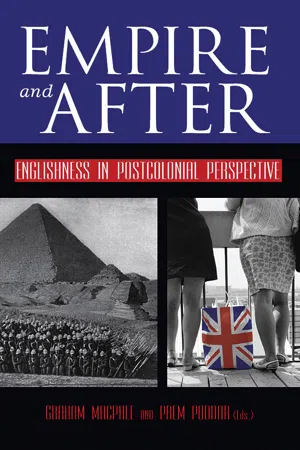
The growing debate over British national identity, and the place of "Englishness" within it, raises crucial questions about multiculturalism, postimperial culture and identity, and the past and future histories of globalization. However, discussions of Englishness have too often been limited by insular conceptions of national literature, culture, and history, which serve to erase or marginalize the colonial and postcolonial locations in which British national identity has been articulated. This volume breaks new ground by drawing together a range of disciplinary approaches in order to resituate the relationship between British national identity and Englishness within a global framework. Ranging from the literature and history of empire to analyses of contemporary culture, postcolonial writing, political rhetoric, and postimperial memory after 9/11, this collection demonstrates that far from being parochial or self-involved, the question of Englishness offers an important avenue for thinking about the politics of national identity in our postcolonial and globalized world.
eBook - ePub
Empire and After
Englishness in Postcolonial Perspective
- 218 pages
- English
- ePUB (mobile friendly)
- Available on iOS & Android
eBook - ePub
Empire and After
Englishness in Postcolonial Perspective
About this book
Trusted by 375,005 students
Access to over 1.5 million titles for a fair monthly price.
Study more efficiently using our study tools.
Information
PART 1
Nation & Empire
CHAPTER 1
“As White As Ours”
Africa, Ireland, Imperial Panic, and
the Effects of British Race Discourse
Enda Duffy

Re-cognizing the Oldest Colony
The most controversial, and, in recent years, frequently quoted description by a Victorian Englishman of the Irish is the following:
I am haunted by the human chimpanzees I saw along that hundred miles of horrible country. I don’t believe that they are our fault. I believe that there are not only more of them, but that they are happier, better, and more comfortably fed and lodged under our rule than they ever were. But to see white chimpanzees is dreadful; if they were black, one would not feel it so much, but their skins, except when tanned by exposure, are as white as ours. (Kingsley 1881: 111–12)
This fantastic mélange of racism, travelogue, and imperial condescension, all abounding under a veneer of righteous Victorian liberalism, may be cited as the nadir of British racism directed at the Irish, extreme even by mid-nineteenth century standards. Inserted, incongruously, in an account of a fishing trip, it was written by Charles Kingsley, on the face of it a highly unlikely source for such virulence. Kingsley, rector of Eversley, Hampshire, was by 1860 a celebrated reformist clergymen, famous as the author of Alton Locke (1850) and Water Babies (1863), forceful and effective exposés of the conditions of child laborers and the urban poor in Britain. At this symptomatic moment, however, he allows his reformer’s zeal to escalate into a rabid kind of othering. Written in 1860, only a year after Darwin’s Origin of the Species, he calls the Irish “white chimpanzees” with a shrill enthusiasm. Determined not to ignore the problems of the place in which he was merely traveling as a tourist, the inevitable contradiction between his tourism and his Christian socialism uncovers, rather, a pathological attempt to racially other those who, as he admits with something close to panic, are of the same race as himself.
Kingsley’s observations have, however, recently run the risk of becoming shop soiled, given their overexposure in debates about the status of relations between Britain and Ireland, and between British and Irish cultural productions, in the Victorian era. At least since L.P. Curtis, who in his pioneering book Apes and Angels: The Irishman in Victorian Caricature (1971), drew attention to the Victorian British habit of juxtaposing Irish and African figures, the rawness of Victorian British racism has been cited as proof positive that nothing less than the colonizer-colonized relationship is needed to characterize the British attitude to, and the reality of British power over, the Irish in the nineteenth century. By now it is clear that by far the most interesting work in Irish historical, literary, and cultural studies in the last quarter century has been produced by those who declared in advance that they considered that Ireland had been a colony of Britain, so that the Republic of Ireland, which gained its independence from Britain in 1921, should be considered a postcolonial nation. It may be claimed that the intellectual leap, made in such forums as the highly important Irish journal The Crane Bag1 in the late 1970s, that Ireland’s history and development be considered in a colonial and postcolonial paradigm, unleashed a series of insights whose power—and whose influence on contemporary Irish culture and even political developments both in Northern Ireland and in the Republic—has been unequaled since the intellectual and cultural work of the Gaelic Revival, which set the cultural conditions for the independence of Ireland in the first place. The Irish claim to colonial status has not, however, been without its doubters, and the strain of skepticism has recently seen a resurgence. It is in this context that commentaries such as Kingsley’s have a renewed relevance. For example, in his polemical Ireland and Empire: Colonial Legacies in Irish History and Culture, Stephen Howe places himself at the vanguard of the opposition, castigating David Lloyd for using Kingsley’s very lines in an essay in Ireland after History as a short-cut proof of the racism of British colonial rule in Ireland; Howe describes Kingsley’s lines as overused and misunderstood (2000: 24). Overuse, however, is the point: to grasp the full implications of an emergent sense of Irishness in the late Victorian period, as I will show, one must take into account the burgeoning discourse on Ireland by British intellectuals at the same moment.
Rather than judge the worth of Lloyd’s claim and Howe’s counterclaim here in an essay on British attitudes to Ireland, I suggest that the recourse of both to Kingsley’s observations shows that any attempt, whether within the ambit of postcolonial studies or otherwise, to understand the permutations of Irish modernity must take into account the agonistic, but nevertheless always more or less mutually aware, relations between intellectual developments in Victorian Britain and Ireland. The broadest terms of reference here are those of Hegel in his account of the master-slave relationship in The Phenomenology of Spirit: if one searches for the truth of the master, one will find it in the slave, while the truth of the slave will only be found in the study of the master. I believe that, at this juncture, Irish post-colonial studies needs to understand better how Irish nationalism was born out of a dialectical struggle with British discourses on Ireland if it is, first, to continue to have further interesting contributions to make to discussions on the nature of Ireland’s version of modernity; second, if it is to have something valuable to contribute to the debates on postcoloniality in the world beyond the shores of Ireland; and finally, if it is to contribute meaningfully to a reimagining of the still prevalent narratives of the master—that is, if it is to be powerful enough (as it should be) to help reimagine Britain itself.
Irish postcolonial studies is coming under attack not because it lacks intellectual power or credibility, but rather precisely because it has been all too successful in convincing people of its validity and redirecting the course of nothing less than the history of the cultural formation—Ireland—which it studies. By now it is clear that this intellectual movement grew up in tandem with, and under the impetus of the shock of, the troubles in Northern Ireland since 1969. The Field Day Theater Company’s location in Derry, from which it soon extended its influence with a pamphlet series and other endeavors, is a clue, as is the poet Seamus Heaney’s very public and troubled reticence about whether he should be approaching the issues of the Northern troubles and what gave rise to them less obliquely in his poems. In this sense, those critics who disparaged Seamus Deane as the respectable intellectual arm of the Republican (that is, the ultra-nationalist) movement, and as a recycler of old versions of Irish nationalism under a new and more voguish critical aegis, were in the broader sense correct: the logic of the postcolonialist position has inevitably been that, as Northern Ireland is the last vestige of British imperialism on the island of Ireland, it should one day break free from its colonial master. By now, this has not come to pass, but the Good Friday Peace Agreement has cleared the way for a novel, if possibly provisional, experiment in quasi-postcolonialism. And this was effected not by any real changes in territorial claims, but by changes in culture and mentality—in part effected by the group associated with Field Day and more broadly with the cultural critics who spoke of Ireland in colonial and postcolonial terms. For, by recasting the old nationalism without losing sympathy with it, they succeeded, paradoxically, in diverting Irish attention away from an insular nationalism that could now be decried, as Deane did decry it, as an “atavism,” and rechanneling Irish and Irish nationalist attentions to the ways in which any nationalism, including Ireland’s, could be a worthy cultural expression of modernity rather than a narrow and sectarian archaic superstition.
The history of this striking achievement in such a marginal island as Ireland has yet to be written. What is clear at this juncture, however, is that, with the new stage of Anglo-Irish relations and the new possibilities for both Northern Ireland and the Republic of Ireland as postcolonial entities on the European and world stage, the intellectual movement which helped give rise to it risks falling into irrelevance. Irish postcolonial studies must enter a new phase. To continue its project it must, I suggest, determinedly fix its gaze outward, beyond Ireland. This reorientation might proceed on both the synchronic and diachronic axes: synchronically, Irish postcolonialism needs to forge links to other postcolonialisms if it is to continue to dispel the atavistic tendency that it condemned in the old “parochial” nationalism of Ireland. This work has already begun: David Lloyd has written eloquently of parallels between Ireland and the Philippines, while Joe Cleary has written strikingly of the nature of partition and opposition to it in Palestine and Ireland (Lloyd 1999; Cleary 2002). It also needs to reenvision Irish history; now, given the greater confidence that casting Ireland’s case as the vanguard of twentieth-century anti-colonial movements has engendered, it can reexamine without any sense of threat the nature of the cultural relations which presaged, and precipitated, the anti-colonial insurgency. It is an experiment in such work that I practice here.2 The turn to comparative work, and the return to a study of past relations, need not be mutually exclusive, but on the contrary, as I will show, to rehistoricize is to point to the inevitability of new kinds of comparison in the present.
The thesis of this chapter is this: what we think of as a construction of emergent Irish nationalism, modern Irish postcolonial identity, was in considerable part constructed in contestation with, and in reaction to, British discourses on Ireland as they developed in the course of the nineteenth century. On the face of it, this is not a controversial statement. It is a well known truism of modernity that although each nationalism is unique in the national features it celebrates, the structure of nationalism as an ideology is, nevertheless, everywhere the same. This structure of thinking and affect was largely developed during the nineteenth century in continental Europe, and the conduit through which it came to the attention of the emergent English speaking, Irish middle class, and the intellectual cadre within that class that emerged around the mid-century, was largely a British one. At the same time, partly in response to an interest in such thinking about nations (a sentiment that would become public policy in 1914 when Britain claimed to be fighting the First World War for “the freedom of small nations”), partly in response to events in Ireland, such as the Great Famine of 1845 to 1849, and particularly as developments in Irish politics affected England (through, for example, such violent episodes as the Fenian bombing which led to execution of the “Manchester Martyrs”), British discourse on Ireland was undergoing a massive change. My claim here, moreover, is that primarily this change did not have to do with Ireland at all. Rather, it was the result of Britain’s growing awareness of itself as an empire; this, indeed, was what British culture itself took from the sense that each country must have a nationalism of its own, constructing itself as something greater than a nation in that it possessed colonies on the grandest scale. Now this sense of being “the empire on which the sun never set” was not developed in the course of attending to Ireland. Rather, I claim, it was worked out in the course of the nineteenth-century, largely in relation to two areas: the Indian subcontinent and Africa.
Here it is the British fascination with Africa which we will examine. This fascination led to a developing, continuously altering view of Africa and a continuous, dispersed, and changing discourse on “Africanness” in British culture, which provided a spectacular counterpoint to, and at the same time a guarantee of, Britain itself as an imperial nation. I contend that this Victorian discourse on Africanness was so strong that it provided in part the model for British thinking on other, possibly less strange, worlds elsewhere—and that the first of these was Ireland. If we read British accounts of Africa and Ireland throughout the century in tandem, we can discern a remarkable congruence in aspects of accounts of both. In this sense, it was the British themselves who first thought of Ireland as a colony, because they were thinking of their African possessions in colonial terms—and it was they who taught the Irish to think likewise.
Before we consider in detail the permutations of nineteenth century British discourse on Africa and Ireland, some words of caution are in order. First, the terrains of both discourses are vast and encompass within them an extraordinary range of opinions and ideological viewpoints: from Frederick Engels’ claim, in a letter to Karl Marx after he had visited Ireland in 1856, that here was “England’s oldest colony,”3 to the more droll observations of such novels as Trollope’s The McDermotts of Ballycloran and Thackeray’s Barry Lyndon; from the romantic glamour of the Irish landscape evoked in Tennyson’s “The Splendor Falls . . .”; to the anomalous, even grotesque evidential texts of the Anglo-Irish fin-de-siecle, such as the letters incriminating Parnell that became known as the “Pigott forgeries” of 1887, or the infamous “Casement Diaries” partly made public after Casement was condemned to death in a London court for his part in the 1916 Easter rebellion. Casement’s diaries, however, could well serve as the final exhibits in this paper for they, perhaps more than any others in the archive of the modern British discourse on Ireland, embody at once the depths and effects of the British attitude to Africa and to Ireland. The existence of the diaries alone directs us to think of these two discourses comparatively, and to search for trends discernable in both.
Second, we must not only keep in mind the interrelation of British discourses on Africa and on Ireland, but the ways in which British discourse on Ireland and what might be called the Irish discourse of self-creation were often intertwined, so that each developed through prolonged points of intercultural contact. In this intimacy, the Irish were continually “meeting the British,” who set out not only to dominate them, but to tell them who they were. (Further complicating matters, part of the ostensibly British discourse on Africa was in fact Irish, particularly because a major recruiting ground for colonial administrators and officers was the younger sons and assorted members of the Anglo-Irish gentry. The poet Richard Murphy’s recent memoir, The Kick, with its details of his childhood in the residency in Sri Lanka following those of his days in Mayo, is a late...
Table of contents
- Cover
- Title
- Copyright
- Contents
- Acknowledgements
- Introduction: Nationalism Beyond the Nation-State
- Part 1: Nation & Empire
- Part 2: Postcolonial Legacies
- Notes on Contributors
- Index
Frequently asked questions
Yes, you can cancel anytime from the Subscription tab in your account settings on the Perlego website. Your subscription will stay active until the end of your current billing period. Learn how to cancel your subscription
No, books cannot be downloaded as external files, such as PDFs, for use outside of Perlego. However, you can download books within the Perlego app for offline reading on mobile or tablet. Learn how to download books offline
Perlego offers two plans: Essential and Complete
- Essential is ideal for learners and professionals who enjoy exploring a wide range of subjects. Access the Essential Library with 800,000+ trusted titles and best-sellers across business, personal growth, and the humanities. Includes unlimited reading time and Standard Read Aloud voice.
- Complete: Perfect for advanced learners and researchers needing full, unrestricted access. Unlock 1.5M+ books across hundreds of subjects, including academic and specialized titles. The Complete Plan also includes advanced features like Premium Read Aloud and Research Assistant.
We are an online textbook subscription service, where you can get access to an entire online library for less than the price of a single book per month. With over 1.5 million books across 990+ topics, we’ve got you covered! Learn about our mission
Look out for the read-aloud symbol on your next book to see if you can listen to it. The read-aloud tool reads text aloud for you, highlighting the text as it is being read. You can pause it, speed it up and slow it down. Learn more about Read Aloud
Yes! You can use the Perlego app on both iOS and Android devices to read anytime, anywhere — even offline. Perfect for commutes or when you’re on the go.
Please note we cannot support devices running on iOS 13 and Android 7 or earlier. Learn more about using the app
Please note we cannot support devices running on iOS 13 and Android 7 or earlier. Learn more about using the app
Yes, you can access Empire and After by Graham MacPhee, Prem Poddar, Graham MacPhee,Prem Poddar in PDF and/or ePUB format, as well as other popular books in Social Sciences & Anthropology. We have over 1.5 million books available in our catalogue for you to explore.