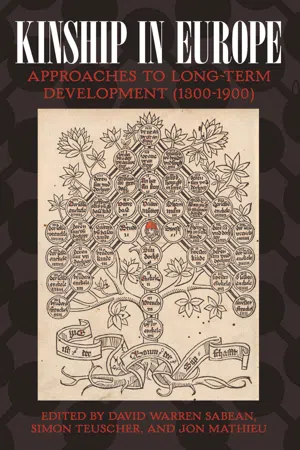
Since the publication of Philippe Ariès's book, Centuries of Childhood, in the early 1960s, there has been great interest among historians in the history of the family and the household. A central aspect of the debate relates the story of the family to implicit notions of modernization, with the rise of the nuclear family in the West as part of its economic and political success. During the past decade, however, that synthesis has begun to break down. Historians have begun to examine kinship - the way individual families are connected to each other through marriage and descent - finding that during the most dynamic period in European industrial development, class formation, and state reorganization, Europe became a "kinship hot" society. The essays in this volume explore two major transitions in kinship patterns - at the end of the Middle Ages and at the end of the eighteenth century - in an effort to reset the agenda in family history.
eBook - ePub
Kinship in Europe
Approaches to Long-Term Development (1300-1900)
- 352 pages
- English
- ePUB (mobile friendly)
- Available on iOS & Android
eBook - ePub
Kinship in Europe
Approaches to Long-Term Development (1300-1900)
About this book
Trusted by 375,005 students
Access to over 1.5 million titles for a fair monthly price.
Study more efficiently using our study tools.
Information
Chapter I

Kinship in Europe
A New Approach to Long Term Development

Kinship has been said to be in decline at almost every moment during Western history. Historians have viewed the appearance of the most diverse new social structures—guilds and brotherhoods in the Middle Ages, the state in the early modern period, the market and voluntary associations in the eighteenth and nineteenth centuries, or social security in the twentieth—as either displacing kinship or replacing its lost functions. Western self-identity has a heavy investment in understanding the long-term development of its kinship practices as successive contractions toward the modern nuclear family. Within this framework, kinship is the functional predecessor of almost everything, but never a constructive factor in the emergence of anything. In what follows, we will suggest that a growing number of studies not only contradict widely held assumptions about the declining importance of kinship, but also point to broad, common, structural shifts in the configurations of kin across Europe between the Middle Ages and the early modern period and again at the turn of the modern era. In this introduction and in this book, we do not bring the story of kinship into the twentieth century, which would require considerations of a third transition and new structural features that demand treatment in their own right.
The different national and methodological traditions of historical scholarship into European kinship present quite diverse approaches, levels of interest, and progress. While we cannot attempt to synthesize the considerable and disparate debates on the subject, we do aim to provoke discussion between different schools of thought by highlighting what we see as broad historical shifts in the articulations and dynamics of kinship. The heterogeneity of research debates is, of course, in part due to the heterogeneity of the subject matter itself. How kin groups organized themselves in different time periods and places, in the town or the countryside, on the noble estate and the peasant farm, among office holders, courtiers, workers, and industrial entrepreneurs presents great differences in both the goals they attempted to realize and in the materials with which they had to work.
Kin relations depend on a wide array of exchange and communication. A sketch of long-term developments is necessarily selective, and we will have to concentrate on those articulations of kinship that lend themselves to comparison and have been addressed by numerous case studies: patterns of inheritance and succession, systems of marriage alliance, the circulation of goods, and the patterned practices of relationship, among blood relations and allied families, as well as developments in the terminology and in the cultural representations of kinship. A great deal of comparative discussion about kinship has been focused on the level of explicit rules in codifications of law and custom. The analysis of legal doctrines, judicial decisions, and innovations in legal instruments certainly remain a crucial task of analyzing kin organization. Nonetheless, some of the most important new research shows that law can be a very flexible instrument for quite different ways of doing things and that practice cannot be deduced from legal norms.1 In contrast to older research, which implicitly expected kinship systems to have been uniform within broad regions, we expect to find tensions between diverging patterns of organizing kinship. Examining such tensions, for instance, between the conceptions of kinship that regulated the distribution of property and the ones that were highlighted for purposes of political representation, allows for a more specific picture of the driving forces of transformation.
In what follows, we will suggest two major transitions in the development of European kinship that many recent case studies from different regions and social settings call attention to. The first leads from the late Middle Ages into the early modern period, and the second can be traced from the mid eighteenth century. The fifteenth and sixteenth centuries witnessed a new stress on familial coherence, a growing inclination to formalize patron-client ties through marriage alliance or godparentage, and a tendency to develop and maintain structured hierarchies within lineages, descent groups, and clans and among allied families.2 These developments were closely connected to processes of state formation and the formalization of social hierarchies as well as to innovations in patterns of succession and inheritance, new forms of delineating and mobilizing property, and novel claims to privileged rights in office, corporations, and monopolies. While the first transition can be associated with an increasing stress on vertically organized relationships, the second one brought about a stronger stress on horizontally ordered interactions. Beginning around the middle of the eighteenth century, alliance and affinity, rather more than descent and heritage, came to organize interactions among kin. During the early modern period, marriage alliances were sought with “strangers,” frequently cemented long-term clientage relations, and created complex patterns of circulation among different political and corporate groups (Stände, ceti, ordres) and wealth strata. From the mid eighteenth century onwards, marriages became more endogamous, both in terms of class and milieu and among consanguineal kin: marriage partners sought out the “familiar.” These innovations are intimately related to the formation of social classes and a differentiation of new gender roles within property-holding groups from the late eighteenth century onwards. And they also reflect reconfigurations in political institutions, state service, property rights, and the circulation of capital. If anything, the nineteenth century can be thought of as a “kinship-hot” society, one where enormous energy was invested in maintaining and developing extensive, reliable, and well-articulated structures of exchange among connected families over many generations. Even though we are trying to understand systems and structures as well as general transitions and unidirectional shifts, we do not intend to replace a master narrative about the constant decline of kinship by another one that is similarly simple. But even less do we want to fail to go beyond the uncontested generality that kinship at all times was diverse, situational, and unsystematically interconnected with other relationships. Our hypotheses aim at stimulating comparative discussions that are both specific enough to relate kinship phenomena to a wider context of social change and sufficiently open to include variations, alternative logics, and innovations.
First Transition: Middle Ages to the
Early Modern Period
Early Modern Period
How Much of a Transformation Was There in the Eleventh Century?
Historical research has long been building on the notion of an antagonism between state organization and kinship, which assumed that as formal institutions of government grew, kinship lost its relevance. Lawrence Stone characterized the state as “the natural enemy” of kinship, and Jacques Heers argued that early state organizations attempted to “break all the ties of kinship.”3 Searching for a period when the state was particularly weak, historians zeroed in on the eleventh century, expecting to find vigorous kinship forms. Between the 1950s and the 1970s, Gerd Tellenbach, Karl Schmid, and Georges Duby gathered evidence of a shift in aristocratic kin organization around the year 1000 that has since been considered one of the most significant ruptures in the development of European kinship.4
In the preceding Carolingian period, the kinship system was adapted to a geographically mobile aristocracy in which wealth and prestige were largely based on service in a comparatively strong royal administration. In general, representations of kinship were less oriented towards generational depth than towards establishing horizontal links to living members of extended and overlapping networks that modern research often refers to as Sippen in German or cousinages in French. Hierarchies within these groups were not defined by specific genealogical constellations, but by individual members' positions outside their kin group, such as their closeness to rulers (Königsnähe). Kinship reckoning was bilateral, inheritance devolved on all the children, and women transmitted property and could perpetuate kinship identity. After the year 1000, the organization of kinship changed as the administrative structures of the Carolinigan Empire disintegrated. Royal rights of taxation and jurisdiction were appropriated by local counts or seignieurs, who considered themselves no longer accountable to a central authority. Aristocrats consolidated property on a particular place, which they frequently fortified and exploited as an autonomous lordship. They became sedentary, tied to their land, and concerned with preventing partition of their estates.
In this context, there emerged new conceptions of kinship that stressed patrilineal descent and the exclusion of family members who earlier would have participated in the wealth and prestige of the Sippe. Both daughters and younger sons were increasingly excluded from succession to local lordship that could thus be passed on unchanged from fathers to their oldest sons (primogeniture). New forms of representing kin groups through coats of arms and surnames highlighted the continuity of agnatic groups over the course of generations. Some scholars even observed traces of a spread of this dynastic family model down to the social group of peasants.5 Georges Duby stressed that hierarchies within the new patrilineal dynasties came to be defined by gender, birth order, and descent, emphasizing vertical structural patterns. Excluded younger sons tended to continue a non-sedentary lifestyle by seeking service in warfare with other lords and became the stock of recruitment for the new social group of knights. The sisters of the successor were frequently married off to his socially inferior vassals, and such alliances hierarchically interlinked dynasties of different status.
While there is broad agreement about a trend towards stronger agnatic relationships being initiated during the Middle Ages, the model developed by Tellenbach, Schmid, and Duby has been whittled away at for some time now. Recent scholarship has pointed to kin terminology, theological discourses, and patterns of inheritance to show that kinship in Europe throughout the Middle Ages and the early modern period, in many respects, remained fundamentally bilateral despite changes in the transmission of property. Indeed, medieval Latin and most Western vernaculars abandoned the elaborate Roman kinship distinctions between paternal and maternal kin. Both in the high and the late Middle Ages, the most frequently used terms to describe and address kin, such as Latin consanguineus or amicus, French lignage, ami or ami charnel, or German fründe, were not only used indiscriminately for paternal and maternal (blood) relatives, but also often even for in-laws. Only at the end of the Middle Ages did terms that singled out the patriline become more prominent.6 Also, ecclesiastical legal principles of the Roman Catholic Church stressed bilateral conceptions of kinship through prohibitions of marriage within a quite extensive range of kin. One had to marry outside, with someone who was “un-familiar,” external to the group descended from great-great-great-great-grandparents and beyond. This is a negative way of describing those to whom one had recognized positive links and ties of obligation; theological representation (largely preserved by later Protestant communities on the continent) recognized relatives on the agnatic and uterine sides as equal, with shared substance diminishing only with generational distance.7
Moreover, recent research into high medieval regimes of property transmission shows that many segments of society were not committed to consistent systems of property transmission at all—certainly not in the rigid sense that can be found in more densely regulated early modern societies. Inheritance arrangements could vary from family to family, and even within the same royal or noble family, the principal estate could go undivided from a father to his firstborn son in one generation, while an equal division could take place in the next.8 Some studies have argued that to the extent that property transmission during the High Middle Ages turned patrilineal at all, it did so in restricted ways. Patrilineal succession to specific rights did not necessarily entail a fully fledged dynastic family organization nor inhibit dividing property in many different ways.9 It is useful to distinguish between inheritance and succession.10 While the oldest son might “succeed” to his family's main estate and to his father's political position, all of the children might inherit property equally both immovable and movable. Patrilineal and primogeniture patterns applied primarily for succession to those lordly rights and titles that had to be passed unchanged from one generation to the other in order to preserve a family's social or political status. The shift toward patrilineal systems was, on the one hand, less general than earlier research had assumed, but on the other, more specifically related to modes of linking political power to the possession of certain goods such as castles, titles, and offices that remained stable over the course of generations. The elements of patrilineal kin organization that can be traced in the eleventh century were thus less due to a stateless stage of Western history than to attempts to institutionalize power. Accordingly, recent studies show that the patrilineal penchant of kin organization was reinforced in the course of the later Middle Ages and the early modern period as more institutionalized forms of organizing political power developed. Thus, both the chronology and the causality of the patrilineal turn of European kinship need to be reconsidered.
Changes at the End of the Middle Ages
The strong focus in older research on inheritance, which emphasizes issues of bilateral and unilineal systems of property devolution, has overshadowed the importance of marital property regimes, how spouses bring together, manage, and pass on their wealth.11 In this respect, Martha Howell's in-depth study of the northern French city of Douhai is particularly thought provoking.12 There, between the fourteenth and sixteenth centuries, a gradual, but at least for the upper classes, general transition of property regimes took place. In the older system, the property spouses brought into marriage and acquired throughout its duration was completely merged. Each of the spouses was the sole inheritor to the other, while their children only inherited whatever was left after the second spouse's death. The husband could freely dispose of the entirety of the marital funds, but at his death, his widow stepped into the exact same “male” rights he had previously held. This included the right to merge possessions from the first marriage into a second one. In the new regime, the property each spouse had brought into marriage remained separated. Parents provided their marrying daughters with a dowry that their husbands could not dispose of, nor did spouses inherit from each other, and children could claim inheritance immediately upon the death of each parent. Under both systems, marital property was frequently regulated in the form of written contracts, but whereas the contracts of the older system were between just two people, the wife and her husband, the new system required the participation of large numbers of kin who also came to acquire lasting responsibilities. Members of the wife's family of origin would protect her property both while her husband was alive and thereafter. After the husband's death, members of his family of origin would be in charge of defending the property interest of his children against the completely separate ones of their mother.
It seems that several regional societies developed similar commitments to the non-merging of ...
Table of contents
- Cover Page
- Title Page
- Copyright Page
- Dedication Page
- Contents
- Glossary
- Preface
- Chapter 1 - Kinship in Europe: A New Approach to Long-Term Development
- Chapter 2 - Bringing it All back Home: Kinship theory in Anthropology
- Transition 1: From Medieval to Early Modern Kinship Patterns
- Transition 2: From Early Modern to Nineteenth-Century Kinship Patterns
- Notes on Contributors
- Index
Frequently asked questions
Yes, you can cancel anytime from the Subscription tab in your account settings on the Perlego website. Your subscription will stay active until the end of your current billing period. Learn how to cancel your subscription
No, books cannot be downloaded as external files, such as PDFs, for use outside of Perlego. However, you can download books within the Perlego app for offline reading on mobile or tablet. Learn how to download books offline
Perlego offers two plans: Essential and Complete
- Essential is ideal for learners and professionals who enjoy exploring a wide range of subjects. Access the Essential Library with 800,000+ trusted titles and best-sellers across business, personal growth, and the humanities. Includes unlimited reading time and Standard Read Aloud voice.
- Complete: Perfect for advanced learners and researchers needing full, unrestricted access. Unlock 1.5M+ books across hundreds of subjects, including academic and specialized titles. The Complete Plan also includes advanced features like Premium Read Aloud and Research Assistant.
We are an online textbook subscription service, where you can get access to an entire online library for less than the price of a single book per month. With over 1.5 million books across 990+ topics, we’ve got you covered! Learn about our mission
Look out for the read-aloud symbol on your next book to see if you can listen to it. The read-aloud tool reads text aloud for you, highlighting the text as it is being read. You can pause it, speed it up and slow it down. Learn more about Read Aloud
Yes! You can use the Perlego app on both iOS and Android devices to read anytime, anywhere — even offline. Perfect for commutes or when you’re on the go.
Please note we cannot support devices running on iOS 13 and Android 7 or earlier. Learn more about using the app
Please note we cannot support devices running on iOS 13 and Android 7 or earlier. Learn more about using the app
Yes, you can access Kinship in Europe by David Warren Sabean, Simon Teuscher, Jon Mathieu, David Warren Sabean,Simon Teuscher,Jon Mathieu in PDF and/or ePUB format, as well as other popular books in Social Sciences & German History. We have over 1.5 million books available in our catalogue for you to explore.